Добрый день, Коллеги. Важное сообщение, просьба принять участие. Музей Ферсмана ищет помощь для реставрационных работ в помещении. Подробности по ссылке
The main developments during four decades of geostatistical applications on the Witwatersrand-type gold deposits are reviewed and critically compared with a view to highlighting the progress made to date. The basic techniques - from the preliminary borehole valuation of mining properties to the block estimating of ore reserves and foreseeable recoveries are analysed and the prospects for methodological improvements are discussed.
Since October 1975 and the first NATO ASl "Geostat - Roma 1975", there has not been an advanced workshop on geostatistics where experts from throughout the world could meet, teach and debate without the pressure of an ordinary professional conference. This second NATO ASI "Geostat - Tahoe 1983" was intended as a high-level teaching activity yet opened to all new ideas and contributions to the discipline of geostatistics. It was expected that the institute would bridge the gap since "Geostat - Roma 1975" and establish the state of the art of the discipline as of 1983 <...>
Although geologists have used statistical analysis in their research for many years, only recently has geostatistics, as a creative tool in the geosciences, received the attention it deserves. Even now many geologists are unaware of the tremendous power statistical methods offer. Today earth scientists can use summary statistics for large data bases, frequency distributions, sampling designs and problems, and applications of stochastic models and use them in dynamic ways for research and developm·ent.
Stochastic simulation has been suggested as a viable method for characterizing the uncertainty associated with the prediction of a nonlinear function of a spatially-varying parameter. Geostatistical simulation algorithms generate realizations of a random field with specified statistical and geostatistical properties. A nonlinear function (called a transfer function) is evaluated over each realization to obtain an uncertainty distribution of a system response that reflects the spatial variability and uncertainty in the parameter. Crucial management decisions, such as potential regulatory compliance of proposed nuclear waste facilities and optimal allocation of resources in environment al remediation, are based on the resulting system response uncertainty distribution. <...>
The paper presents some contemporary approaches to spatial environmental data analysis. The main topics are concentrated on the decision-oriented problems of environmental spatial data mining and modeling: valorization and representativity of data with the help of exploratory data analysis, spatial predictions, probabilistic and risk mapping, development and application of conditional stochastic simulation models. The innovative part of the paper presents integrated/hybrid model—machine learning (ML) residuals sequential simulations—MLRSS.
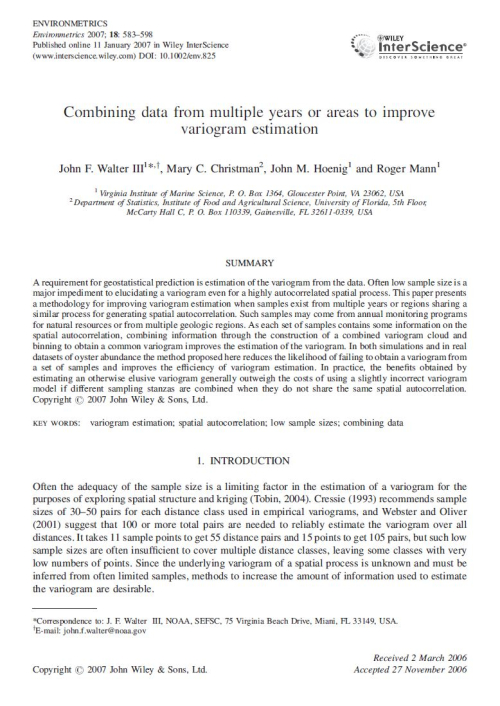
A requirement for geostatistical prediction is estimation of the variogram from the data. Often low sample size is a major impediment to elucidating a variogram even for a highly autocorrelated spatial process. This paper presents a methodology for improving variogram estimation when samples exist from multiple years or regions sharing a similar process for generating spatial autocorrelation.
Although it is generally understood that the Antarctic Ice Sheet plays a critical role in the changing global system, there is to date still a lack of generally available information on the subject. Climatic change and the role of the polar areas are often discussed in the media.
Spatial statistics has developed rapidly during the last 30 years. We have seen an interesting progress both in theoretical developments and in practical studies. Some early applications were in mining, forestry, and hydrology. It seems to be honest to remark that the increasing availability of computer power and skillful computer software has stimulated the ability to solve increasingly complex problems.
An introduction to the description, analysis, and modeling of geospatial data and of the resulting uncertainty in the models. Theory and its correct application will be integrated with the use of various software tools (including GIS) and appropriate examples to emphasize the crossdisciplinary applicability of geostatistical analysis and modeling.
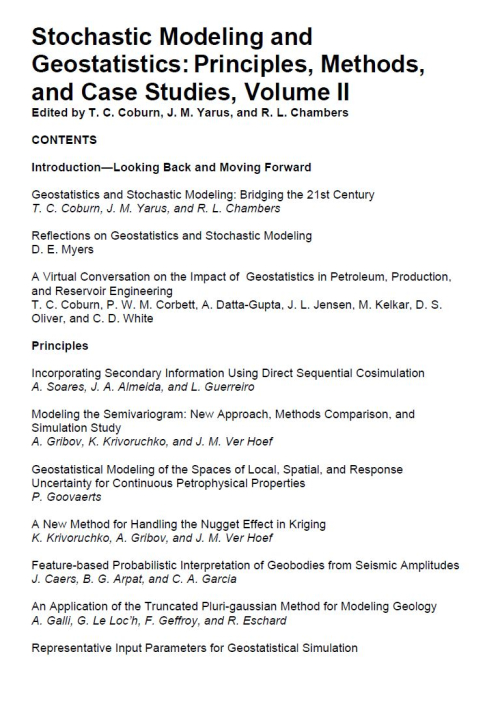
Since publication of the first volume of Stochastic Modeling and Geostatistics in 1994, there has been an explosion of interest and activity in geostatistical methods and spatial stochastic modeling techniques. Many of the computational algorithms and methodological approaches that were available then have greatly matured, and new, even better ones have come to the forefront. Advances in computing and increased focus on software commercialization have resulted in improved access to, and usability of, the available tools and techniques. Against this backdrop, Stochastic Modeling and Geostatistics Volume II provides a much-needed update on this important technology. As in the case of the first volume, it largely focuses on applications and case studies from the petroleum and related fields, but it also contains an appropriate mix of the theory and methods developed throughout the past decade. Geologists, petroleum engineers, and other individuals working in the earth and environmental sciences will find Stochastic Modeling and Geostatistics Volume II to be an important addition to their technical information resources.