Добрый день, Коллеги. Важное сообщение, просьба принять участие. Музей Ферсмана ищет помощь для реставрационных работ в помещении. Подробности по ссылке
This article and a future article in the SEG Newsletter will serve as previews to an SEG-sponsored forum to examine and discuss the origins of gold deposits in the Carlin and Witwatersrand camps. The forum will be held in Reno, Nevada, on May 14, 2005, in conjunction with Geological Society of Nevada’s Symposium 2005 – Window to the World. Both districts have been the focus of major controversies. In this article, three short papers discuss the origin of Carlin-type deposits in north-central Nevada. Over the last few decades, Carlin-type deposits have been seen as shallow hot spring deposits, distal products of porphyry copper deposits, and the uppermost parts of deep mesother-mal systems. The first paper, by Jean Cline, provides an introduction to the characteristics of Carlin-type deposits and a framework for discussions of their origin. The second paper, by Marcus Johnston and Michael Ressel, argues for a magmatic origin for the deposits, and specifically that plutons are the source of heat and probably fluids and metals. The third paper, by Eric Seedorff and Mark Barton, discusses amagmatic models for the origin of Carlin-type deposits, as well as pointing out shortcomings in magmatic models. These authors will give talks at the May 2005 forum, which will be followed by panel and open discussions with the aim of identifying what we need to know to better understand and explore for these deposits.
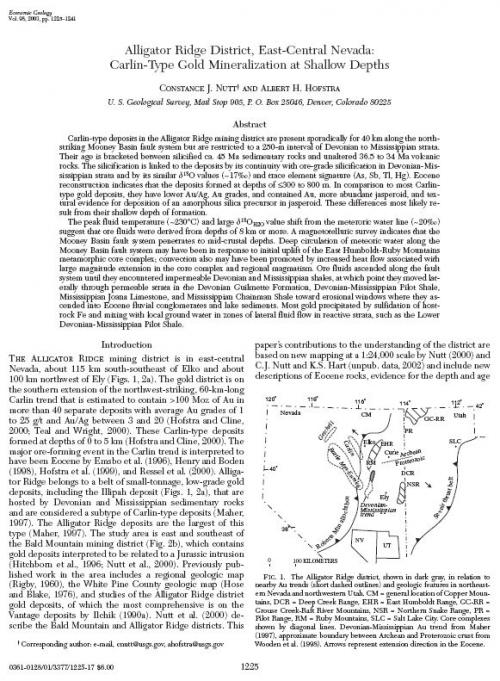
Carlin-type deposits in the Alligator Ridge mining district are present sporadically for 40 km along the north-striking Mooney Basin fault system but are restricted to a 250-m interval of Devonian to Mississippian strata. Their age is bracketed between silicified ca. 45 Ma sedimentary rocks and unaltered 36.5 to 34 Ma volcanic rocks. The silicification is linked to the deposits by its continuity with ore-grade silicification in Devonian-Mis-sissippian strata and by its similar δ18O values (~17‰) and trace element signature (As, Sb, Tl, Hg). Eocene reconstruction indicates that the deposits formed at depths of ≤300 to 800 m. In comparison to most Carlin-type gold deposits, they have lower Au/Ag, Au grades, and contained Au, more abundant jasperoid, and tex-tural evidence for deposition of an amorphous silica precursor in jasperoid. These differences most likely result from their shallow depth of formation.
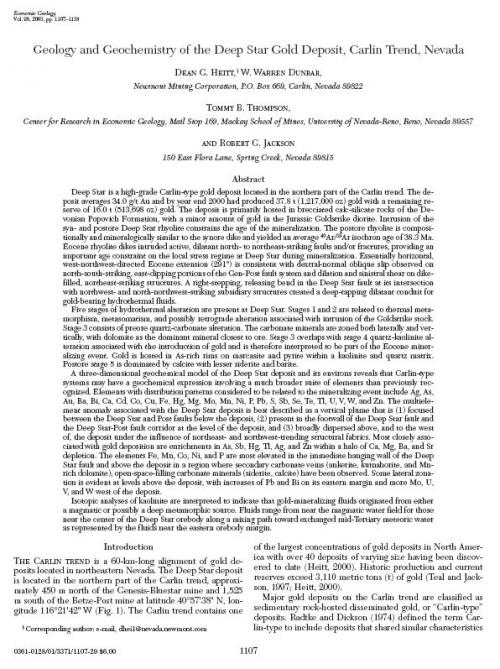
Deep Star is a high-grade Carlin-type gold deposit located in the northern part of the Carlin trend. The deposit averages 34.0 g/t Au and by year end 2000 had produced 37.8 t (1,217,000 oz) gold with a remaining reserve of 16.0 t (513,698 oz) gold. The deposit is primarily hosted in brecciated calc-silicate rocks of the Devonian Popovich Formation, with a minor amount of gold in the Jurassic Goldstrike diorite. Intrusion of the syn- and postore Deep Star rhyolite constrains the age of the mineralization. The postore rhyolite is composi-tionally and mineralogically similar to the synore dike and yielded an average 40Ar/39Ar isochron age of 38.3 Ma. Eocene rhyolite dikes intruded active, dilatant north- to northeast-striking faults and/or fractures, providing an important age constraint on the local stress regime at Deep Star during mineralization. Essentially horizontal, west-northwest-directed Eocene extension (291°) is consistent with dextral-normal oblique slip observed on north-south-striking, east-dipping portions of the Gen-Post fault system and dilation and sinistral shear on dike-filled, northeast-striking structures. A right-stepping, releasing bend in the Deep Star fault at its intersection with northwest- and north-northwest-striking subsidiary structures created a deep-tapping dilatant conduit for gold-bearing hydrothermal fluids.
Происхождение высокосортной золотой руды, источник флюидных компонентов руды и генезис месторождений Мейкл и соседних месторождений Карлинского типа, Северный Карлин-Тренд, Невада
The Meikle mine exploits one of the world’s highest grade Carlin-type gold deposits with reserves of ca. 220 t gold at an average grade of 24.7 g/t. Locally, gold grades exceed 400 g/t. Several geologic events converged at Meikle to create these spectacular gold grades. Prior to mineralization, a Devonian hydrothermal system altered the Bootstrap limestone to Fe-rich dolomite. Subsequently the rocks were brecciated by faulting and Late Jurassic intrusive activity. The resulting permeability focused flow of late Eocene Carlin-type ore fluids and allowed them to react with the Fe-rich dolomite. Fluid inclusion data and mineral assemblages indicate that these fluids were hot (ca. 220°C),of moderate salinity (<6 wt % NaCl equiv), acidic, and H2S rich. Gold-rich pyrite formed by dissolution of dolomite and sulfidation of its contained Fe. Where dissolution and replacement were complete, ore-stage pyrite and other insoluble minerals were all that remained. Locally, these minerals accumulated as internal sediments in dissolution cavities to form ore with gold grades >400 g/t.
The Goldstrike property, located in the Carlin Trend in Nevada, contains a diverse group of Carlin deposits, including some of the largest and highest grade examples known. The largest deposit, Betze-Post, has a gold endowment of approximately 1,250 metric tons (t) Au, and the Meikle deposit, which contains 220 t Au, has a grade of 24.7 g/t Au. Goldstrike is part of the larger Blue Star-Goldstrike subdistrict, which has an areal extent of 58.5 by 2 km and a total gold endowment of 1,970 t. The first discovery of gold at Goldstrike was in 1962. Subsequent exploration culminated in the discovery in 1986 of large high-grade orebodies beneath smaller, lower grade orebodies. Exploration over a 40-yr period has relied on the evolution in understanding of geology and ore controls, supported by the application of geochemical and geophysical exploration techniques.
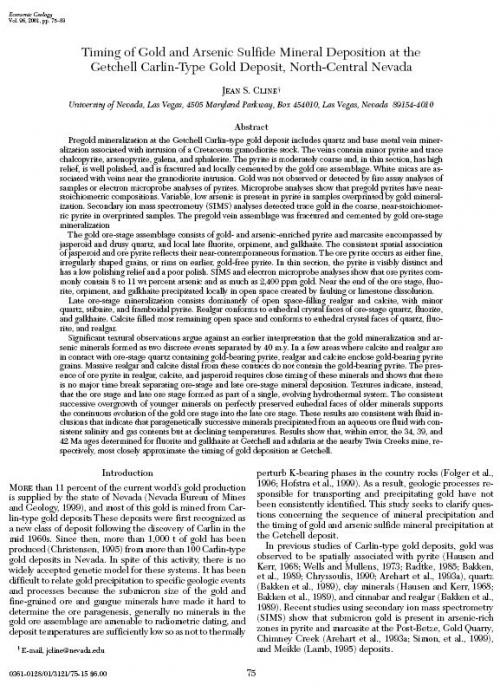
Pregold mineralization at the Getchell Carlin-type gold deposit includes quartz and base metal vein mineralization associated with intrusion of a Cretaceous granodiorite stock. The veins contain minor pyrite and trace chalcopyrite, arsenopyrite, galena, and sphalerite. The pyrite is moderately coarse and, in thin section, has high relief, is well polished, and is fractured and locally cemented by the gold ore assemblage. White micas are associated with veins near the granodiorite intrusion. Gold was not observed or detected by fire assay analyses of samples or electron microprobe analyses of pyrites. Microprobe analyses show that pregold pyrites have near-stoichiometric compositions. Variable, low arsenic is present in pyrite in samples overprinted by gold mineralization. Secondary ion mass spectrometry (SIMS) analyses detected trace gold in the coarse, near-stoichiomet-ric pyrite in overprinted samples. The pregold vein assemblage was fractured and cemented by gold ore-stage mineralization
The Rain mine includes two mined-out open pits that contained 36.4 t (1.17 Moz) gold, averaging 1.8 g/t gold, and underground reserves, including underground production, estimated at 4.9 t (157,000 oz) gold averaging 7.7 g/t. Rain orebodies are localized in a breccia complex within the hanging wall of the Rain fault and hosted within the Mississippian Webb Formation immediately overlying the contact with the Devonian Devils Gate Limestone.
The ore host includes four texturally and genetically distinct breccia types: (1) crackle breccia; (2) hy-drothermal breccia; (3) tuffisite with accretionary lapilli; and (4) collapse breccia. Crackle breccia forms a capping over multistage hydrothermal breccias that are cut by tabular- to pipe-shaped tuffisite dikes, with some containing accretionary lapilli. Pre- and synore hydrothermal breccias formed during at least three episodes of convective fluidization, followed by quartz-sulfide-barite cementation. High-grade gold was deposited as a late phase along the upper portion of the hydrothermal breccia mass and extended into the crackle breccia zone. Collapse breccias occur along the floor of the composite breccia mass and have irregular upper and lower contacts. The lower contact occurs on a dissolution boundary with the Devils Gate Limestone.
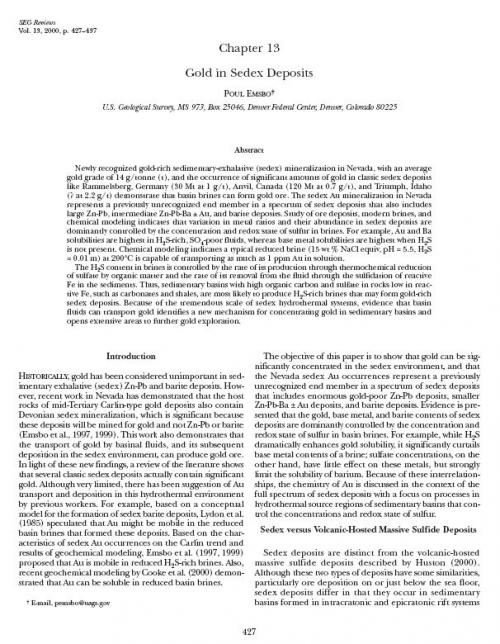
Newly recognized gold-rich sedimentary-exhalative (sedex) mineralization in Nevada, with an average gold grade of 14 g/tonne (t), and the occurrence of significant amounts of gold in classic sedex deposits like Rammelsberg, Germany (30 Mt at 1 g/t), Anvil, Canada (120 Mt at 0.7 g/t), and Triumph, Idaho (? at 2.2 g/t) demonstrate that basin brines can form gold ore. The sedex Au mineralization in Nevada represents a previously unrecognized end member in a spectrum of sedex deposits that also includes large Zn-Pb, intermediate Zn-Pb-Ba ± Au, and barite deposits. Study of ore deposits, modern brines, and chemical modeling indicates that variation in metal ratios and their abundance in sedex deposits are dominantly controlled by the concentration and redox state of sulfur in brines. For example, Au and Ba solubilities are highest in H2S-rich, SO4-poor fluids, whereas base metal solubilities are highest when H2S is not present. Chemical modeling indicates a typical reduced brine (15 wt % NaCl equiv, pH = 5.5, H2S = 0.01 m) at 200°C is capable of transporting as much as 1 ppm Au in solution.
The H2S content in brines is controlled by the rate of its production through thermochemical reduction of sulfate by organic matter and the rate of its removal from the fluid through the sulfidation of reactive Fe in the sediments. Thus, sedimentary basins with high organic carbon and sulfate in rocks low in reactive Fe, such as carbonates and shales, are most likely to produce H2S-rich brines that may form gold-rich sedex deposits. Because of the tremendous scale of sedex hydrothermal systems, evidence that basin fluids can transport gold identifies a new mechanism for concentrating gold in sedimentary basins and opens extensive areas to further gold exploration.
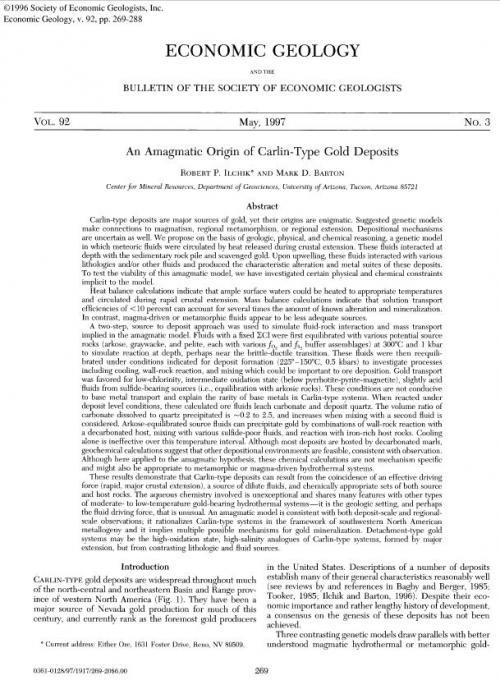
Carlin-type deposits are major sources of gold, yet their origins are enigmatic. Suggested genetic models make connections to magmatism, regional metamorphism, or regional extension. Depositional mechanisms are uncertain as well. We propose on the basis of geologic, physical, and chemical reasoning, a genetic model in which meteoric fluids were circulated by heat released during crustal extension. These fluids interacted at depth with the sedimentary rock pile and scavenged gold. Upon upwelling, these fluids interacted with various lithologies and/or other fluids and produced the characteristic alteration and metal suites of these deposits. To test the viability of this amagmatic model, we have investigated certain physical and chemical constraints implicit to the model.
Gold mineralization at Carlin is clearly younger than hydrocarbon maturation (pre-Cretaceous) and felsic dike intrusion (Cretaceous), and older than deep oxidation (late Tertiary). Within the episode of gold mineralization, the main gold ore (MGO) stage and late gold ore (LGO) stage are distinguished paragenetically, wi-th a variety of vein and mineralization types in each. MGO stage fluids contained 5 to 10 mole percent COa, appreciable H2S, and 3 ± 1 wt percent NaCl equiv. At least portions of MGO stage mineralization were characterized by two-phase boiling (COa exsolution) at 215° ± 30°C and 800 ± 400 bars. In contrast, LGO stage fluids were gas poor with salinities <1.5 wt percent NaCl equiv and record only nonboiling conditions. MGO stage fluids had 518Oh2o values of 5 to 9 per mil, whereas LGO stage fluids resembled unevolved meteoric water with 518Oh2o values < —3 per mil.
From the MGO stage to the LGO stage, calcite 5180 values shifted from near whole-rock values of 12 ± 3 per mil to around 0 ± 1 per mil as LGO stage fluids flooded the system. Jasperoids also record a large range (9-22%o) in 518Oh2o values. These data indicate the involvement of two very different fluids in ore deposition. Because MGO and LGO stage features are closely associated spatially with each other and with Au, As, Sb, Hg, and other ore elements, both fluids are believed to have both been present during most stages of ore deposition.
At pressures of 80 to 85 percent lithostatic, depths of 3.8 ± 1.9 km are required to accommodate the 800 ± 400 bars of pressure recorded in MGO stage fluid inclusions. Carlin, therefore, is not an epi-thermal or hot spring deposit. Carbon dioxide in gas-rich MGO stage fluids may have originated either directly from buried intrusions or their contact aureoles, or from low-grade regional metamorphism at depth. The water may have been originally meteoric, and Au may be magmatic or derived from leaching of deep metamorphic or sedimentary rocks. Ore deposition appears to have occurred in zones of throttling at a pressure seal between normally pressured and overpressured regimes, where fluids experienced a change from near-lithostatic to hydrostatic conditions. Such pressure seals are common in deep sedimentary basins and may be a key to highly localized gold deposition. Mixing of two fluids and interaction with host rocks along thin permeable bioclastic horizons are believed to have been the major factors in depositing ore.