Добрый день, Коллеги. Важное сообщение, просьба принять участие. Музей Ферсмана ищет помощь для реставрационных работ в помещении. Подробности по ссылке
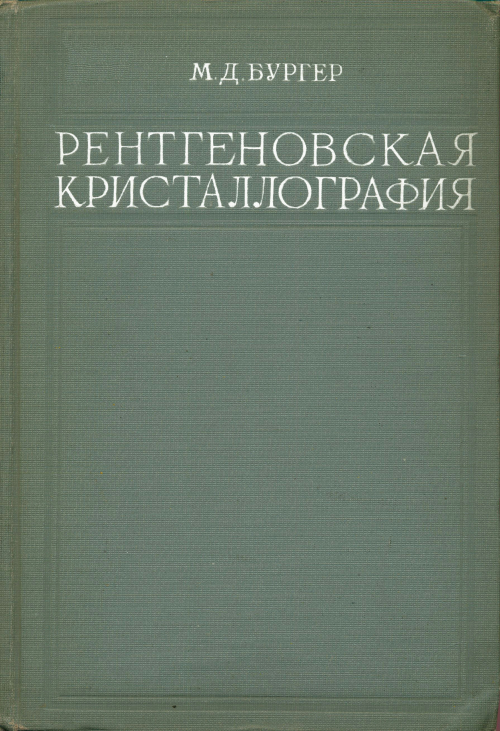
Книга Бургера „Рентгеновская кристаллография“ посвящена изложению рентгеновских методов исследования структуры кристаллов, особенно рентген-гониометрических методов, которые за последние 10—15 лет получили широкое распространение. Кроме того, в книге Бургера детально рассматриваются приемы определения пространственных групп, а также методы прецизионного определения линейных и угловых констант кристаллов. Ее характерной особенностью является то, что изложение всех методов доведено до сообщения сведений и приемов практического применения этих методов. Наличие большого числа графиков и таблиц делает книгу также полезным справочником.
Слоистые двойные гидроксиды (СДГ) являются активно исследуемым в настоящее время классом материалов, что связано с их уникальными физико-химическими свойствами, обусловленными особенностями кристаллической структуры. Её основу составляют положительно заряженные октаэдрические слои бруситового типа, между которыми располагаются молекулы воды и дополнительные анионы (карбонат-, гидроксид-, сульфат-, фосфат-, хлорид-ионы и т.д.). В связи с тем, что октаэдрические слои имеют положительный заряд, слоистые двойные гидроксиды являются редким случаем анионных обменников. Они широко используются для селективного извлечения анионов из раствора, создания катализаторов, абсорбции тяжёлых металлов и органических соединений, в фото- и электрохимии и фармацевтике.
Несогласные монослои и ориентированный нарост (И. Ван-дер-Мерее) Тонкие алюминиевые пленки на поверхности ионных кристаллов (Т. Родин)
Влияние посторонних ионов на рост кристаллов из раствора (Б. Райстран)
Ориентированные наросты и стабилизация кубической (I), тетрагональной (II) и ромбической (III) модификаций нитрата аммония при обычных температурах (Р. Хокарт, А. Матье-Сико)
Изменение габитуса кристаллов при введении примесей в процессе роста (Г. Бакли)
The aim of this book is to provide reliable information not only on the science of crystallization from solution and from melt but also on the basic design methods for laboratory and especially industrial crystallizers. Up to now the niche between scientific results and practical design and operation of large-scale crystallizers has scarcely been filled. A work devoted to this objective has to take into account relevant crystallization phenomena as well as chemical engineering processes such as fluid dynamics, multiphase flow, and heat and mass transfer. In the design of crystallizers, experiments are initially performed on laboratory crystallizers to obtain kinetic data. In this book, information is given on reliable scale-up of such crystallizers.
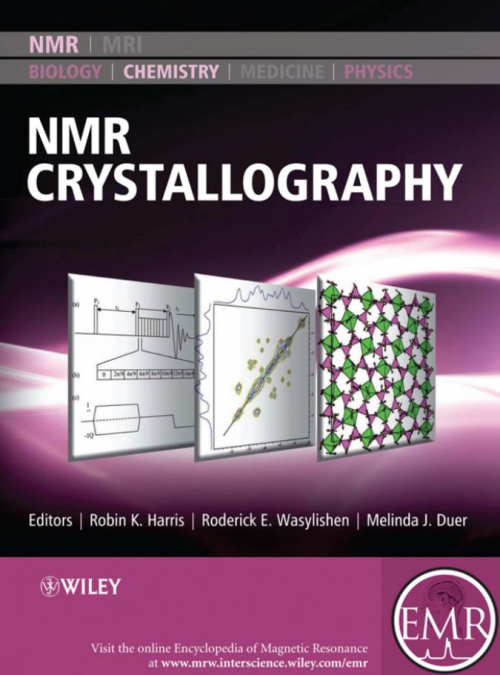
Since the earliest days of NMR, it has been recognized that the technique can provide information on matters concerning the disposition of atoms in the unit cells of crystals. Thus, the distance between protons in the water molecules of gypsum, CaSO4 · 2H2O, was determined by Pake and reported as 1.58 A in 1948. However, the term NMR crystallography has only recently come into common usage, and even now causes raised eyebrows within some parts of the diffraction community. On the other hand, the power of solid-state NMR to give crystallographic information has considerably increased since the CPMAS suite of techniques was introduced in 1976.
The manual outlines the terms, concepts, basic principles and laws of crystallography, the mechanisms for describing the symmetry of crystals, the algorithm for determining and forming the names of simple shapes. A general idea of the origin, growth of crystals and processes of mineral formation is given. The main physical and morphological properties of minerals are considered. Descriptive mineralogy includes a list of about 100 of the most common minerals.
Die erste Auflage dieses Buches ist seit sieben Jahren vergriffen. Die Frage, ob eine neue Auflage gemacht werden sollte, wurde von allen Seiten bejaht. Ich möchte glauben, daß die Überlegungen, die mich 1949 zur Herausgabe bewogen haben (s. Vorwort zur 1. Auflage), auch heute noch bestehen, ja, daß eine Darstellung der unter dem Begriff "Mineralogie" zusammengefaßten Wissensgebiete gerade bei der rapiden Entwicklung dieser Gebiete besonders notwendig erscheint. Diese Erweiterung unseres Wissens hatte zur Folge, daß ich mir nicht mehr zutraute, das Gesamtgebiet neu zu bearbeiten. Prof. ZEMANN hat es freundliehst übernommen, den 1., kristallographischen, Teil zu revidieren, er hat viele wichtige Verbesserungen angebracht.
The material in this book is derived from an intensive course in X-ray structure analysis organized on behalf of the Chemical Crystallography Group of the British Crystallographic Association and held every two years since 1987. As with a crystal structure derived from X-ray diffraction data, the course contents have been gradually refined over the years and they reached a stage in 1999 (the seventh course) where we considered they could be published, and hence made available to a far wider audience than can be accommodated on the course itself.
Much of our present knowledge of the architecture of molecules has been obtained from studies of the diffraction of X rays or neutrons by crystals. X rays* are scattered by the electrons of atoms and ions, and the interference between the X rays scattered by the different atoms or ions in a crystal can result in a diffraction pattern. Similarly, neutrons are scattered by the nuclei of atoms. Measurements on a crystal diffraction pattern can lead to information on the arrangement of atoms or ions within the crystal. This is the experimental technique to be described in this book
The 5000 lines of FORTRAN code that became known as SHELX-76 had their origins around 1970 when the University of Cambridge replaced the ICL Titan computer with an IBM-370. My previous attempts to write programs used Titan Autocode, a simple but efficient programming language closer to assembler than to a modern high-level language. With the IBM computer came two major innovations: a FORTRAN compiler and punched cards.