Добрый день, Коллеги. Важное сообщение, просьба принять участие. Музей Ферсмана ищет помощь для реставрационных работ в помещении. Подробности по ссылке
Reduced intrusion-related gold systems (RIRGS) are characterized by widespread arrays of sheeted auriferous quartz veins that preferentially form in the brittle carapace at the top of small plutons, where they form bulk-tonnage, low-grade Au deposits characterized by a Au-Bi-Te-W metal assemblage, such as the Fort Knox and Dublin Gulch deposits. RIRGS also include a wide range of intrusion-related mineral deposit styles (skarns, replacements, veins) that form within the region of hydrothermal infl uence surrounding the causative pluton, and are characterized by proximal Au-W-As and distal Ag-Pb-Zn metal associations, thereby generating a zoned mineral system.
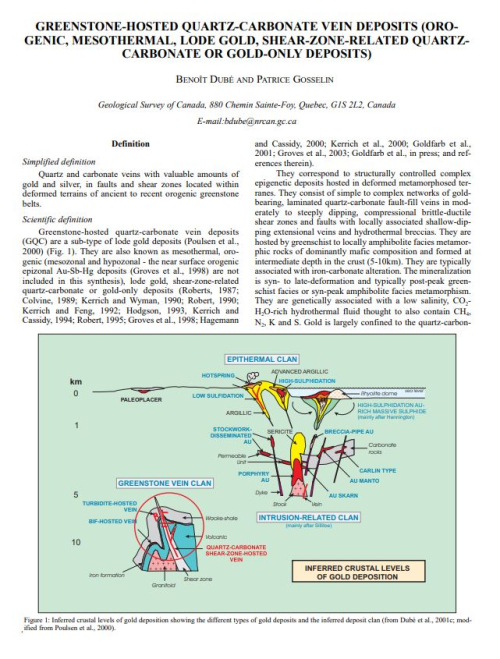
Simplified definition Quartz and carbonate veins with valuable amounts of gold and silver, in faults and shear zones located within deformed terrains of ancient to recent orogenic reenstone belts. Scientific definition Greenstone-hosted quartz-carbonate vein deposits (GQC) are a sub-type of lode gold deposits (Poulsen et al., 2000) (Fig. 1). They are also known as mesothermal, orogenic (mesozonal and hypozonal - the near surface orogenic epizonal Au-Sb-Hg deposits (Groves et al., 1998) are not included in this synthesis), lode gold, shear-zone-related quartz-carbonate or gold-only deposits (Roberts, 1987; Colvine, 1989; Kerrich and Wyman, 1990; Robert, 1990; Kerrich and Feng, 1992; Hodgson, 1993, Kerrich and Cassidy, 1994; Robert, 1995; Groves et al., 1998; Hagemann and Cassidy, 2000; Kerrich et al., 2000; Goldfarb et al., 2001; Groves et al., 2003; Goldfarb et al., in press; and references therein).
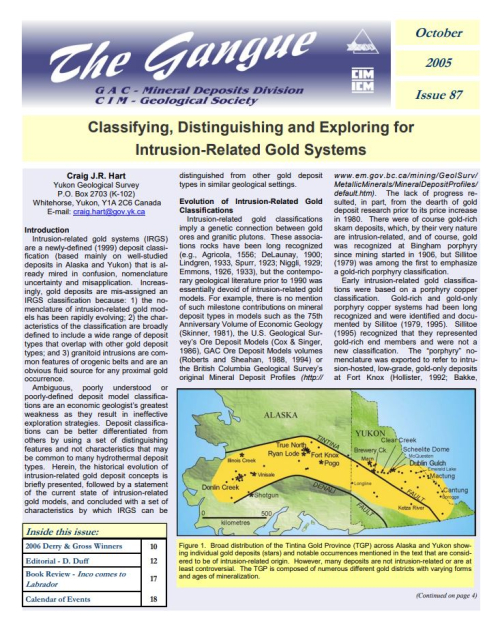
Intrusion-related gold systems (IRGS) are a newly-defined (1999) deposit classification (based mainly on well-studied deposits in Alaska and Yukon) that is already mired in confusion, nomenclature uncertainty and misapplication. Increasingly, gold deposits are mis-assigned an IRGS classification because: 1) the nomenclature of intrusion-related gold models has been rapidly evolving; 2) the characteristics of the classification are broadly defined to include a wide range of deposit types that overlap with other gold deposit types; and 3) granitoid intrusions are common features of orogenic belts and are an obvious fluid source for any proximal gold occurrence.
Reduced intrusion-related gold deposits have become a new, low-grade, large-tonnage exploration target during the last decade. The best recognized examples of such deposits are recognized throughout the Tintina Gold Province of the northern North American Cordillera. Because such examples may have many features in common with orogenic gold deposits, such as anomalous Bi, W, and Te,
Месторождения золота, локализующиеся в метаморфических толщах, на западе классифицируемые как «орогенный»1 и связанный с восстановленной интрузией («Reduced Intrusion-related Gold Systems», далее – RIRGS2) типы, играют ведущую роль в экономическом отношении, на них приходится более 40 % добычи золота в мире, за исключением россыпей и месторождения Витватерсранд (ЮАР) [Бортников и др., 2016; Чугаев, 2024; Frimmel, 2008; Phillips, 2013; Lipson, 2014; Goldfarb et.al., 2014]. Изучение генезиса руд является важным не только в понимании процессов образования месторождений, но и в выборе стратегии поисковых и геолого-разведочных работ.
This volume brings together a collection of papers that summarize current ideas and recent progress in the study of granite-related mineralization systems. They provide a combination of field, experimental and theoretical studies. Papers are grouped according to the main granite-related ore systems: granite-pegmatite, skarn and greisen-veins, porphyry, orogenic gold, intrusion-related, epithermal and porphyry-related gold and base metal, iron oxide–copper–gold (IOCG), and special case studies. The studies provide a broad spread in terms of both space and time, highlighting granite-related ore deposits from Europe (Russia, Sweden, Croatia and Turkey), the Middle East (Iran), Asia (Japan and China) and South America (Brazil and Argentina) and spanning rocks from Palaeoproterozoic to Miocene in age.
The Bald Mountain mining district has produced about 2 million ounces (Moz) of Au. Geologic mapping, field relationships, geochemical data, petrographic observations, fluid inclusion characteristics, and Pb, S, O, and H isotope data indicate that Au mineralization was associated with a reduced Jurassic intrusion. Gold deposits are localized within and surrounding a Jurassic (159 Ma) quartz monzonite porphyry pluton and dike complex that intrudes Cambrian to Mississippian carbonate and clastic rocks. The pluton, associated dikes, and Au mineralization were controlled by a crustal-scale northwest-trending structure named the Bida trend. Gold deposits are localized by fracture networks in the pluton and the contact metamorphic aureole, dike margins, high-angle faults, and certain strata or shale-limestone contacts in sedimentary rocks. Gold mineralization was accompanied by silicification and phyllic alteration, ±argillic alteration at shallow levels. Although Au is typically present throughout, the system exhibits a classic concentric geochemical zonation pattern with Mo, W, Bi, and Cu near the center, Ag, Pb, and Zn at intermediate distances, and As and Sb peripheral to the intrusion. Near the center of the system, micron-sized native Au occurs with base metal sulfides and sulfosalts. In peripheral deposits and in later stages of mineralization, Au is typically submicron in size and resides in pyrite or arsenopyrite. Electron microprobe and laser ablation ICP-MS analyses show that arsenopyrite, pyrite, and Bi sulfide minerals contain 10s to 1,000s of ppm Au. Ore-forming fluids were aqueous and carbonic at deep levels and episodically hypersaline at shallow levels due to boiling. The isotopic compositions of H and O in quartz and sericite and S and Pb in sulfides are indicative of magmatic ore fluids with sedimentary sulfur. Together, the evidence suggests that Au was introduced by reduced S-bearing magmatic fluids derived from a reduced intrusion. The reduced character of the intrusion was caused by assimilation of carbonaceous sedimentary rocks.
Tertiary faults dismember the area and drop down the upper part of the mineralizing system to the west. The abundant and widespread kaolinite in oxide ores is relatively disordered (1A polytype) and has δD and δ18O values suggestive of a supergene origin. The deep weathering and oxidation of the ores associated with exhumation made them amenable to open-pit mining and processing using cyanide heap leach methods.
У нас есть: 33723 книги, 8273 карты, 47 инбоксов. Итого: 42043 материала