Добрый день, Коллеги. Важное сообщение, просьба принять участие. Музей Ферсмана ищет помощь для реставрационных работ в помещении. Подробности по ссылке

Выпуск 136
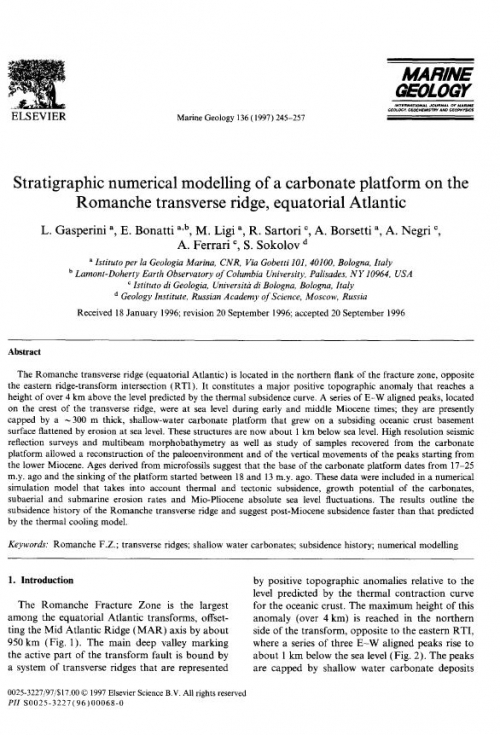
Издание:Journal Marine Geology, 1997 г., 13 стр.
Язык(и)Английский
Stratigraphic numerical modelling of a carbonate platform on the Romanche transverse ridge, equatorial Atlantic

The Romanche transverse ridge (equatorial Atlantic) is located in the northern flank of the fracture zone, opposite the eastern ridge-transform intersection (RTI). It constitutes a major positive topographic anomaly that reaches a height of over 4 km above the level predicted by the thermal subsidence curve. A series of E-W aligned peaks, located on the crest of the transverse ridge, were at sea level during early and middle Miocene times; they are presently capped by a ~300 m thick, shallow-water carbonate platform that grew on a subsiding oceanic crust basement surface flattened by erosion at sea level. These structures are now about 1 km below sea level. High resolution seismic reflection surveys and multibeam morphobathymetry as well as study of samples recovered from the carbonate platform allowed a reconstruction of the paleoenvironment and of the vertical movements of the peaks starting from the lower Miocene. Ages derived from microfossils suggest that the base of the carbonate platform dates from 17-25 m.y. ago and the sinking of the platform started between 18 and 13 m.y. ago. These data were included in a numerical simulation model that takes into account thermal and tectonic subsidence, growth potential of the carbonates, subaerial and submarine erosion rates and Mio-Pliocene absolute sea level fluctuations. The results outline the subsidence history of the Romanche transverse ridge and suggest post-Miocene subsidence faster than that predicted by the thermal cooling model.


Выпуск 5
Автор(ы):Shengyong Y., Xuejing X., Xueqiu W.
Издание:Journal of Geochemical Exploration, 1995 г., 9 стр.
Язык(и)Английский
Concepts for geochemical gold exploration based on the abundance and distribution of ultrafine gold / Концепции геохимической разведки золота, основанные на содержании и распределении ультрадисперсного золота

Conventionally, geochemical exploration for gold is based on the assumptions that (1) gold is chemically inert in surficial environments; (2) gold occurs mainly in discrete grains; and (3) gold is transferred by mechanical means to form clastic dispersion halos and dispersion trains. Consequently, the commonly adopted methodology has been (1) to determine gold in heavy mineral concentrates; (2) to use large samples in order to improve the reproducibility of gold analyses; (3) to use high detection limits and thresholds; and (4) to determine total gold contents and pathfinder elements in the samples. However, these methods are not always successful in locating gold deposits, and they have limited application in the search for buried or blind deposits.

In China, studies of the distribution and migration of particulate and ultrafine gold indicated that (1) gold is active and mobile in surficial environments; (2) gold occurs not only as discrete grains, but also as ultrafine particles and other complex forms; and (3) regional low-concentration gold anomalies as well as local anomalies over buried gold deposits originate from ultrafine gold and other complex forms of gold. The methodology developed in China for regional and local geochemical gold exploration is based on this experience. Results of investigations around two gold deposits in China are presented.

Издание:Prentice-Hall Inc, New York, 1946 г., 473 стр.
Язык(и)Английский
Structural geology / Структурная геология

Emphasis in this book has been placed on principles, methods, and technique. The structure of specific areas is not discussed, except for the purpose of illustrating principles. The writer has intentionally refrained from a treatment of the more speculative phases of geotectonics because he believes that such subjects can be intelligently studied only by geologists with a broad background in many fields of geology.

The indecisiveness of some of the criteria used in structural geology may cause dismay to some students. It is better, however, for the reader to realize the difficulties of structural geology and to understand at the outset that such a subject can never be treated with mathematical precision. The structural geologist must be proficient in weighing and balancing the evidence.

Выпуск 378
Автор(ы):Shimamoto T., Uehara S.
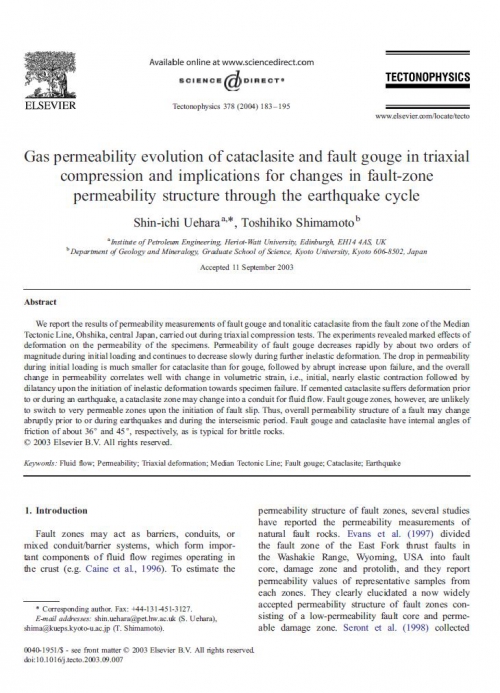
Издание:Journal Tectonophysics, 2004 г., 13 стр.
Язык(и)Английский
Gas permeability evolution of cataclasite and fault gouge in triaxial compression and implications for changes in fault-zone permeability structure through the earthquake cycle

Эволюция газопроницаемости катаклазита и разломной впадины при трехосном сжатии и влияние на изменения структуры проницаемости зоны разлома в течение цикла землетрясений

We report the results of permeability measurements of fault gouge and tonalitic cataclasite from the fault zone of the Median Tectonic Line, Ohshika, central Japan, carried out during triaxial compression tests. The experiments revealed marked effects of deformation on the permeability of the specimens. Permeability of fault gouge decreases rapidly by about two orders of magnitude during initial loading and continues to decrease slowly during further inelastic deformation.

Автор(ы):Daly R.A.
Издание:Prentice-Hall Inc, New York, 1940 г., 434 стр.
Язык(и)Английский
Strength and structure of the Earth

Structural geology records colossal work done by natural forces on the visible and invisible rocks of every continent. The energy expended in this work has been chiefly of two kinds—solar and terrestrial. Geologists of the nineteenth century paid particular attention to the part played by solar radiation in governing the dynamical history of the outer earth. A leading project of the twentieth century is to learn how the conditions of the planet's deep interior have also controlled the same history.

Выпуск 55
Автор(ы):Xiaoling W., Yinxiu L.
Издание:Journal of Geochemical Exploration, 1995 г., 5 стр.
Язык(и)Английский
A rapid field analytical method for gold in geochemical exploration / Быстрый полевой аналитический метод определения золота при геохимической разведке

A rapid field method for gold analysis in geochemical exploration has been developed. Cold extraction of Au, at room temperature, using a mixture of sodium bromide, sulphuric acid, hydrogen peroxide is performed; the technique has the advantage of avoiding the irritating odour of commonly used aqua regia digestion. Polyurethane foam is used to concentrate gold from solution. After desorption of Au using mixed reagents (0.5% Na2S03-NaCl solution at pH 8), two sequential procedures, depending on the concentration, are followed for the determination of gold. (1) A 1 mL portion of desorbed solution is used to form Au-TMK-DBS (Thio Micher's Ketone and dodecyl benzene sodium sulphonate) ternary complex. Concentrations below 20 ng/g Au are determined by visual colour comparison of the organic layer with a series of standards. (2) If the concentration is greater than 20 ng/g Au, a complexation reaction using the same reagents is followed by fibre-optic colorimetry. The method is rapid and simple, and the tiresome operation of ashing the foam is avoided. The limit of detection is 0.5 ng/g Au and eighty determinations can be made in one working day. The method could be used for rapid follow-up of rock sample or in situ drill core analyses. About 600 samples from 5 gold districts were tested by this method. The results are very satisfactory.

Выпуск 280
Издание:Journal Tectonophysics, 1997 г., 15 стр.
Язык(и)Английский
Lithospheric shear zones and mantle-crust connections

A crustal-scale ductile shear zone network in the Precambrian granulite-facies crust of Madagascar is examined to determine the nature of the connections between the mantle arid lower crust. Based on three independent data sets - field and satellite mapping, C- and O-isotope geochemistry and gravimetry - this crust is divided into three zones: (1) outside of shear zones; (2) minor shear zones that are <140 km long and 7 km wide; and (3) major shear zones mat are >350 km long (up to 1000 km) and 20-35 km wide. The mantle is uplifted by about 10 km beneath the major shear zones. The major shear zones are rooted in and are inferred to be controlled by the mantle; they directly tapped mantle-derived C02. The small-scale minor shear zones were controlled by crustal processes and focused crustally derived H20-rich±C02 fluids. The regular distribution of the shear zones on a crustal scale is in agreement with models of buckling of the continental lithosphere in a compressional context. The propagation of these mechanical instabilities promoted and channelled fluid flow. These major Pan-African shear zones thinned the crust and were reactivated during the subsequent drifting of Madagascar and opening of the Indian Ocean during Jurassic to Cretaceous times. They also controlled many of the brittle fault zones in the overlying sedimentary basins. Mantle-rooted large-scale shear zones are inferred to be a general feature of cratonic areas reactivated by shear zone systems.

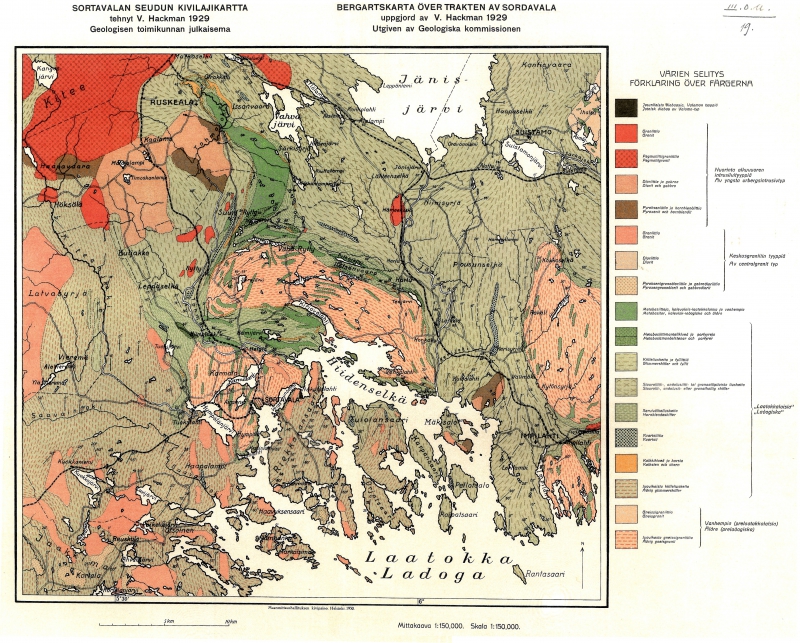
Sortavala Seudun Kivilajikartta
Карта составлена:Geologisen toimikunnan jukaisema, 1929 г.
Редактор(ы):Hackman V.
Язык(и)Английский, Финский
Масштаб:1:150000
Назначение карты:Геологическая карта
Скачать
Карта (6.9M)
На странице представлен материал:Геологическая карта: Sortavala Seudun Kivilajikartta, масштаб: 1:150000 , составлена: Geologisen toimikunnan jukaisema, 1929 г., редактор(ы): Hackman V.
Выпуск 50
Автор(ы):Austrheim H., Griffin W.L.
Издание:Journal Chemical Geology, Amsterdam, 1985 г., 15 стр.
Язык(и)Английский
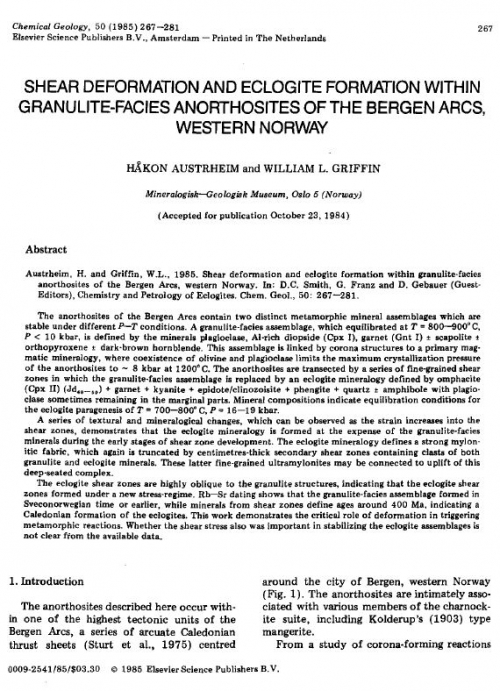
Shear deformation and eclogite formation within granulite-facies anorthosites of the bergen arcs, Western Norway

Austrheim, H. and Griffin, W.L., 1985. Shear deformation and eclogite formation within granulite-facies anorthosites of the Bergen Arcs, western Norway. In: D.C. Smith, G. Franz and D. Gebauer (Guest-Editors), Chemistry and Petrology of Eciogites. Chem. Geol., 50: 267—281.

The anorthosites of the Bergen Arcs contain two distinct metamorphic mineral assemblages which are stable under different P—T conditions. A granulite-facies assemblage, which equilibrated at T = 800—900° C, P < 10 kbar, is defined by the minerals plagioclase, Al-rich diopside (Cpx I), garnet (Gnt I) ± scapolite ± orthopyroxene + dark-brown hornblende. This assemblage is linked by corona structures to a primary mag-matic mineralogy, where coexistence of olivine and plagioclase limits the maximum crystallization pressure of the anorthosites to ~ 8 kbar at 1200°C. The anorthosites are transected by a series of fine-grained shear zones in which the granulite-facies assemblage is replaced by an eclogite mineralogy defined by omphacite (Cpx II) (Jd40_i0) + garnet + kyanite + epidote/clinozoisite + phengite + quartz ± amphibole with plagioclase sometimes remaining in the marginal parts. Mineral compositions indicate equilibration conditions for the eclogite paragenesis of Г = 700—800° С, Р = 16—19 kbar.

Выпуск 63
Издание:Journal of Geochemical Exploration, 1998 г., 31 стр.
Язык(и)Английский
Alteration and primary geochemical dispersion associated with the Bulletin lode-gold deposit, Wiluna, Western Australia

The Bulletin lode-gold deposit is within the northernmost part of the Norseman-Wiluna greenstone belt in me Archaean Yilgarn Block, Western Australia. It is located within a brittle-ductile shear zone and hosted by tholeiitic metavolcanic rocks. Syn-metamorphic wallrock alteration envelops the gold mineralisation and is pervasive throughout the entire shear zone and extends up to 150 m into the undeformed wallrocks. Alteration is characterised by the sequence of distal chlorite-calcite, intermediate calcite-dolomite, outer proximal sericite and inner proximal dolomite-sericite zones. The thickness of the alteration envelope, and the occurrence of dolomite in the alteration sequence, can be used as a rough guide to the width, extent and grade of gold mineralisation, because a positive correlation exists between these variables. Mass transfer evaluations indicate that chemical changes related to the wallrock alteration are similar in all host rocks: in general, Ag, As, Au, Ba, C02, K, Rb, S, Sb, Те and W are enriched, Na and Y are depleted, and Al, Cr, Cu, Fe, Mg, Mn, Nb, Ni, P, Se, V, Zn and Zr are immobile, while Ca, Si and Sr show only minor or negligible relative changes. The degree of mobility of each component increases with proximity to gold mineralisation. The largest potential exploration targets are possibly defined by regional As (>6 ppm) and Sb (>0.6 ppm) anomalies. These anomalies, if real, extend laterally for > 150 m from the mineralised shear zone into areas of apparently unaltered rocks. Anomalies defined by Те (> 10 ppb), W (>0.6 ppm), carbonation indices, local enrichment of Sb (>2.0 ppm) and As (>28 ppm), and potassic alteration indices also form significant exploration targets extending beyond the HJB shear zone and the Au anomaly (>6 ppb) and, locally, into apparently unaltered rock. Gold, itself, has a restricted dispersion, with an anomaly extending for 1-35 m from ore, and being restricted to within the shear zone itself. Amongst individual geochemical parameters, only As and Sb define significant, consistent and smooth trends (vectors) when laterally approaching the ore. However, the respective dimensions of individual geochenucal anomalies can be used as an extensive, though stepwise, vector towards ore


Ленты новостей
537.77