Добрый день, Коллеги. Важное сообщение, просьба принять участие. Музей Ферсмана ищет помощь для реставрационных работ в помещении. Подробности по ссылке

Выпуск 90
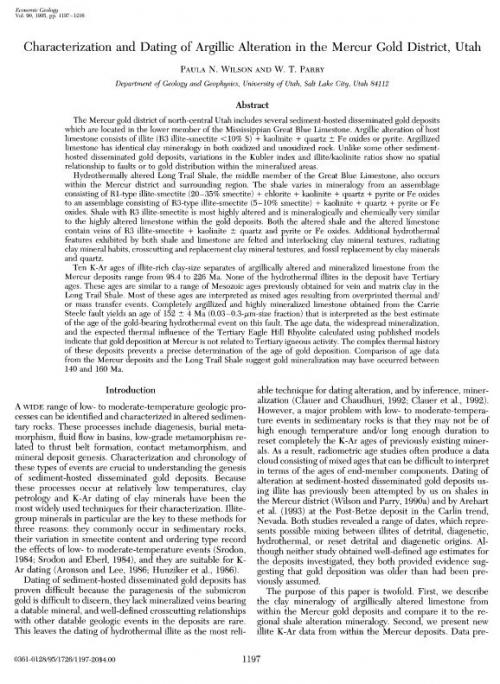
Автор(ы):Parry W.T., Wilson P.N.
Издание:Economic geology, 1995 г., 20 стр.
Язык(и)Английский
Characterization and dating of argillic alteration in the Mercur gold district, Utah

The Mercur gold district of north-central Utah includes several sediment-hosted disseminated gold deposits which are located in the lower member of the Mississippian Great Blue Limestone. Argillic alteration of host limestone consists of illite (R3 illite-smectite <10% S) + kaolinite + quartz ± Fe oxides or pyrite. Argillized limestone has identical clay mineralogy in both oxidized and unoxidized rock. Unlike some other sediment-hosted disseminated gold deposits, variations in the Kubler index and illite/kaolinite ratios show no spatial relationship to faults or to gold distribution within the mineralized areas.

Выпуск 84
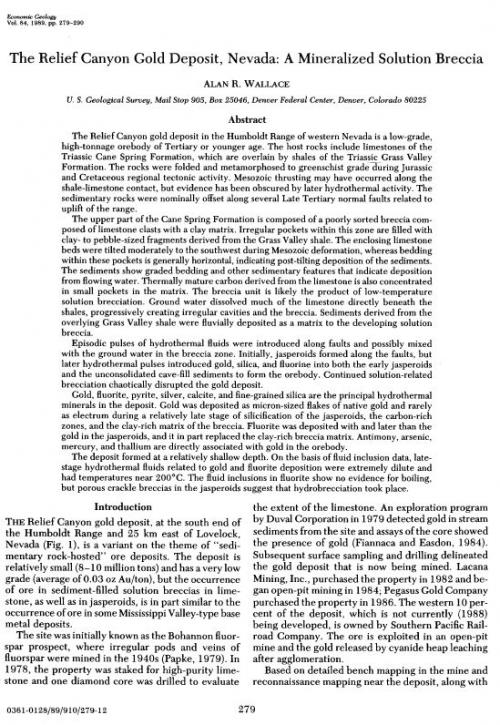
Автор(ы):Wallace A.R.
Издание:Economic geology, 1989 г., 12 стр.
Язык(и)Английский
The Relief Canyon gold deposit, Nevada: a mineralized solution breccia

The Relief Canyon gold deposit in the Humboldt Range of western Nevada is a low-grade, high-tonnage orebody of Tertiary or younger age. The host rocks include limestones of the Triassic Cane Spring Formation, which are overlain by shales of the Triassic Grass Valley Formation. The rocks were folded and metamorphosed to greenschist grade during Jurassic and Cretaceous regional tectonic activity. Mesozoic thrusting may have occurred along the shale-limestone contact, but evidence has been obscured by later hydrothermal activity. The sedimentary rocks were nominally offset along several Late Tertiary normal faults related to uplift of the range.

Выпуск 83
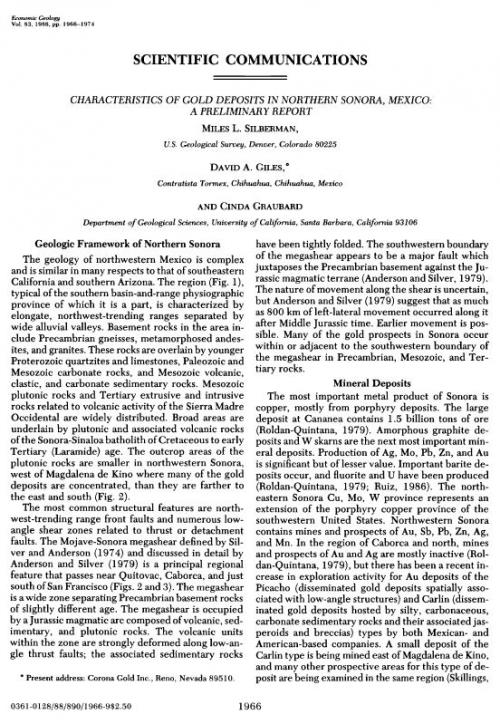
Издание:Economic geology, 1988 г., 9 стр.
Язык(и)Английский
Characteristics of gold deposits on Nortern Sonora, Mexico: a preliminary report

The geology of northwestern Mexico is complex and is similar in many respects to that of southeastern California and southern Arizona. The region (Fig. 1), typical of the southern basin-and-range physiographic province of which it is a part, is characterized by elongate, northwest-trending ranges separated by wide alluvial valleys. Basement rocks in the area include Precambrian gneisses, metamorphosed andes-ites, and granites. These rocks are overlain by younger Proterozoic quartzites and limestones, Paleozoic and Mesozoic carbonate rocks, and Mesozoic volcanic, clastic, and carbonate sedimentary rocks. Mesozoic plutonic rocks and Tertiary extrusive and intrusive rocks related to volcanic activity of the Sierra Madre Occidental are widely distributed. Broad areas are underlain by plutonic and associated volcanic rocks of the Sonora-Sinaloabatholith of Cretaceous to early Tertiary (Laramide) age. The outcrop areas of the plutonic rocks are smaller in northwestern Sonora, west of Magdalena de Kino where many of the gold deposits are concentrated, than they are farther to the east and south (Fig. 2).

Выпуск 83
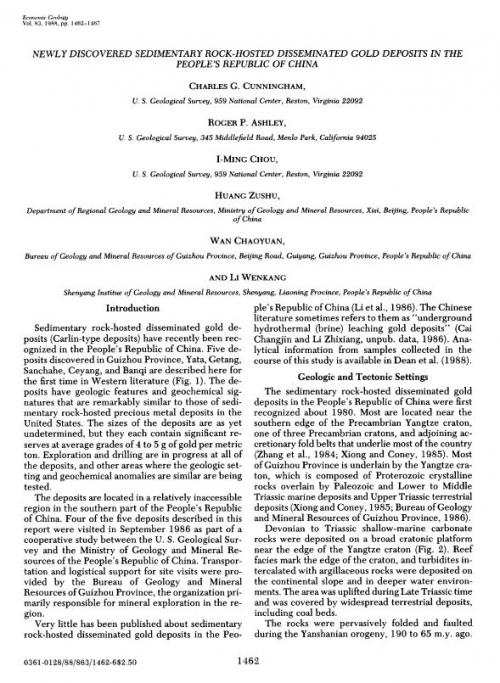
Издание:Economic geology, 1988 г., 6 стр.
Язык(и)Английский
Newly discovered sedimentary rock-hosted disseminated gold deposits in the People's republic of China

Sedimentary rock-hosted disseminated gold deposits (Carlin-type deposits) have recently been recognized in the People's Republic of China. Five deposits discovered in Guizhou Province, Yata, Getang, Sanchahe, Ceyang, and Banqi are described here for the first time in Western literature (Fig. 1). The deposits have geologic features and geochemical signatures that are remarkably similar to those of sedimentary rock-hosted precious metal deposits in the United States. The sizes of the deposits are as yet undetermined, but they each contain significant reserves at average grades of 4 to 5 g of gold per metric ton. Exploration and drilling are in progress at all of the deposits, and other areas where the geologic setting and geochemical anomalies are similar are being tested.

The deposits are located in a relatively inaccessible region in the southern part of the People's Republic of China. Four of the five deposits described in this report were visited in September 1986 as part of a cooperative study between the U. S. Geological Survey and the Ministry of Geology and Mineral Resources of the People's Republic of China. Transportation and logistical support for site visits were provided by the Bureau of Geology and Mineral Resources of Guizhou Province, the organization primarily responsible for mineral exploration in the region.

Very little has been published about sedimentary rock-hosted disseminated gold deposits in the People's Republic of China (Li et al., 1986). The Chinese literature sometimes refers to them as "underground hydrothermal (brine) leaching gold deposits" (Cai Changjin and Li Zhixiang, unpub. data, 1986). Analytical information from samples collected in the course of this study is available in Dean et al. (1988)

Выпуск 83
Автор(ы):Angel A.A., Noble D.C.
Издание:Economic geology, 1988 г., 11 стр.
Язык(и)Английский
Sedimentary Rock-Hosted Disseminated Precious Metal Mineralization at Purisima Concepcion, Yauricocha District, Central Peru

Sedimentary rock-hosted disseminated gold ores lithologically and chemically similar to those of Carlin-type deposits of the western United States are present in the Yauricocha district, central Peru. The Purisima Concepcion deposit is located in the core of a steeply plunging anticline several hundred meters beyond large pipe-shaped Cu-Zn-Pb-Ag-Au replacement orebodies in limestone bordering a late Miocene granodiorite stock. The central part of the stock is potassium-silicate altered and contains high-salinity fluid inclusions.

Выпуск 82
Автор(ы):Jewell P.W., Parry W.T.
Издание:Economic geology, 1987 г., 9 стр.
Язык(и)Английский
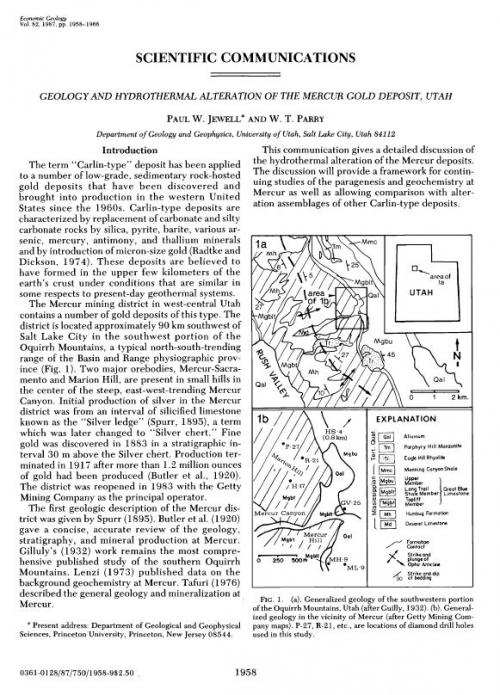
Geology and hydrotermal alteration of the Mercur gold deposit, Utah

The term "Carlin-type" deposit has been applied to a number of low-grade, sedimentary rock-hosted gold deposits that have been discovered and brought into production in the western United States since the 1960s. Carlin-type deposits are characterized by replacement of carbonate and silty carbonate rocks by silica, pyrite, barite, various arsenic, mercury, antimony, and thallium minerals and by introduction of micron-size gold (Radtke and Dickson, 1974). These deposits are believed to have formed in the upper few kilometers of the earth's crust under conditions that are similar in some respects to present-day geothermal systems.

The Mercur mining district in west-central Utah contains a number of gold deposits of this type. The district is located approximately 90 km southwest of Salt Lake City in the southwest portion of the Oquirrh Mountains, a typical north-south-trending range of the Basin and Range physiographic province (Fig. 1). Two major orebodies, Mercur-Sacra-mento and Marion Hill, are present in small hills in the center of the steep, east-west-trending Mercur Canyon. Initial production of silver in the Mercur district was from an interval of silicified limestone known as the "Silver ledge" (Spurr, 1895), a term which was later changed to "Silver chert." Fine gold was discovered in 1883 in a stratigraphic interval 30 m above the Silver chert. Production terminated in 1917 after more than 1.2 million ounces of gold had been produced (Butler et al., 1920). The district was reopened in 1983 with the Getty Mining Company as the principal operator.

The first geologic description of the Mercur district was given by Spurr (1895). Butler et al. (1920) gave a concise, accurate review of the geology, stratigraphy, and mineral production at Mercur. Gilluly's (1932) work remains the most comprehensive published study of the southern Oquirrh Mountains. Lenzi (1973) published data on the background geochemistry at Mercur. Tafuri (1976) described the general geology and mineralization at Mercur.

This communication gives a detailed discussion of the hydrothermal alteration of the Mercur deposits. The discussion will provide a framework for continuing studies of the paragenesis and geochemistry at Mercur as well as allowing comparison with alteration assemblages of other Carlin-type deposits.


Редактор(ы):Singh P., Singh V.P., Haritashya U.K.
Издание:Springer, 2011 г., 1253 стр.
Язык(и)Английский
Encyclopedia of Snow, Ice and Glaciers

The earth's cryosphere, which includes snow, glaciers, ice caps, ice sheets, ice shelves, sea ice, river and lake ice, and permafrost, contains about 75% of the earth's fresh water. It exists at almost all latitudes, from the tropics to the poles, and plays a vital role in controlling the global climate system. It also provides direct visible evidence of the effect of climate change, and, therefore, requires proper understanding of its complex dynamics. This encyclopedia mainly focuses on the various aspects of snow, ice and glaciers, but also covers other cryospheric branches, and provides up-to-date information and basic concepts on relevant topics. It includes alphabetically arranged and professionally written, comprehensive and authoritative academic articles by well-known international experts in individual fields. The encyclopedia contains a broad spectrum of topics, ranging from the atmospheric processes responsible for snow formation; transformation of snow to ice and changes in their properties; classification of ice and glaciers and their worldwide distribution; glaciation and ice ages; glacier dynamics; glacier surface and subsurface characteristics; geomorphic processes and landscape formation; hydrology and sedimentary systems; permafrost degradation; hazards caused by cryospheric changes; and trends of glacier retreat on the global scale along with the impact of climate change. This book can serve as a source of reference at the undergraduate and graduate level and help to better understand snow, ice and glaciers. It will also be an indispensable tool containing specialized literature for geologists, geographers, climatologists, hydrologists, and water resources engineers; as well as for those who are engaged in the practice of agricultural and civil engineering, earth sciences, environmental sciences and engineering, ecosystem management, and other relevant subjects.

Источник:twirpx
Выпуск 98
Издание:Economic geology, 2003 г., 13 стр.
Язык(и)Английский
Timing Constraints of Gold Mineralization along the Carlin Trend Utilizing Apatite Fission-Track, 40Ar/39Ar, and Apatite (U-Th)/He Methods

Apatite fission-track analysis is used to demonstrate that the timing of gold mineralization at the Carlin East and Betze-Post deposits is 37.3 ± 1.5 Ma, based on the weighted mean of measured fission-track ages, and 41.6 ± 1.6 Ma, based on the weighted mean of the ages of the oldest fission tracks retained. Regional measured apatite fission-track ages cluster between 28 and 41 Ma to the south of the Carlin East deposit whereas measured ages are greater than ~56 Ma to the north. The regional trend of the apatite fission-track ages and the pattern of gravity and magnetic anomalies suggest that the thermal center for gold mineralization along the Carlin trend was south of the Carlin East deposit, near the 37 Ma Welches Canyon stock. Modeling of apatite fission-track-age data on both sides of the Post fault indicates that the Little Boulder stock was approximately 35°C cooler at 40 Ma relative to similarly positioned samples in the Goldstrike stock. It is unclear whether this thermal history difference across the Post fault is due to post-40 Ma differential exhumation or differential heating across the fault at the time of gold mineralization. Comparison of apatite fission-track and whole-rock 40Ar/39Ar ages from altered dikes in the ore zone at Carlin East demonstrates that 40Ar/39Ar ages do not reflect the age of gold mineralization, whereas the apatite fission-track ages were completely reset at the time of hydrother-mal activity. (U-Th)/He ages are younger than the inferred mineralization age and may reflect weak hy-drothermal activity associated with Miocene volcanism.

Выпуск 98
Издание:Economic geology, 2003 г., 14 стр.
Язык(и)Английский
Evaluation of Radioisotope Dating of Carlin-Type Deposits in the Great Basin, Western North America, and Implications for Deposit Genesis

A variety of techniques have been used in attempts to date the mineralization in Carlin-type deposits in the Great Basin, with highly variable results. These techniques and results are reviewed in this paper, along with presentation of two new dates, for the Rodeo deposit on the Carlin trend and for the Barneys Canyon deposit in Utah. Complete resetting of sericite by hydrothermal fluids of the temperature and duration of hydrother-mal activity that form Carlin-type deposits is considered highly unlikely. Therefore, dates from sericite are generally of questionable value unless that sericite can be shown to have formed during the same hydrothermal event during which Au was deposited. For the deposits that have been investigated to date, sericite dates rarely, if ever, record the age of Au mineralization. However, sericite ages do appear to record pre-Au events in some districts. Such events may have contributed to ground preparation and, to a much lesser extent, to the tenor of the ore. Fission-track and U/Th-He techniques provide important age constraints on mineralization in some districts but also suffer from a less than clear association with Au. Rb-Sr dating of galkhaite, an Hg sulfosalt, provides the only direct age of mineralization, but galkhaite has been recognized in only a few locations (and dated in only two deposits). In a similar manner, adularia is contemporaneous with Au at Twin Creeks, but Twin Creeks is the only Carlin-type deposit where adularia has been reported. Several other techniques (U-Pb, Re-Os, Sm-Nd) have been used in attempts to date the deposits but with limited success.

Выпуск 94
Издание:Economic geology, 1998 г., 34 стр.
Язык(и)Английский
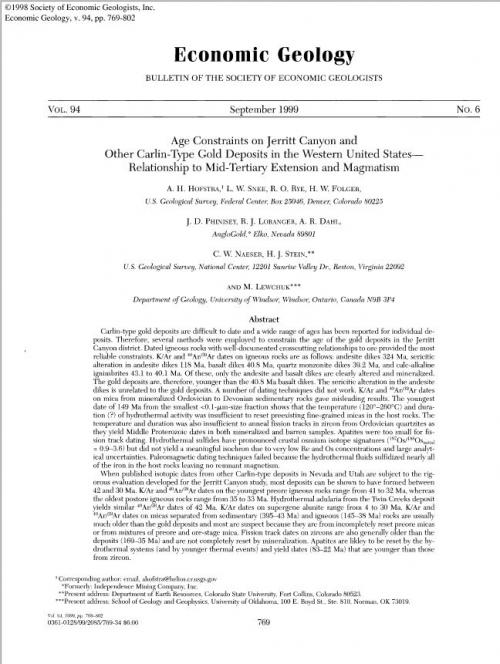
Age Constraints on Jerritt Canyon and Other Carlin-Type Gold Deposits in the Western United States— Relationship to Mid-Tertiary Extension and Magmatism

Возрастные ограничения для золоторудных месторождений Джерритт-Каньон и других месторождений карлинского типа на западе США — связь со среднетретичным растяжением и магматизмом

Carlin-type gold deposits are difficult to date and a wide range of ages has been reported for individual deposits. Therefore, several methods were employed to constrain the age of the gold deposits in the Jerritt Canyon district. Dated igneous rocks with well-documented crosscutting relationships to ore provided the most reliable constraints. K/Ar and 40Ar/39Ar dates on igneous rocks are as follows: andesite dikes 324 Ma, sericitic alteration in andesite dikes 118 Ma, basalt dikes 40.8 Ma, quartz monzonite dikes 39.2 Ma, and calc-alkaline ignimbrites 43.1 to 40.1 Ma. Of these, only the andesite and basalt dikes are clearly altered and mineralized. The gold deposits are, therefore, younger than the 40.8 Ma basalt dikes. The sericitic alteration in the andesite dikes is unrelated to the gold deposits. A number of dating techniques did not work. K/Ar and 40Ar/39Ar dates on mica from mineralized Ordovician to Devonian sedimentary rocks gave misleading results. The youngest date of 149 Ma from the smallest <0.1-)U,m-size fraction shows that the temperature (120°-260°C) and duration (?) of hydrothermal activity was insufficient to reset preexisting fine-grained micas in the host rocks. The temperature and duration was also insufficient to anneal fission tracks in zircon from Ordovician quartzites as they yield Middle Proterozoic dates in both mineralized and barren samples. Apatites were too small for fission track dating. Hydrothermal sulfides have pronounced crustal osmium isotope signatures (18'Os/188Osinitiai = 0.9-3.6) but did not yield a meaningful isochron due to very low Re and Os concentrations and large analytical uncertainties. Paleomagnetic dating techniques failed because the hydrothermal fluids sulfidized nearly all of the iron in the host rocks leaving no remnant magnetism.

Ленты новостей
550.65