Добрый день, Коллеги. Важное сообщение, просьба принять участие. Музей Ферсмана ищет помощь для реставрационных работ в помещении. Подробности по ссылке

Выпуск 46
Автор(ы):Joralemon P.
Издание:Economic geology, 1951 г., 44 стр.
Язык(и)Английский
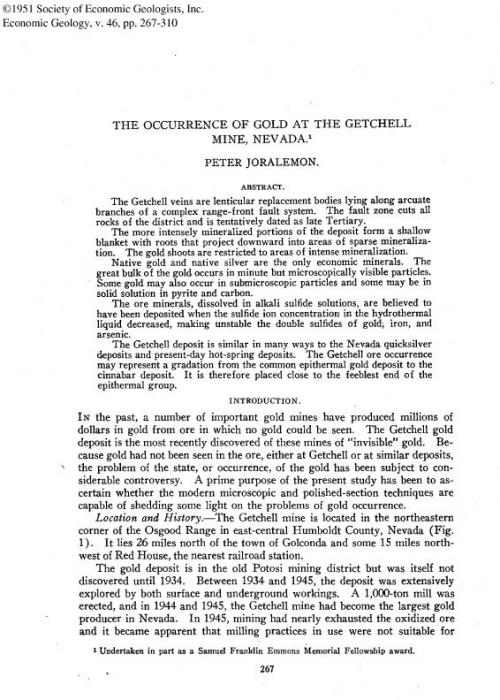
The occurrence of gold at the Getchell mine, Nevada

The Getchell veins are lenticular replacement bodies lying along arcuate branches of a complex range-front fault system. The fault zone cuts all rocks of the district and is tentatively dated as late Tertiary.

The more intensely mineralized portions of the deposit form a shallow blanket with roots that project downward into areas of sparse mineralization.    The gold shoots are restricted to areas of intense mineralization.

Native gold and native silver are the only economic minerals. The great bulk of the gold occurs in minute but microscopically visible particles. Some gold may also occur in submicroscopic particles and some may be in solid solution in pyrite and carbon.

The ore minerals, dissolved in alkali sulfide solutions, are believed to have been deposited when the sulfide ion concentration in the hydrothermal liquid decreased, making unstable the double sulfides of gold-, iron, and arsenic.

The Getchell deposit is similar in many ways to the Nevada quicksilver deposits and present-day hot-spring deposits. The Getchell ore occurrence may represent a gradation from the common epithermal gold deposit to the cinnabar deposit. It is therefore placed close to the feeblest end of the epithermal group.

Выпуск 16
Автор(ы):Ferguson H.G.
Издание:Economic geology, 1921 г., 36 стр.
Язык(и)Английский
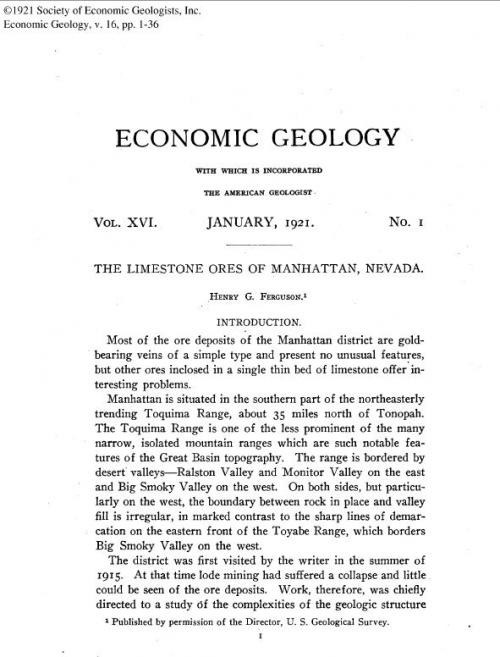
The limestone ores of Manhattan, Nevada


Most of the ore deposits of the Manhattan district are gold-bearing veins of a simple type and present no unusual features, but other ores inclosed in a single thin bed of limestone offer interesting problems.

Manhattan is situated in the southern part of the northeasterly trending Toquima Range, about 35 miles north of Tonopah. The Toquima Range is one of the less prominent of the many narrow, isolated mountain ranges which are such notable features of the Great Basin topography. The range is bordered by desert valleys—Ralston Valley and Monitor Valley on the east and Big Smoky Valley on the west. On both sides, but particularly on the west, the boundary between rock in place and valley fill is irregular, in marked contrast to the sharp lines of demarcation on the eastern front of the Toyabe Range, which borders Big Smoky Valley on the west.

Выпуск 106
Автор(ы):Muntean J.L., Taufen P.
Издание:Economic geology, 2011 г., 25 стр.
Язык(и)Английский
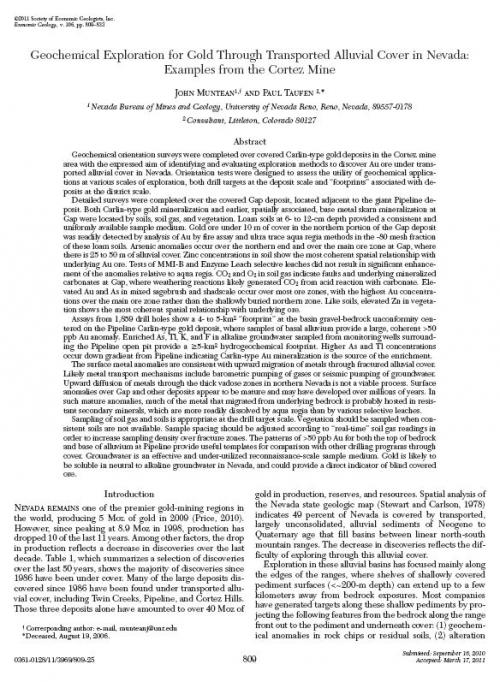
Geochemical exploration for gold through transported alluvial cover in Nevada: examples from the Cortez Mine


Geochemical orientation surveys were completed over covered Carlin-type gold deposits in the Cortez mine area with the expressed aim of identifying and evaluating exploration methods to discover Au ore under transported alluvial cover in Nevada. Orientation tests were designed to assess the utility of geochemical applications at various scales of exploration, both drill targets at the deposit scale and “footprints” associated with deposits at the district scale.

Detailed surveys were completed over the covered Gap deposit, located adjacent to the giant Pipeline deposit. Both Carlin-type gold mineralization and earlier, spatially associated, base metal skarn mineralization at Gap were located by soils, soil gas, and vegetation. Loam soils at 6- to 12-cm depth provided a consistent and uniformly available sample medium. Gold ore under 10 m of cover in the northern portion of the Gap deposit was readily detected by analysis of Au by fire assay and ultra trace aqua regia methods in the -80 mesh fraction of these loam soils. Arsenic anomalies occur over the northern end and over the main ore zone at Gap, where there is 25 to 50 m of alluvial cover. Zinc concentrations in soil show the most coherent spatial relationship with underlying Au ore. Tests of MMI-B and Enzyme Leach selective leaches did not result in significant enhancement of the anomalies relative to aqua regia. CO2 and O2 in soil gas indicate faults and underlying mineralized carbonates at Gap, where weathering reactions likely generated CO2 from acid reaction with carbonate. Elevated Au and As in mixed sagebrush and shadscale occur over most ore zones, with the highest Au concentrations over the main ore zone rather than the shallowly buried northern zone. Like soils, elevated Zn in vegetation shows the most coherent spatial relationship with underlying ore.

Выпуск 105
Издание:Economic geology, 2010 г., 34 стр.
Язык(и)Английский
Mineral paragenesis, alteration, and geochemistry of the two types of gold ore and the host rocks from the carlin-type deposits in the southern part of the Goldstrike Property, Northern Nevada: implications for sources of ore-forming elements, ore genesis

Минеральный парагенезис, изменение и геохимия двух типов золотой руды и вмещающих пород месторождений карлинского типа в южной части участка Голдстрайк, Северная Невада: влияние на источники рудообразующих элементов, генезис руды

This study was undertaken to characterize the mineral paragenesis and metal zoning at the property scale, evaluate the potential sources of ore-related metals, quantify the relationship between intensity of alteration and gold grade, and propose a comprehensive genetic model for the Carlin-type Au deposits at the southern part of the Goldstrike property, Nevada.

Выпуск 104
Издание:Economic geology, 2009 г., 22 стр.
Язык(и)Английский
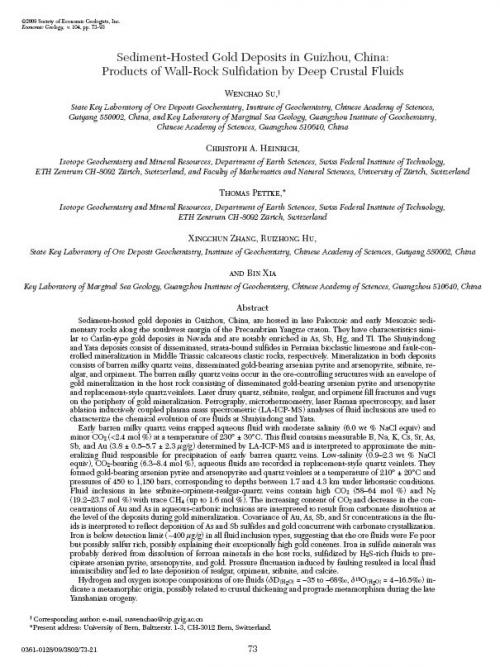
Sediment-hosted gold deposits in Guizhou, China: products of wall-rock sulfidation by deep crustal fluids / Залежи золота в отложениях в Гуйчжоу, Китай: продукты сульфидирования стеновых пород глубинными флюидами земной коры


Sediment-hosted gold deposits in Guizhou, China, are hosted in late Paleozoic and early Mesozoic sedimentary rocks along the southwest margin of the Precambrian Yangtze craton. They have characteristics similar to Carlin-type gold deposits in Nevada and are notably enriched in As, Sb, Hg, and Tl. The Shuiyindong and Yata deposits consist of disseminated, strata-bound sulfides in Permian bioclastic limestone and fault-controlled mineralization in Middle Triassic calcareous clastic rocks, respectively. Mineralization in both deposits consists of barren milky quartz veins, disseminated gold-bearing arsenian pyrite and arsenopyrite, stibnite, realgar, and orpiment. The barren milky quartz veins occur in the ore-controlling structures with an envelope of gold mineralization in the host rock consisting of disseminated gold-bearing arsenian pyrite and arsenopyrite and replacement-style quartz veinlets. Later drusy quartz, stibnite, realgar, and orpiment fill fractures and vugs on the periphery of gold mineralization. Petrography, microthermometry, laser Raman spectroscopy, and laser ablation inductively coupled plasma mass spectrometric (LA-ICP-MS) analyses of fluid inclusions are used to characterize the chemical evolution of ore fluids at Shuiyindong and Yata.

Выпуск 103
Издание:Economic geology, 2008 г., 24 стр.
Язык(и)Английский
Geology of the cove mine, Lander County, Nevada, and a genetic model for the McCoy-Cove hydrothermal system / Геология шахты Коув, округ Ландер, штат Невада, и генетическая модель гидротермальной системы Маккой-Коув

The McCoy Au-Ag skarn and Cove Au-Ag deposits are located in the northern Fish Creek Mountains, Lander County, Nevada. Through the end of mining in 2001, large-scale open-pit and associated underground production at the two deposits yielded 3.3 million ounces (Moz) of Au and 108 Moz of Ag. Most production was from Cove, making it the fourth-largest Ag producer in the history of Nevada.

Cove is hosted by the middle to early Late Triassic Augusta Mountain Formation, which consists of limestone with lesser dolostone and clastic units. Ore also is present locally in Eocene porphyritic granodiorite dikes and sills. The deposit comprises two distinct ore types: a central core of polymetallic vein-type ore and an outer aureole of relatively Ag rich Carlin-style ore. Polymetallic veins consist of pyrite-sphalerite-galena–dominated Au- and Ag-bearing veins, veinlets, stockworks, crustifications, and disseminations in clastic and carbonate strata and locally in the intrusions. Carlin-style ore comprises disseminated Fe ± As sulfides with arsenian, argentiferous, and auriferous components ± native Au-electrum in silty to sandy carbonate strata. Polymetallic vein-type ore has Ag/Au ratios of >50/1, and Carlin-style ore has Ag/Au ratios that decrease from ~50/1 near the feeder faults to ~1/1 in one of the more distal ore zones. Both types of ore are associated with decarbona-tized, silicified, and illitized rocks. New structural and age data for fresh and altered intrusive rocks indicate that mineralization at Cove occurred during active extension and magmatism at ~39 Ma (40Ar-39Ar). Fluid inclusion and δD and δ18O data for polymetallic vein-type ore indicate that the mineralizing fluids had temperatures of 250° to 370°C and were magmatic in origin.

Выпуск 102
Автор(ы):Hofstra A.H., Nutt† C.J.
Издание:Economic geology, 2007 г., 27 стр.
Язык(и)Английский
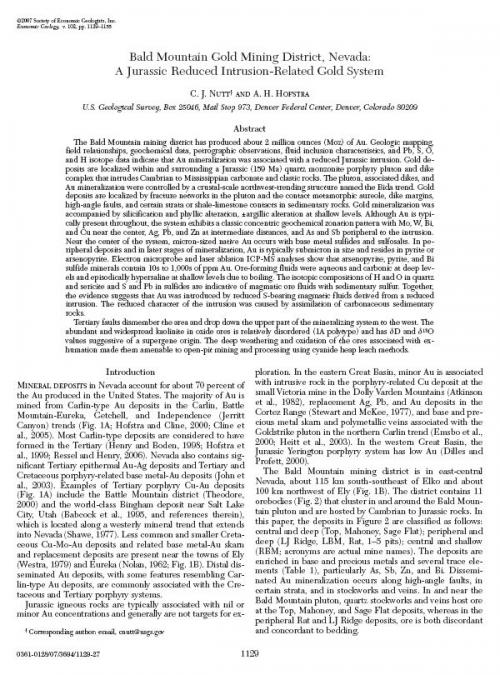
Bald mountain gold mining district, Nevada: a Jurassic reduced intrusion-related gold system

The Bald Mountain mining district has produced about 2 million ounces (Moz) of Au. Geologic mapping, field relationships, geochemical data, petrographic observations, fluid inclusion characteristics, and Pb, S, O, and H isotope data indicate that Au mineralization was associated with a reduced Jurassic intrusion. Gold deposits are localized within and surrounding a Jurassic (159 Ma) quartz monzonite porphyry pluton and dike complex that intrudes Cambrian to Mississippian carbonate and clastic rocks. The pluton, associated dikes, and Au mineralization were controlled by a crustal-scale northwest-trending structure named the Bida trend. Gold deposits are localized by fracture networks in the pluton and the contact metamorphic aureole, dike margins, high-angle faults, and certain strata or shale-limestone contacts in sedimentary rocks. Gold mineralization was accompanied by silicification and phyllic alteration, ±argillic alteration at shallow levels. Although Au is typically present throughout, the system exhibits a classic concentric geochemical zonation pattern with Mo, W, Bi, and Cu near the center, Ag, Pb, and Zn at intermediate distances, and As and Sb peripheral to the intrusion. Near the center of the system, micron-sized native Au occurs with base metal sulfides and sulfosalts. In peripheral deposits and in later stages of mineralization, Au is typically submicron in size and resides in pyrite or arsenopyrite. Electron microprobe and laser ablation ICP-MS analyses show that arsenopyrite, pyrite, and Bi sulfide minerals contain 10s to 1,000s of ppm Au. Ore-forming fluids were aqueous and carbonic at deep levels and episodically hypersaline at shallow levels due to boiling. The isotopic compositions of H and O in quartz and sericite and S and Pb in sulfides are indicative of magmatic ore fluids with sedimentary sulfur. Together, the evidence suggests that Au was introduced by reduced S-bearing magmatic fluids derived from a reduced intrusion. The reduced character of the intrusion was caused by assimilation of carbonaceous sedimentary rocks.

Tertiary faults dismember the area and drop down the upper part of the mineralizing system to the west. The abundant and widespread kaolinite in oxide ores is relatively disordered (1A polytype) and has δD and δ18O values suggestive of a supergene origin. The deep weathering and oxidation of the ores associated with exhumation made them amenable to open-pit mining and processing using cyanide heap leach methods.


Редактор(ы):Miccadei E., Piacentini T.
Издание:Intechopen, Риека, 2012 г., 294 стр., ISBN: 978-953-51-0361-5
Язык(и)Английский
Studies on environmental and applied geomorphology / Исследования по экологической и прикладной геоморфологии

This book includes several geomorphological studies up-to-date, incorporating different disciplines and methodologies, always focused on methods, tools and general issues of environmental and applied geomorphology. In designing the book the integration of multiple methodological fields (geomorphological mapping, remote sensing, meteorological and climate analysis, vegetation and biogeomorphological investigations, geographic information systems GIS, land management methods), study areas, countries and continents (Europe, America, Asia, Africa) are considered.

Contents:
Using Discrete Debris Accumulations to Help Interpret Upland Glaciation of the Younger Dryas in the British Isles
Biogeomorphologic Approaches to a Study of Hillslope Processes Using Non-Destructive Methods
Geomorphological Instability Triggered by Heavy Rainfall: Examples in the Abruzzi Region (Central Italy)
Environmental Changes in Lakes Catchments as a Trigger for Rapid Eutrophication - A Prespa Lake Case Study
Intervention of Human Activities on Geomorphological Evolution of Coastal Areas: Cases from Turkey
Spatial and Time Balancing Act: Coastal Geomorphology in View of Integrated Coastal Zone Management (ICZM)
Hydro-Geomorphic Classification and Potential Vegetation Mapping for Upper Mississippi River Bottomland Restoration
Anthropogenic Induced Geomorphological Change Along the Western Arabian Gulf Coast
Comparison of SRTM and ASTER Derived Digital Elevation Models over Two Regions in Ghana - Implications for Hydrological and Environmental Modeling
From Landscape Preservation to Landscape Governance: European Experiences with Sustainable Development of Protected Landscapes

Редактор(ы):Lobosco R.J., Schulz H.E., Andrade A.L.
Издание:Intechopen, Риека, 2011 г., 300 стр., ISBN: 978-953-307-893-9
Язык(и)Английский
Hydrodynamics - Natural Water Bodies

Hydrodynamics is a very rich area of study, involving some of the most intriguing theoretical problems, considering our present level of knowledge. General nonlinear solutions, closed statistical equations, explanation of sudden changes, for example, are wanted in different areas of research, being also matter of study in Hydromechanics. Further, any solution in this field depends on many factors, or many “boundary conditions”. The changing of the boundary conditions is one of the ways through which the human being affects its fluidic environment. Changes in a specific site can impose catastrophic consequences in a whole region. For example, the permanent leakage of petroleum in one point in the ocean may affect the life along the entire region covered by the marine currents that transport this oil. Gases or liquids, the changes in the quality of the fluids in which we live certainly affect our quality of life. The knowledge about fluids, their movements, and their ability to transport physical properties and compounds is thus recognized as important for life. As a consequence, thinking about new solutions for general or specific problems in Hydromechanics may help to attain a sustainable relationship with our environment

Источник:intechweb
Автор(ы):Keith R.
Редактор(ы):Lindley R., Darrin J.
Издание:McGraw-Hill Book Company, 2008 г., 1244 стр., ISBN: 0-07-164101-7
Язык(и)Английский
Maintenance.Engineering.Handbook. / Техническое обслуживание. Инженерия. Справочник.

Some engineering fields change dramatically from year to year, with radical breakthroughs in technology happening often. These fields may have hundreds or more papers and texts published each year on the latest best practices. Maintenance engineering is a field which, for the most part, hasn’t fundamentally changed much over the years. And there aren’t many sources for the latest information or best practices. But in recent years, maintenance engineering has, more and more, put an emphasis on true reliability. A business which is asset-intensive, such as manufacturing, relies on a reliability-centered field of engineering to be successful. In my opinion, reliability engineering itself has become a technology used for the purpose of improving manufacturing capacity, without capital investment. The Maintenance Engineering Handbook has long been regarded as the premier source for expertise on maintenance theory and practices for any industry. This text has been considered invaluable and now, this latest edition defines those practices that are critical to developing an effective reliability engineering function within your business. This text is no longer just about mechanical, electrical, and civil maintenance engineering. Instead, the seventh edition also focuses on recognized and proven best practices in maintenance, repair, and overhaul (MRO) inventory management, root-cause analysis, and performance management. Keith Mobley, the editor in chief of this text, has more than 35 years of direct experience in corporate management, process and equipment design, and reliability-centered maintenance methodologies. For the past 16 years, he has helped hundreds of clients across the globe achieve and sustain world-class performance through the implementation of maintenance and reliability engineering principles. You may spend your career worrying about excessive downtime and high maintenance costs as a result of repetitive failures. As a fellow veteran maintenance and reliability engineer, I encourage you to recognize that this field is changing and improvements are being made that empower today’s business leaders. This text can help you reap the benefits of those changes so that your hard work produces the best possible results.

Ленты новостей
619.37