Добрый день, Коллеги. Важное сообщение, просьба принять участие. Музей Ферсмана ищет помощь для реставрационных работ в помещении. Подробности по ссылке

Автор(ы):Laznicka P.
Издание:PGS Publishing, Linden Park, 2002 г., 18 стр.
Язык(и)Английский
Wernecke Mountains (Yukon) Breccias and Scattered Ore Occurrences: What Contribution to FeOx-Cu-Au-U Metallogeny? / Горы Вернеке (Юкон) Брекчии и разрозненные рудопроявления: каков вклад в металлогению FeOx-Cu-Au-U?

The Wernecke and Southern Ogilvie Mountains in Yukon are part of an almost east-west trending range in the northern Canadian Cordillera in which several areas of the Palaeo-Mesoproterozoic basement are exposed, enveloped by a Phanerozoic miogeoclinal sequence. The oldest division, the -1.8-1.4 Ga Wernecke Supergroup, is interpreted as a "clastic rift'". It is an up to 15 km thick pile, the bulk of which is a monotonous, well-bedded siltite-quartz rich litharenite-argillite, topped by carbonate-pelite units. Less than 1% of the area consists of small gabbro to diorite intrusions of several, mostly Palaeoproterozoic and Mesoproterozoic, generations. The predominantly brittle deformation regime produced extensive tracts of disrupted and dismembered units grading to tectonic (not subduction !) melange. These have been overprinted by large scale Na, Ca, Mg, Fe, C02 and lesser Si, K metasomatism to produce widespread albitisation, chloritisation, carbonatisation, hematitisation and less extensive sericitisation (with local biotite) of the fractured sedimentary » magmatic rocks as well as tectonic fragmentites. The "Wernecke Breccia" is a metasomatised disaggregated breccia series and it is associated with hundreds of small scattered showings of specular hematite, magnetite and chalcopyrite, several occurrences of U and Co minerals, and anomalous gold. Not even a marginally economic orebody has so far been discovered despite intermittent exploration going back to the 1960s. It appears that we are dealing with a moderately deep (closely above the ductile-brittle interface) level of regional release and displacement of metals from source rocks (Fe, Cu and Co from gabbros; U perhaps from carbonaceous argillites) by metasomatic destruction of the carrier minerals. However, the system lacked sufficient plumbing and the channelling required to produce better metal accumulations at higher levels.

Издание:PGS Publishing, Linden Park, 2002 г., 6 стр.
Язык(и)Английский
Comparison of the Geology of Proterozoic Iron Oxide Deposits in the Adirondack and Mid-Atlantic Belt of Pennsylvania, New Jersey and New York / Сравнение геологии протерозойских железооксидных отложений в Адирондаке и Срединно-Атлантическом поясе Пенсильв

Сравнение геологии протерозойских железооксидных отложений в Адирондаке и Срединно-Атлантическом поясе Пенсильвании, Нью-Джерси и Нью-Йорка

Proterozoic hydrothermal iron oxide deposits occur within two metallogenic belts in the northeastern U.S.: the Adirondack region, and the Mid-Atlantic (Reading Prong) belt. A 175 km wide belt of Palaeozoic cover separates these two regions, although some iron deposits occur in Proterozoic rocks near the unconformity, suggesting a possible continuation beneath the cover. Although potentially part of the same continuous metallogenic province sharing similar mineralogy, host rock composition and hydrothermal alteration, deposits in the two regions differ in degree of deformation. Differences in the degree of metamorphic deformation fuel the debate of the relative timing of mineralisation, igneous activity, and metamorphism. Generally less deformed textures in the Adirondack deposits led workers in the New York deposits to conclude iron ores in the Adirondacks are associated with anorogenic granites that postdate peak metamorphism. Folded iron ores in granitic gneiss of the Mid-Atlantic belt suggest some deposits in eastern Pennsylvania, northern New Jersey, and southern New York predate peak metamorphism. REE-enriched deposits in both belts are characterised by abundant apatite, tourmaline, and manganese concentrations, as well as the presence of hematite-chlorite alteration in addition to magnetite. Unlike deposits hosted exclusively within granite gneisses, deposits within supracrustal rocks commonly contain significant sulphides and so are potential hosts for copper mineralisation.

Издание:PGS Publishing, Linden Park, 2002 г., 19 стр.
Язык(и)Английский
The Epigenetic Sediment-hosted Serra Pelada Au-PGE Deposit and its Potential Genetic Association with Fe-Oxide Cu-Au Mineralisation within the Carajas Mineral Province, Amazon Craton, Brazil / Эпигенетическое месторождение Серра Пелада Au-PGE

Эпигенетическое месторождение Серра Пелада Au-PGE, залегающее в отложениях, и его потенциальная генетическая связь с железооксидно-медно-золотой минерализацией в минеральной провинции Карахас, Амазонский кратон, Бразилия

The Serra Pelada Au-PGE deposit is located within the Carajas Mineral Province of the southeastern Amazon Craton, Brazil. Gold-PGE ores are epigenetic and display a strong structural control, being hosted in sub-greenschist facies carbonaceous and calcareous meta-siltstone, within the hinge zone of a reclined, tight, regional-scale F2 synform. Although the entire orebody has undergone deep tropical weathering, some evidence of the original hydrothermal alteration is preserved. Gold-PGE mineralisation is associated with the formation of magnetite- and hematite-rich hydrothermal breccias, massive zones of hematite metasomatism, intense sericite (white mica)-kaolin metasomatism, siderite veining and a jasperoid envelope of amorphous silica alteration hosting rare disseminated pyrite. All other Au-PGE ore-related mineral assemblages have undergone intense weathering to hydrated Fe-oxides and secondary clay minerals, preventing further description of primary ore and alteration features. The geochemistry of the primary Au-PGE ores at Serra Pelada displays many similarities to that of Fe-oxide Cu-Au deposits within the Carajas Mineral Province, and indeed world-wide, in terms of metal association (eg. Co, Ni, Cu, U), LREE enrichment and accompanying Fe-metasomatism. The Au-Pd-Pt association also suggests ore metal transport in acid, oxidising, chloride-rich fluids, similar to those for Fe-oxide Cu-Au deposits. In combination with these similarities, and the location of the Serra Pelada Au-Pd-Pt deposit, it is suggested that the latter represents a distal equivalent to the Fe-oxide Cu-Au deposits and, as such, a target that may have been overlooked during exploration programs around such terrains globally.

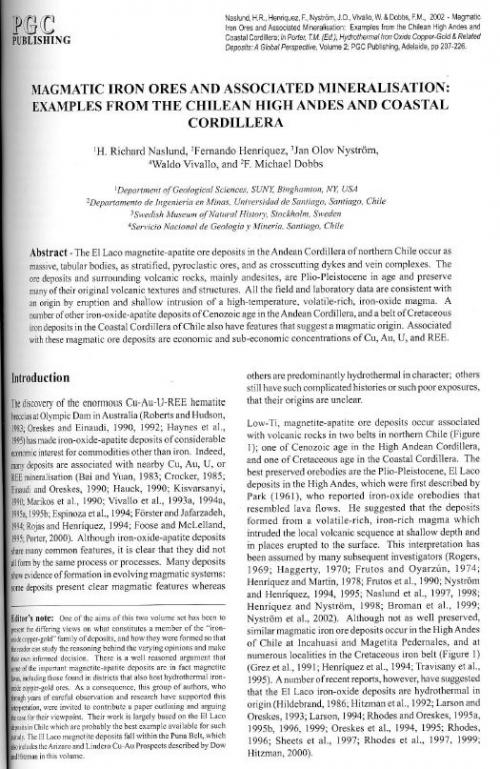
Издание:PGS Publishing, Linden Park, 2002 г., 20 стр.
Язык(и)Английский
Magmatic Iron Ores and Associated Mineralisation: Examples from the Chilean High Andes and Coastal Cordillera

The El Laco magnetite-apatite ore deposits in the Andean Cordillera of northern Chile occur as massive, tabular bodies, as stratified, pyroclastic ores, and as crosscutting dykes and vein complexes. The ore deposits and surrounding volcanic rocks, mainly andesites, are Plio-Pleistocene in age and preserve many of their original volcanic textures and structures. All the field and laboratory data are consistent with an origin by eruption and shallow intrusion of a high-temperature, volatile-rich, iron-oxide magma. A number of other iron-oxide-apatite deposits of Cenozoic age in the Andean Cordillera, and a belt of Cretaceous iron deposits in the Coastal Cordillera of Chile also have features that suggest a magmatic origin. Associated with these magmatic ore deposits are economic and sub-economic concentrations of Cu, Au, U, and REE.

Том 10
Редактор(ы):Spohn T.
Издание:Elsevier, 2007 г., 637 стр., ISBN: 978-0444519283
Язык(и)Английский
Treatise on geophisics. Planets and Moons. Volume 10/ Трактат о геофизике. Планеты и Луны. Том 10.


Humanity has always been fascinated with the wandering stars in the sky, the planets. Ancient astrologists have observed and used the paths of the planets in the sky to time the seasons and to predict the future. Observations of the planets helped J. Kepler to formulate his laws of planetary motion and revolutionize the perception of the world. With the advent of the space age, the planets have been transferred from bright spots in the sky to worlds of their own right that can be explored, in part by using the in situ and remote-sensing tools of the geosciences. The terrestrial planets are of particular interest to the geoscientist because comparison with our own planet allows a better understanding of our home, the Earth. Venus offers an example of a runaway greenhouse that has resulted in what we would call a hellish place. With temperatures of around 450C and a corrosive atmosphere that is also optically nontransparent, Venus poses enormous difficulties to spacecraft exploration. Mars is a much friendlier planet to explore but a planet where greenhouse effects and atmospheric loss processes have resulted in a cold and dusty desert. But aside from considerations of the usefulness of space exploration in terms of understanding Earth, the interested mind can visit astounding and puzzling places. There is the dynamic atmosphere of Jupiter with a giant thunderstorm that has been raging for centuries. There is Saturn with its majestic rings and there are Uranus and Neptune wit complicated magnetic fields. These giant planets have moons that are similarly astounding. There is the

volcanic satellite of Jupiter, Io that surpasses the Earth, and any other terrestrial planet in volcanic activity and surface heat flow. This activity is powered by tides that twist the satellite such that its interior partially melts. A much smaller moon of Saturn, Enceladus, also has geysers that could be powered by tidal heating. Its volcanic activity releases water vapor not lava. There is another moon of Saturn, Titan, that hides its surface underneath a layer of photochemical smog in a thick nitrogen atmosphere and there are  moons of similar sizes that lack any comparable atmosphere. Miranda, satellite of Uranus, appears as if it has been ripped apart and reassembled. Triton, a satellite of Neptune, has geysers of nitrogen powered by solar irradiation. Magnetic field data suggest that icy moons orbiting the giant planets may have oceans underneath thick ice covers.These oceans can, at least in principle, harbor or have harbored life. Moreover, there are asteroids with moons and comets that may still hold the clues to how the solar system and life on Earth formed. This volume of the Treatise on Geophysics discusses fundamental aspects of the science of the planets. It is focused on geophysical properties of the Earth-like planets and moons, those bodies that consist largely of rock, iron, and water, and the processes occurring in their interiors and on their surfaces. But it goes further by discussing the giant planets and their satellites as well. The better part of the volume is dedicated to the interior structure and evolution of the terrestrial planets and to their physical properties such as gravity and magnetic fields, rotation and surface–atmosphere interactions. What is the planetological context of life?

Том 9
Редактор(ы):Stevenson D.J.
Издание:Elsevier, 2007 г., 313 стр., ISBN: 978-0444519283
Язык(и)Английский
Treatise on geophisics. Evolution of the Earth. Volume 9 / Трактат о геофизике. Эволюция земли. Том 9

Evolutionary science is for the most part based on observation and indirect inference. It is not experimental science, even though experiments can certainly play a role in our understanding of processes. We can never hope to have the resources to build our own planet and observe how it evolves; we cannot even hope (at least in the foreseeable future) to observe an ensemble of Earth-like planets elsewhere in the universe and at diverse stages of their evolution (though there is certainly much discussion about detection of such planets; e.g., Seager (2003)). There are two central ideas that govern our thinking about Earth and its history. One is ‘provenance’: the nature and origin of the material that went into making Earth. This is our cosmic heritage, one that we presumably share with neighboring terrestrial planets, and (to some uncertain extent) we share with the meteorites and the abundances of elements in the Sun. The other is ‘process’: Earth is an engine and its current structure is a consequence of those ongoing processes, expressed in the form it takes now. The most obvious and important of these processes is plate tectonics and the inextricably entwined process of mantle convection. However, this central evolutionary process cannot be separated from the nature of the atmosphere and ocean, the geochemical evolution of various parts of Earth expressed in the rock record, and life. Figure 1 shows conceptually the ideas of Earth evolution, expressed as a curve in some multidimensional space that is here simplified by focusing on two variables (‘this’ and ‘that’), the identities of which are not important. They could be physical variables such as temperature, or chemical variables (composition of a particular reservoir) or isotopic tracers. The figure intends to convey the idea that we have an initial condition, an evolutionary path, and a present state. The initial condition is dictated not only by provenance but also by the physics of the formation process. By analogy, we would say that the apples from an apple tree owemuch of their nature not only to the genetics of apples (the process of their formation) but also, to some extent, the soil and climate in which the tree grew.We are informed of this initial condition by astronomy, which tells us about how planets form in other solar systems, by geochemistry (a memory within Earth of thematerials and conditions of Earth formation), and by physical modeling: simulations and analysis of what may have occurred. Notably, we do not get information on the initial condition from geology since there are no rocks or landforms that date back to the earliest history of Earth. Geology, aided by geochemistry and geobiology, plays a central role informing us about Earth history. Though some geophysicists study evolution, nearly all geophysical techniques are directed toward understanding a snapshot of present Earth, or a very short period prior to present Earth, and it is only through modeling (e.g., of geological data) that the physical aspects of evolution are illuminated.

Том 8
Редактор(ы):Olson P.
Издание:Elsevier, 2007 г., 352 стр., ISBN: 978-0444519283
Язык(и)Английский
Treatise on geophisics. Core Dynamics. Volume 8/ Трактат о геофизике. Динамика ядра. Том 8.

For as long as man has speculated about the interior of the Earth, it has been presumed that there exists a central core. Centuries before the rise of modern science, philosophers, and theologians had concluded that the Earth has a hot region at its center, with properties distinct from all other parts of the planet. For nearly as long a time it has been known that the Earth is also magnetic, but the cause of the Earth’s agnetism remained just as mysterious as the nature of the deep interior. Scientific inquiry about the core grew from early investigations of the properties of the geomagnetic field, which began during the era of global exploration. Although the ancient Chinese deserve the credit for discovering Earth’s magnetism, Gilbert (1600) was the first to demonstrate that the compass needle is controlled by a force originating within the Earth (Figure 1). He showed that the pattern of magnetic field lines on a uniformly magnetized sphere approximate the known directions of the compass needle over the Earth’s surface. Three hundred and fifty years later, Sidney Chapman characterized Gilbert’s demonstration as ‘‘the only successful experiment in the history of geomagnetism!’’ Later it was observed that Earth’s magnetic field changes slowly with time. In his famous explanation for this secular variation, Halley (1683, 1692) proposed that the geomagnetic field has its origin near the Earth’s center, in a region separated from the solid crust by a cavernous, fluidfilled shell. Halley (Figure 2) envisioned that both the crust and the central region or core rotate in the prograde sense, but the core spins slightly slower, causing the magnetic field to drift systematically westward as seen at the surface. Thus, two important and long-lasting concepts were born: the basic three-layer model of Earth’s interior (solid crust and mantle, liquid outer and solid inner core), and the association between the westward geomagnetic drift and westward motion of the fluid outer core with respect to other parts of the Earth system. Halley’s model implicitly assumed that the magnetic field originated in a solid inner core (Evans, 1988), akin to Gilbert’s uniformly magnetized sphere. Subsequently, it was shown that Halley’s model is at variance with the ferromagnetic properties of Earth materials, which lose their permanent magnetization at the Curie temperature at depths of a few tens of kilometers beneath the surface (see Chapter 5.06). However, by then the physical connection between magnetic fields and electric currents had been established, providing an alternative explanation for the geomagnetic field that relied on free electric currents rather than permanent magnetization.

Том 7
Редактор(ы):Bercovici D.
Издание:Elsevier, 2007 г., 500 стр., ISBN: 978-0444519283
Язык(и)Английский
Treatise on geophisics. Mantle Dynamics. Volume 7/ Трактат о геофизике. Динамика мантии. Том 7.

Much of what we refer to as geology, or more accurately geological activity on Earth, is due to the simple act of our planet cooling to space. What allows this activity to persist over the lifetime of the solar system is that the major and most massive portion of the planet, namely the mantle, is so large, moves so slowly, and cools so gradually that it sets the pace of cooling for the whole Earth.

Том 6
Редактор(ы):Watts A.B.
Издание:Elsevier, 2007 г., 604 стр., ISBN: 978-0444519283
Язык(и)Английский
Treatise on geophisics. Crust and Lithosphere Dynamics. Volume 6/ Трактат о геофизике. Земная кора и динамика литосферы. Том 6.

It has been known since the pioneering work of Joseph Barrell during the early part of the last century that the outermost layers of the Earth comprise a strong upper layer, the lithosphere, which overlies a weak lower layer, the asthenosphere. Barrell (1914a) argued that because river deltas such as the Niger and Nile lack a flanking topographic depression, they must be supported by the strength of the lithosphere. He used (Barrell, 1914b) Pratt isostatic gravity anomalies over North America as a proxy for the magnitude of the stress differences that could be supported by the lithosphere and showed, using the equations of Darwin (1882), that stresses increase and then decrease with depth, passing by transition into the weak underlying asthenosphere. Today, we distinguish the lithosphere from the asthenosphere not only on the basis of its strength, but its physical properties such as temperature, density, and seismic velocity structure. The lithosphere, for example, is generally associated with cooler temperatures, higher average densities, and higher average S-wave velocities than the asthenosphere. Plate tectonics is based on the assumption that the lithosphere is rigid on long timescales and is moving across the surface of the Earth with the plates. The positive density contrast between the lithosphere and the asthenosphere suggests, however, that the rigid layer may be gravitationally unstable. Indeed, oceanic lithosphere – after it is created at a mid-oceanic ridge – cools, subsides, and sinks into the underlying asthenosphere, for example, at a deep-sea trench–outer-rise system.Continental lithosphere may also be unstable. In rifts (e.g., East Africa) the lithosphere is regionally heated, thinned, and uplifted and only subsides locally below sea level. In collisional systems (e.g., Himalaya, Betics), however, continental lithosphere is thickened (Molnar et al., 1998) or is infiltrated by fluids released during metamorphic reactions (Le Pichon et al., 1997). Both processes may cause dense rocks of the lower crust to enter the eclogite stability field. As a result, the lower crust becomes denser than the underlying mantle, detaches, and, as at trenches, may sink into the underlying asthenosphere. Isostatic considerations, however, suggest that the crust – which comprises the uppermost part of the lithosphere – is buoyant and is in a state of flotation on the underlying mantle. Furthermore, flexure studies suggest that when it is subject to long-term geological loads such as volcanoes and sediment, the lithosphere, rather than behaving as a number of independent floating blocks, as local models of isostasy such as Airy and Pratt predict, responds by bending – in a similar manner as would an elastic plate that overlies an inviscid fluid substrate.


Том 5
Редактор(ы):Kono M.
Издание:Elsevier, 2007 г., 582 стр., ISBN: 978-0444519283
Язык(и)Английский
Treatise on geophisics. Geomagnetism. Volume 5/ Трактат о геофизике. Геомагнетизм. Том 5.

The Earth has its own magnetic field (the geomagnetic field), which is confined by the action of the solar wind into a volume called the magnetosphere (see Chapter 5.03). This field is not steady, but varies with time due partly to the interaction with the solar wind, but more importantly by its own physical processes. Direct observation of such changes has been carried out only in the last few centuries, but with indirect measurements we can understand the field behavior millions of years back in time. In this extended time frame, there is evidence that the polarity of the magnetic field reversed frequently, and that the magnetic dipole axis in very ancient times was significantly displaced from the present rotational axis (the North and South geographic Poles). It is of considerable interest how such knowledge was acquired over several centuries. We will take a brief tour of the historical events that provided important steps in formulating our understanding of the geomagnetic field. In doing so, we have to rely solely on the written records, which is the reason why only the European and Chinese histories are referred. There are many works on this topic; among them, the important ones are Mitchell (1932–46), Harradon (1943–45), Needham (1962), and Yamamoto (2003). The English translations of Chinese literature below were taken from Needham (1962). Chinese sentences given together with English were taken from the Japanese translation of this book (Hashimoto et al., 1977). When we talk about the earliest recognition of the magnetism of the Earth, we should be careful to discriminate two separate issues; that is, the attractive force exerted by a magnet on iron, and the north- (or south-) seeking property of the magnet. The former can be taken as the forerunner to the science of magnetism, while the latter is the basis for appreciation of the magnetic field associated with the Earth. Our main interest is in the geomagnetic field, but it is necessary to look into magnets first.

Ленты новостей
590.18