Добрый день, Коллеги. Важное сообщение, просьба принять участие. Музей Ферсмана ищет помощь для реставрационных работ в помещении. Подробности по ссылке

Поиск по книгам
Издание:2003 г., 8 стр.
Язык(и)Английский
An integrated exploration approach to map BIF (Banded Iron Formation) -hosted gold deposits in the Rio Das Velhas greenstone belt, Guadrilátero Ferrífero, Brazil

Комплексный геологоразведочный подход к составлению карты залежей золота в железистой формации в зеленокаменном поясе Рио-дас-Вельяс, Гвадрилатеро-Ферриферо, Бразилия

A statistical modeling approach was applied to airborne geophysical data to locate areas favorable for gold mineralization in Rio das Velhas Greenstone Belt, Quadrilátero Ferrífero (QF).

Издание 2
Автор(ы):Reynolds J.M.
Издание:Wiley Blackwell, 2011 г., 711 стр., ISBN: 978-0-471-485360
Язык(и)Английский
An introduction to applied and environmental geophysics / Введение в прикладную и экологическую геофизику

In the broadest sense, the science of geophysics is the application of physics to investigations of the Earth,Moon and planets.The subject is thus related to astronomy. Normally, however, the definition of ‘geophysics’ is used in a more restricted way, being applied solely to theEarth. Even then, the termincludes such subjects asmeteorology and ionospheric physics, and other aspects of atmospheric sciences.

Автор(ы):Isaaks E.H., Srivastava R.M.
Издание:Oxford university press, Oxford, 1989 г., 577 стр.
Язык(и)Английский
An introduction to applied geostatistics / Введение в прикладную геостатистику

This began as an attempt to write the book that we wish we had read when we were trying to learn geostatistics, a task that turned out to be much more difficult than we originally envisaged. To the many people who provided encouragement, support, and advice throughout the writing of this book, we are very grateful.

We owe a lot to Andre Journel, without whom this book would never have been written. In addition to providing the support necessary for this project, he has been an insightful technical reviewer and an energetic cheerleader.

Автор(ы):Evans A.M.
Издание:Blackwell science Ltd, 1997 г., 374 стр., ISBN: 0-86542-876-X
Язык(и)Английский
An introduction to economic geology and its environmental impact / Введение в экономическую геологию и ее влияние на окружающую среду

Why is economic geology essential to our progress? It has been said that agriculture is the most basic of man's activities, but in this time of overpopulation and indeed in the preceding centuries it would have been impossible to feed the world's teeming millions without recourse to mining and the use of minerals and metals for ploughing, fertilization, harvesting, food preparation and so on. Indeed, of these two basic industries— agriculture and mining—mining is the older. It started some 500000 years ago when man commenced exploring for tool-making materials — flint, obsidian, quartzite were chipped and ground to sharp cutting edges. Early man found that some localities were richer than others and began to search for these richer deposits, to mine them, establish axe factories and to trade in the finished products. He soon developed an appreciation of their geological occurrence. For example, by 3 000 B.C. large underground flint mines were in operation at Grime's Graves in Norfolk, U.K. and it is clear that the miners had noted that particular horizons in the chalk host rock carried the best and most numerous flints.

Издание 5
Автор(ы):Bennison G.M.
Издание:Edward Arnold, 1990 г., 77 стр., ISBN: 978-1-4615-9632-5
Язык(и)Английский
An introduction to geological structures and maps / Введение в геологическое картирование и геологические структуры

This book is designed primarily for university and college students taking geology as an honours course or as a subsidiary subject. Its aim is to lead the student by easy stages from the simplest ideas on geological structures right through the first year course on geological mapping, and much that it contains should be of use to students of geology at GeE 'A' level. The approach is designed to help the student working with little or no supervision: each new topic is simply explained and illustrated by text-figures, and exercises are set on succeeding problem maps.

Издание 8
Издание:Routledge, 2011 г., 178 стр., ISBN: 978-1-032-32018-2
Язык(и)Английский
An introduction to geological structures and maps / Введение в геологическое картирование и геологические структуры

The onset and rapid spread of canals across the face of Britain in the late eighteenth century, closely followed by the building of the railway network in the early nineteenth century, were largely responsible for making the study of the strata, or stratigraphy, a subject of both practical and economic value. It is not surprising, therefore, that it was a land surveyor and canal engineer, William Smith (1769–1839), working initially in southern and eastern England, who first worked out that rock strata were not randomly disposed around the country but arranged in a definite order.

Издание 4
Автор(ы):Bennison G.M.
Издание:Edward Arnold, 1985 г., 65 стр., ISBN: 0-7131-6432-8
Язык(и)Английский
An introduction to geological structures and maps / Введение в геологическое картирование и геологические структуры

Changes in ideas on teaching geological map interpretation for first year degree course level, and for ‘A’ level syllabuses, indicated that some modifications might be made to the latter part of this book. Apart from minor amendments and the updating of terminology, three main changes have been made. First, the topic of isopachytes (see p. 30) is generally taught in degree courses but is not to my knowledge dealt with in any book on geological maps. Problems of overburden isopachytes are introduced first, being applied to Map 9 and a redrawn Map 10, while bed isopachytes are covered by two new maps, 18 and 19. Second, rather more emphasis is placed on subsurface problems. Third, in the last decade maps set by several ‘A’ level examining boards have been line drawings based on geological survey (BGS) maps. Their solution depends not on the construction of structure contours but on broad interpretation of outcrop patterns. Of course, all maps should be approached in this way, first deducing the general structures before drawing any constructional lines. Three maps, one new to this edition, are based on geological survey maps and additional exercises on survey maps are included. Where possible, terminology has been explained in the text, but if necessary, readers can consult a specialist dictionary, such as Monkhouse and Small, A Dictionary of the Natural Environment, (London, Edward Arnold, 1978), or Whitten and Brooks, A Dictionary of Geology, (Harmondsworth, Penguin, 1978).

My thanks are due to colleagues named above for their continuing interest and helpful suggestions, to Dr D.E. Roberts and especially to Dr R. Pickering, and to Mr Carl Burness for drafting my new and amended maps to such a high standard. <...>


Издание 7
Автор(ы):Bennison G.M.
Издание:Edward Arnold, 2003 г., 160 стр., ISBN: 0-340-80956-6
Язык(и)Английский
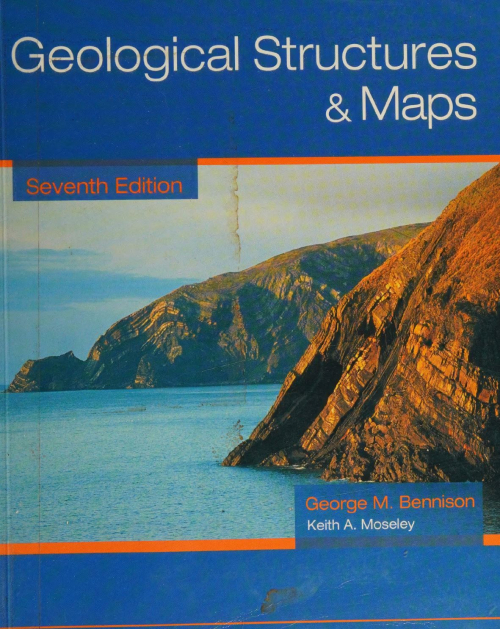
An introduction to geological structures and maps / Введение в геологическое картирование и геологические структуры

This new edition, the 7th, takes note of trends in syllabuses on geological structures and associated problem maps, particularly the move to take less account of the use of structure contours in understanding maps and solving structural problems. There are now two chapters on Map solution without structure contours, the first with simpler maps means that this topic has been introduced at an earlier stage in the book. The second introduces more difficult maps and there are, in these two chapters, three new additional maps. The use of structure contours is not diminished in this edition — the chapter explaining the construction of structure contours is retained with minor additions — as are the maps in the chapter on Economic problems which, reflecting the real world, rely heavily on structure contours for their solution. The other most obvious addition, is that of 16 photographs to illustrate geological features as they are introduced. There are a number of minor additions to the text. In respnse to many requests over the years, this edition now contains completed sections of every map (where a section was required) in addition to the two given in the 6th Edition. Solutions to the maps in Chapters 2 and 11 are also included in the appendix. I would like to express may thanks to my coauthor for his contribution, particularly his photographs, and to former colleagues for all their help in the past in providing the foundation on which this present edition is based. <...>

Автор(ы):Brooks M., Hill I., Kearey P.
Издание:Blackwell science Ltd, 2002 г., 280 стр., ISBN: 0-632-04929-4
Язык(и)Английский
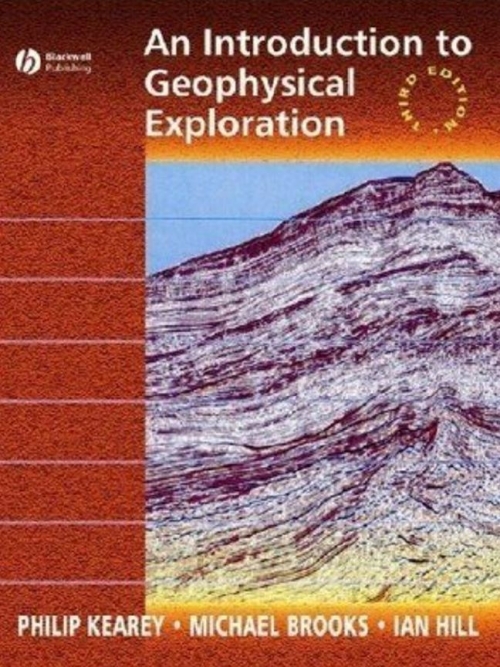
An introduction to geophysical exploration / Введение в геофизические методы исследования

This book provides a general introduction to the most important methods of geophysical exploration. These methods represent a primary tool for investigation of the subsurface and are applicable to a very wide range of problems. Although their main application is in prospecting for natural resources, the methods are also used, for example, as an aid to geological surveying, as a means of deriving information on the Earth’s internal physical properties, and in engineering or archaeological site investigations. Consequently, geophysical exploration is of importance not only to geophysicists but also to geologists, physicists, engineers and archaeologists. The book covers the physical principles, methodology, interpretational procedures and fields of application of the various survey methods.The main emphasis has been placed on seismic methods because these represent the most extensively used techniques, being routinely and widely employed by the oil industry in prospecting for hydrocarbons. Since this is an introductory text we have not attempted to be completely comprehensive in our coverage of the subject. Readers seeking further information on any of the survey methods described should refer to the more advanced texts listed at the end of each chapter. <...>

974.15