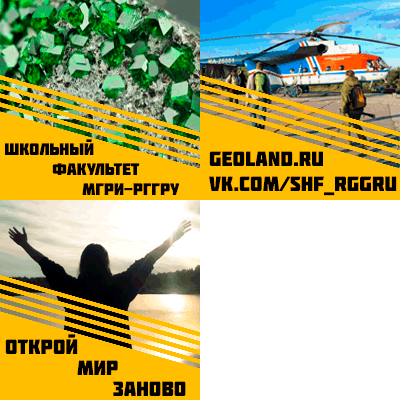
Добрый день, Коллеги. Важное сообщение, просьба принять участие. Музей Ферсмана ищет помощь для реставрационных работ в помещении. Подробности по ссылке
Planet Earth was formed roughly 4.6 billion years ago. For human beings—used to measuring time in terms of days, weeks, and months—such an enormous span of time can be a difficult concept to grasp. Geologists, scientists who study the Earth and the processes that continue to shape it, have broken up this vast expanse of “deep time” into major divisions based on what they have learned from the study of ancient rocks and fossils. The first of these divisions—from approximately 4.6 billion until 542 million years ago—is known as the Precambrian, meaning everything that happened before the Cambrian period. (Today some people prefer to call this period the Cryptozoic, which means “hidden life.”) Almost all of planet Earth’s history is Precambrian. Until recently, however, it has remained the most unknown, the strangest, and most perplexing period in all geologic
history—what some have referred to as the “Dark Ages” of Earth’s existence. <...>
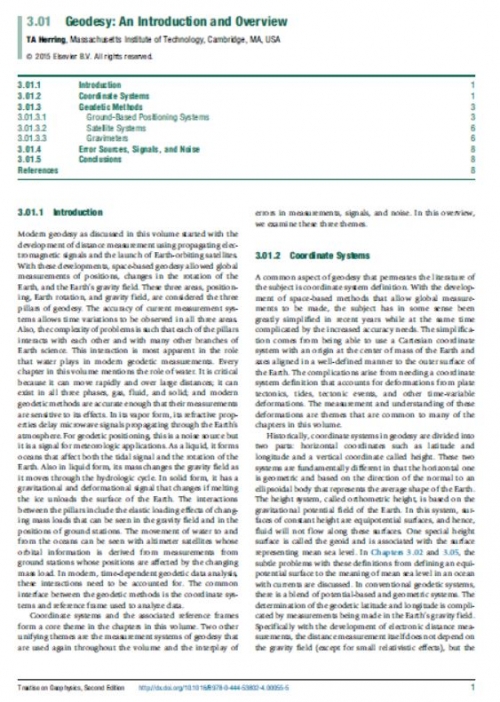
Modern geodesy as discussed in this volume started with the development of distance measurement using propagating electromagnetic signals and the launch of Earth-orbiting satellites. With these developments, space-based geodesy allowed global measurements of positions, changes in the rotation of the Earth, and the Earth’s gravity field. These three areas, positioning, Earth rotation, and gravity field, are considered the three pillars of geodesy. The accuracy of current measurement systems allows time variations to be observed in all three areas. Also, the complexity of problems is such that each of the pillars interacts with each other and with many other branches of Earth science. This interaction is most apparent in the role that water plays in modern geodetic measurements.
The basic principles of geodesy are presented in an elementary form. The formation of geodetic datums is introduced and the necessity of connecting or joining datums is discussed. Methods used to connect independent geodetic systems to a single world reference system are discussed, including the role of gravity data. The 1983 edition of this publication contains an expanded discussion of satellite and related technological applications to geodesy and an updated description of the World Geodetic System. <...>
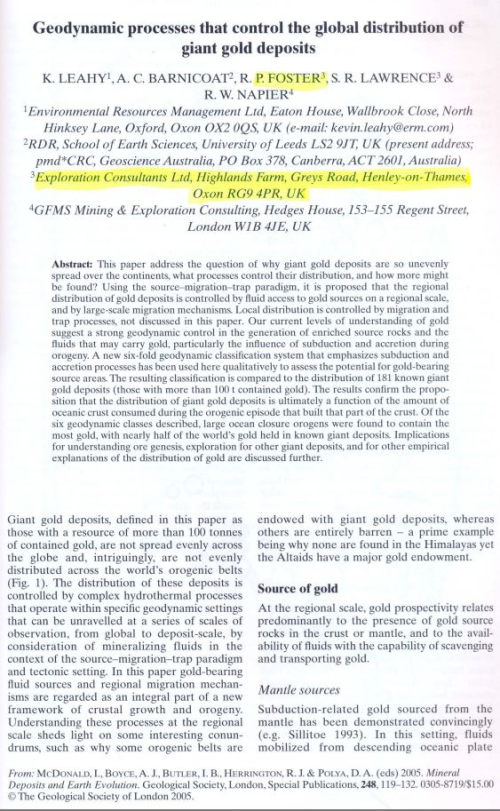
This paper address the question of why giant gold deposits are so unevenly spread over the continents, what processes control their distribution, and how more might be found? Using the source-migration-trap paradigm, it is proposed that the regional distribution of gold deposits is controlled by fluid access to gold sources on a regional scale, and by large-scale migration mechanisms.
The plate tectonic model provides a framework for understanding many geodynamic processes. Earthquakes, volcanism, and mountain building are examples. The plate velocities, 10– 100 mm yr−1, imply a fluid-like behavior of the solid Earth. Hot mantle rock can flow (behave as a fluid) on geological time scales due to solid-state creep and thermal convection. The hot mantle rock is cooled by heat loss to the Earth’s surface resulting in a cold thermal “boundary layer.” This boundary layer is rigid and is referred to as the lithosphere. The surface lithosphere is broken into a series of plates that are in relative motion with respect to each other. This motion results in “plate tectonics.”
Introduction to Geodynamics of the Indian Plate: Evolutionary Perspectives Sampat K. Tandon and Neal Gupta Evolving Early Earth: Insights from Peninsular India M. Jayananda, S. Dey, and K. R. Aadhiseshan Tracking India Within Precambrian Supercontinent Cycles Sarbani Patranabis-Deb, Dilip Saha, and M. Santosh Proterozoic Sedimentary Basins of India Partha Pratim Chakraborty, S. K. Tandon, Sagnik Basu Roy, Subhojit Saha, and Pritam P. Paul Oxygenation of Early Atmosphere and Potential Stratigraphic Records from India Joydip Mukhopadhyay
This book is a reflection of my enthusiasm for the quantitative treatment of geological problems. However, I am originally a field geologist and over the years I had to rely on the help of many who are more numerically literate than myself to teach me the wonders of quantitative geodynamics. Many of those are acknowledged in the first edition of this book. Of those who helped me with this 2nd edition, my special thanks go to S Hergarten and J Robl.
The large scale structure of the earth is caused by geodynamic processes which are explained using energetic, kinematic and dynamic descriptions. While “geodynamic processes” are understood to include a large variety of processes and the term is used quite loosely, the methods of their description involve well defined fields. Energetic descriptions are involved with distribution of energy in our planet, typically expressed in terms of heat and temperature. Kinematic descriptions describe movements using velocities, strains and strain rates. Dynamic descriptions indicate how stresses and forces behave.
This book is devoted to the theory of geoelectromagnetic oscillations and waves, i.e. waves of natural origin arising in the Earth’s crust, in the ocean, in the atmosphere, in the ionosphere, in the magnetosphere and in the interplanetary medium in front of the magnetosphere. We have sought to give a simple and clear presentation of the physical picture of the waves. When selecting the material special attention was paid to the theoretical inferences that can be easily compared with the observational data. Complicated and unwieldy calculations were omitted where possible. At the same time, where formulae have been presented without derivation, we have tried to explain their physical meaning.