Добрый день, Коллеги. Важное сообщение, просьба принять участие. Музей Ферсмана ищет помощь для реставрационных работ в помещении. Подробности по ссылке
Our dependence on the minerals that underpin modern life has grown enormously over the last few decades. Figure 1.1 shows the price, the average grade and production of copper ore has changed dramatically from 1900 to the present. At the start of last century the price was 7000 US$ per ton (expressed in 1998 currency) to negate the effects of inflation; by 2002 it had decreased three-fold to about 1800 US $ per ton, then, in the three years to 2010 it rose sharply to about 9000 US$ per ton before declining again in the latest recession. Over the same period, the total amount of copper mined gradually increased, except in the early 20s and 30s when both price and production dropped. How do we explain these changes, and what do they tell us about how the metal is found and mined, and about how it is used by society? Understanding these concepts is the basis of economic geology <...>
The EYCMP is a world-class gold and nickel mineral province that is reaching exploration maturity with a diminishing number of significant new finds. Effective mineral exploration is contingent on robust tectonic frameworks and knowledge of palaeo-tectonic settings (Goldfarb et al., 2001, 2005; Bierlein et al., 2002). The pmd*CRC Y1, Y2, Y3 and the current Y4 programs on the Eastern Yilgarn Craton (EYC) were established to drive geological research in the region with the aim of original new insights and models that will both aid and stimulate new approaches to mineral exploration in the region. <...>
This book is about metamorphic rocks: the processes involved in their formation and the reasons why they occur at particular places on the continents. It has been written to serve as an elementary text on the subjects of metamorphism and mountain building for non-specialist students of geology. It will be equally useful where geology is either the main or subsidiary subject and could be used by students intending to advance further in geology (the list of advanced texts in the further reading section would be more appropriate to such students). My intention in writing this book has been to try to dispel the notion that metamorphism comprises the 'haunted wing' of geology. Admittedly, there are rather a large number of technical terms in the book, but I hope that after working through it you will not find metamorphism an unduly difficult or obscure aspect of geology. Throughout, I have emphasised the strong links between mountain building, plate tectonics and metamorphic processes
METAMORPHISM is the mineralogical and structural (textural) adjustment of (dominantly) solid rocks to physical and chemical conditions which differ from those under which the rocks originated. Weathering and similar processes are conventionally excluded. The type of metamorphism depends on the relative values of temperature ( T ) , confining pressure (/*con)> pressure or chemical activity or fugacity of water (expressed generally as PHJO)* deformation or directed pressures (P^ir) and their variation with time {t). There is only a limited degree of interdependence of these controls and the metamorphic history of a rock is an expression of their mutual interaction with time (Fyfe, Turner and Verhoogen, 1958; Pitcher and Flinn, 1965). <...>
The book “Metasomatic Texture in Granites” is an atlas, in which the authors stress on the exposition of metasomatic textures and their formation mechanisms than other atlases both at home and abroad. In the book the metasomatism of various minerals, including albite, K-feldspar, muscovite, biotite, quartz, beryl, calcite, apatite, etc., is systematically discussed with clear, colored, microscopic pictures and explanations. <...>
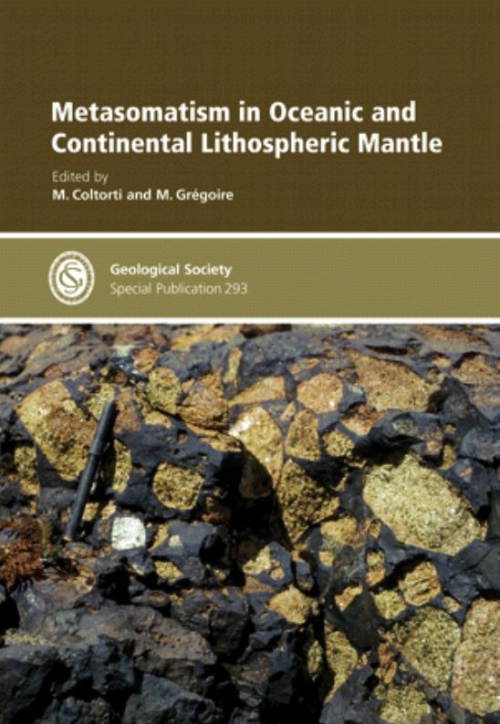
In the foreword of the volume Mantle Metasomatism by Menzies & Hawkesworth (1987), Boettcher stated that the concept of mantle metasomatism has been of immense heuristic value for Earth scientists. At that time, metasomatism was still strongly related to allochemical metamorphism, where chemical composition of the rock is changed by the additional or removal of material.
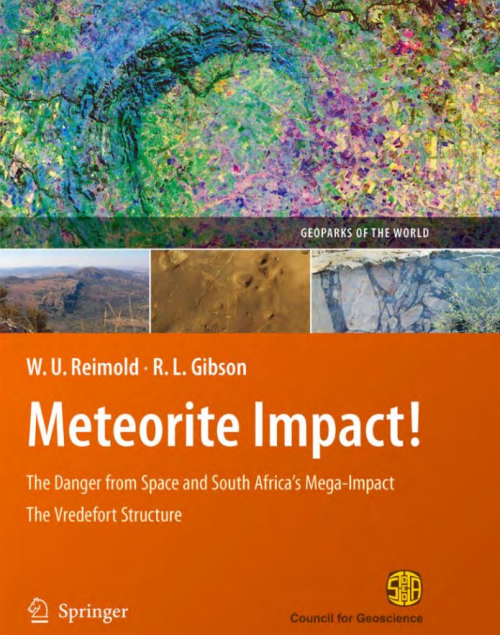
Two thousand million years (Ma) ago a mountain-sized bolide from Space, travelling at tens of thousands of kilometres per hour, slammed into the Earth at a position approximately 120 km southwest of the present-day city of Johannesburg, in the vicinity of the present towns of Vredefort and Parys. Within moments, it had blown a hole tens of kilometres deep and more than 100 km wide into the crust of the Earth. Th e force of the impact hurled countless millions of tonnes of rock, some of it heated to temperatures of thousands of degrees centigrade (°C), around the crater over an area extending for hundreds of kilometres from the impact site (Fig. 3a).
In this book, the authors present current research in the study of the classification, geology and exploration of asteroids and meteorites. Topics discussed include meteorites and their asteroidal parent bodies; the diversion and exploitation of ice-rich NEOs using the solar collector; radar characteristics of asteroid 33342 (1998 WT24); asteroid dimensions and the truncated pareto distribution; Hilda asteroids in the Jupiter neighborhood; and asteroid Apophis and 1950 DA.
GRADY, M. M., HUTCHISON, R., MCCALL, G. J. H. & ROTHERY, D. A. Meteorites: their flux with time and impact effects
SHOEMAKER, E. M. Long-term variations in the impact cratering record on Earth The flux of extraterrestrial material to the Earth: determination by astronomical and statistical techniques
BAILEY, M. E. & EMEL'YANENKO, V. V. Cometary capture and the nature of the impactors NAr'IER, W. M. Galactic periodicity and the geological record
HUGHES, D. W. The mass distribution of crater producing bodies The flux of meteorites to the Earth: determinations by terrestrial techniques