Добрый день, Коллеги. Важное сообщение, просьба принять участие. Музей Ферсмана ищет помощь для реставрационных работ в помещении. Подробности по ссылке
Landforms and landscapes vary enormously across the Earth, from high mountains to endless plains. At a smaller scale, nature often surprises us creating shapes which look improbable. Many physical landscapes are so immensely beautiful that they received the highest possible recognition—they hold the status of World Heritage properties. Apart from often being immensely scenic, landscapes tell stories that not uncommonly can be traced back in time for tens of millions of years and include unique events. In addition, many landscapes owe their appearance and harmony not solely to the natural forces. For centuries, and even millennia, they have been shaped by humans who have modified hillslopes, river courses, and coastlines, and erected structures which often blend with the natural landforms to form inseparable entities. These landscapes are studied by geomorphology—‘the science of scenery’—a part of Earth Sciences that focuses on landforms, their assemblages, surface, and subsurface processes that molded them in the past and that change them today. To show the importance of geomorphology in understanding the landscape, and to present the beauty and diversity of the geomorphological sceneries across the world, we have launched a book series World Geomorphological Landscapes. It aims to be a scientific library of monographs that present and explain physical landscapes, focusing on both representative and uniquely spectacular examples. Each book will contain details on geomorphology of a particular country or a geographically coherent region. This volume presents the geomorphology of Brazil, a big country with a multitude of spectacular landscapes, from the very well known—such as the steep-sided domes of Rio de Janeiro, Iguazu Falls, or majestic rivers of the Amazonian Lowland—to many hidden gems scattered across the Brazilian Shield. For such a vast and varied territory to make a selection of case studies must have been an arduous task, so inevitably they present only a small fraction of what Brazil has to offer in terms of geomorphological sceneries to enjoy. To discover and learn more, go to Brazil! This would be an unforgettable geomorphological experience. The World Geomorphological Landscapes series is produced under the scientific patronage of the International Association of Geomorphologists (IAG)—a society that brings together geomorphologists from all over the world. The IAG was established in 1989 and is an independent scientific association affiliated with the International Geographical Union (IGU) and the International Union of Geological Sciences (IUGS). Among its main aims are to promote geomorphology and to foster dissemination of geomorphological knowledge. I believe that this lavishly illustrated series, which sticks to the scientific rigor, is the most appropriate means to fulfill these aims and to serve the geoscientific community. To this end, my great thanks go to the editors of this volume—Prof. Bianca Carvalho Vieira as the senior editor, and Profs. André Augusto Rodrigues Salgado and Leonardo José Cordeiro Santos as co-editors. <...>
Landforms and landscapes vary enormously across the Earth, from high mountains to endless plains. At a smaller scale, Nature often surprises us by creating shapes which look improbable. Many physical landscapes are so immensely beautiful that they have received the highest possible recognition—they hold the status of World Heritage properties. Apart from often being immensely scenic, landscapes tell stories which not uncommonly can be traced back in time for tens of million years and include unique events.
1 Introduction to the Landscapes and Landforms of Italy Mauro Soldati and Mauro Marchetti Part I Physical Environment 2 The Great Diversity of Italian Landscapes and Landforms: Their Origin and Human Imprint Mauro Marchetti, Mauro Soldati, and Vittoria Vandelli 3 Outline of the Geology of Italy Alfonso Bosellini 4 The Climate of Italy Simona Fratianni and Fiorella Acquaotta 5 Morphological Regions of Italy Paola Fredi and Elvidio Lupia Palmieri Part II Landscapes and Landforms
Landscapes and Landforms of Portugal volume presents, for the first time, a series of synthesis chapters on landscape highlights of mainland Portugal, covering a wide diversity of geomorphological settings. These are presented with language and graphic styles that try to bridge-the-gap from professional scientists to undergraduate students, while being also accessible to all those interested in the earth sciences, to help for a better understanding of landscape evolution and specific features of the Portuguese landforms.
The landscapes and landforms of Scotland are renowned for their outstanding geodiversity, the outcome of a long and complex geological evolution, Cenozoic uplift and etchplanation, and modification by glacial and interglacial processes during the Quaternary.
The variety of Swiss landscapes is due to the combination of varied structural and climatic contexts and a rich geological heritage. The book is divided in three mainsections. The first section presents the physical context and details the variety of Swiss geomorphological landscapes. The second section proposes 23 examples of Swiss landscapes, in three main subsections: eight examples of structural landscapes; nine cases of glacial, periglacial and high mountain landscapes; and six examples of river landscapes and landscapes related to gravity-driven processes. The last section deals with geoheritage, geoparks and geotourism. <...>
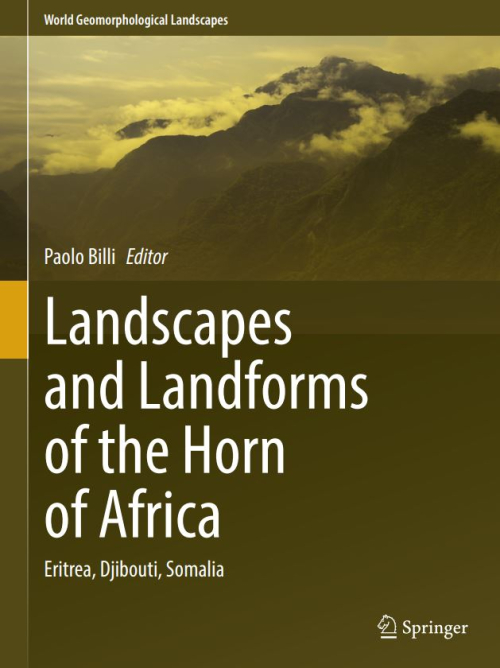
Climate Variability in the Horn of Africa Eastern Countries: Eritrea, Djibouti, Somalia Paolo Billi Geology and Geomorphological Landscapes of Eritrea Ernesto Abbate and Paolo Billi Geomorphology of Afar Jacques Varet Geomorphology of Eritrean River Systems Paolo Billi Pleistocene Landscape Variability Recorded in the Homo-Bearing Dandiero Basin (Eritrea) Massimiliano Ghinassi, Mauro Papini, Lorenzo Rook, Oriol Oms, and Federico Sani Landscape and Landforms of the Samoti Plain, Eritrean Danakil
Consideration of the nature and occurrence of landslide hazards leads to perspectives on the dominant role of landsliding in the geomorphology of active orogens, and consequently the major role that landsliding plays in determining hazard- and riskscapes both within and downstream of these areas. Discussion of landslide risks suggests that probabilistic analyses are only likely to be reliable in planning location-specific landslide risk management strategies for small, frequent events, and the potential for identifying sites of future landslidesdboth rainfall generated and coseismicdis examined. Finally the role of landslides in triggering consequential hazards, such as tsunami, river flooding, and debris flows, is emphasized. <...>
The “Landslides and Reservoirs” session of the Second World Landslide Forum was aimed to discuss various aspects of reservoirs banks stability assessment and to specify information required by geotechnical and hydraulic engineers to stabilize hazardous slopes and to minimize risk of hydraulic projects related to slopes instability. 13 oral presentations and 15 posters were presented by researchers from 15 countries – Austria, Belgium, Canada, China, Czech Republic, Italy, Japan, Kyrgyzstan, New Zealand, Norway, Peru, Romania, Russia, Sri Lanka, and Tajikistan. <...>
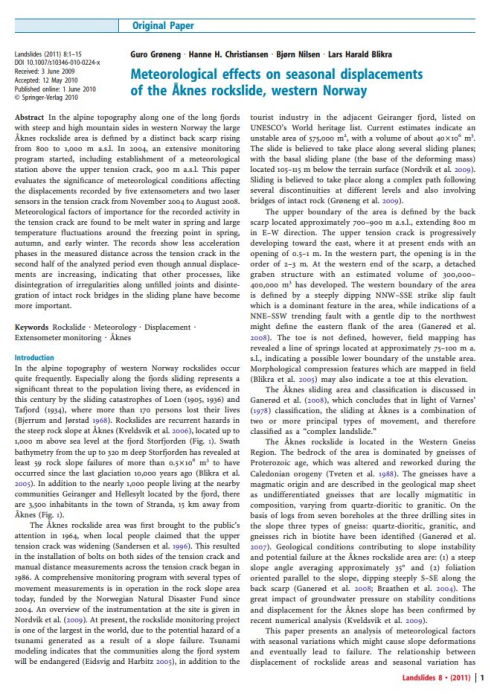
Meteorological effects on seasonal displacements of the Åknes rockslide, western Norway Geotechnical characterization of a landslide in a Blue Clay slope Rock avalanches and other landslides in the central Southern Alps of New Zealand: a regional study considering possible climate change impacts Mechanism on apparent dip sliding of oblique inclined bedding rockslide at Jiweishan, Chongqing, China FLaIR and SUSHI: two mathematical models for early warning of landslides induced by rainfall Real-time slope water table forecasting by multi-tank model combined with dual ensemble Kalman filter Emergency response to the Tangjiashan landslide-dammed lake resulting from the 2008 Wenchuan Earthquake, China Massive landslide triggered by 2008 Iwate–Miyagi inland earthquake in the Aratozawa Dam area, Tohoku, Japan