Добрый день, Коллеги. Важное сообщение, просьба принять участие. Музей Ферсмана ищет помощь для реставрационных работ в помещении. Подробности по ссылке
At a time of surplus of nearly all metals and the inevitable closing of many mining operations, it is a matter of the industry's survival to seek new commodities that are in high demand. The lanthanides, better known as the rare-earth elements (REE), tantalum (Ta) and niobium (Nb) are among the promising alternatives. Bibliographies of the metallogeny and related aspects of these elements are surprisingly short, despite their rapidly increasing importance in modern technology. A need to review and condense the available expertise has been ernerging in the recent past <...>
The study of seismic wave propagation, especially of the P (longitudinal) waves, has enabled us to distinguish two components in the shallower part of the earth:
- The crust (thickness varying from 10 to 70 km, average 30 Ian);
- The underlying mantle, separated from the crust by a surface of discontinuity at which the seismic-wave velocities change suddenly (the Mohorovicic discontinuity, generally shortened to Moho).
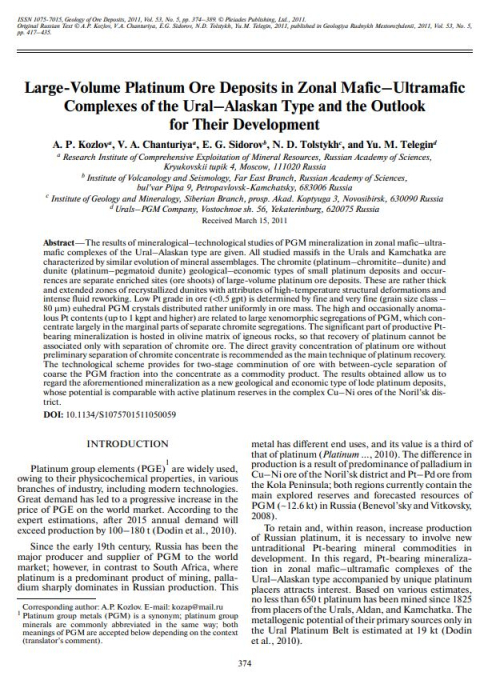
The results of mineralogical–technological studies of PGM mineralization in zonal mafic–ultra mafic complexes of the Ural–Alaskan type are given. All studied massifs in the Urals and Kamchatka are characterized by similar evolution of mineral assemblages. The chromite (platinum–chromitite–dunite) and dunite (platinum–pegmatoid dunite) geological–economic types of small platinum deposits and occur rences are separate enriched sites (ore shoots) of largevolume platinum ore deposits. These are rather thick and extended zones of recrystallized dunites with attributes of hightemperature structural deformations and intense fluid reworking.
Inductively coupled plasma mass spectrometry (ICP‐MS) is undoubtedly the fastest‐growing trace element technique available today. Since its commercialization in 1983, approximately 5000 systems have been installed worldwide, carrying out many varied and diverse applications. The most common ones, which represent approximately 80% of the ICP‐MS analyses being carried out today, include environmental, geological, semiconductor, biomedical, and nuclear application fields.
Since the University of Oulu bought last year a LA-ICP-MS to expand their ways of research concerning corrosion and agglomeration problems in fluidized bed boilers. The objective of this thesis was to give a review about LA-ICP-MS, what are its capabilities, how to calibrate, what are the start up procedures and what kind of measurements can we make? The thesis will discus every step of the LA-ICP-MS; ablation, ionisation and detection applied on the LA-ICP-MS of the University of Oulu. After the literature part we try to improve our measurement strategies with the LAICP-MS, in order to get better results out of it. I would like to thank the University of Oulu for giving me the opportunity to write my thesis here. While writing my thesis I had a lot of help from Risto Laitinen, Minna Tiainen, Harri Kola, Heikki Ollila, Mirja Piispanen and Susanna Arvilommi, I would like to thank them for that. Thanks go also to Andoni Michelena and Bert De Smet for reading my thesis through. Finally I would like to thank my parents for their financial and mental support. <...>
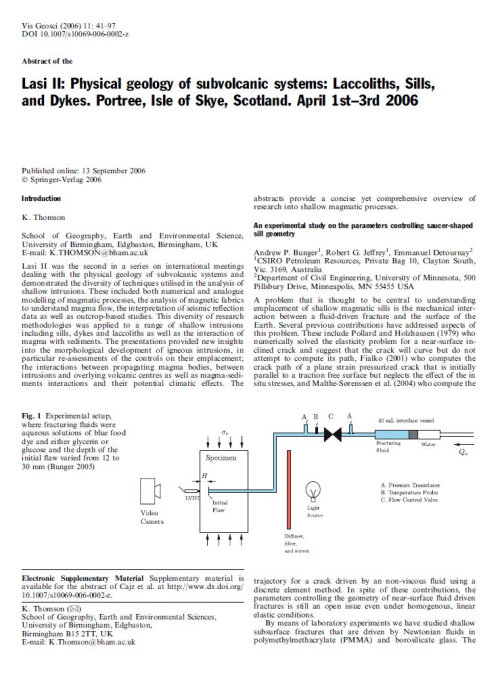
Lasi II was the second in a series on international meetings dealing with the physical geology of subvolcanic systems and demonstrated the diversity of techniques utilised in the analysis of shallow intrusions. These included both numerical and analogue modelling of magmatic processes, the analysis of magnetic fabrics to understand magma flow, the interpretation of seismic reflection data as well as outcrop-based studies. This diversity of research methodologies was applied to a range of shallow intrusions including sills, dykes and laccoliths as well as the interaction of magma with sediments. The presentations provided new insights into the morphological development of igneous intrusions, in particular re-assessments of the controls on their emplacement; the interactions between propagating magma bodies, between intrusions and overlying volcanic centres as well as magma-sediments interactions and their potential climatic effects. <...>
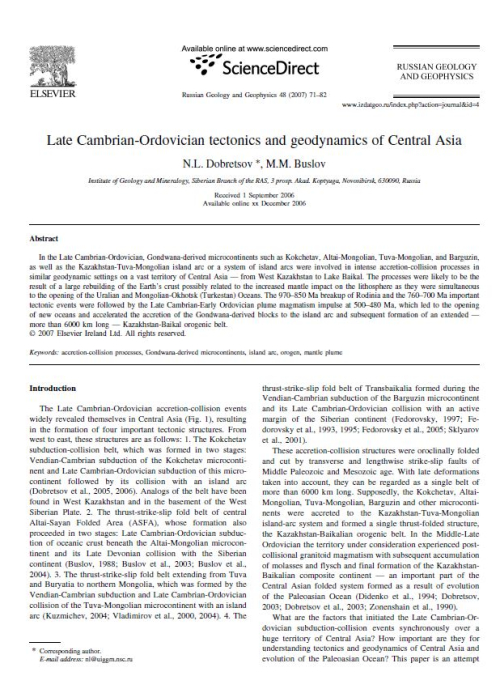
In the Late Cambrian-Ordovician, Gondwana-derived microcontinents such as Kokchetav, Altai-Mongolian, Tuva-Mongolian, and Barguzin, as well as the Kazakhstan-Tuva-Mongolian island arc or a system of island arcs were involved in intense accretion-collision processes in similar geodynamic settings on a vast territory of Central Asia — from West Kazakhstan to Lake Baikal. The processes were likely to be the result of a large rebuilding of the Earth’s crust possibly related to the increased mantle impact on the lithosphere as they were simultaneous to the opening of the Uralian and Mongolian-Okhotsk (Turkestan) Oceans. The 970–850 Ma breakup of Rodinia and the 760–700 Ma important tectonic events were followed by the Late Cambrian-Early Ordovician plume magmatism impulse at 500–480 Ma, which led to the opening of new oceans and accelerated the accretion of the Gondwana-derived blocks to the island arc and subsequent formation of an extended — more than 6000 km long — Kazakhstan-Baikal orogenic belt.
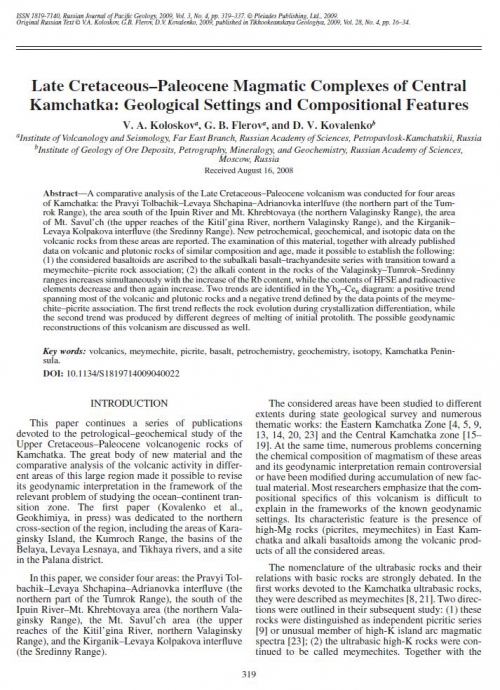
A comparative analysis of the Late Cretaceous–Paleocene volcanism was conducted for four areas of Kamchatka: the Pravyi Tolbachik–Levaya Shchapina–Adrianovka interlfuve (the northern part of the Tum-rok Range), the area south of the Ipuin River and Mt. Khrebtovaya (the northern Valaginsky Range), the area of Mt. Savul’ch (the upper reaches of the Kitil’gina River, northern Valaginsky Range), and the Kirganik– Levaya Kolpakova interfluve (the Sredinny Range). New petrochemical, geochemical, and isotopic data on the volcanic rocks from these areas are reported. The examination of this material, together with already published data on volcanic and plutonic rocks of similar composition and age, made it possible to establish the following: (1) the considered basaltoids are ascribed to the subalkali basalt–trachyandesite series with transition toward a meymechite–picrite rock association; (2) the alkali content in the rocks of the Valaginsky–Tumrok–Sredinny ranges increases simultaneously with the increase of the Rb content, while the contents of HFSE and radioactive elements decrease and then again increase. Two trends are identified in the Ybn–Cen diagram: a positive trend spanning most of the volcanic and plutonic rocks and a negative trend defined by the data points of the meyme-chite–picrite association. The first trend reflects the rock evolution during crystallization differentiation, while the second trend was produced by different degrees of melting of initial protolith. The possible geodynamic reconstructions of this volcanism are discussed as well
The Fossil Bluff Group of eastern Alexander Island was deposited in the fore-arc basin of an active magmatic arc, which formed the present-day Antarctic Peninsula. Cephalopods are common throughout the group. Ammonites and belemnites of several localities within the northern half of the outcrop are described, and previously described cephalopods are revised. Nine genera and seventeen species of ammonites (of which Raimondiceras alexandrensis and Blanfordiceras weaveri are new), and two genera and sixteen species of belemnites (including two new subgenera: Belemnopsis {Parabelemnopsis) and B. (Telobelemnopsis), and four new species: B. {Belemnopsis) launceloti, B. (T.) rymilli, B. (T.) bertrami and B. (T.) stephensoni) are described. This detailed study of the cephalopods indicates that the Fossil Bluff Group ranges in age from Kimmeridgian (late Jurassic) to at least Aptian (early Cretaceous), and enables seven ammonite biozones and three belemnite biozones (including two sub-biozones) to be erected within the group. By comparing this new biozonation with other Southern Hemisphere schemes, the positions of the stage boundaries within the succession can be recognized.