Добрый день, Коллеги. Важное сообщение, просьба принять участие. Музей Ферсмана ищет помощь для реставрационных работ в помещении. Подробности по ссылке
In history, before miners had access to productive equipment and blasting agents, mining was hard and hazardous manual work. The idea of excavating large volumes of rock to access even the richest mineral zones was not feasible, and, as a result, ore veins were selectively followed, predominantly close to the surface, or inside mountains. During the past century, introduction of diesel power and electricity, combined with new methods of mineral dressing, paved the way for large scale open pit mining, and later for mechanized underground mining. Nevertheless, the largest quantities of ore are still excavated from surface deposits. Atlas Copco, as an equipment supplier with a truly global presence, has been at the forefront of technical and innovative development. From pneumatic to hydraulic power, from railbound to trackless haulage, from handheld to rig mounted rock drills, and lately, from manual to computerized operation, Atlas Copco expertise is making mining safer and more efficient. <...>
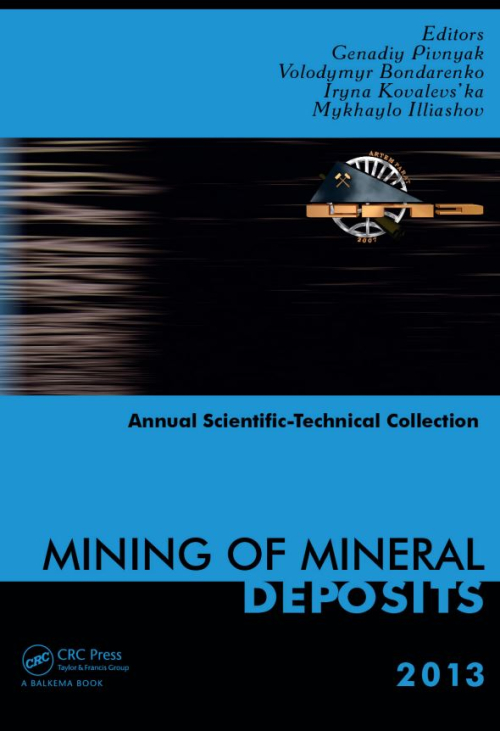
New-generation technique and technology for leakage tests А. Bulat, O. Voloshyn, S. Ponomarenko & D. Gubenko
Optimal parameters of wall bolts computation in the united bearing system of extraction workings frame-bolt support V. Bondarenko, I. Kovalevs’ka, R. Svystun & Yu.
Cherednichenko Pillars sizing at magnetite quartzites room-work N. Stupnik, V. Kalinichenko & S. Pismennyi
The calculation scheme of mathematical modeling of displacement process of a terrestrial surface by working out of coal layers M. Antoshchenko, L. Chepurnaya & M. Filatyev
Changes of overburden stresses in time and their manifestations in seismic wave indices A. Antsyferov, A. Trifonov, V. Tumanov & L. Ivanov
Specifics of percarbonic rock mass displacement in longwalls end areas and extraction workings I. Kovalevs’ka, V. Vivcharenko & V. Snigur
Engineers in the mining industry often must solve problems while in the field at prospects, projects, or places far from any personal bookshelf, company office, or public or private library. And it isn’t always feasible to bring along the voluminous authoritative books on mining topics so familiar to the profession. This handbook, then, is designed to fill the technical reference gap for the mobile professional who is away from the normal workplace with its comprehensive store of technical information and resources. It is a distillation of key technical information from the mining literature.
This text seeks to demonstrate how mining companies that adopt the ISO management standards could, at the same time, integrate them into the tailings management model represented by the Tailings Guide by Mining Association of Canada and demonstrate adherence to the Global Standard developed by the Global Tailings Review, while adopting the quality management approach advocated by the authors, aimed at the design and construction of tailings dams. <...>
The study of carbon ate- si lie tclastic mixed sequences has seen an increase in the number of investigations that focus on mixed settings as pan of the continuum between the carbonate and clastic end members. The level of interest in such mixed sequences has been reflected in recent years by sessions at national meetings that dealt specifically with the topic, and also by recent publications
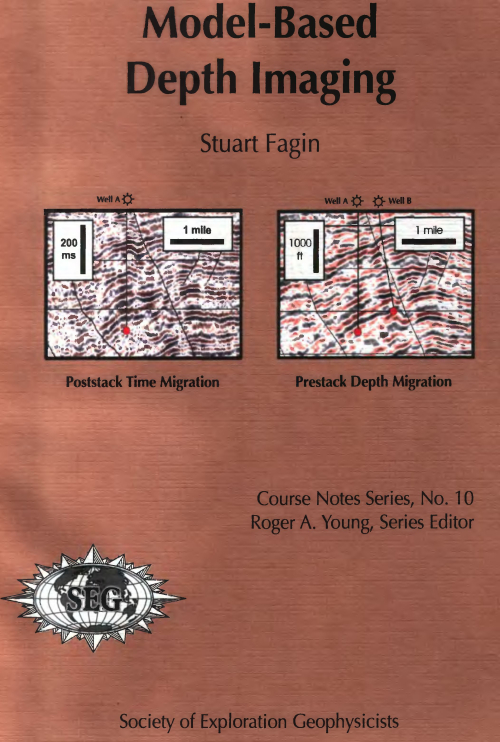
Depth imaging is changing the face of seismic technology. First and foremost, depth imaging greatly extends our ability to image geologic structure. This is true not only for highly complex structures such as thrust imbricates and subsalt structures, but also for subtle structural plays like fault shadows. In fact, since the late 1980’s, almost all structural play exploration has been stalled at the frontier where time imaging is no longer effective. In the 1990’s depth imaging has taken us through this frontier and is renewing many of these structural plays.
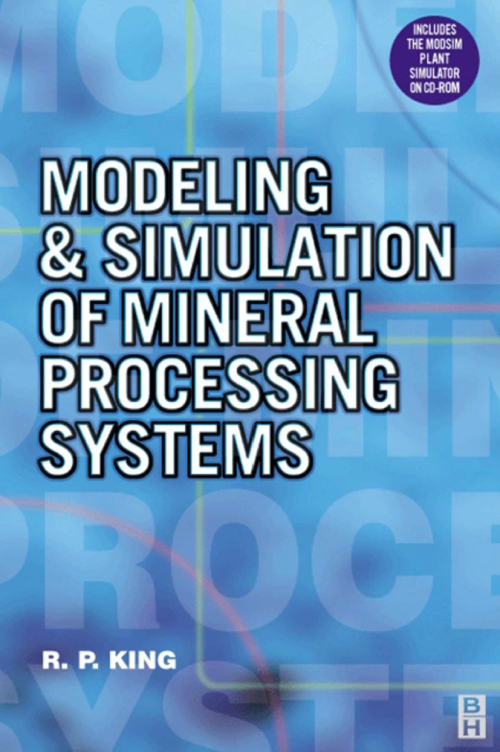
Quantitative modeling techniques and methods are central to the study and development of process engineering, and mineral processing is no exception. Models in mineral processing have been difficult to develop because of the complexity of the unit operations that are used in virtually all mineral recovery systems. Chief among these difficulties is the fact that the feed material is invariably a particulate solid. Many of the conventional mathematical modeling techniques that are commonly used for process equipment have limited application to particulate systems and models for most unit operations in mineral processing have unique features. Common ground is quite difficult to find. The one obvious exception is the population balance technique and this forms a central thread that runs throughout the modeling techniques that are described in this book. The models that are described are certainly incomplete in many respects, and these will be developed and refined by many researchers during the years ahead. Nevertheless, the models are useful for practical quantitative work and many have been widely used to assist in the design of new equipment and processes. Some of the newer models have not yet been seriously tested in the industrial environment <...>
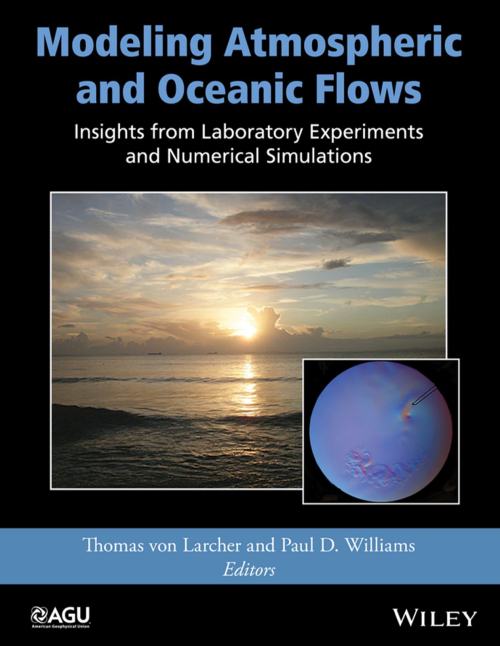
Introduction: Simulations of Natural Flows in the Laboratory and on a Computer Paul F. Linden
Section I: Baroclinic-Driven Flows
1 General Circulation of Planetary Atmospheres: Insights from Rotating Annulus and Related Experiments Peter L. Read, Edgar P. Pérez, Irene M. Moroz, and Roland M. B. Young
2 Primary Flow Transitions in the Baroclinic Annulus: Prandtl Number Effects Gregory M. Lewis, Nicolas Périnet, and Lennaert van Veen
3 Amplitude Vacillation in Baroclinic Flows Wolf-Gerrit Früh
Molecular dynamics is recognized as a powerful method in modern computational physics. This method is essentially based on a factual observation: the apparent strong complexity and extreme variety of natural phenomena are not due to the intrinsic complexity of the physical laws but due to the very large number of basic elements in interaction through, in fact, simple laws. This is particularly true for granular materials in which a single intergranular friction coefficient between rigid grains is enough to simulate, at a macroscopic scale, the very intricate behavior of sand with a Mohr–Coulomb plasticity criterion, a dilatant behavior under shearing, non-associate plastic strains, etc. and, in fine, an incrementally nonlinear constitutive relation. Passing in a natural way from the grain scale to the sample scale, the discrete element method (DEM) is able to precisely bridge the gap between micro and macro-scales in a very realistic way, as it is today verified in many mechanics labs. <...>