Добрый день, Коллеги. Важное сообщение, просьба принять участие. Музей Ферсмана ищет помощь для реставрационных работ в помещении. Подробности по ссылке

Поиск по книгам
Автор(ы):Attendorn H.-G., Bowen R.N.C.
Издание:Chapman & Hall, 1997 г., 522 стр., ISBN: 0-412-75280-8
Язык(и)Английский
Radioactive and stable isotope geology / Геология радиоактивных и стабильных изотопов

Isotopic (nuclear) geology constitutes an exact, quantitative branch of the Earth sciences which has expanded rapidly to cover a wide spectrum of applications since the establishment of its basic principles by the early 1950s, in part following seminal researches by H. C. Urey, H. A. Lowenstam, S. Epstein, T. Mayeda and numerous others. This immense progress, accelerating in recent years, led to the application of isotopes in attempting to resolve a variety of geochemical and geological problems in the Earth sciences. Lunar exploration too provided rocks for analysis and their examination stimulated refinements in mass spectrometry later used for terrestrial materials as well. New geochronometric methods were devised and include those based on the radioactive decay of l47Sm to l4:tNd, l76Lu to l7f,Hf, l87Re to ,87Os and 4llK to 4(1Ca, as well as others depending upon the production and distribution of cosmogenic radionuclides such as 2(,A1, l0Be and 36C1.


Автор(ы):Bowen R.N.C.
Издание:Plenum press, 1998 г., 47 стр.
Язык(и)Английский
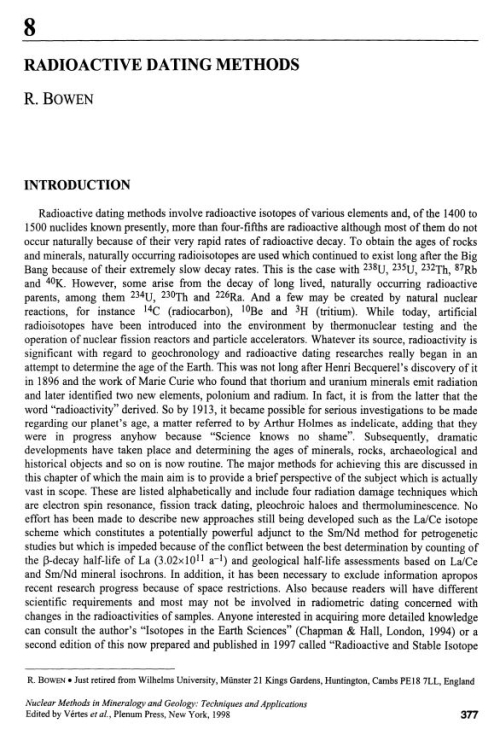
Radioactive dating methods / Радиоактивные методы датирования

Radioactive dating methods involve radioactive isotopes of various elements and, of the 1400 to 1500 nuclides known presently, more than four-fifths are radioactive although most of them do not occur naturally because of their very rapid rates of radioactive decay. To obtain the ages of rocks and minerals, naturally occurring radioisotopes are used which continued to exist long after the Big Bang because of their extremely slow decay rates. This is the case with 238U, 235U, 232Th, 87Rb and 40K. However, some arise from the decay of long lived, naturally occurring radioactive parents, among them 234U, 230Th and 226Ra. And a few may be created by natural nuclear reactions, for instance 14C (radiocarbon),

Автор(ы):Shields G., Stille P.
Издание:Springer, 1997 г., 224 стр., ISBN: 3-540-63177-1
Язык(и)Английский
Radiogenic isotope geochemistry of sedimentary and aquatic systems / Геохимия радиоактивных изотопов осадочных и водных систем

This book is based on the script of a lecture course in isotope geochemistry, which is given at the University of Strasbourg, France and at the Eidgen6ssische Tech nische Hochschule (ETH), Zurich, Switzerland by Peter Stille. It is intended to be read by geologists, hydrologists, geochemists and any researchers and students from the broad fieldof environmental science. Its purpose is to enable readers to venture safely into the often mirky realms of radiogenic isotope geochemistry' applied to sedimentary and aquatic systems. The authors have strived to construct the book in such a way that it can be read and understood by those readers, especially students, who have no background in geochemistry. 7 chapters.take the reader through the rock cycle from weathering on the continent to eventual deposition in the sea, looked at largely from the perspective of radiogenic isotope geochemistry. <...>

Издание 2
Автор(ы):Dickin A.P.
Издание:Cambridge University Press, 2005 г., 508 стр., ISBN: 978-0-511-11544-8
Язык(и)Английский
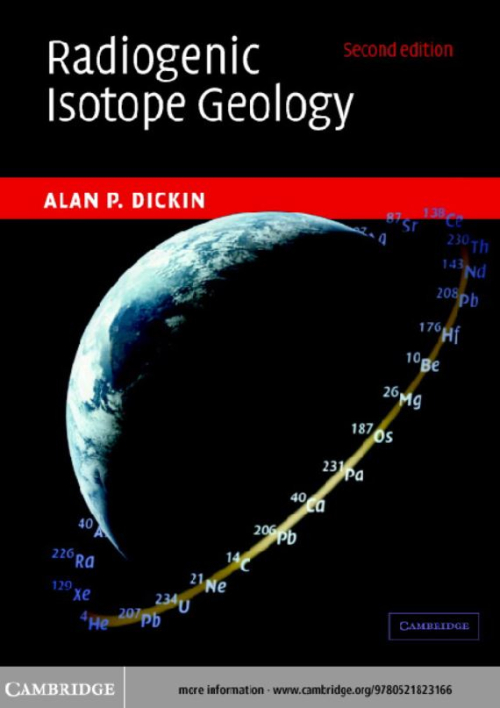
Radiogenic isotope geology / Радиогенная изотопная геология

Modern isotope geochemistry is a rapidly expanding field that has a part to play in a broad range of Earth and planetary sciences – from extra-solar-system processes to environmental geoscience. This new edition of a popular textbook is completely updated and places more emphasis on the uses of radiogenic isotopes in environmental Earth science.

Издание:Springer, 2010 г., 311 стр., ISBN: 978-90-481-2998-0
Язык(и)Английский
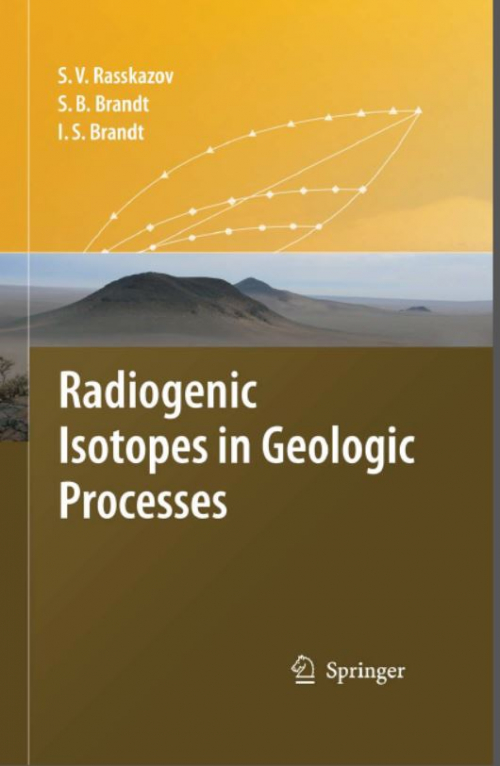
Radiogenic isotopes in geologic processes / Радиогенные изотопы в геологических процессах

Do we actually understand geologic processes? New technology brings new information and perceptions, which sometimes overturn imaginations based on simple observation and estimation, in conjunction with common sense inference. In 1902– 1904, Pierre Curie and Ernest Rutherford first formulated the idea of using radioactive transformation of nuclides as a geologic chronometer. After a century of working with such tools, geology has advanced from a descriptive science to an analytic science that formulates conclusions based on exact values. The technology of radiogenic isotope geology has created a branch of science that considers the Earth as a planet generated within a Solar system and studies the subsequent evolution of geologic processes that has resulted in the present formation of our planet’s continents and oceans.<...>

Редактор(ы):Corset J., Turrell G.
Издание:Elsevier, 1996 г., 470 стр., ISBN: 978-0-12-189690-4
Язык(и)Английский
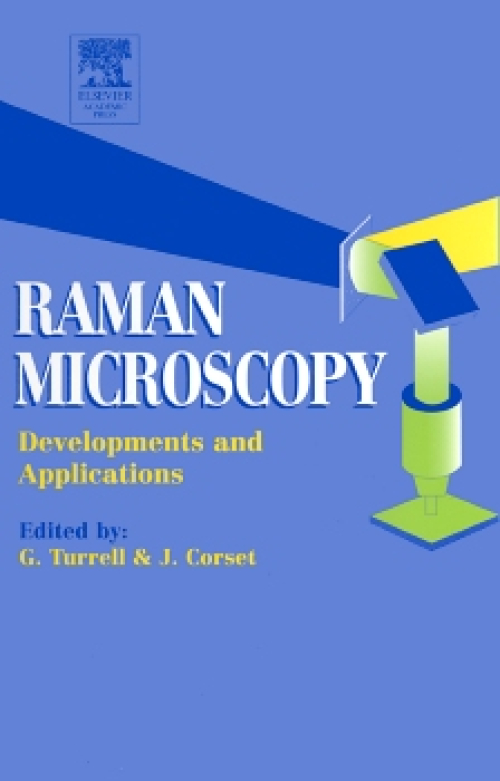
Raman microscopy / Рамановская микроскопия

It is no surprise to see the micro-Raman Group at Lille come forth with this timely publication to document the present state of Raman microscopy. A quarter century has passed since the early attempts at Raman microsampling when the field began to merge with, and complement, other microprobe techniques. In the late 1960s to the early '70s, it was mainly the electron beam methods that opened up the microscopic domain to instrumental analysis, aside from classical light microscopy. In this realm, the principal goal was to obtain morphological, structural, and compositional information from the analyzed specimen.

Редактор(ы):Rull F., Caumon M.-C., Dubessy I.
Издание:The Mieralogical Society of Great Britain and Ireland, London, 2012 г., 504 стр., ISBN: 978-0-903056-31-1
Язык(и)Английский
Raman Spectroscopy applied to the Eath Sciences and Cultural Heritage

In Earth Sciences and Cultural Heritage Science we can only understand the formation of the 'objects' if they are well characterized. Optical observation, including optical microscopy, is still the primary tool and is essential in obtaining a preliminary, qualitative determination of an object, to determine the relations between it and other objects, and to place it in a general context. Most of the time, however, optical observations are insufficient. Spectroscopic methods are the second "set of eyes" used to gain greater insight into these objects and to use physical chemistry, if applicable, to derive the mechanisms of formation. Spectroscopic methods are numerous and have been described in a previous volume (6) in the EMU Notes in Mineralogy series, edited by A. Beran & E. Libowitzky (2004).

Источник:Geo.web.ru
Автор(ы):McCreery R.L.
Издание:Wiley, 2000 г., 436 стр., ISBN: 0-471-25287-5
Язык(и)Английский
Raman spectroscopy for chemical analysis / Рамановская спектроскопия для геохимического анализа

This book was inspired by the transition of Raman spectroscopy from a technically demanding research technique to a useful and practical method of chemical analysis. There are many fine texts and thousands of scientific articles on research in Raman spectroscopy, primarily oriented toward understanding the Raman effect itself and using Raman scattering to probe molecular structure and dynamics.

Издание:2016 г., 32 стр.
Язык(и)Английский
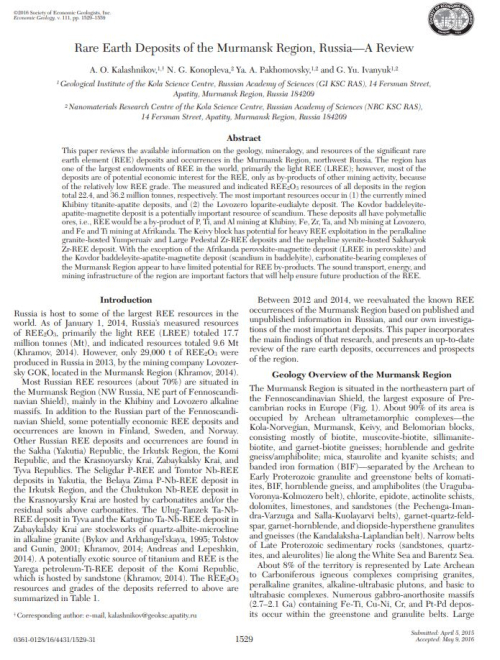
Rare earth deposits of the Murmansk Region, Russia—A review / Месторождения редкоземельных металлов Мурманской области, Россия. Обзор

This paper reviews the available information on the geology, mineralogy, and resources of the significant rare earth element (REE) deposits and occurrences in the Murmansk Region, northwest Russia. The region has one of the largest endowments of REE in the world, primarily the light REE (LREE); however, most of the deposits are of potential economic interest for the REE, only as by-products of other mining activity, because of the relatively low REE grade.

Редактор(ы):Henderson P.
Издание:Elsevier, 1984 г., 292 стр., ISBN: 7-116-00408-4
Язык(и)Китайский
Rare Earth element geochemistry / Геохимия редкоземельных элементов

The rare earth elements, lanthanum to lutetium (atomic numbers 57—71), are members of Group IIIA in the periodic table (Fig. 1.1) and all have very similar chemical and physical properties. This uniformity arises from the nature of their electronic configurations, leading to a particularly stable 3+ oxidation state and a small but steady decrease in ionic radius with increase in atomic number for a given co-ordination number. Despite the similarity in their chemical behaviour, these elements can be partially fractionated, one from the other, by several petrological and mineralogical processes. The wide variety of types and sizes of the cation co-ordination polyhedra in rock-forming minerals provides the means for this chemical fractionation: it is this phenomenon which has important consequences in geochemistry <...>

503.42