Добрый день, Коллеги. Важное сообщение, просьба принять участие. Музей Ферсмана ищет помощь для реставрационных работ в помещении. Подробности по ссылке
Редкоземельные элементы. Новый подход к взаимосвязи спроса, предложения и использования: на примере использования неодима в постоянных магнитах
Rare earth elements (REE) have gained enormous economic, public and increasingly scientific interest in the few recent years. Numerous headlines have appeared during the last about 4 years dealing with REE in the news and newspapers around the world, in press announcements, as short informational letters as well as numerous reports and studies from onsultants, think tanks and governmental research groups. The vastness of the reports could lead to the conclusion that all has been said about REE, that the problems have been identified and the actions to be taken are known.
Rare Earth Oxides are used in mature markets (such as catalysts, glassmaking and metallurgy), which account for 59% of the total worldwide consumption of rare earth elements, and in newer, high-growth markets (such as battery alloys, ceramics, and permanent magnets), which account for 41% of the total worldwide consumption of rare earth elements.
The concentration of production of rare earth elements (REEs) outside the United States raises the important issue of supply vulnerability. REEs are used for new energy technologies and national security applications. Is the United States vulnerable to supply disruptions of REEs? Are these elements essential to U.S. national security and economic well-being? There are 17 rare earth elements (REEs), 15 within the chemical group called lanthanides, plus yttrium and scandium. The lanthanides consist of the following: lanthanum, cerium, praseodymium, neodymium, promethium, samarium, europium, gadolinium, terbium, dysprosium, holmium, erbium, thulium, ytterbium, and lutetium. Rare earths are moderately abundant in the earth’s crust, some even more abundant than copper, lead, gold, and platinum.
In the article the features of the formation and metallogeny of the geological structures of Great Altai (Rudny Altai, Kalba-Narym, Western Kalba and Jarma-Saur) which are included into the system of the Central Asian mobile belt are considered. The characteristic of the main types of rare metal minefields of the Kalba-Narymsky belt genetically connected with the Perm granitoid magmatism of the post-conflict orogenny stage of activization is given. The rhythmical and pulsation model of pegmatitovy ore formation in the conditions of the half-closed magmatic system, reflecting the phasic development of mineral complexes from graphic and oligoclase-microcline (barren) to microcline-albite and albite-spodumene ore (Ta, Nb, Be, Li, Sn, etc.) is developed. On the basis of the revealed criteria of ore formation recommendations about the direction of the further researches are made.
Nucleosynthesis is the study of the nuclear processes responsible for the formation of the elements which constitute the baryonic matter of the Universe. The elements of which the Universe is composed indeed have a quite complicated nucleosynthesis history, which extends from the first three minutes of the Big Bang through to the present. Contemporary nucleosynthesis theory associates the production of certain elements/isotopes or groups of elements with a number of specific astrophysical settings, the most significant of which are: (i) the cosmological Big Bang, (ii) stars, and (iii) supernovae.
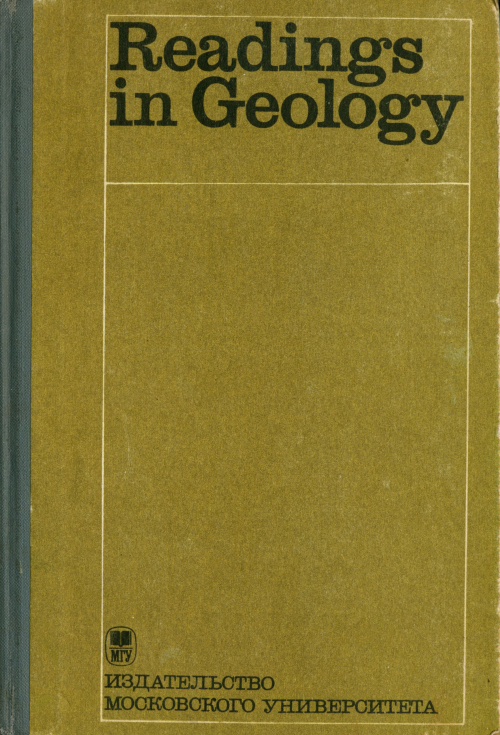
Предлагаемое пособие на английском языке представляет сборник текстов по научной тематике и предназначается для дополнительного аудиторного и внеаудиторного чтения на языке для студентов тарших курсов, для реферативных групп и аспирантов. Пособие включается тексты (или общенаучные тексты) по научной тематике. Тексты оригинальрные неадаптированные, подобранные из современных английских и американских источников
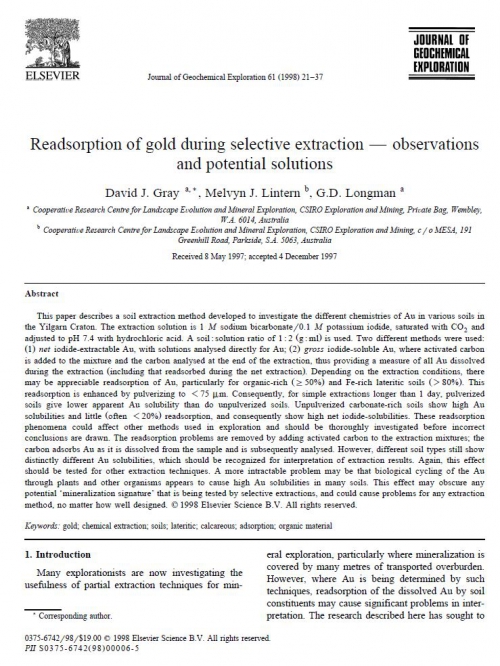
This paper describes a soil extraction method developed to investigate the different chemistries of Au in various soils in the Yilgarn Craton. The extraction solution is 1 M sodium bicarbonater0.1 M potassium iodide, saturated with CO2 and adjusted to pH 7.4 with hydrochloric acid. A soil : solution ratio of 1 : 2 Žg : ml. is used. Two different methods were used: Ž1. net iodide-extractable Au, with solutions analysed directly for Au; Ž2. gross iodide-soluble Au, where activated carbon is added to the mixture and the carbon analysed at the end of the extraction, thus providing a measure of all Au dissolved during the extraction Žincluding that readsorbed during the net extraction.. Depending on the extraction conditions, there may be appreciable readsorption of Au, particularly for organic-rich ŽG50%. and Fe-rich lateritic soils Ž)80%.. This readsorption is enhanced by pulverizing to -75 mm. Consequently, for simple extractions longer than 1 day, pulverized soils give lower apparent Au solubility than do unpulverized soils. Unpulverized carbonate-rich soils show high Au solubilities and little Žoften -20%. readsorption, and consequently show high net iodide-solubilities. These readsorption phenomena could affect other methods used in exploration and should be thoroughly investigated before incorrect conclusions are drawn. The readsorption problems are removed by adding activated carbon to the extraction mixtures; the carbon adsorbs Au as it is dissolved from the sample and is subsequently analysed. However, different soil types still show distinctly different Au solubilities, which should be recognized for interpretation of extraction results. Again, this effect should be tested for other extraction techniques. A more intractable problem may be that biological cycling of the Au through plants and other organisms appears to cause high Au solubilities in many soils. This effect may obscure any potential ‘mineralization signature’ that is being tested by selective extractions, and could cause problems for any extraction method, no matter how well designed
Water is essential for life. It is required for other uses also such as irrigation, industry, and power development. Its demand is increasing with the increase in population and changes in life style, whereas the availability is practically constant. In India, water is available as precipitation which is concentrated largely in a few months of monsoon season and snowfall in the higher mountains for an equally short time window. Rainfall in monsoon months is also temporally and spatially random.
Mineralization, hydrocarbons and diagenesis JOHNSTON, J. D., COLLER, D., MILLAR, G. & CRITCHLEY, M. F. Basement structural controls on Carboniferous-hosted base metal mineral deposits in Ireland SHEARLEY, E., REDMOND, P., KING, M. & GOODMAN, R. Geological controls on mineralization and dolomitization of the Lisheen Zn-Pb-Ag Deposit, Co. Tipperary, Ireland HOLLIS, C. & WALKDEN, G. The use of burial diagenetic calcite cements to determine the controls upon hydrocarbon emplacement and mineralization on a carbonate platform, Derbyshire, England VEALE, C. & PARNELL, J. Metal-organic interactions in the Dinantian Solway Basin, UK: inferences for oil migration studies Carbonate buildups and Waulsortian mud-mounds PICKARD, N. A. H. Evidence for microbial influence on the development of Lower Carboniferous buildups AHR, W. M. & STANTON, R. J. JR. Constituent composition of Early Mississippian carbonate buildups and their level-bottom equivalents, Sacramento Mountains, New Mexico KIRKBY, K. C. & HUNT, D. Episodic growth of a Waulsortian buildup: the Lower Carboniferous Muleshoe Mound, Sacramento Mountains, New Mexico, USA