Добрый день, Коллеги. Важное сообщение, просьба принять участие. Музей Ферсмана ищет помощь для реставрационных работ в помещении. Подробности по ссылке
In the two decades since "Orthosilicates" (Reviews in Mineralogy, Vol. 5), much has been learned about the internal textures, trace-element and isotope geochemistry (both radiogenic and stable) and chemical and mechanical stability of zircon. The application of this knowledge and the use of zircon in geologic studies have become widespread. Today, the study of zircon exists as the pseudo-discipline of "zirconology" that involves materials scientists and geoscientists from across a range of sub-disciplines including stable and radiogenic isotopes, sedimentology, petrology, trace elements and experimental mineralogy. Zirconology has become an important field of research, so much so that coverage of the mineral zircon in a review volume that included zircon as one of many accessory minerals would not meet the needs or interests of the zirconology community in terms of depth or breadth of coverage.
The current volume has taken a different approach from previous volumes concerned with major groups of rock-forming minerals. Some of the contents have previously been organized by the investigative technique or groups of similar techniques: crystal-structure rei nement, spectroscopy, TEM etc. Here, we have taken an approach that focuses on aspects of amphiboles rather than experimental techniques: crystal chemistry, new compositions, long-range order, short-range order etc., and all experimental results germane to these topics are discussed in each chapter. The intent of this approach is to focus on amphiboles, and to emphasize that many techniques are necessary to fully understand each aspect of the amphiboles and their behavior in both natural and industrial processes.
The production of Cu-Zn from volcanogenic massive sulfide (VMS) deposits in the eastern Pontides began in the early 1900s, with the exploitation of high-grade ores scattered across the district. The district still possesses economically important blind VMS and associated sulfide deposits. Careful descriptive documentation of the typical features of these VMS ores illustrated the geological characteristics that are important in identifying ore localities and can be used to define exploration targets.
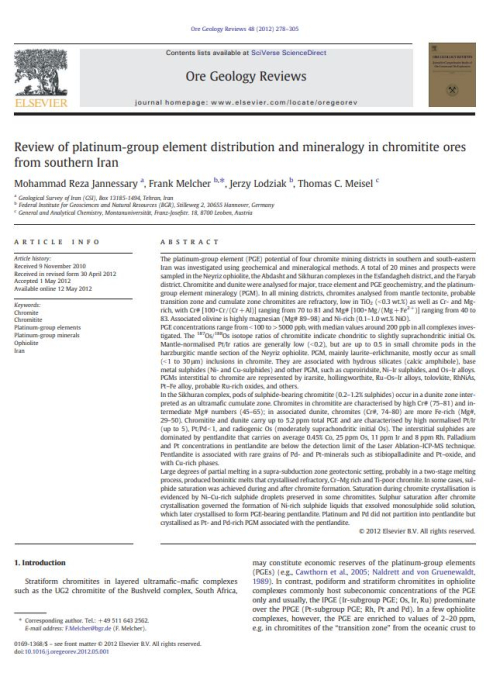
The platinum-group element (PGE) potential of four chromite mining districts in southern and south-eastern Iran was investigated using geochemical and mineralogical methods. A total of 20 mines and prospects were sampled in the Neyriz ophiolite, the Abdasht and Sikhuran complexes in the Esfandagheh district, and the Faryab district. Chromitite and dunite were analysed for major, trace element and PGE geochemistry, and the platinumgroup element mineralogy (PGM). In all mining districts, chromites analysed from mantle tectonite, probable transition zone and cumulate zone chromitites are refractory, low in TiO2 (b0.3 wt.%) as well as Cr- and Mgrich, with Cr# [100*Cr /(Cr+Al)] ranging from 70 to 81 and Mg# [100*Mg /(Mg+ Fe2+)] ranging from 40 to 83.
Our understanding of rock forming geological processes and thereby of geodynamic processes depends largely on a sound basis of knowledge of minerals. Due to the application of new analytical techniques, the number of newly discovered minerals increases steadily, and what used to be a simple mineral may have turned into a complex group.
The metal sulfides have played an important role in mineralogy and geochemistry since these disciplines first emerged and, for reasons detailed in the first chapter, have achieved an even greater importance in both fundamental and applied mineral sciences in recent years. It is no surprise that Volume 1 in the series, of which this book is Volume 61, was devoted to "Sulfide Mineralogy." For some years there has been the need for an updated volume covering the subject areas of Volume 1 and addressing the new areas which have developed since its publication in 1974.
When discussing the stability of iron oxides, one must invariably deal with oxygen fugacity as a variable. To many geophysicists the importance of this variable in determining the stability and composition of oxides is not immediately apparent. Indeed, even within the petrologic community there are many misconceptions about what oxygen fugacity is and how it applies to rocks. The purpose of this chapter is to introduce the concept of oxygen fugacity so that later discussions within this book that use oxygen fugacity as a variable will be more comprehensible. <...>
The purpose of this volume is to provide, in a rapidly-printed, inexpensive format, an up-to-date review of the mineralogy and petrology of rock-forming opaque oxide rr.inerals. It was the textbook for the short course on rock-forming oxide minerals sponsored by the Mineralogical Society of America at the Colorado School of Mines, November 5-7, 1976. The contributors hope that the work will be valuable not only to participants in the short course, but also to others desiring a modern review of the subject. <...>
Marine Minerals was first published in 1979 as Volume 6 of the series entitled "SHORT COURSE NOTES." In 1980 the Mineralogical Society of America changed the name of the series to "REVIEWS IN MINERALOGY," and for that reason this, the second printing of Marine Minerals has been reissued under the new banner. Only minor corrections have been made. The reader's attention is directed to the titles of other volumes published in the "REVIEWS" series, as listed on the opposite page. <...>