Добрый день, Коллеги. Важное сообщение, просьба принять участие. Музей Ферсмана ищет помощь для реставрационных работ в помещении. Подробности по ссылке
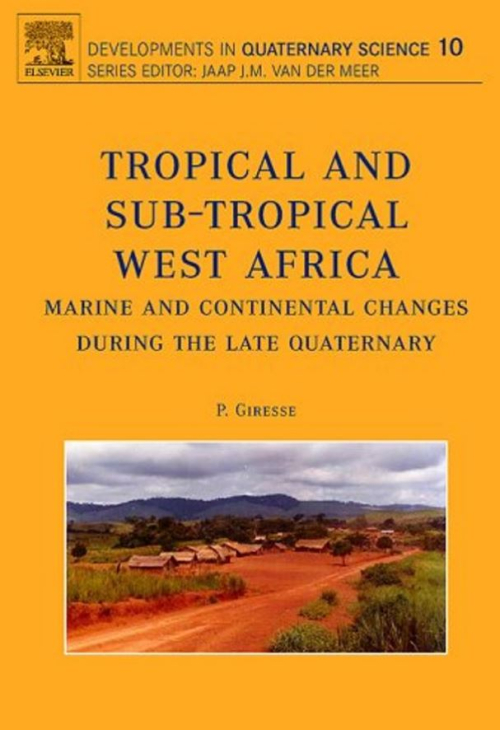
The geological maps show that Africa is almost entirely made up of basement Precambrian rocks. The only exceptions are constituted by northwestern and southern parts of the continent where narrow Phanerozoic mountains belts are stacked against the Precambrian landmass. Structurally, the Precambrian geology of Africa is grossly divided into cratons and mobile belts (Petters, 1991). The two most important cratons are the West African craton and the Congo (Zaire) craton (Fig. 1 (a,b)). Surrounding the cratons are the belts, which have been deformed or metamorphosed during the Early Palaeozoic Pan-African orogeny. Cratonic nuclei are observed in the central, northeastern and northwestern parts of the Congo (Zaire) craton. According to Cahen (1984), the African orogenic history indicates that the bulk of this craton was stabilised after an early Proterozoic orogeny. The history of the tectonic evolution of Africa is based on a collection of radiometric ages.
In the preparation of this book I have drawn upon the help of many people and institutions. Many of these have no direct connection with the writing of the book, but without their assistance, which made the necessary field experience possible, this study could not have been written.
In civil engineering, tunnel construction has always been based on observations far more than any other construction. Reason for this phenomenon can be seen in the fact, that there is no other condition as decisive as the changing ground conditions in underground construction. Observational methods by their nature are subject of experience, especially when using predominantly manual methods for construction. Experience can be explained as kind of data base of an individual.
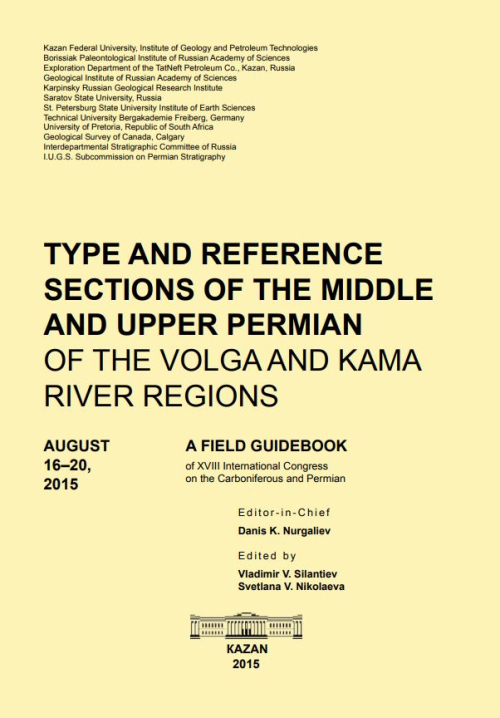
Типовые и эталонные разрезы средней и верхней Перми в Поволжье и Прикамье. Полевой справочник XVIII Международного конгресса по каменноугольному и пермскому периодам
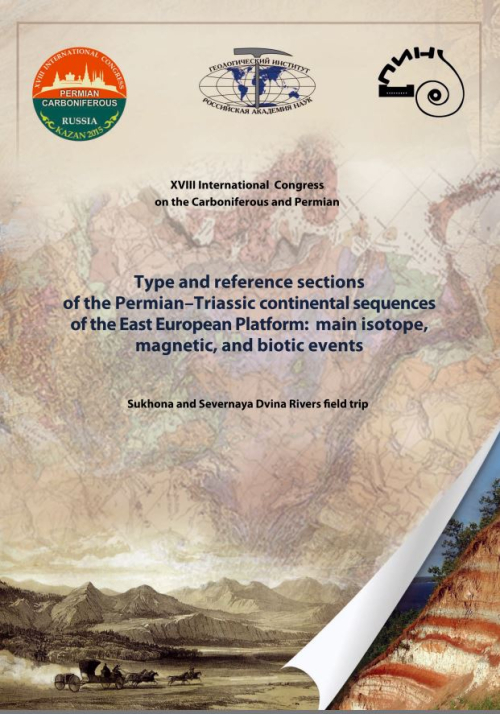
Detailed descriptions and new biostratigraphic, paleomagnetic, geochemical, chemostratigraphic, and sedimentological data on the most important type and reference sections of the Ufimian, Kazanian, Urzhumian, and Severodvinian stages are presented. The guidebook is intended for geologists and paleontologists who study Permian stratigraphy, paleontology and mineral resources, and for students and teachers of fieldwork techniques.
The best section of the Permian continental sequence of the Russian Platform is located in the Sukhona and Malaya Severnaya Dvina Rivers Basin, Vologda Region. This territory is situated in the north-eastern part of the Moscow Basin (Syncline), on the Sukhona Swell (Fig. 1). It is a tectonically active area (uplift). As a result, the Sukhona River is actively cutting into the bedrock and forming high beauty outcrops (up to 60 m) for a distance of 100 km.
A number of global and regional classifications of uranium deposits have been proposed in the past by Heinrich (1958), Ruzicka (1971), Ziegler (1974), Kazansky and Laverov (1977), Mickle and Mathews (1978), Mathews et al. (1979), Dahlkamp (1980), Nash et al. (1981), Barthel et al. (1986), and others. Although they remain in principle valid, recently published descriptions of uranium deposits discovered during the past exploration boom, and new research data on earlier established and defined types of uranium deposits justify a rearrangement and refinement of the classification scheme.
Tyrannosaurus rex is assuredly the dinosaur with the greatest public visibility, and it has been cast as a heavy in countless fi lms dating back to Harry Hoyt’s (1925) adaptation of Sir Arthur Conan Doyle’s (1912) Lost World. However, as of 1980, only seven specimens of the dinosaur were known (Larson 2008). In the last three decades, this number has swelled at least sevenfold (Larson 2008), and our knowledge of the relationships, anatomy, and biology of T. rex and its close relatives has expanded dramatically both through new specimens coming to light and through a plethora of analytical studies. This volume had its genesis in a conference held in Rockford, Illinois, on September 16–18, 2005, titled “The Origin, Systematics, and Paleobiology of Tyrannosauridae,” and jointly sponsored by the Burpee Museum of Natural History and Northern Illinois University. The symposium was held in conjunction with the development of the Burpee’s new dinosaur hall, the centerpiece of which was a skeletal reconstruction of “Jane” (BMR P2002.4.1), a relatively complete and very well preserved specimen of a juvenile tyrannosaur recovered by the Burpee Museum in 2002 from Carter County, Montana, and now mounted on display at the museum <...>
Медно-порфировые рудно-магматические системы “диоритовой” модели распространены во всех вулканогенных мегазонах Урала. Рудоносные гранитоиды представлены преимущественно кварцевыми диоритами островодужного геохимического типа. U-Pb SHRIMP-II датирование цирконов из диоритов подтверждает, в основном, геологические данные об омоложении рудоносных систем по латерали с запада на восток от (S2)–D1–2 в Тагило-Магнитогорской мегазоне до D32-C11 в восточной части Восточно-Уральской мегазоны и C2 (К-Ar метод) в самой восточной части разреза (Валерьяновской мегазоне). Некоторое исключение представляют объекты западной части Восточно-Уральской вулканогенной мегазоны (Увельская зона). Здесь для циркона из диоритов Северо-Томинского месторождения установлен S2 возраст. Кварцевые диориты этого месторождения отличается от остальных изученных объектов наиболее высокими значениями (εNd)t в диоритах (6.7-9.4) и низкими содержаниями U, Th. Для цирконов всех месторождений неплохо выражена прямая линейная зависимость между U и Th, хотя единичные анализы с наиболее высокими содержаниями U заметно от нее отклоняются. Большая часть кристаллов циркона из диоритов Магнитогорской мегазоны содержит гораздо больше U и Th, чем из диоритов Восточно-Уральской мегазоны. Изотопные и петрогеохимические данные могут свидетельствовать об однородном нижнекоровом-верхнемантийном метабазитовом источнике диоритоидов в латеральном разрезе всего восточного склона Южного Урала, смещающимся во времени на восток. На данном этапе исследований можно считать, что эндогенные крупные промышленные месторождения связаны с порфировым диоритовым магматизмом D32-C11 и D1–2 возраста, а промышленные коры выветривания - с гипергенным преобразованием минерализованных диоритов S2 и D1–2 возраста.
Как известно, циркон, бадделеит, рутил, монацит и титанит являются надёжными минералами-геохронометрами для определения абсолютного возраста горных пород U-Pb методом. Однако для щелочных, щелочно-ультраосновных пород и высокотемпературных метасоматических пород их использование часто затруднено ввиду отсутствия этих минералов или их низкой степени сохранности. В связи с этим поиск новых минералов-геохронометров для датирования таких пород является важной и актуальной задачей современной геохронологии. В настоящей работе в качестве потенциальных U-Pb минералов-геохронометров рассматриваются широко распространенные в различных типах изверженных и метасоматических пород урансодержащие Ca-Fe гранаты.
Цель диссертации заключалась в выявлении возможностей и ограничений применения Ca-Fe гранатов в качестве U-Pb минералов-геохронометров для определения возраста щелочных, щёлочно-ультраосновных пород и известковых скарнов. <...>