Добрый день, Коллеги. Важное сообщение, просьба принять участие. Музей Ферсмана ищет помощь для реставрационных работ в помещении. Подробности по ссылке
Although uranium occurrences are widespread in Mongolia, minable or potentially economic deposits are restricted to date to the North Choibalsan region (Mardai/Dornod District, referred to as Mardai in Mongolian and Dornod (or Dornot) in Russian papers) in NE Mongolia and to the Gobi Desert in S Mongolia (e.g. Choir, Khairkan, Undurshil, Sainshand Basins) (Note: data given for U deposits in Mongolia are based on 1995 status unless otherwise cited). Deposits in these two regions are of volcanic and sandstone type, respectively.
Uranium deposits are known from fi ve uranium provinces and some separate areas (>Fig. 1.1, and discussed below) but no complete uranium inventory of China is published since uranium resources are a state secret. Available information on resources is scanty, incomplete, and burdened with discrepancies. It is unclear whether reported fi gures document original resources or the resource status at a specifi c mining stage. Th erefore, data on resources should to be treated with caution. Taking this into account, available information suggests the following general picture of China’s present resource situation (status 2002).
Uranium deposits and signifi cant occurrences are reported from ten regions of Asian Russia. Th ey include all signifi cant districts and present production centers in Russia (>Fig. 10.1).OECD-NEA/IAEA (2005) reports a total of 172 400 t U as remaining resources recoverable at <$80 per kg U, 131 750 t U of which are attributed to the RAR and 40 650 t U to the EAR-I category. Resources distribution by types of deposits amounts to 117 120 t U in volcanic-, 21 410 t U in sandstone-, and 33 870 t in vein-type deposits.
An important prerequisite to the long-term use of nuclear energy is information on uranium ore deposits from which uranium can be economically exploited. Hence the basic purpose of this book is to present an overview of uranium geology and data characteristic for uranium districts and deposits in the United States of America and Latin American countries. With respect to the classification terminology of uranium deposits used in this volume, the reader is referred to the typological classification system of uranium deposits presented in Part I Typology of Uranium Deposits in the first volume of the series Uranium Deposits of the World - Asia (Dahlkamp 2009).
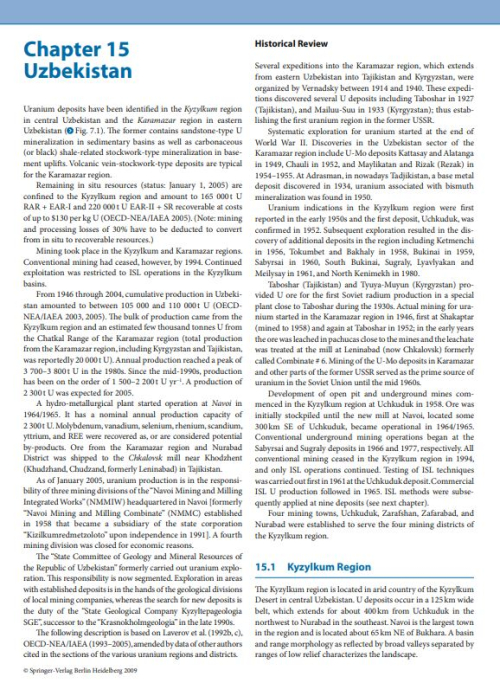
Uranium deposits have been identified in the Kyzylkum region in central Uzbekistan and the Karamazar region in eastern Uzbekistan (>Fig. 7.1). The former contains sandstone-type U mineralization in sedimentary basins as well as carbonaceous (or black) shale-related stockwork-type mineralization in basement uplift s. Volcanic vein-stockwork-type deposits are typical for the Karamazar region. Remaining in situ resources (status: January 1, 2005) are confi ned to the Kyzylkum region and amount to 165 000 t U RAR + EAR-I and 220 000 t U EAR-II + SR recoverable at costs of up to $130 per kg U (OECD-NEA/IAEA 2005). (Note: mining and processing losses of 30% have to be deducted to convert from in situ to recoverable resources.) Mining took place in the Kyzylkum and Karamazar regions. Conventional mining had ceased, however, by 1994. Continued exploitation was restricted to ISL operations in the Kyzylkum basins.
In 1983 the Nuclear Energy Agency of the Organisation for Economic Cooperation and Development (OECD/NEA) and the IAEA jointly published a book on Uranium Extraction Technology. A primary objective of this report was to document the significant technological developments that took place during the 1970s. The purpose of this present publication is to update and expand the original book.
Compared with other mineral commodities, especially metals, whose utility has become evident by centuries of trial and error, the appreciation of uranium has developed from theories based in physics in the 1930s to exploit the unique energy density of uranium’s transformation in nuclear fission. Initially this was in the crucible of a world war, but always beyond military uses was the promise of the “uranium boiler” canvassed in the second British MAUD (Military Application of Uranium Detonation) report in July 1941—the work of “one of the most effective scientific committees that ever existed.” <...>
The uranium minerals that today are at the centre of worldwide attention were unknown until 1780, when Wagsfort found a pitchblende sample in 10hanngeorgenstadt. This discovery passed unnoticed, however, since Wags fort thought that it contained a black species of a zinc mineral-hence the n':lme 'pitchblende' (= pitch-like blende). Seven years later, Klaproth, while examining the mineral, noted that it contained an oxide of an unknown metal, which he called 'uranium' in honour of the planet Uranus, recently discovered by Herschel. Klaproth also believed that he had separated the metal, but, in fact, the attempt failed, and uranium, given its strong affinity with oxygen, was not separated until several years later. In 1833 Arfwedson attempted the separation and, in so doing, reduced the pitchblende. His attempt was not successful and only U02 was obtained. It was Peligot, in 1840, who was finally successful. He managed the reduction of the metal working with metallic potassium. It should be remembered that twelve years earlier Berzelius had isolated thorium.
Uranium is a strategic resource that is the basis for both nuclear power and nuclear weapons. Nuclear power accounts for around 16% of the world’s electricity and uses uranium as a fuel to drive steam turbines.
The large scale use of uranium started around 1940 with the Manhattan project and the development of nuclear bombs, but later started to be focused more and more on power generation with nuclear reactors. <...>
The emphasis of this volume is on the characterization of uranium deposits. Chapter 1 includes an introductory note in the form of a brief summary of world uranium resources and their definitions with respect to confidence classes and cost categories. This was considered justified insofar as an understanding of an ore deposit cannot be achieved from purely geological parameters. Economic considerations have to be included. Demand for the commodity and, in the western world, related price/cost factors dictate and define whether a localized metal concentration is a deposit that can be profitably exploited presently or in the future, or whether it is a mineral occurrence of only scientific value.