Добрый день, Коллеги. Важное сообщение, просьба принять участие. Музей Ферсмана ищет помощь для реставрационных работ в помещении. Подробности по ссылке
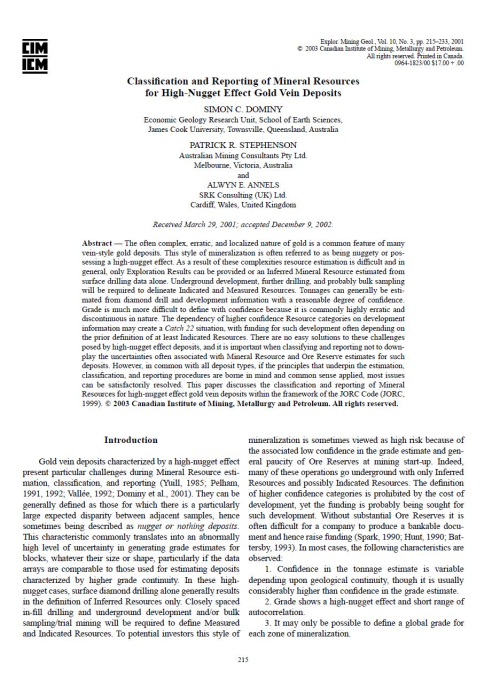
The often complex, erratic, and localized nature of gold is a common feature of many vein-style gold deposits. This style of mineralization is often referred to as being nuggety or possessing a high-nugget effect. As a result of these complexities resource estimation is difficult and in general, only Exploration Results can be provided or an Inferred Mineral Resource estimated from surface drilling data alone. Underground development, further drilling, and probably bulk sampling will be required to delineate Indicated and Measured Resources.
Remotely sensed image data is widely used in a range of oceanographic, terrestrial, and atmospheric applications, such as land-cover mapping, environmental modeling and monitoring, and the updating of geographical databases. Hence, the quantized pixel values making up an image may be converted to physical values of radiance and related to some property of the surface being sensed. An example of this approach is the calibration of thermal infrared imagery to produce maps of temperature fields, such as sea surface temperature.
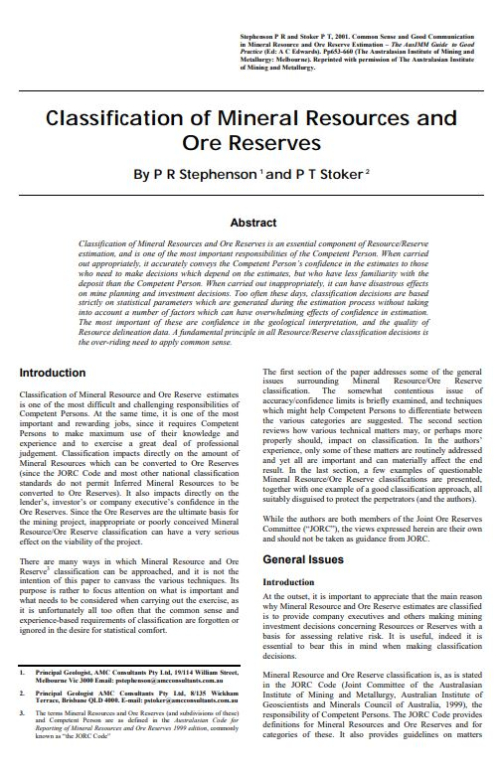
Classification of Mineral Resources and Ore Reserves is an essential component of Resource/Reserve estimation, and is one of the most important responsibilities of the Competent Person. When carried out appropriately, it accurately conveys the Competent Person’s confidence in the estimates to those who need to make decisions which depend on the estimates, but who have less familiarity with the deposit than the Competent Person.
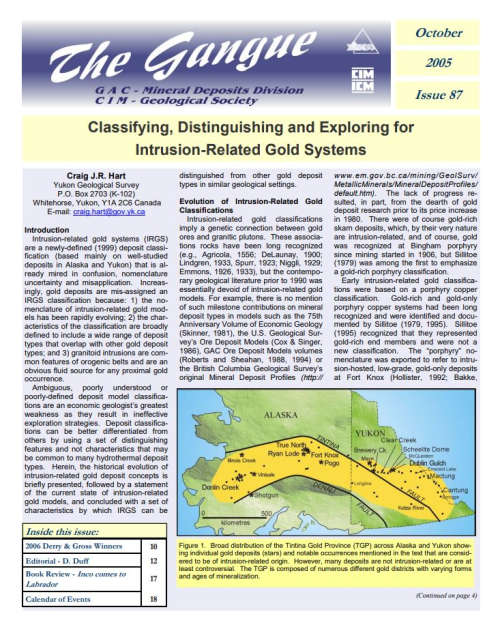
Intrusion-related gold systems (IRGS) are a newly-defined (1999) deposit classification (based mainly on well-studied deposits in Alaska and Yukon) that is already mired in confusion, nomenclature uncertainty and misapplication. Increasingly, gold deposits are mis-assigned an IRGS classification because: 1) the nomenclature of intrusion-related gold models has been rapidly evolving; 2) the characteristics of the classification are broadly defined to include a wide range of deposit types that overlap with other gold deposit types; and 3) granitoid intrusions are common features of orogenic belts and are an obvious fluid source for any proximal gold occurrence.
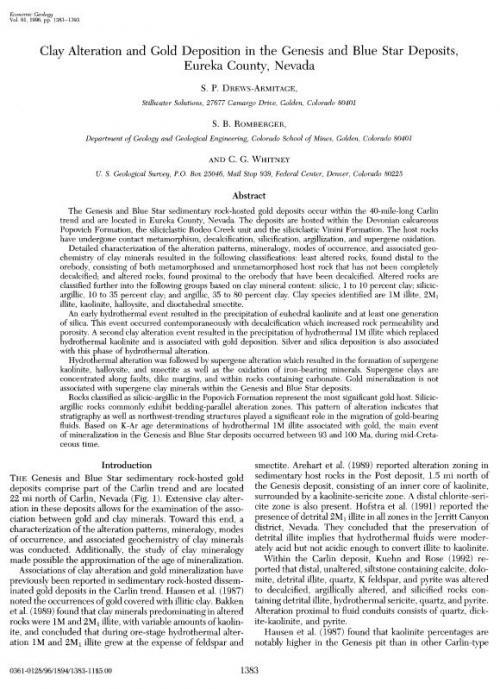
The Genesis and Blue Star sedimentary rock-hosted gold deposits occur within the 40-mile-long Carlin trend and are located in Eureka County, Nevada. The deposits are hosted within the Devonian calcareous Popovich Formation, the siliciclastic Rodeo Creek unit and the siliciclastic Vinini Formation. The host rocks have undergone contact metamorphism, decalcification, silicification, argillization, and supergene oxidation.
Clay, noun. Old English Cladg. A stiff viscous earth. (Blackies Compact Etymological Dictionary. Blackie & Son, London and Glasgow. 1946. War Economy Standard) Clay: The original Indo-European word was 'gloi-" "gli-' from which came "glue' and 'gluten'. In Germanic this became 'klai-; and the Old English 'claeg" became Modern English "clay'. From the same source came "clammy' and the northern England dialect "claggy' all of which describe a similar sticky consistency. (Oxford English Dictionary and Ayto's Dictionary of Word Origins, Bloomsbury, 1999) Clay." from Old Greek yRia, y2oia "'glue" 72ivfl "slime, mucus "" y2oidq "'anything sticky" 'from L-E. base *glei-, *gli- 'to glue, paste stick together. (Klein E. A comprehensive etymological dictionary of the English language. Elsevier, Amsterdam, 1967; Skeat W. An etymological dictionary of the English language.
Oxford University Press, 1961; Mann S.E. An Indo-European comparative dictionary. Buske Verlag, Hamburg, 1987) <...>
Clays are one of the most important groups of minerals that destroy permeability in sandstones, but they also react with drilling and completion fluids and induce fine-particle migrationduring hydrocarbon production. They are a very complex family of minerals that commonly are mutually intergrown and contain a wide range of solid solutions and form by a wide range of processes. They form under a wide diversity of pressure and temperature conditions, as well as rock and fluid compositional conditions.
A knowledge of clay is important in many spheres of scientific endeavour, particularly in natural sciences such as geology, mineralogy and soil science, but also in more applied areas like environmental and materials science. Over the last two decades research into clay mineralogy has been strongly influenced by the development and application of a number of spectroscopic techniques which are now able to yield information about clay materials at a level of detail that previously would have seemed inconceivable.
This paper is a guide to the X-ray examination of clay minerals; it incorporates background information concerning the principal crystallographic features of clay minerals, and how this is used in the X-ray identification of these minerals, together with laboratory techniques and the application of X-ray diffractometry to the diagnosis of the clay minerals in natural sedimentary materials. <...>