Добрый день, Коллеги. Важное сообщение, просьба принять участие. Музей Ферсмана ищет помощь для реставрационных работ в помещении. Подробности по ссылке
Актуальность изучения перспективного Кызыкчадрского рудного поля с потенциально промышленным месторождением Кызык-Чадр определяется его значением как резервной сырьевой базы для проектируемого Аксугского ГМК в Восточной Тыве. В то же время, месторождение Кызык-Чадр вызывает научный интерес как один из наиболее древних объектов медно-порфирового типа в Алтае-Саянском регионе, вовлеченный в интенсивную тектоническую переработку на последующих геотектонических этапах. Характерные черты геологической позиции, строения, вещественного состава и зональности месторождения Кызык-Чадр положены в основу адаптированной геолого-поисковой модели, для использования при прогнозировании и проведении геологоразведочных работ в целях дальнейшего укрепления МСБ меди, молибдена и золота Алтае-Саянского региона.
Гидротермальные изменения, выявленные с помощью люминесценции и химического состава апатита: потенциальный минерал-индикатор для изучения скрытых порфирово-медных месторождений
Apatite is a common resistate mineral occurring in a range of host rocks and ore-related hydrothermal alteration assemblages. Apatite in several porphyry copper deposits in British Columbia has a unique set of physical and compositional characteristics that can be used to evaluate the chemical conditions of magmas that formed the causative intrusions or associated hydrothermal alteration.
Porphyry Cu deposits in the Chilean and Argentinian central Andes occur in a series of orogen-parallel magmatic arcs, which migrated episodically eastward since the Early Cretaceous. The three Cenozoic belts, corresponding to Paleocene-early Eocene, middle Eocene-early Oligocene, and Miocene-early Pliocene epochs, cut obliquely across a composite belt of subeconomic porphyry Cu mineralization formed at several times during the Late Carboniferous to Triassic interval.
Mineral exploration is undertaken in stages, with each stage designed to get to the next decision point of whether or not to keep exploring a particular area based on the results at hand. As a general rule, each consecutive exploration stage is more expensive due to the progressively more drill- and study-intensive nature of the work required, in particular after discovery of a potentially economic mineral deposit.
Porphyry Cu systems host some of the most widely distributed mineralization types at convergent plate boundaries, including porphyry deposits centered on intrusions; skarn, carbonate-replacement, and sedimenthosted Au deposits in increasingly peripheral locations; and superjacent high- and intermediate-sulfidation epithermal deposits. The systems commonly define linear belts, some many hundreds of kilometers long, as well as occurring less commonly in apparent isolation.
Extensive research during the 20th century on porphyry Cu (-Mo-Au) deposits has revealed the following major geodynamic, petrological, mineralogical, and geochemical features that characterize these deposits: (1) these systems commonly occur in continental and oceanic magmatic arcs or in collisional orogenic belts; (2) they have spatial and genetic relationships to basaltic-to-felsic magmas emplaced in the upper 10 km of the crust;
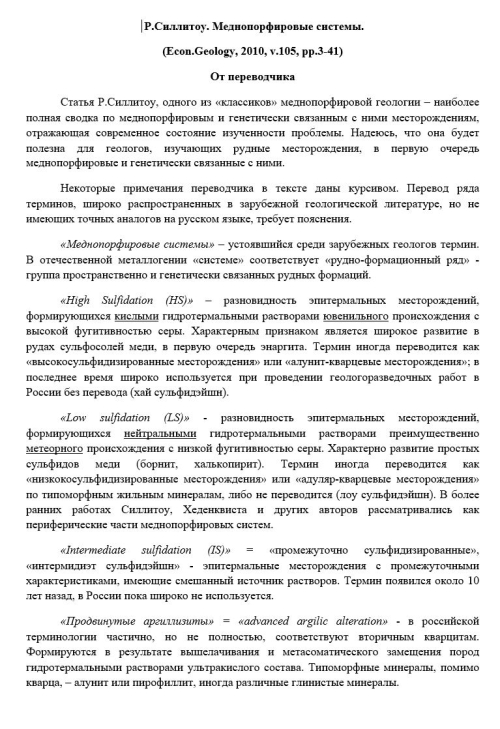
Статья Р.Силлитоу, одного из «классиков» меднопорфировой геологии – наиболее полная сводка по меднопорфировым и генетически связанным с ними месторождениям, отражающая современное состояние изученности проблемы. Надеюсь, что она будет полезна для геологов, изучающих рудные месторождения, в первую очередь меднопорфировые и генетически связанные с ними.
Меднопорфировые месторождения (МПМ) являются ведущими в мире по запасам и добыче Cu и Mo, а также сопутствующих Au, Ag, Re. Среди них наибольшее количество объектов «мирового класса» – гигантских (>10 млн. т Cu) и супергигантских (>25 млн. т Cu), в т.ч. самые крупные из известных чилийские месторождения Чукикамата и Эль Теньенте с запасами Cu более 100 млн. т каждое. По геологическому строению вулканоплутонические пояса (ВПП) России имеют сходство с поясами Северной и Южной Америки, Азиатско-Тихоокеанского региона, где сосредоточены сотни МПМ, включая десятки крупных и сверхкрупных.
Рассматриваются проблемы сравнительной металлогении архея, протерозоя, фанерозоя, источников рудообразующих веществ, формирования син- и эпигенетических стратиформных месторождений, кор выветривания и связанных с ними полезных ископаемых, петролого-геохимические аспекты металлогении, геология и условия образования месторождений меди: сульфидных медноникелевых, медно-порфировых, колчеданных, колчеданно-полиметаллических в песчаниках и сланцах.
В книге освещены различные вопросы, касающиеся геологического строения, минералою-петрографической и геохимической характеристики медно-порфировых месторождений Северного Прибалхашья. Затрагиваются вопросы генезиса и классификации месторождений. Большое внимание уделено гидротермально измененным породам и вопросам корреляции различных типов измененных пород с медно-молибденовым оруденением. Книга рассчитана на широкий круг петрографов, геохимиков и минералогов, изучающих рудные месторождения.