Добрый день, Коллеги. Важное сообщение, просьба принять участие. Музей Ферсмана ищет помощь для реставрационных работ в помещении. Подробности по ссылке
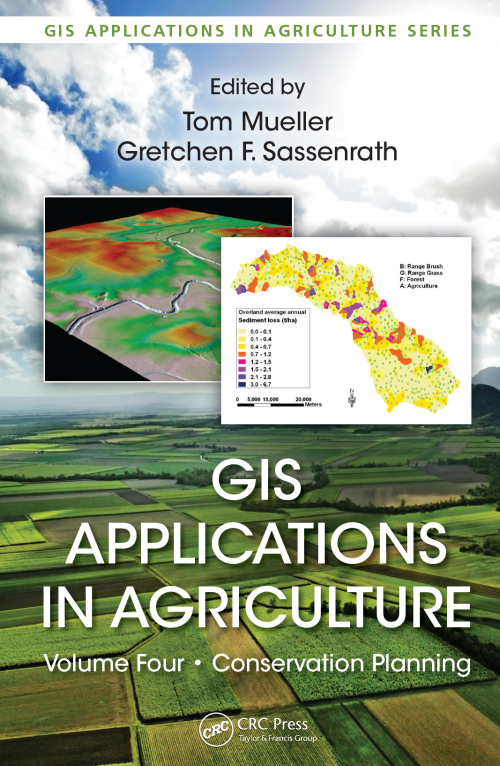
GIS Applications in Agriculture, Volume Four: Conservation Planning, edited by Tom Mueller and Gretchen F. Sassenrath, is the fourth volume in the book series GIS Applications in Agriculture, which is designed to enhance the application and use of geographic information systems (GISs) in agriculture by providing detailed GIS applications that are useful to scientists, educators, students, consultants, and farmers. The first volume, GIS Applications in Agriculture, edited by Francis J. Pierce and David Clay, was published by CRC Press in 2007. The second volume, GIS Applications in Agriculture: Nutrient Management for Improved Energy Efficiency, edited by David Clay and John Shanahan, and the third volume, GIS Applications in Agriculture: Invasive Species, edited by Sharon Clay, were published by CRC Press in 2011. While the newest book in this series, the idea of a book on conservation planning using GIS was identified in 2007 when the book series began. Intuitively, conservation planning through GIS applications should appeal to all conservationists who clearly understand that a key to achieving soil and water conservation is rooted in an understanding of the spatial and temporal variation in both soil and water resources and natural and human-induced forces that affect the quality and quantity of those resources. <...>
GIS Tutorial 1: Basic Workbook is the direct result of the authors' experiences teaching GIS to high school students in a summer program at Carnegie Mellon University, undergraduate and graduate students in several departments and disciplines at Carnegie Mellon University, as well as working professionals. GIS Tutorial 1 is a hands-on workbook with step-by-step exercises that take the reader from the basics of using ArcGlS Desktop interfaces through performing advanced spatial analyses. <...>
We are pleased to offer this fourth edition of Thematic Cartography and Geovisualization published by CRC Press. We deem a fourth edition particularly appropriate given the extensive developments that have taken place in cartography and GIScience since the third edition was first published in 2009. One development is the continued evolution of the Internet and the associated World Wide Web, which is commonly referred to as Web 2.0. One characteristic of Web 2.0 is the ability to harness the collective intelligence of Web users. In the case of geography, we often refer to this collective intelligence as “volunteered geographic information” or VGI;
Многолетний опыт геолого-геофизических исследований свидетельствует о том, что потенциал применения геоинформационных технологий (ГИТ) и географических информационных систем (ГИС) в среде специалистов, занимающихся проблемами алмазопоисковой геологии (геологов, геофизиков и минералогов) полностью не раскрыт и в значительной степени недооценен.
Рассмотрены вопросы создания и применения геоинформационных систем (ГИС) для решения задач управления, бизнеса, мониторинга и др. Описаны особенности организации данных и их моделирования в этих системах. Даны характеристики основных инструментальных систем ГИС, предназначенных для организации прикладных геоинформационных систем. Приведены варианты решения практических задач в управлении, экологии, контроле, учете и т.д. Для студентов вузов, учащихся колледжей, лицеев и других средних учебных заведений, а также для всех, интересующихся этой тематикой.
In this exercise, you will install the data that will be used throughout this course. The data is stored on a CD and will be copied to your hard drive by an automated install program. After installing the data, you will have the opportunity to create an ESRI Global Account, which will allow you to access all pages on the ESRI Support Center, a valuable online technical resource <...>
Geocoding is the process of assigning a location, usually in the form of coordinate values, to an address by comparing the descriptive location elements in the address to those present in the reference material. Addresses come in many forms, ranging from the common address format of house number followed by the street name and succeeding information to other location descriptions such as postal zone or census tract. In essence, an address includes any type of information that distinguishes a place.
This chapter begins by illustrating many of the applications of geocoding.
Next, a brief overview of the tools and software available with ESRI® ArcGIS® is given. Finally, tips on applying these tools to the geocoding process will be presented. <...>
For the analysis of spatially distributed data, a fundamental aspect is first considered: can the data be interpolated, or are they of such a type that an interpolation between two values measured at different locations makes no sense?
Various branches of physics and earth sciences have been studied from the point of view of mathematical morphology and its applications, but for the first time a whole book is devoted to a morphological approach to structural geology. In this sense, it fits in with a long tradition since the two founders of mathematical morphology were both mining engineers.