Добрый день, Коллеги. Важное сообщение, просьба принять участие. Музей Ферсмана ищет помощь для реставрационных работ в помещении. Подробности по ссылке

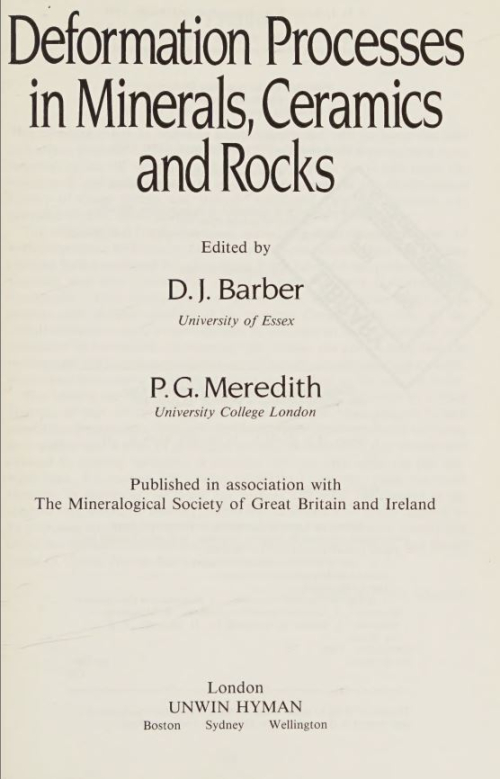
Автор(ы):Barber D.J., Meredith P.G.
Издание:Unwin Hyman, London, 1990 г., 455 стр., ISBN: 0-04-445088-5
Язык(и)Английский
Deformation processes in minerals, ceramics and rocks / Деформационные процессы в минералах, керамике и горных породах

Most of the chapters comprising this monograph are based on oral presentations delivered at the meeting held in London in April 1987, to which we refer in the Preface. The additional contributions were judged to be needed in order to make the monograph more comprehensive and self-sufficient. In particular, there are two overviews written by the individual editors, which are intended to give the necessary frameworks and references to relevant previous work in the two broad and rather poorly defined fields of fracture and ductile deformation, respectively.

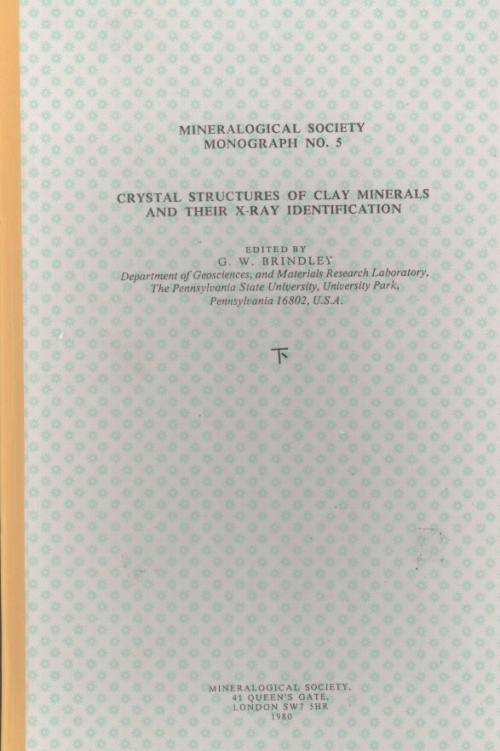
Автор(ы):Brindley G.W., Brown G.
Издание:Mineralogical Society, 1980 г., 249 стр.
Язык(и)Английский
Crystal structures of clay minerals and their X-ray identification / Кристаллические структуры глинистых минералов и их рентгеновская идентификация

The terms interlayering, mixed-layering, and interstratification describe phyllosilicate structures in which two or more kinds of layers occur in a vertical stacking sequence, that is, along c* or a line normal to (001). Phyllosilicate layers are strongly bonded internally but rather weakly bonded to each other. Thus, each layer approximates a one-dimensional “molecule” in the e* direction, and a two-dimensional crystal in the a and b directions. The basal surfaces of different kinds of layers are geometrically very similar and consist of sheets of oxygen or hydroxyl ions in quasi-hexagonal array. Consequently, layers with different internal arrangements can stack together and still articulate well at their interfaces. These structural factors are almost unique to the clays and phyllosilicates generally, and doubtless are responsible for the common occurrence of interstratified species. <...>

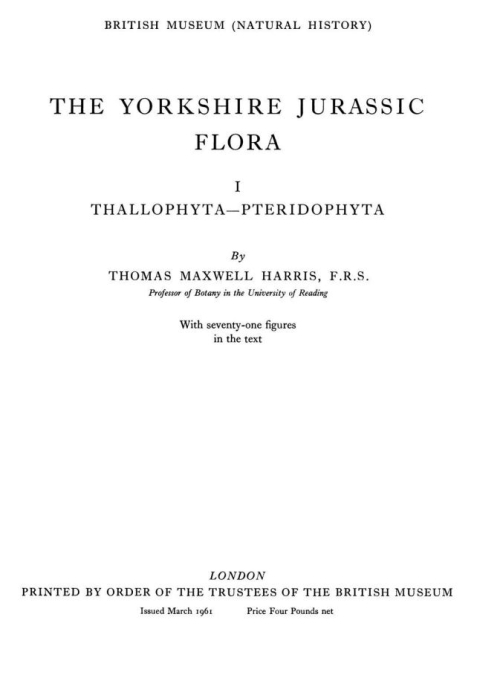
Автор(ы):Harris T.M.
Издание:London, 1961 г., 219 стр.
Язык(и)Английский
The Yorkshire jurassic flora. I. Thallophyta-pteridophyta / Йоркширская флора юрского периода. I. Thallophyta-pteridophyta

THE study of the Yorkshire Jurassic flora was begun by the founders of Palaeobotany, and many have added to it. It is the standard Middle Jurassic flora and my aim in writing this  monograph has been to make the knowledge of it more available and complete. Seward did this in his catalogue in 1900, but since then more has been learnt about every species and the information has been published in upwards of a hundred scattered papers. Advance has, however, been uneven and half the species were neglected entirely. Thus half the material in the present monograph is a compilation of published work and half is new.  <...>

Издание 2
Автор(ы):Pirsson L.V., Schuchert C.
Издание:John Wiley & Sons INC, New York, 1924 г., 748 стр.
Язык(и)Английский
A text-book of geology. Part 1. Physical geology. Part 2. Historical geology / A text-book of geology. Часть 1. Физическая геология. Часть 2. Историческая геология

In 1915, when the first edition of this text-book appeared, the author had had ten years' experience in teaching Historical Geology in the Sheffield Scientific School of Yale University. Since then he has continued his interest in the subject, teaching it until 1920, and has made almost daily annotations in his table copy of the first edition concerning the newer facts as they appeared in publications. It soon became a perplexing problem to know what to eliminate so as to keep the book within bounds, as one intended for  eginners in Geology rather than for matured geologists.

Автор(ы):Shoemaker R.S.
Издание:Society for Mining Metallurgy and Exploration Inc., 2009 г., 70 стр., ISBN: 978-087335-308-3
Язык(и)Английский
The circulating load practical mineral processing plant design by an old-time ore dresser / Практичная установка для переработки минерального сырья с циркулирующей загрузкой, спроектированная старинным переработчиком руды

We got one of our best ideas concerning primary crushers from a 54- × 74-inch gyratory crusher installed at the Ray Mines division of Kennecott Copper. This crusher had a rubber belt feeder under its surge pocket— one that we believe to be the first ever installed. It was 6 feet wide and about 80 feet long and was also used as a picking belt to remove timbers that came from the old underground mine. The total height of the installation from the belt feeder floor to the top of the dump pocket was 63 feet. The belt, which also handled old drill steel and miscellaneous scrap iron, had a life of about 14 months and handled 10 million tons in  that time. <...>

Автор(ы):Mohapatra B., Patra D.
Издание:2009 г., 38 стр.
Язык(и)Английский
Study of reduction behaviour of iron ore lumps / Изучение свойств кусковой железной руды при восстановлении

DRI or Sponge Iron is a porous solid-state product of direct reduction process, which is produced either in lump or pellet form. DRI is a good substitute for steel scrap for producing steel in EAF, BOF etc, which resulted a rapid growth of the sponge Iron Industry. In view of increasing demand of sponge Iron in the manufacturing of different verities of steel, a good deal of emphasis is being given to promote the study of direct reduction process.

Автор(ы):Carlson J.T., Kawatra S.K.
Издание:Society for Mining Metallurgy and Exploration Inc., 2014 г., 169 стр., ISBN: 978‑0‑87335-391-5
Язык(и)Английский
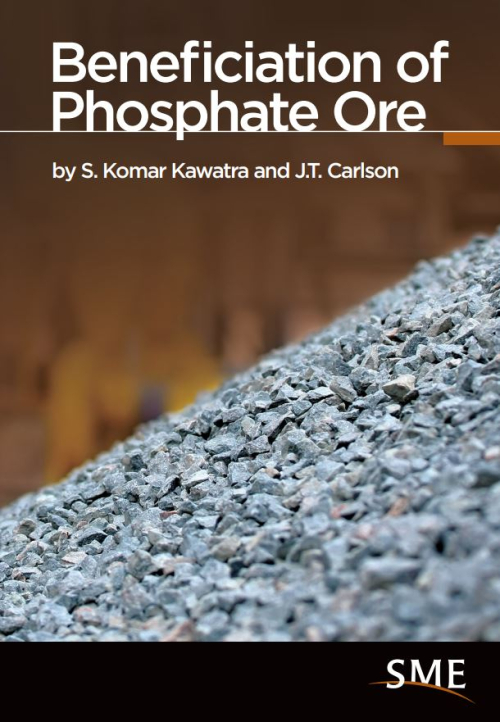
Beneficiation of phosphate ore / Обогащение фосфатной руды

Phosphate rock is an important mineral commodity used in the production of phosphoric acid. The majority of phosphoric acid is produced by the “wet process,” in which phosphate rock is reacted with sulfuric acid to produce phosphoric acid and gypsum (calcium sulfate dihydrate). The wet process demands a phosphate rock feed that meets certain specifications in order to produce phosphoric acid efficiently and economically.

Автор(ы):Dahlkamp F.J.
Издание:Springer, 1993 г., 79 стр.
Язык(и)Английский
Typology of uranium deposits / Типология урановых месторождений

A number of global and regional classifications of uranium deposits have been proposed in the past by Heinrich (1958), Ruzicka (1971), Ziegler (1974), Kazansky and Laverov (1977), Mickle and Mathews (1978), Mathews et al. (1979), Dahlkamp (1980), Nash et al. (1981), Barthel et al. (1986), and others. Although they remain in principle valid, recently published descriptions of uranium deposits discovered during the past exploration boom, and new research data on earlier established and defined types of uranium deposits justify a rearrangement and refinement of the classification scheme.


Автор(ы):Dahlkamp F.J.
Издание:Springer, 2009 г., 48 стр.
Язык(и)Английский
Uranium deposits of the world. Uzbekistan / Месторождения урана в мире. Узбекистан

Uranium deposits have been identified in the Kyzylkum region in central Uzbekistan and the Karamazar region in eastern Uzbekistan (>Fig. 7.1). The former contains sandstone-type U mineralization in sedimentary basins as well as carbonaceous (or black) shale-related stockwork-type mineralization in basement uplift s. Volcanic vein-stockwork-type deposits are typical for the Karamazar region. Remaining in situ resources (status: January 1, 2005) are confi ned to the Kyzylkum region and amount to 165 000 t U RAR + EAR-I and 220 000 t U EAR-II + SR recoverable at costs of up to $130 per kg U (OECD-NEA/IAEA 2005). (Note: mining and processing losses of 30% have to be deducted to convert from in situ to recoverable resources.) Mining took place in the Kyzylkum and Karamazar regions.  Conventional mining had ceased, however, by 1994. Continued  exploitation was restricted to ISL operations in the Kyzylkum  basins.

Ленты новостей
531.76