Добрый день, Коллеги. Важное сообщение, просьба принять участие. Музей Ферсмана ищет помощь для реставрационных работ в помещении. Подробности по ссылке

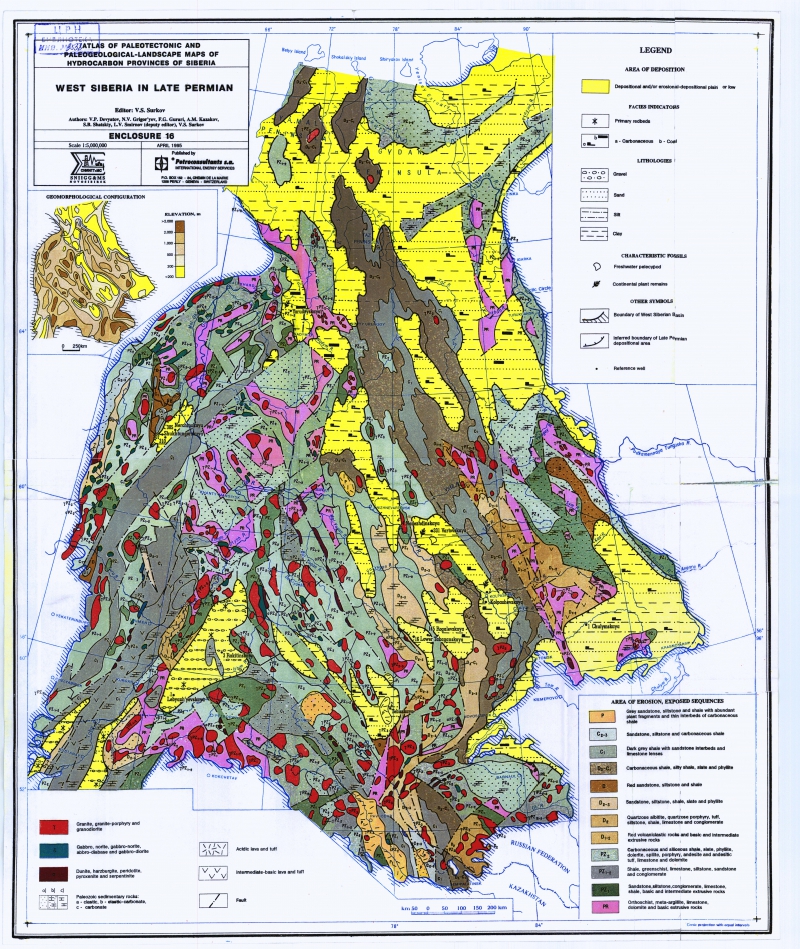
Atlas of paleotectonic and paleogeological-landscape maps of hydrocarbon provinces of siberia / Атлас палеотектонических и палеогеологических карт Западно-Сибирской нефтегазоносной провинции (Лист 1 - поздняя Пермь)
Карта составлена:СНИИГГиМС, 1995 г.
Редактор(ы):Сурков В.С.
Язык(и)Английский
Масштаб:1:5000000
Назначение карты:Палеогеологическая карта
Скачать
Карта (7.62M)
На странице представлен материал:Палеогеологическая карта: Atlas of paleotectonic and paleogeological-landscape maps of hydrocarbon provinces of siberia / Атлас палеотектонических и палеогеологических карт Западно-Сибирской нефтегазоносной провинции (Лист 1 - поздняя Пермь), масштаб: 1:5000000 , составлена: СНИИГГиМС, 1995 г., редактор(ы): Сурков В.С.
Выпуск 98
Издание:Economic geology, 2003 г., 12 стр.
Язык(и)Английский
Source of iron for sulfidation and gold deposition, Twin Creeks carlin-type deposit, Nevada

This study was undertaken to determine the source of iron in Comus Formation sedimentary rocks that were sulfidized during deposition of gold in the Megapit area of the Twin Creeks Carlin-type deposit. Sedimentary rocks in and near the Megapit contain ferroan dolomite, largely as overgrowths on iron-poor dolomite. Iron to form these overgrowths appears to have been released from mafic volcanic rocks that are interlayered with the sedimentary rocks. These igneous rocks have undergone two stages of hydrothermal alteration. The first stage involved formation of albite and iron-rich chlorite, possibly caused by interaction with seawater. The second stage involved destruction of the iron-rich chlorite by illite or sericite, which released iron to form ferroan dolomite in the sedimentary rocks. Comparisons show that transfer of iron from the igneous rocks to the sedimentary rocks can account for the present distributions of iron in these rocks. Relative to basalts, Comus Formation igneous rocks are enriched in iron and potassium. These results suggest that ferroan dolomite in sedimentary rocks is not solely a product of diagenetic processes and can form when iron is released from adjacent iron-bearing igneous rocks. Recognition of this additional mechanism for formation of ferroan dolomite expands the range of geologic settings that can be favorable for formation of gold deposits formed by sulfidation.

Выпуск 97
Издание:Economic geology, 2002 г., 6 стр.
Язык(и)Английский
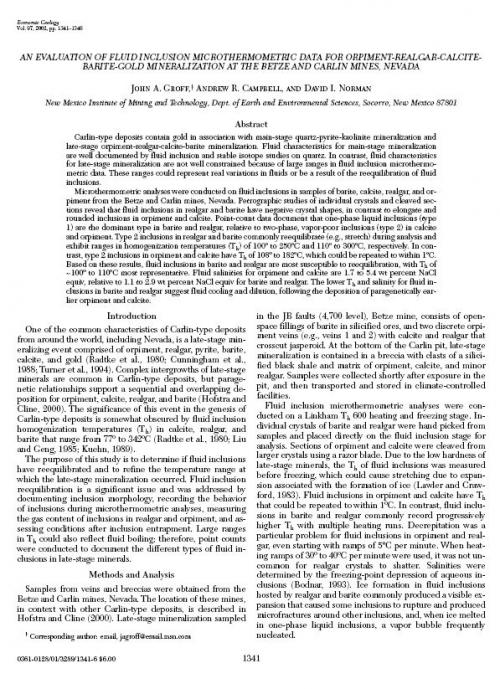
An evaluation of fluid inclusion microthermometric data for orpiment-realgar-calcite-barite-gold mineralization at the betze and carlin mines, Nevada

Carlin-type deposits contain gold in association with main-stage quartz-pyrite-kaolinite mineralization and late-stage orpiment-realgar-calcite-barite mineralization. Fluid characteristics for main-stage mineralization are well documented by fluid inclusion and stable isotope studies on quartz. In contrast, fluid characteristics for late-stage mineralization are not well constrained because of large ranges in fluid inclusion microthermo-metric data. These ranges could represent real variations in fluids or be a result of the reequilibration of fluid inclusions.

Microthermometric analyses were conducted on fluid inclusions in samples of barite, calcite, realgar, and or-piment from the Betze and Carlin mines, Nevada. Petrographic studies of individual crystals and cleaved sections reveal that fluid inclusions in realgar and barite have negative crystal shapes, in contrast to elongate and rounded inclusions in orpiment and calcite. Point-count data document that one-phase liquid inclusions (type 1) are the dominant type in barite and realgar, relative to two-phase, vapor-poor inclusions (type 2) in calcite and orpiment. Type 2 inclusions in realgar and barite commonly reequilibrate (e.g., stretch) during analysis and exhibit ranges in homogenization temperatures (Th) of 100º to 250ºC and 110º to 300ºC, respectively. In contrast, type 2 inclusions in orpiment and calcite have Th of 108º to 182ºC, which could be repeated to within 1ºC. Based on these results, fluid inclusions in barite and realgar are most susceptible to reequilibration, with Th of ~100º to 110ºC most representative. Fluid salinities for orpiment and calcite are 1.7 to 5.4 wt percent NaCl equiv, relative to 1.1 to 2.9 wt percent NaCl equiv for barite and realgar. The lower Th and salinity for fluid inclusions in barite and realgar suggest fluid cooling and dilution, following the deposition of paragenetically earlier orpiment and calcite.

Выпуск 96
Автор(ы):Cline J.S., Tracy L.C.
Издание:Economic geology, 2001 г., 18 стр.
Язык(и)Английский
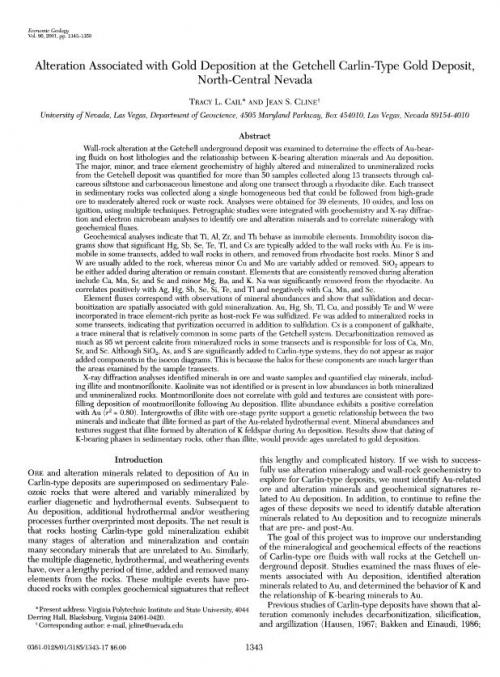
Alteration associated with gold deposition at the getchell carlin-type gold deposit, North-Central Nevada

Wall-rock alteration at the Getchell underground deposit was examined to determine the effects of Au-bear-ing fluids on host lithologies and the relationship between K-bearing alteration minerals and Au deposition. The major, minor, and trace element geochemistry of highly altered and mineralized to unmineralized rocks from the Getchell deposit was quantified for more than 50 samples collected along 13 transects through calcareous siltstone and carbonaceous limestone and along one transect through a rhyodacite dike. Each transect in sedimentary rocks was collected along a single homogeneous bed that could be followed from high-grade ore to moderately altered rock or waste rock. Analyses were obtained for 39 elements, 10 oxides, and loss on ignition, using multiple techniques. Petrographic studies were integrated with geochemistry and X-ray diffraction and electron microbeam analyses to identify ore and alteration minerals and to correlate mineralogy with geochemical fluxes.

Выпуск 93
Издание:Economic geology, 1998 г., 15 стр.
Язык(и)Английский
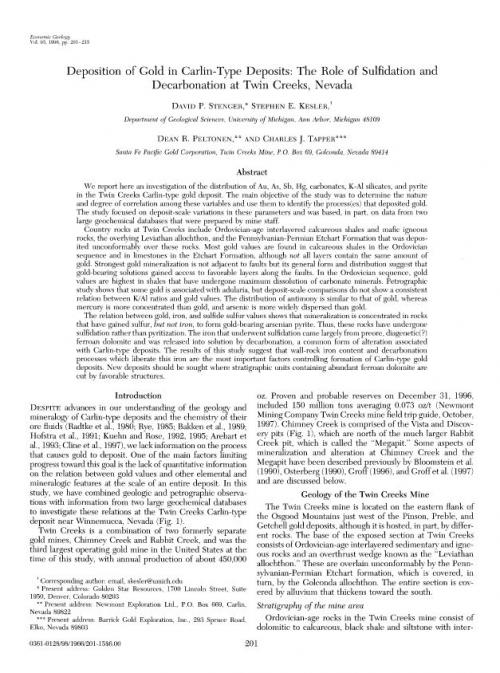
Deposition of gold in carlin-type deposits: the role of sulfidation and decarbonation at Twin Creeks, Nevada / Осаждение золота в месторождениях типа Карлин: роль сульфидирования и обезуглероживания в Твин-Криксе, штат Невада

We report here an investigation of the distribution of Au, As, Sb, Hg, carbonates, K-Al silicates, and pyrite in the Twin Creeks Carlin-type gold deposit. The main objective of the study was to determine the nature and degree of correlation among these variables and use them to identify the process(es) that deposited gold. The study focused on deposit-scale variations in these parameters and was based, in part, on data from two large geochemical databases that were prepared by mine staff.

Country rocks at Twin Creeks include Ordovician-age interlayered calcareous shales and mafic igneous rocks, the overlying Leviathan allochthon, and the Pennsylvanian-Permian Etchart Formation that was deposited unconformably over these rocks. Most gold values are found in calcareous shales in the Ordovician sequence and in limestones in the Etchart Formation, although not all layers contain the same amount of gold. Strongest gold mineralization is not adjacent to faults but its general form and distribution suggest that gold-bearing solutions gained access to favorable layers along the faults. In the Ordovician sequence, gold values are highest in shales that have undergone maximum dissolution of carbonate minerals. Petrographic study shows that some gold is associated with adularia, but deposit-scale comparisons do not show a consistent relation between K/Al ratios and gold values. The distribution of antimony is similar to that of gold, whereas mercury is more concentrated than gold, and arsenic is more widely dispersed than gold.

The relation between gold, iron, and sulfide sulfur values shows that mineralization is concentrated in rocks that have gained sulfur, but not iron, to form gold-bearing arsenian pyrite. Thus, these rocks have undergone sulfidation rather than pyritization. The iron that underwent sulfidation came largely from preore, diagenetic(P) ferroan dolomite and was released into solution by decarbonation, a common form of alteration associated with Carlin-type deposits. The results of this study suggest that wall-rock iron content and decarbonation processes which liberate this iron are the most important factors controlling formation of Carlin-type gold deposits. New deposits should be sought where stratigraphic units containing abundant ferroan dolomite are cut by favorable structures.

Редактор(ы):Thompson A.J.B., Thompson J.F.H., Dunne K.P.E.
Издание:Mineral deposits division, 1996 г., 119 стр., ISBN: 978-0919216594
Язык(и)Английский
Atlas of alteration. A field and petrographic guide to hydrothermal alteration minerals /  Атлас изменений. Полевое и петрографическое руководство по минералам гидротермальных изменений

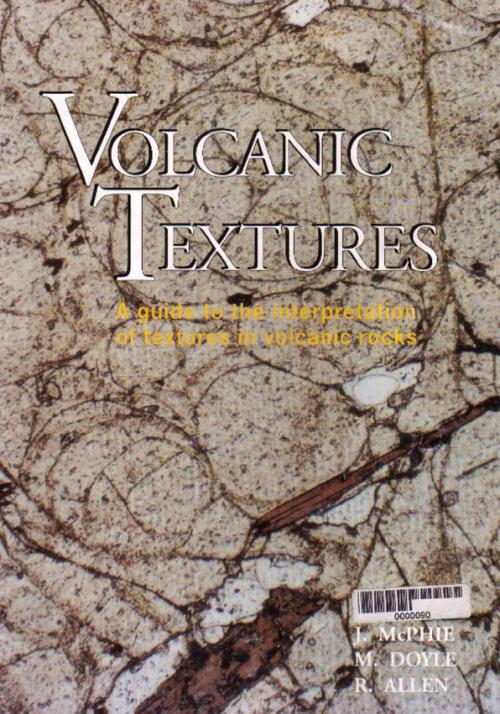
Secondary alteration of rocks and their contained minerals is common in nature. Alteration reflects the interaction of fluid, typically dominated by water, with rock at temperatures that range from warm (< 100°C) to hot (>500°C). For geologists who wish to study the primary mineralogy and chemistry of rocks, alteration is a nuisance to be avoided. Alteration mineralogy, however, documents the post-formation history of the rock, information that has practical implications. In particular, alteration is ubiquitous in and around hydrothermal mineral deposits. The distribution and mineralogy of this alteration relates to the hydrothermal environment, and hence, the type of mineral deposit. More importantly for mineral exploration, hydrothermal alteration around mineral deposits commonly forms halos that provide a target which is much larger than the deposit itself. The mineralogy and in some environments the chemical composition of the alteration provide an indication of the proximity of mineralization, or in the ideal case, a vector towards mineralization. Interpretation of alteration is, therefore, a routine part of exploration for hydrothermal mineral deposits. Similarly, as a product of geothermal activity, the mineralogy of hydrothermal alteration provides information on reservoir and fluid characteristics, and the evolution of the geothermal system. These data are used in conjunction with other information to evaluate potential geothermal resources.

Автор(ы):Allen R., Doyle M., McPhie J.
Издание:University of Tasmania, Hobart, 1993 г., 198 стр., ISBN: 0-85901-522-X
Язык(и)Английский
Volcanic textures. A guide to the interpretation of textures in volcanic rocks / Вулканические текстуры. Руководство по интерпретации текстур вулканических пород

Production of this book has depended on generous financial support from sponsors of the Key Centre for Ore Deposit and Exploration Studies, in particular, the Tasmanian Department of «Mines, Aberfoyle Resources, ВНР Exploration, CRA Exploration, Geopeko, Pancontinental, Pasminco, RGC Exploration and Western Mining Corporation.

Although the material presented comes principally from the collections of J.McP and RLA. we made use of some thin-sections, hand specimens and photographs contributed by colleagues: Stephen Abborr, Guillermo Alvarado. David Cooke. Keith Corbea, Bruce Gemmell. Bruce Houghton, John Waters, Matthew While and Colin Wilson. We are further indebted tо Aberfoyle Resources and Pasminco for usc of many sample from drillcore stores at Hellyer and Rosebery.

Professor Ross large initiated the projecr and provided much appreciated cncouragement throughout irs realisation. The first draft was substantially revised after reviews by Stuart Bull and Ross Large (CODES); Fergus Fitzgerald (Pasminco Exploration), Malcolm Howells (British Geological Survey/, Noel White (ВНР) and Hiromitsu Yamagishi (Geological Survey of Hokkaido).

The production team included June Pongratz (design and desktop publishing), Jcancttc I lankin and Kirst)' Whalcy (typing!- Debbie Flardmg (draughting). Simon Stephens and Naomi Dcards (thin-section and slab preparation). Fred Koolhof (technical advice and some photography) and Alison Jones (final editing).

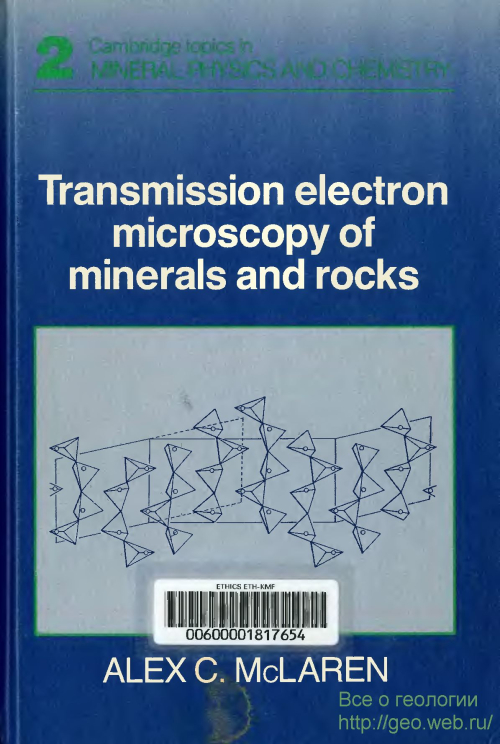
Автор(ы):McLaren A.C.
Редактор(ы):Liebermann R.C., Putnis A.
Издание:Cambridge University Press, New York, 1991 г., 387 стр., ISBN: 0-521-35098-0
Язык(и)Английский
Transmission electron microscopy of minerals and rocks / Просвечивающая электронная микроскопия минералов и горных пород

Of the many techniques that have been applied to the study of crystal defects, probably no single technique has contributed more to our understanding of their nature, properties, and influence on the physical and chemical properties of crystalline materials than transmission electron microscopy (ТЕМ). Although the importance of crystal defects and the use of ТЕМ for their direct observation were recognized by physical metallurgists in the early 1950s, it was at least a decade later that earth scientists responded to many of the new ideas of the defect solid state and to the power of ТЕМ. However, ТЕМ is now used extensively for the direct observation of defect microstructures in minerals and rocks, and there appears to be an increasing number of earth scientists who want to use the technique or to become more familiar with the interpretation of ТЕМ observations. This book is written for such people. However, it makes no attempt to be a practical manual of ТЕМ or a definitive text, but rather an introduction to the basic principles of the technique and of the interpretation of electron micrographs and electron diffraction patterns. As such, I hope the book will also be useful to students of materials science.

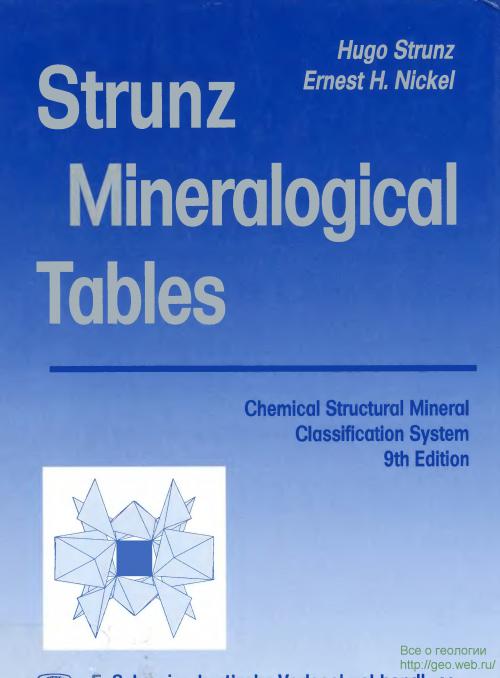
Автор(ы):Nickel E.H., Strunz H.
Издание:E.Schweizerbrat'sche Verlagsbuchhandlung, Stuttgart, 2001 г., 872 стр., ISBN: 3-510-65188-X
Язык(и)Английский
Strunz mineralogical tables. Chemical structural mineral

The chemical-structural mineral classification system developed since the first edition of Mineralogische Tabellen (1941) evolved from the chemical mineral system of Haiiy (1801), which was based on cations, and of Berzelius (1814,1824), based on anions, followed by the chemical-morphological system of Gustav Rose (1838.1852). the periodic system of the chemical elements (cf. Introduction), and finally by the developing knowledge of atomic crystal structures (since Laue, 1912, Bragg, 1913).

The classification system used in the first, and subsequent editions of Mineralogische Tabellen. combines chemical features with structural principles, such as structure types, cation size and coordination numbers; minerals are generally arranged according to increasing cation size. A characteristic scheme of chemical formulae was introduced, as well as internationalized names, such as neso- to tektosilicates. International priority principles have always been acknowledged.

Since the last edition (1978), technological developments, such as improved electron microscopy (since Ernst Ruska, 1931), chemical analysis by microprobe (since Raymond Castaing, 1951). scanning electron microscopy (since Oatley & McMullan, 1952), automatic computer-controlled instrumentation and software for structure determination, have made it possible to carry out the chemical, structural, morphological and physical characterization of tiny particles of new minerals (on the scale of micrograms) within a few days or weeks; computerized structural and morphological drawings can be produced within minutes.

As a result, the number of minerals approved by the Commission on New Minerals & Mineral Names of the IMA (International Mineralogical Association) has grown from about 2500 in 1978 to about 4000 at present, with about 60 to 80 new minerals added each year.

In this edition, the world of minerals is divided by chemical features into ten classes, each of which is subdivided, on chemical-structural principles, into divisions, subdivisions, groups of isotypic and homeotypic minerals, or individual minerals with unique structure types; groups with two or more mineral names comprise minerals with similar structure or composition. The classification system and alphanumeric coding scheme used in this 9,h edition of the Strunz Mineralogical Tables were presented at the 1994 IMA meeting in Pisa. They permit the insertion of thousands of new minerals in the future without changing the basic classification framework.

The authors gratefully acknowledge the contributions to this volume made by a number of mineralogical colleagues, particularly Emil Makovicky for helpful suggestions relating to the sulfide and sulfosalt classification, and Friedrich Liebau for constructive critical reading of the cyclo- and inosilicate portions of the manuscript. We also acknowledge the contribution made by Irmgard Stolle, Berlin, who provided assistance in the preparation of the manuscript.

This contribution to mineralogy is indebted to about seven generations of diligent and active researchers over a period of two hundred years. The authors welcome suggestions for improvements.

Издание 2
Редактор(ы):Licker M.D.
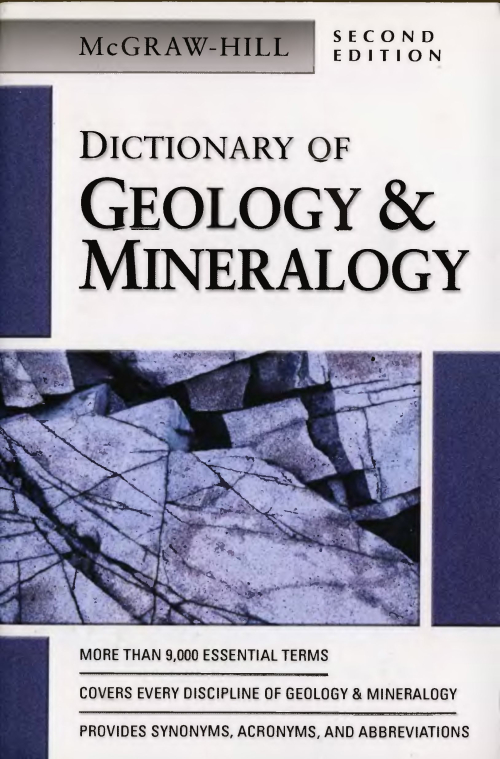
Издание:McGraw-Hill Book Company, New York, 2003 г., 420 стр., ISBN: 0-07-141044-9
Язык(и)Английский
Dictionary of geology & mineralogy / Геолого-минералогический словарь

The McGraw-Hill Dictionary of Geology and Mineralogy provides a compendium of more than 9000 terms that are central to a broad range of geological sciences and related fields. The coverage in this Second Edition is focused on the areas of geochemistry, geology, geophysics, mineralogy, paleobotany, paleontology, and petrology, with new terms added and others revised as necessary.

Geology deals with the solid earth and the processes that formed and modified it as it evolved Related disciplines include the study of the physics of the earth (geophysics); earth chemistry, composition, and chemical changes (geochemistry); the composition, properties, and structure of minerals (mineralogy); the description, classification, origin, and evolution of rocks (petrology); and the study of ancient life (paleontology).

Ленты новостей
620.38