Добрый день, Коллеги. Важное сообщение, просьба принять участие. Музей Ферсмана ищет помощь для реставрационных работ в помещении. Подробности по ссылке

Автор(ы):McGhee Jr.G.R.
Издание:Cambridge University Press, Cambridge, 2007 г., 200 стр., ISBN: 978-0-511-26116-9
Язык(и)Английский
The geometry of evolution

The concept of the adaptive landscape is the creation of the great American geneticist Sewall Wright who, along with the equally great British scientists R. A. Fisher and J.B. S. Haldane, crafted the Neo-Darwinian synthesis of evolutionary theory in the 1930s. The metaphor of the adaptive landscape, that evolution via the process of natural selection could be visualized as a journey across adaptive hills and valleys, mountains and ravines, permeated both evolutionary biology and the philosophy of science through the succeeding years of the twentieth century. Yet critics of the adaptive landscape concept have maintained that the concept is of heuristic value only; that is, it is fine for creating conceptual models, but that you cannot actually use the concept in analysing the evolution of actual animals or plants. That criticism became invalid in the year 1966 when the palaeontologist David M. Raup used computer simulations to model hypothetical life forms that have never existed in the evolution of life on Earth, and who subsequently created the concept of the theoretical morphospace.

The focus of this book is to demonstrate to the reader the power of the adaptive landscape concept in understanding the process of evolution, and to demonstrate that the adaptive landscape concept can be put into actual analytical practice through the usage of theoretical morphospaces. The adaptive landscape concept allows us to visualize the possible effects of natural selection through simple spatial relationships, rather than complicated modelling of changing environmental or ecological conditions. For that reason, this book relies heavily on spatial graphics to convey the concepts developed within these pages, and less so on formal mathematics.

I thank the Santa Fe Institute for the invitation to visit and work on computational methods in theoretical morphology in 2000, for it was at the Santa Fe Institute that the idea of writing this book came to me in conversations with Dave Raup. I thank the Konrad Lorenz Institute for Evolution and Cognition Research for the Fellowship that enabled me to work at the institute in 2005, for it was there that I developed many of the ideas presented in Chapters 7 and 8 of this book. Finally, I thank my wife, Marae, for her patient love.


Автор(ы):Stel H, Veenhof R.P.
Издание:Elsevier, 1991 г., 14 стр.
Язык(и)Английский
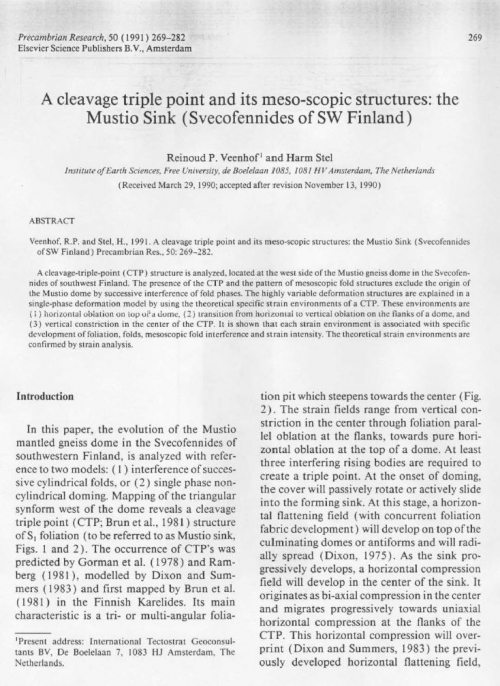
A cleavage triple point and its meso-scopic structures: the Mustio Sink (Svecofennides of SW Finland)

Veenhof, R.P. and Stel, H.. 1991. A cleavage triple point and its meso-scopiс structures: the Mustio Sink (Svecofennides of SW Finland) Precambrian Res., 50: 269-282,

A cleavage-triple-point (CTP) structure is analyzed, located at the west side of the Mustio gneiss dome in the Svecofennides of southwest Finland. The presence of the CTP and the pattern of mesoscopic fold structures exclude the origin of the Mustio dome by successive interference of fold phases. The highly variable deformation structures are explained in a single-phase deformation model by using the theoretical specific strain environments ofa CTP. These environment are (1) horizontal oblation on lop ofa dome, (2) transition from horizontal to vertical obiation on ihe flanks ofa dome, and (3) vertical constriction in the center of the CTP, It is shown that each strain environment is associated with specific development of foliation, folds, mesoscopic fold interference and strain intensity. The theoretical strain environments are confirmed by strain analysis.


Издание:Elsevier, 2003 г., 12 стр.
Язык(и)Английский
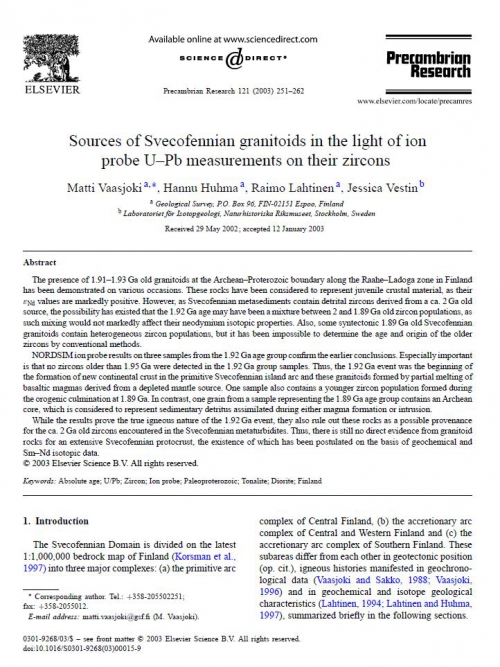
Sources of Svecofennian granitoids in the light of ion probe U–Pb measurements on their zircons

The presence of 1.91–1.93 Ga old granitoids at the Archean–Proterozoic boundary along the Raahe–Ladoga zone in Finland has been demonstrated on various occasions. These rocks have been considered to represent juvenile crustal material, as their εNd values are markedly positive. However, as Svecofennian metasediments contain detrital zircons derived from a ca. 2 Ga old source, the possibility has existed that the 1.92 Ga age may have been a mixture between 2 and 1.89 Ga old zircon populations, as such mixing would not markedly affect their neodymium isotopic properties. Also, some syntectonic 1.89 Ga old Svecofennian granitoids contain heterogeneous zircon populations, but it has been impossible to determine the age and origin of the older zircons by conventional methods.

NORDSIM ion probe results on three samples from the 1.92 Ga age group confirm the earlier conclusions. Especially important is that no zircons older than 1.95 Ga were detected in the 1.92 Ga group samples. Thus, the 1.92 Ga event was the beginning of the formation of new continental crust in the primitive Svecofennian island arc and these granitoids formed by partial melting of basaltic magmas derived from a depleted mantle source. One sample also contains a younger zircon population formed during the orogenic culmination at 1.89 Ga. In contrast, one grain from a sample representing the 1.89 Ga age group contains an Archean core, which is considered to represent sedimentary detritus assimilated during either magma formation or intrusion.

While the results prove the true igneous nature of the 1.92 Ga event, they also rule out these rocks as a possible provenance for the ca. 2 Ga old zircons encountered in the Svecofennian metaturbidites. Thus, there is still no direct evidence from granitoid rocks for an extensive Svecofennian protocrust, the existence of which has been postulated on the basis of geochemical and Sm–Nd isotopic data.

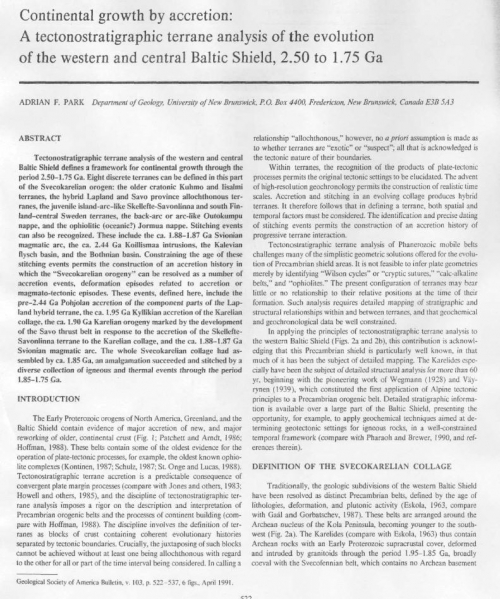
Автор(ы):Park A.F.
Издание:Geology Society of America, 1991 г., 16 стр.
Язык(и)Английский
Continental growth by accretion: A tectonostratigraphic terrane analysis of the evolution of the western and central Baltic Shield / Рост континентов путем аккреции: тектоностратиграфический террейновый анализ эволюции западного и центрального Балтийского

Tectonostratigraphic terrane analysis of the western and central Baltic Shield defines a framework for continental growth through the period 2.50-1,75 Ga, Eight discrete terrenes can he defined in this part of the Svecokarelian orogen: the older cratonic Kuhmo and HsaJmi terranes, the hybrid Lapland and Savo province allochthonous ler-ranes, the juvenile island-arc-I ike Skeltefte-Savonlinna and south Finland-central Sweden terranes. (he back-arc or arc-tike Outokumpu nappe, and the ophiolitic (oceanic?) Jormua nappe. Stitching events can also he recngnized. These include the ca- 1.88-1.87 Ca Svionian magmalic arc, the ca. 2.44 Ca Koillismaa intrusions, the Kalevian flysch basin, and the Bolhnian basin. Constraining the age of these stitching events permits the construction of an accretion history in which the "Svecok3relian orogeny" can be resolved as a number of accretion events, deformation episodes related to accretion or mjgmato-tectonic episodes. These events, defined here, include the pre-2.44 Ca Pohjolan accretion of the component parts of the Lapland hybrid terrane. the ca. 1.95 Ca Kyllikian accretion of the Karelian collage, Ihc ca. 1.90 Ga Karelian orogeny marked by the development of the Savo thrust bell in response to the accretion of the Skellefte-Savonlinna terrane to the Karelian collage, and (he ca. 1.88-1.87 Ga Svionian magmalic arc. The whole Svecokaretian collage had assembled by ca. 1.85 Ca, an amalgamation succeeded and stitched by a diverse collection of igneous and thermal events through the period 1.85-1.75 Ca.

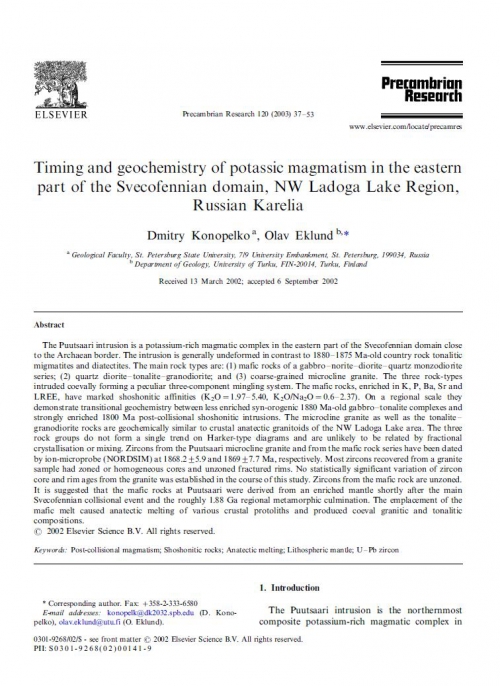
Издание:Elsevier, 2002 г., 17 стр.
Язык(и)Английский
Timing and geochemistry of potassic magmatism in the eastern part of the Svecofennian domain, NW Ladoga Lake Region, Russian Karelia

The Puutsaari intrusion is a potassium-rich magmatic complex in the eastern part of the Svecofennian domain close to the Archaean border. The intrusion is generally undeformed in contrast to 1880-1875 Ma-old country rock tonalitic migmatites and diatectites. The main rock types are: (1) mafic rocks of a gabbro-norite-diorite-quartz monzodiorite series; (2) quartz diorite-tonalite-granodiorite; and (3) coarse-grained microcline granite. The three rock-types intruded coevally forming a peculiar three-component mingling system. The mafic rocks, enriched in K, P, Ba, Sr and LREE, have marked shoshonitic affinities (K2O = 1.97-5.40, K2O/Na2O = 0.6-2.37). On a regional scale they demonstrate transitional geochemistry between less enriched syn-orogenic 1880 Ma-old gabbro-tonalite complexes and strongly enriched 1800 Ma post-collisional shoshonitic intrusions. The microcline granite as well as the tonalite-granodiorite rocks are geochemically similar to crustal anatectic granitoids of the NW Ladoga Lake area. The three rock groups do not form a single trend on Harker-type diagrams and are unlikely to be related by fractional crystallisation or mixing. Zircons from the Puutsaari microcline granite and from the mafic rock series have been dated by ion-microprobe (NORDSIM) at 1868.2 9/ 5.9 and 18699/7.7 Ma, respectively. Most zircons recovered from a granite sample had zoned or homogeneous cores and unzoned fractured rims. No statistically significant variation of zircon core and rim ages from the granite was established in the course of this study. Zircons from the mafic rock are unzoned. It is suggested that the mafic rocks at Puutsaari were derived from an enriched mantle shortly after the main Svecofennian collisional event and the roughly 1.88 Ga regional metamorphic culmination. The emplacement of the mafic melt caused anatectic melting of various crustal protoliths and produced coeval granitic and tonalitic compositions.

Редактор(ы):Newhouse W.H.
Издание:Princeton University Press, New Jersey, 1942 г., 280 стр.
Язык(и)Английский
Ore deposits as related to structural features / Рудные месторождения в зависимости от структурных особенностей

Geologists seldom agree on the relative importance of the several structural features that have localized ore in a given mining district. Such differing views are characteristic of a science in that stage of its growth when sufficient facts have not yet accumulated to test and clarify hypothesis. In most other sciences a worker can bring under his observation the body of data necessary to form and check hypothesis adequately.

The geologist whose material—ore bearing districts—is widely spaced over the earth's crust has a more difficult task. He can study only a few ore bearing districts in detail during a lifetime.

The Committee believed that it could fill a unique need by bringing together facts of structural feature and ore occurrence. Geologists who have had sustained and intimate contact with the ore occurrence in a mine or district were solicited for summary accounts of structural features as related to ore occurrence. The response showed a widespread interest and one deep enough to stimulate production of these data by more than sixty contributors. The Committee is indebted to these men for their labors.                     

The emphasis has been on description, on fact, rather than on theory. However these facts, as is true in any science, are salted by interpretation. The descriptions and opinions given by the contributors are their own. No attempt was made to force a common formula of treatment or a harmony that does not exist. The differences in viewpoint and emphasis present are regarded as a sign of healthy growth. Although many types of structural features and ore deposits are represented, no claim is made for completeness, and no endeavor was made to secure a weighted average of types of relationship.

If this book serves in small part to aid and stimulate further efforts to correlate structural features and ore occurrence, it will have fulfilled its purpose.

Том 1
Редактор(ы):Кутина Я.
Язык(и)Английский, Русский
Конференция проблемы постмагматического рудообразования (с особым вниманием к геохимии рудных жил). Том 1

Настоящий сборник является собранием коротких статей, которые были получены Организационным комитетом Конференции из разных стран. Организационный комитет, руководствуясь стремлением ориентировать авторов представленных статей, опубликовал в первом циркуляре, в котором сообщалось об организации Конференции (циркуляр от 1-го мая 1961 г.) и в некоторых журналах список вопросов, которые должны быть освещены в статьях. Их объем был ограничен пятью страницами машинописи и двумя страницами приложений. Это ограничение было необходимо для того, чтобы не нарушить предполагаемый объем сборника и, кроме того, мы хотели, чтобы статья обобщала состояние знаний по определенной проблеме в той или другой стране, определенной школе или у данного автора, но чтобы она не представляла собой детального изложения фактов.

Том 2
Редактор(ы):Бенешов З., Ридер М., Штемпрок М.
Язык(и)Английский, Русский
Конференция проблемы постмагматического рудообразования (с особым вниманием к геохимии рудных жил). Том 2

В сентябре 1963 года в Чехословакии состоялась Конференция „Проблемы постмагматического рудообразования (с особым вниманием к геохимии рудных жил)". Конференция была организована Центральным геологическим институтом Чехословакии и факультетом естествознания Карлова университета под покровительством Чехословацкой академии наук и при поддержке Международного геохимического общества.

Собственно лекционная и дискуссионная часть Конференции проходила в Праге с 16 по 21 сентября 1963 года. В Конференции приняло участие 292 делегата из 24 стран (в том числе 150 из Чехословакии).

В рамках Конференции были организованы две экскурсии с посещением рудных месторождений, на которых был продемонстрирован материал к некоторым докладам Конференции.

Выпуск 64
Автор(ы):Karki A., Laajoki K., Luukas
Издание:Elsevier, Amsterdam, 1993 г., 17 стр.
Язык(и)Английский
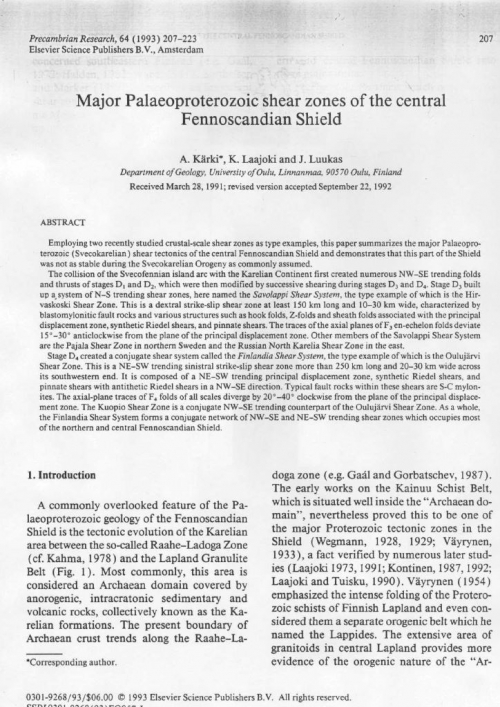
Major Palaeoproterozoic shear zones of the central Fennoscandian Shield

Employing two recently studied crustal-scale shear zones as type examples, this paper summarizes the major Palaeoproterozoic (Svecokarelian) shear tectonics of the central Fennoscandian Shield and demonstrates that this part of the Shield was not as stable during the Svecokarelian Orogeny as commonly assumed.

The collision of the Svecofennian island arc with the Karelian Continent first created numerous NW-SE trending folds and thrusts of stages Di and D2, which were then modified by successive shearing during stages D3 and D4. Stage D3 built up a system of N-S trending shear zones, here named the Savolappi Shear System, the type example of which is the Hir-vaskoski Shear Zone. This is a dextral strike-slip shear zone at least 150 km long and 10-30 km wide, characterized by blastomylonitic fault rocks and various structures such as hook folds, Z-fo!ds and sheath folds associated with the principal displacement zone, synthetic Riedel shears, and pinnate shears. The traces of the axial planes of F3 en-echelon folds deviate 15е—30е anticlockwise from the plane of the principal displacement zone. Other members of the Savolappi Shear System are the Pajala Shear Zone in northern Sweden and the Russian North Karelia Shear Zone in the east.

Stage D4 created a conjugate shear system called the Finlandia Shear System, the type example of which is the Oulujarvi Shear Zone. This is a NE-SW trending sinistral strike-slip shear zone more than 250 km long and 20-30 km wide across its southwestern end. It is composed of a NE-SW trending principal displacement zone, synthetic Riedel shears, and pinnate shears with antithetic Riedel shears in a NW-SE direction. Typical fault rocks within these shears are S-C mylon-ites. The axial-plane traces of F+folds of all scales diverge by 20°-40° clockwise from the plane of the principal displacement zone. The Kuopio Shear Zone is a conjugate NW-SE trending counterpart of the Oulujarvi Shear Zone. As a whole, the Finlandia Shear System forms a conjugate network of NW-SE and NE-SW trending shear zones which occupies most of the northern and central Fennoscandian Shield.

Выпуск 64
Автор(ы):Ehler C., Lindroos A., Slonen O.
Издание:Elsevier, Amsterdam, 1993 г., 15 стр.
Язык(и)Английский
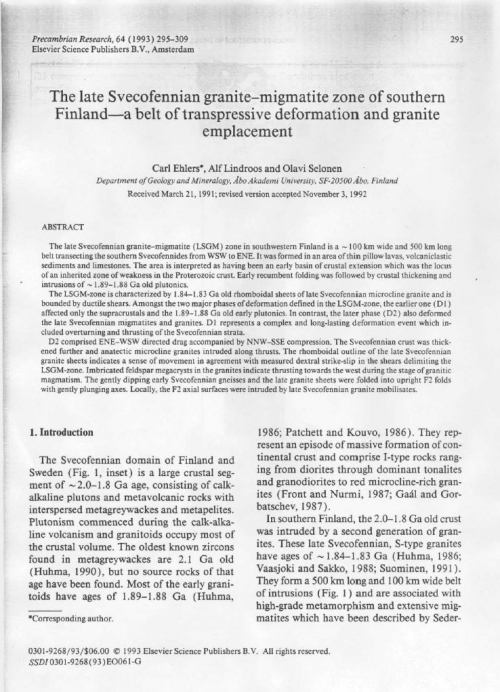
The late Svecofennian granite-migmatite zone of southern Finland—a belt of transpressive deformation and granite emplacement

The late Svecofennian granite-migmatite (LSGM) zone in southwestern Finland is a ~ 100 km wide and 500 km long bell transecting the southern Svecofennides from WSW to ENE. It was formed in an area of thin pillow lavas, volcaniciastic sediments and limestones. The area is interpreted as having been an early basin of crustal extension which was the locus ofan inherited zone of weakness in the Proterozoic crust. Early recumbent folding was followed by crustal thickening and intrusions of - 1.89-1.88 Ga old plutonics.

The LSGM-zone is characterized by 1.84-1.83 Ga old rhomboidal sheets of late Svecofennian microctine granite and is bounded by ductile shears. Amongst the two major phases of deformation defined in the LSGM-zone, the earlier one (D1) affected only the supracrustals and the 1.89-1.88 Ga old early plutonics. In contrast, the later phase (D2) also deformed the late Svecofennian migmatites and granites. Dl represents a complex and long-lasting deformation event which included overturning and thrusting of the Svecofennian strata.

D2 comprised ENE-WSW directed drag accompanied by NNW-SSE compression. The Svecofennian crust was thickened further and anatectic microcline granites intruded along thrusts. The rhomboidal outline of the late Svecofennian granite sheets indicates a sense of movement in agreement with measured dextral strike-slip in the shears delimiting the LSGM-zone. Imbricated feldspar megacrysts in the granites indicate thrusting towards the west during the stage of granitic magmatism. The gently dipping early Svecofennian gneisses and the late granite sheets were folded into upright F2 folds with gently plunging axes. Locally, the F2 axial surfaces were intruded by late Svecofennian granite mobilisates.


Ленты новостей
576.2