Добрый день, Коллеги. Важное сообщение, просьба принять участие. Музей Ферсмана ищет помощь для реставрационных работ в помещении. Подробности по ссылке

Том 41, Выпуск 6
Издание:Journal Geotectonics, 2007 г., 17 стр.
Язык(и)Английский
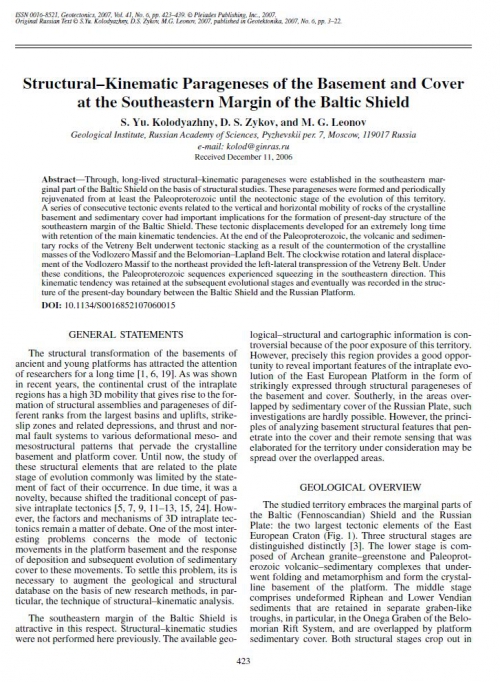
Structural–kinematic parageneses of the basement and cover at the southeastern margin of the Baltic Shield

Through, long-lived structural–kinematic parageneses were established in the southeastern marginal part of the Baltic Shield on the basis of structural studies. These parageneses were formed and periodically rejuvenated from at least the Paleoproterozoic until the neotectonic stage of the evolution of this territory. A series of consecutive tectonic events related to the vertical and horizontal mobility of rocks of the crystalline basement and sedimentary cover had important implications for the formation of present-day structure of the southeastern margin of the Baltic Shield. These tectonic displacements developed for an extremely long time with retention of the main kinematic tendencies. At the end of the Paleoproterozoic, the volcanic and sedimentary rocks of the Vetreny Belt underwent tectonic stacking as a result of the countermotion of the crystalline masses of the Vodlozero Massif and the Belomorian–Lapland Belt. The clockwise rotation and lateral displacement of the Vodlozero Massif to the northeast provided the left-lateral transpression of the Vetreny Belt. Under these conditions, the Paleoproterozoic sequences experienced squeezing in the southeastern direction. This kinematic tendency was retained at the subsequent evolutional stages and eventually was recorded in the structure of the present-day boundary between the Baltic Shield and the Russian Platform.


Автор(ы):Groves D., Hall G., Wijns C.
Издание:Barossa Valley, 2004 г., 4 стр.
Язык(и)Английский
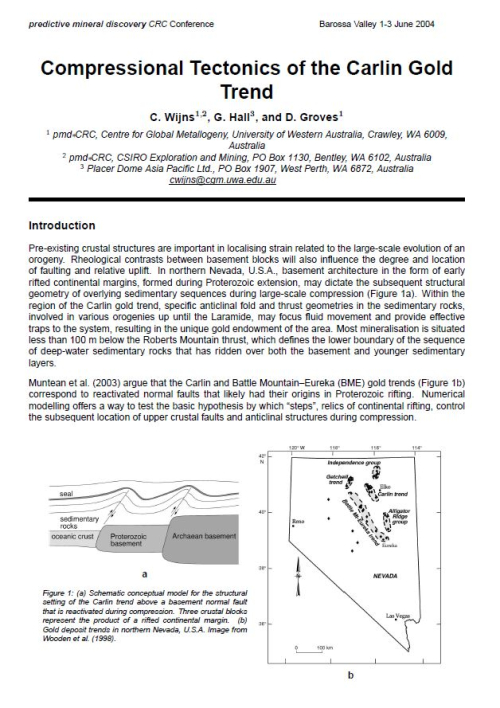
Compressional tectonics of the carlin gold trend / Тектоника сжатия золоторудной зоны карлинского типа

Pre-existing crustal structures are important in localising strain related to the large-scale evolution of an orogeny. Rheological contrasts between basement blocks will also influence the degree and location of faulting and relative uplift. In northern Nevada, U.S.A., basement architecture in the form of early rifted continental margins, formed during Proterozoic extension, may dictate the subsequent structural geometry of overlying sedimentary sequences during large-scale compression (Figure 1a). Within the region of the Carlin gold trend, specific anticlinal fold and thrust geometries in the sedimentary rocks, involved in various orogenies up until the Laramide, may focus fluid movement and provide effective traps to the system, resulting in the unique gold endowment of the area. Most mineralisation is situated less than 100 m below the Roberts Mountain thrust, which defines the lower boundary of the sequence of deep-water sedimentary rocks that has ridden over both the basement and younger sedimentary layers.

Muntean et al. (2003) argue that the Carlin and Battle Mountain–Eureka (BME) gold trends (Figure 1b) correspond to reactivated normal faults that likely had their origins in Proterozoic rifting. Numerical modelling offers a way to test the basic hypothesis by which “steps”, relics of continental rifting, control the subsequent location of upper crustal faults and anticlinal structures during compression.

Выпуск 23
Издание:Terra Nova, 2011 г., 9 стр.
Язык(и)Английский
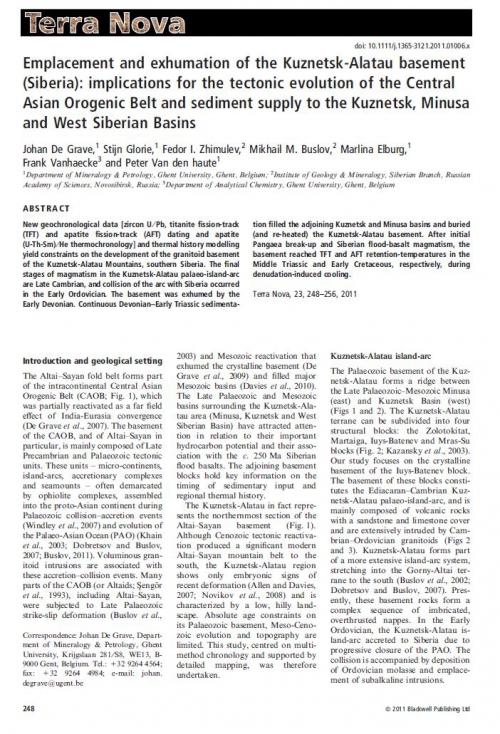
Emplacement and exhumation of the Kuznetsk-Alatau basement (Siberia): implications for the tectonic evolution of the Central Asian Orogenic Belt and sediment supply to the Kuznetsk, Minusa and West Siberian Basins

New geochronological data [zircon U ⁄Pb, titanite fission-track (TFT) and apatite fission-track (AFT) dating and apatite (U-Th-Sm)/He thermochronology] and thermal history modelling yield constraints on the development of the granitoid basement of the Kuznetsk-Alatau Mountains, southern Siberia. The final stages of magmatism in the Kuznetsk-Alatau palaeo-island-arc are Late Cambrian, and collision of the arc with Siberia occurred in the Early Ordovician. The basement was exhumed by the Early Devonian. Continuous Devonian–Early Triassic sedimenta-

tion filled the adjoining Kuznetsk and Minusa basins and buried (and re-heated) the Kuznetsk-Alatau basement. After initial Pangaea break-up and Siberian flood-basalt magmatism, the basement reached TFT and AFT retention-temperatures in the Middle Triassic and Early Cretaceous, respectively, during denudation-induced cooling.


Том 17, Выпуск 11
Издание:Elsevier, 1993 г., 11 стр.
Язык(и)Английский
Comparative rheological behaviour of albite and quartz in siliceous schists revealed by the microboudinage of piedmontite

This paper presents a detailed comparison of the microboudinage of piedmontite in two different mineralogical hosts, a quartz matrix, and albite porphyroblasts in a siliceous schist, with the aim of clarifying the rheological properties of albite in relation to those of quartz. Stress and strain analyses of the microboudinage confirm that the boudinage took place in the retrograde stage of metamorphism during decreasing temperature, and reveal that albite deformed at the same strain rate as quartz above the plastic-brittle transition temperature of albite.

Том 428, Выпуск 4
Издание:Доклады Академии наук, 2009 г., 4 стр.
Язык(и)Английский
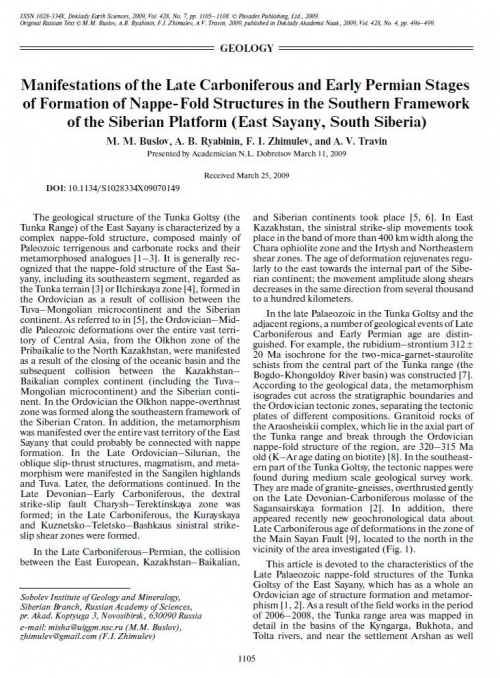
Manifestations of the late carboniferous and early permian stages of formation of nappe-fold structures in the southern framework of the Siberian platform (East Sayany, South Siberia)

Проявления позднекаменноугольного и раннепермского этапов формирования покровно-складчатых структур в южном обрамлении Сибирской платформы (Восточные Саяны, Южная Сибирь)


The geological structure of the Tunka Goltsy (the Tunka Range) of the East Sayany is characterized by a complex nappe-fold structure, composed mainly of Paleozoic terrigenous and carbonate rocks and their metamorphosed analogues [1–3]. It is generally recognized that the nappe-fold structure of the East Sa-yany, including its southeastern segment, regarded as the Tunka terrain [3] or Ilchirskaya zone [4], formed in the Ordovician as a result of collision between the Tuva–Mongolian microcontinent and the Siberian continent. As referred to in [5], the Ordovician–Mid-dle Paleozoic deformations over the entire vast territory of Central Asia, from the Olkhon zone of the Pribaikalie to the North Kazakhstan, were manifested as a result of the closing of the oceanic basin and the subsequent collision between the Kazakhstan– Baikalian complex continent (including the Tuva– Mongolian microcontinent) and the Siberian continent. In the Ordovician the Olkhon nappe-overthrust zone was formed along the southeastern framework of the Siberian Craton. In addition, the metamorphism was manifested over the entire vast territory of the East Sayany that could probably be connected with nappe formation. In the Late Ordovician–Silurian, the oblique slip-thrust structures, magmatism, and meta-morphism were manifested in the Sangilen highlands and Tuva. Later, the deformations continued. In the Late Devonian–Early Carboniferous, the dextral strike-slip fault Charysh–Terektinskaya zone was formed; in the Late Carboniferous, the Kurayskaya and Kuznetsko–Teletsko–Bashkaus sinistral strike-slip shear zones were formed.


Автор(ы):Clifford T.N.
Издание:Earth and planetary science letters, Amsterdam, 1966 г., 14 стр.
Язык(и)Английский
Tectono-metallogenic units and metallogenic provinces of Africa

When the major mineral deposits of Africa are studied in relation to the structure of the continent, two tectono-metallogenic units emerge, as follows: (a) younger orogens consisting of zones which have suffered orogenesis from time to time during the past ca. 1200 m.y. - characterised by major deposits of Cu, Pb, Zn, Co. Sn, W, Be and Nb-Ta; and (b) older cratons, with a record of older orogenesis but which have remained stable throughout the younger periods of tectonism - characterised by important deposits of Au, Fe, Cr, asbestos and diamond. The more localised metallogenic provinces of ore con­centration within these major units are briefly discussed.

Том 20, Выпуск 11
Автор(ы):Hippertt J.F., Hong F.D.
Издание:Elsevier, 1998 г., 14 стр.
Язык(и)Английский
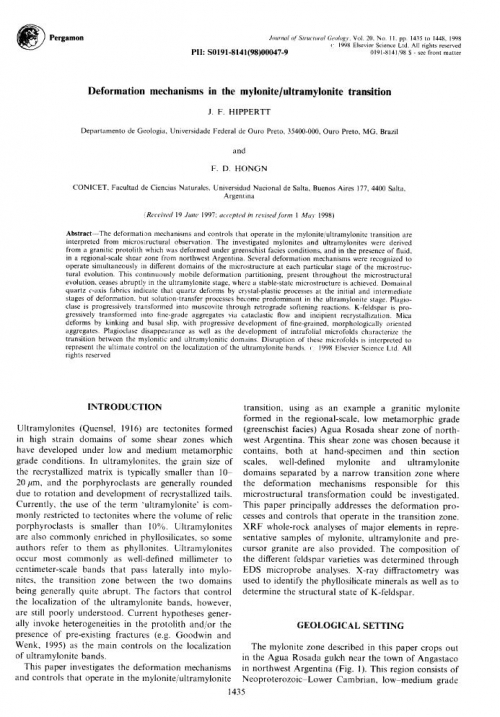
Deformation mechanisms in the mylonite/ultramylonite transition

The deformation mechanisms and controls that operate in the mylonite/ultramylonite transition are interpreted from microstructural observation. The investigated mylonites and ultramylonites were derived from a granitic protolith which was deformed under greenschist facies conditions, and in the presence of fluid, in a regional-scale shear zone from northwest Argentina. Several deformation mechanisms were recognized to operate simultaneously in different domains of the microstructure at each particular stage of the microstructural evolution. This continuously mobile deformation partitioning, present throughout the microstructural evolution, ceases abruptly in the ultramylonite stage, where a stable-state microstructure is achieved. Domainal quartz c-axis fabrics indicate that quartz deforms by crystal-plastic processes at the initial and intermediate stages of deformation, but solution-transfer processes become predominant in the ultramylonite stage. Plagio-clase is progressively transformed into muscovite through retrograde softening reactions. K-feldspar is progressively transformed into fine-grade aggregates via cataclastic flow and incipient recrystallization. Mica deforms by kinking and basal slip, with progressive development of fine-grained, morphologically oriented aggregates. Plagioclase disappearance as well as the development of intrafolial microfolds characterize the transition between the mylonitic and ultramylonitic domains. Disruption of these microfolds is interpreted to represent the ultimate control on the localization of the ultramylonite bands, с 1998 Elsevier Science Ltd. All rights reserved

Издание:Russian Geology and Geophysics, 1999 г., 7 стр., УДК: 550.384 + 551.2
Язык(и)Английский
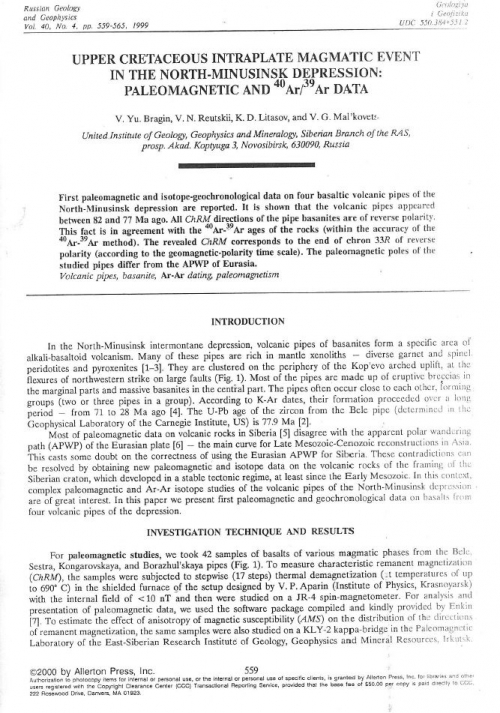
Upper cretaceous intraplate magmatic event in the North-Minusinsk depression: paleomagnetic and 40Ar/39Ar data

First paleomagnetic and isotope-geochronological data on four basaltic volcanic pipes of the North-Minusinsk depression are reported. It is shown that the volcanic pipes appeared between 82 and 77 Ma ago. All ChRM directions of the pipe basanites are of reverse polarity. This fact is in agreement with the 40Ar-?9Ar ages of the rocks (within the accuracy of the 40Ar-39Ar method). The revealed ChRM corresponds to the end of chron 33R of reverse polarity (according to the geomagnetic-polarity time scale). The paleomagnetic poles of the studied pipes differ from the APWP of Eurasia.

In the North-Minusinsk intermontane depression, volcanic

Издание:Economic geology, 2005 г., 34 стр.
Язык(и)Английский
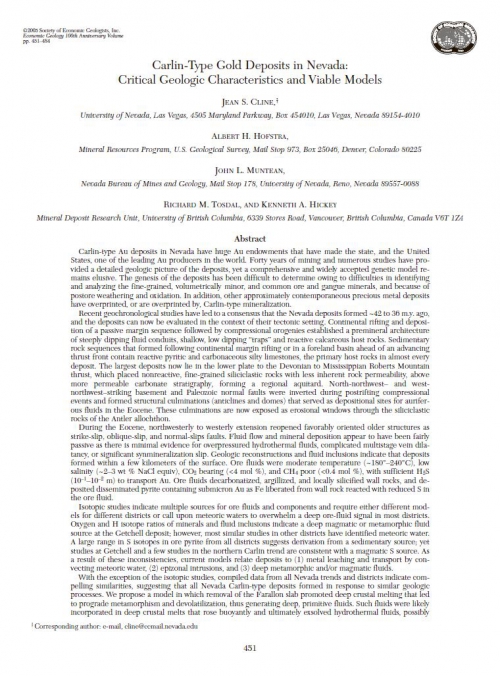
Carlin-type gold deposits in Nevada: critical geologic characteristics and viable models

Carlin-type Au deposits in Nevada have huge Au endowments that have made the state, and the United States, one of the leading Au producers in the world. Forty years of mining and numerous studies have provided a detailed geologic picture of the deposits, yet a comprehensive and widely accepted genetic model remains elusive. The genesis of the deposits has been difficult to determine owing to difficulties in identifying and analyzing the fine-grained, volumetrically minor, and common ore and gangue minerals, and because of postore weathering and oxidation. In addition, other approximately contemporaneous precious metal deposits have overprinted, or are overprinted by, Carlin-type mineralization.

Автор(ы):Barnes C.G., Bray E.A., Ressel M.W.
Издание:U.S. Geological survey, Reston, 2007 г., 62 стр., ISBN: 1411317769
Язык(и)Английский
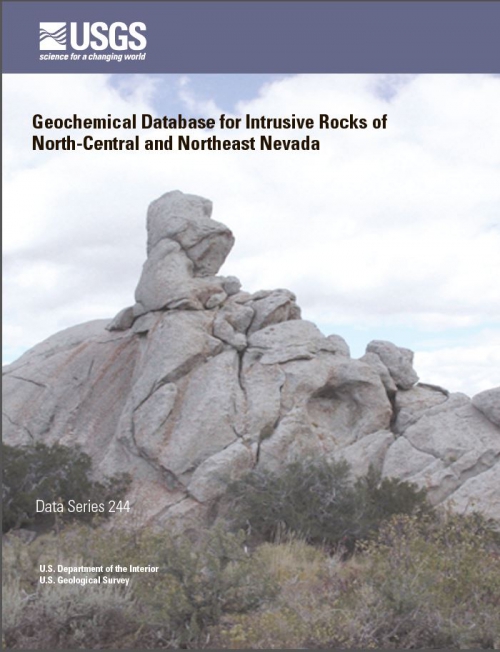
Geochemical database for intrusive rocks of north-central and northeast Nevada

Data presented in this report pertain to the igneous intrusions of north-central and northeast Nevada and were compiled as part of the Metallogeny of the Great Basin project conducted by the U.S. Geological Survey between 2001 and 2007. The geographic area addressed in this compilation is approximately bounded by lats 38.5° and 42°N., long 118.5° W., and the Nevada-Utah border (fig. 1). The area contains numerous large plutons and smaller stocks but also contains many small, shallowly emplaced intrusive bodies, including dikes, sills, and intrusive lava dome complexes. The age, composition, and geographic distribution of intrusions in north-central and northeast Nevada (hereafter, the study area) are summarized by du Bray and Crafford (2007). Intrusive igneous rocks, of multiple ages, are known to be major constituents of the geologic framework in the study area (Stewart and Carlson, 1978). Abundant middle to late Mesozoic and early to middle Cenozoic intrusions in the study area are probably byproducts of subduction-related processes, including back-arc magmatism, that prevailed along the west edge of the North American plate during this interval.

Ленты новостей
574.58