Добрый день, Коллеги. Важное сообщение, просьба принять участие. Музей Ферсмана ищет помощь для реставрационных работ в помещении. Подробности по ссылке

Том 41, Выпуск 3
Издание:Journal Geotectonics, 2007 г., 21 стр.
Язык(и)Английский
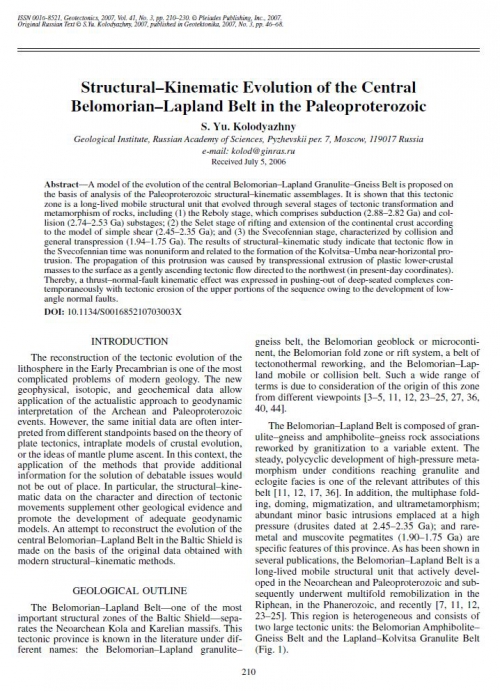
Structural–kinematic evolution of the central Belomorian–Lapland belt in the paleoproterozoic

A model of the evolution of the central Belomorian–Lapland Granulite–Gneiss Belt is proposed on the basis of analysis of the Paleoproterozoic structural–kinematic assemblages. It is shown that this tectonic zone is a long-lived mobile structural unit that evolved through several stages of tectonic transformation and metamorphism of rocks, including (1) the Reboly stage, which comprises subduction (2.88–2.82 Ga) and collision (2.74–2.53 Ga) substages; (2) the Selet stage of rifting and extension of the continental crust according to the model of simple shear (2.45–2.35 Ga); and (3) the Svecofennian stage, characterized by collision and general transpression (1.94–1.75 Ga). The results of structural–kinematic study indicate that tectonic flow in the Svecofennian time was nonuniform and related to the formation of the Kolvitsa–Umba near-horizontal protrusion. The propagation of this protrusion was caused by transpressional extrusion of plastic lower-crustal masses to the surface as a gently ascending tectonic flow directed to the northwest (in present-day coordinates). Thereby, a thrust–normal-fault kinematic effect was expressed in pushing-out of deep-seated complexes contemporaneously with tectonic erosion of the upper portions of the sequence owing to the development of low-angle normal faults.


Издание:Economic geology, 2009 г., 8 стр.
Язык(и)Английский
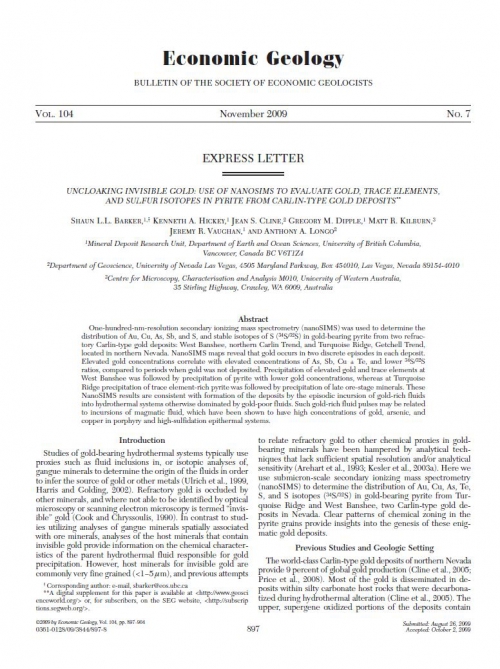
Uncloaking invisible gold: use of nanosims to evaluate gold, trace elements, and sulfur isotopes in pyrite from Carlin-type gold deposits

Вскрытие невидимого золота: использование наноразмеров для оценки содержания золота, микроэлементов и изотопов серы в пирите из золоторудных месторождений типа Карлин


One-hundred-nm-resolution secondary ionizing mass spectrometry (nanoSIMS) was used to determine the distribution of Au, Cu, As, Sb, and S, and stable isotopes of S (34S/32S) in gold-bearing pyrite from two refractory Carlin-type gold deposits: West Banshee, northern Carlin Trend, and Turquoise Ridge, Getchell Trend, located in northern Nevada. NanoSIMS maps reveal that gold occurs in two discrete episodes in each deposit. Elevated gold concentrations correlate with elevated concentrations of As, Sb, Cu ± Te, and lower 34S/32S ratios, compared to periods when gold was not deposited. Precipitation of elevated gold and trace elements at West Banshee was followed by precipitation of pyrite with lower gold concentrations, whereas at Turquoise Ridge precipitation of trace element-rich pyrite was followed by precipitation of late ore-stage minerals. These NanoSIMS results are consistent with formation of the deposits by the episodic incursion of gold-rich fluids into hydrothermal systems otherwise dominated by gold-poor fluids. Such gold-rich fluid pulses may be related to incursions of magmatic fluid, which have been shown to have high concentrations of gold, arsenic, and copper in porphyry and high-sulfidation epithermal systems.

Автор(ы):Reyment A.R., Savazi E.
Издание:Elsevier, 1999 г., 285 стр., ISBN: 0-444-82568-1
Язык(и)Английский
Aspects of multivariate statistical analysis in geology / Аспекты многомерного статистического анализа в геологии

Multivariate statistical methods have become commonplace in the Earth Sciences. What was once an exclusive area of activity is now within the reach of Everyman, owing to the ubiquitousness of mini-computers and the ready availability of software for doing the computing. In the days when one was required to do one's own programming, it was necessary to acquire considerable proficiency in linear algebra and one or more programming languages. Today, the vast majority of the people who use multivariate methods to analyse geological data have little or no idea of the matrix operations underlying a particular method, nor, for that matter, what the program is actually supposed to be doing. This situation can be both good and bad. It can do no harm if everything goes according to schedule, the program being used is competently constructed, which, alas, is far from being the general case, and there are no strong deviations from standard statistical theory in the data under examination. It is bad if the data do not fit the theoretical requirements of a particular method and even worse if the method of computation used is inappropriate. It is an inescapable and sad fact of life that much geological and biological material deviates in some manner or other from the theoretical requirements of a multivariate statistical procedure. The immediate relevance of this observation is that there are many sources of error in doing an analysis of geological data by means of standard statistical software.

Издание 2
Автор(ы):Bell F.G.
Издание:Elsevier, 2007 г., 593 стр., ISBN: 978-0-7506-8007-6
Язык(и)Английский
Engineering geology / Инженерная геология

As noted in the Preface to the first edition, engineering geology can be defined as the application of Geology to engineering practice. In other words, it is concerned with those geological factors that influence the location, design, construction and maintenance of engineering works. Accordingly, it draws on a number of geological disciplines such as geomorphology, structural geology, sedimentology, petrology and stratigraphy. In addition, engineering geology involves hydrogeology and some understanding of rock and soil mechanics.

Similar to the first edition, this edition too is written for undergraduate and post-graduate students of engineering geology. It is hoped that this will also be of value to those involved in the profession, especially at the earlier stages of their careers. However, it is aimed at not just engineering geologists but also at those in civil and mining engineering, water engineering, quarrying and, to a lesser extent, architecture, planning, surveying and building. In other words, those who deal with the ground should know something about it.


Автор(ы):Paor D.G.D.
Издание:Elsevier, 1996 г., 545 стр., ISBN: 0-08-042430-9
Язык(и)Английский
Structural geology and personal computers / Структурная геология и персональный компьютер

Some thirty years ago, structural geology underwent a revolution that fundamentally changed how we think about the deformation of rocks. Regional field observations and laboratory data were given profound new meaning in terms of the global model of lithospheric behavior called "Plate Tectonics". Today structural geologists are witnessing a second revolution and although it is of a very different, less fundamental, type it will clearly have a profound and lasting effect on our field. This new revolution has been fuelled by the widespread use of the personal computer which has become the principal tool of scientists worldwide for data storage or retrieval, teaching, communication with colleagues, number crunching, modeling, and preparation of publications.

Издание:80 стр.
Язык(и)Английский, Русский
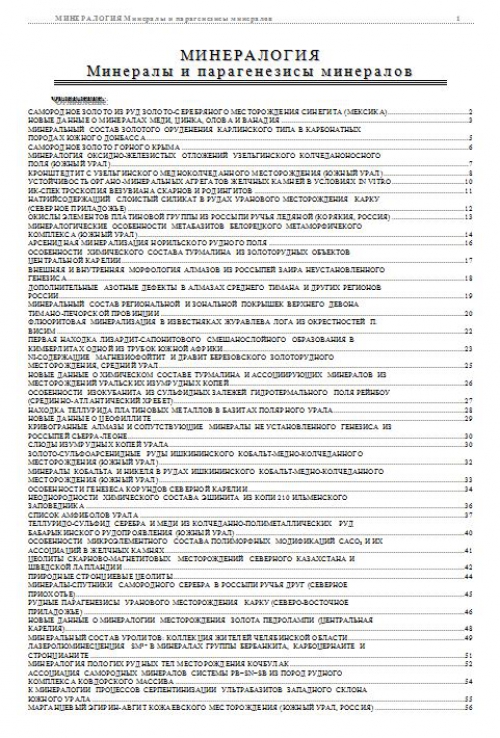
Минералогия. Минералы и парагенезисы минералов. Сборник статей

Оглавление:

  1. Самородное золото из руд золото-серебряного месторождения Синегита (Мексика)
  2. Новые данные о минералах меди, цинка, олова и ванадия
  3. Минеральный состав золотого оруденения Карлинского типа в карбонатах южного Донабасса
  4. Самородное золото горного Крыма
  5. Минералогия оксидно-железистых отложений Узельгиенского колчеданоносного поля (Южный Урал)
  6. Кронштедтит с Узельгинского медноколчеданного месторождения (Южный Урал)
  7. Устойчивость органо-минеральных агрегатов желчных камней в условиях IN VITRO
  8. ИК-спектроскопия везувиана скарнов и родингитов
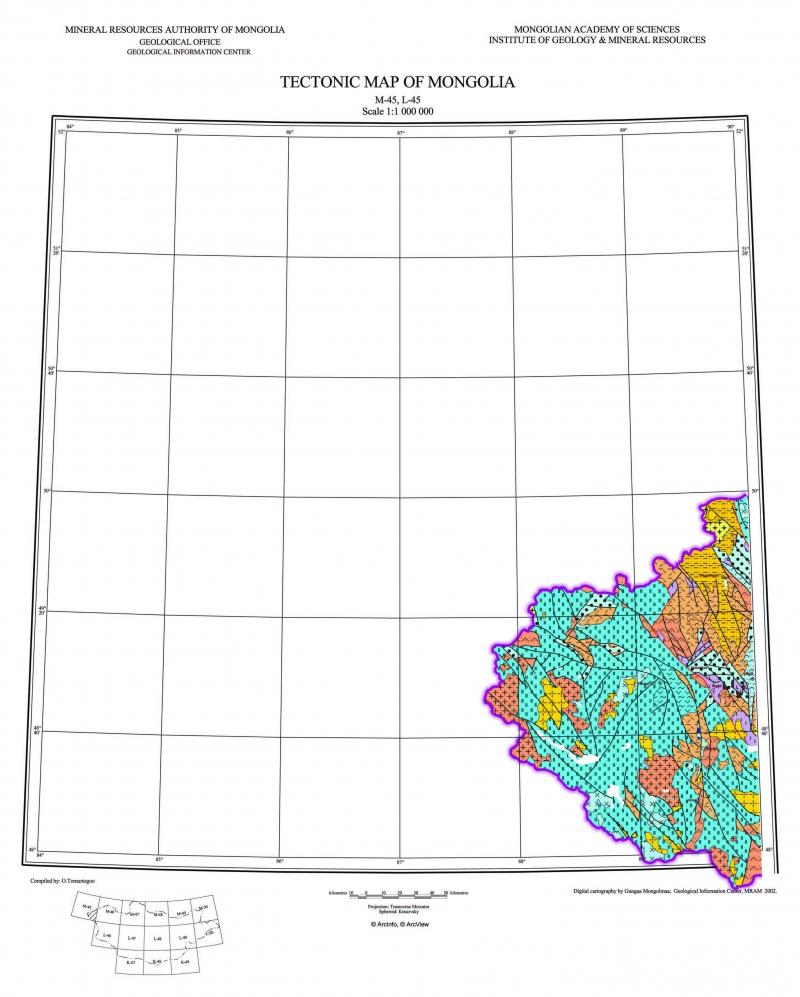
Tectonic of Mongolia / Атлас тектонических карт Монголии
Карта составлена:Geological information center of the mineral resources authority of Mongolia, Institute of geology and mineral resourse of the Mongolian Academi of Science, 2002 г.
Редактор(ы):Tomurtogoo O.
Язык(и)Английский
Масштаб:1:1000000
Назначение карты:Тектоническая карта
МеткиМонголия (146)
Примечание:A quarter of century passed since the first publication of the Tectonic Map of Mongolia at a scale of 1:1,500,000 [68]. Since then earth science has been enriched by new geodynamic paradigms and methods of regional tectonic research, and much has been learned about the geology of Mongolia by new findings on the stratigraphy, petrology, geochemistry, and mineral resources. In addition, the desire to build a new free-market economy in Mongolia requires further development of the mineral resources of the country, which in turn demands more geologic research in order to find new mineral deposits. These circumstances led the Ministry of Industry and Trade of Mongolia (MIT) to publish a Tectonic Map of Mongolia at a scale of 1:1,000,000 as part of the government program to create a unified geological database. Under the direction of the MIT, a Tectonic Map of Mongolia was compiled at the Institute of Geology and Mineral Resources (IGMR) of the Mongolian Academy of Sciences (MAS), and the Geological Information Center (GIC) of the Mineral Resources Authority of Mongolia (MRAM) prepared the digital version of the Map in English and Mongolian.
Скачать
Карта (1.05M)
На странице представлен материал:Тектоническая карта: Tectonic of Mongolia / Атлас тектонических карт Монголии, масштаб: 1:1000000 , составлена: Geological information center of the mineral resources authority of Mongolia, Institute of geology and mineral resourse of the Mongolian Academi of Science, 2002 г., редактор(ы): Tomurtogoo O.
Издание:Доклады Академии наук, 2010 г., 5 стр.
Язык(и)Английский
New Data on the Structural Setting and 40Ar/39Ar Age of the MP–LP Metamorphism of the Daulet Formation, Kokchetav Metamorphic Belt, Northern Kazakhstan, and Their Tectonic Interpretation

Новые данные о структурном положении и возрасте 40Ar/39Ar метаморфизма MP–LP Даулетской свиты, Кокчетавский метаморфический пояс, Северный Казахстан, и их тектоническая интерпретация


Ultra-high-pressure (UHP) and high-pressure (HP) metamorphic complexes in continental subduc-tion zones are spatially associated with younger medium-pressure (MP) and low pressure (LP) meta-morphic rocks [1]. It is a controversial question whether these MP–LP rocks are formed by the contact effect of exhumed hot nappe stack of UHP–HP rocks on the underlying rocks (by analogy with meta-morphic base of obducted ophiolite allochthon) or result from later syncollisional metamorphism related to crustal thickening and granite magmatism. MP and LP metamorphic complexes with inverted metamor-phic zoning are known in the collisional Himalaya nappe-thrust system [2, 3]. Structurally, they are confined to the overthrusting of the Himalayas onto the Indian continent along the Main Central Thrust. The MP (garnet–kyanite–staurolite) and LP (sillimanite– biotite and biotite) rocks were formed at the initial stage of thrusting (25–15 Ma) and exhumed to the surface by later thrusts and denudation [3].

Редактор(ы):Gluyas J.G., Hichens H.M.
Издание:The Geological Society, Лондон, 2003 г., 960 стр., ISBN: 1-86239-089-4
Язык(и)Английский
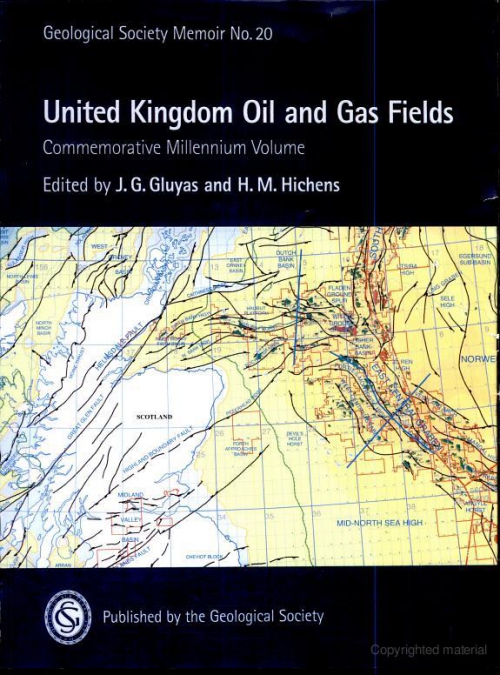
United Kingdom Oil and Gas Fields / Нефтяные и газовые месторождения Великобритании

В книге собрана информация о месторождениях углеводородов Великобритании, находящихся в Северном море и восточной Атлантике (Ирландское море). Для каждого месторождения приведены данные по истории открытия, стратиграфии, строению, коллекторским свойствам, нефтематеринским породам, количеству запасов углеводородов, системе транспортировки.

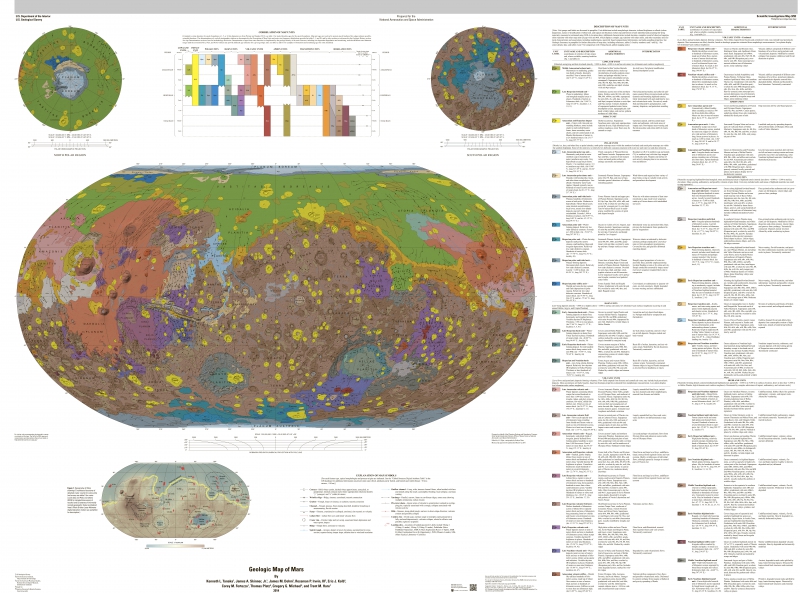
Geologic map of Mars / Геологическая карта Марса
Карта составлена:National Aeronautics and Space Administration, 2014 г.
Редактор(ы):Zigler J.L.
Язык(и)Английский
Масштаб:1:20000000
Серии карт:Геологические карты Марса
Назначение карты:Геологическая карта
МеткиМарс (11)
Скачать
Карта (37.55M)
На странице представлен материал:Геологическая карта: Geologic map of Mars / Геологическая карта Марса, масштаб: 1:20000000 , серия: Геологические карты Марса, составлена: National Aeronautics and Space Administration, 2014 г., редактор(ы): Zigler J.L.
Ленты новостей
549.38