Добрый день, Коллеги. Важное сообщение, просьба принять участие. Музей Ферсмана ищет помощь для реставрационных работ в помещении. Подробности по ссылке

Редактор(ы):Weber L.J., Harris P.M.
Издание:SEMP, Tulsa, 2006 г., 469 стр.
Язык(и)Английский
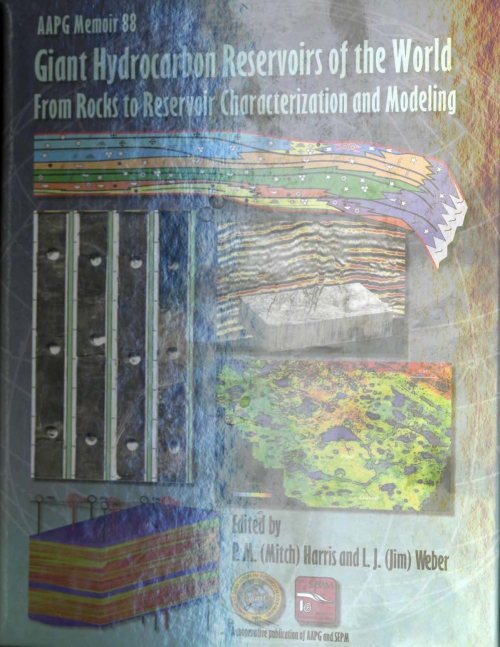
Giant hydrocarbon reservoirs of the world from rocks to reservoir characterization and modeling / Гигантские залежи углеводородов в мире: от горных пород до определения характеристик и моделирования коллекторов

The SEPM/AAPG core workshop "Giant Hydrocarbon Reservoirs of the World: From Rocks to Reservoir Characterization and Modeling" and this companion publication are an attempt to assemble information on giant (>500 MOEB recoverable reserves) reservoirs that is of value to a wide audience. Various examples and methods of reservoir characterization, development, and modeling practices are documented in this volume. Although far from exhaustive, this compilation includes a wide range of reservoirs when examined from any perspective, i.e., location, geology, production history, and characterization. Figure 1 shows the geographic distribution of the reservoir examples that are included in this volume.

Издание:Журнал "Geodynamics & Tectonophysics", Иркутск, 2013 г., 34 стр.
Язык(и)Английский, Русский
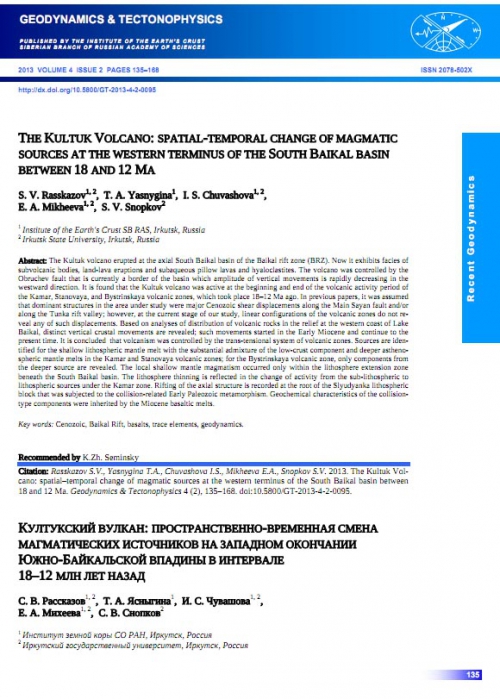
Култукский вулкан - пространственно-временная смена магматических источников на западном окончании Южно-Байкальской впадины в интервале 18-12 млн. лет назад

На  западном окончании осевой Южно­-Байкальской впадины Байкальской рифтовой зоны, в постройке Култукского вулкана, представлены фации субвулканических тел, наземных лавовых извержений и подводных извержений подушечных лав и гиалокластитов. Вулкан контролировался Обручевским разломом. В настоящее время этот разлом ограничивает впадину с быстро уменьшающейся к  западу амплитудой вертикальных движений. Уста­
новлена активность вулкана в начале и в конце лавовых извержений, происходивших во временном интервале 18–12 млн лет назад в трех вулканических зонах: Камарской, Становой и Быстринской. В предшествующих работах предполагалось, что на территории исследований преобладали кайнозойские крупномасштабные сдвиговые смещения по 
Главному Саянскому разлому или вдоль Тункинской рифтовой долины. Согласно авторской реконструкции линейной конфигурации вулканических зон, такие смещения на данном этапе исследований не обнаружены. По распределению разновозрастных вулканических пород в рельефе выявлены ярко выраженные вертикальные движения коры, начинавшиеся в раннем миоцене и продолжающиеся до настоящего времени. Сделан вывод о контроле вулканизма транстенсионной системой вулканических зон. В Камарской и Становой зонах определены источники малоглубинных выплавок из мантийной части литосферы с существенной примесью нижнекорового компонента и более  глубинные – из астеносферной мантии, в Быстринской – только более глубинные. Локальный малоглубинный мантийный магматизм был пространственно ограничен областью растяжения литосферы под Южно­-Байкальской впадиной. 
Утонение литосферы отражено в смене активности подлитосферных источников литосферными под Камарской зоной. Рифтогенез осевой структуры фиксировался в корневой части Слюдянского литосферного блока, претерпевшего раннепалеозойский синколлизионный метаморфизм. Миоценовыми базальтовыми выплавками унаследованы гео­
химические характеристики, свойственные компонентам коллизионных обстановок.

Том 47, Выпуск 4
Издание:Russian Geology and Geophysics, 2006 г., 17 стр., УДК: 551.24:552.48 (574)
Язык(и)Английский
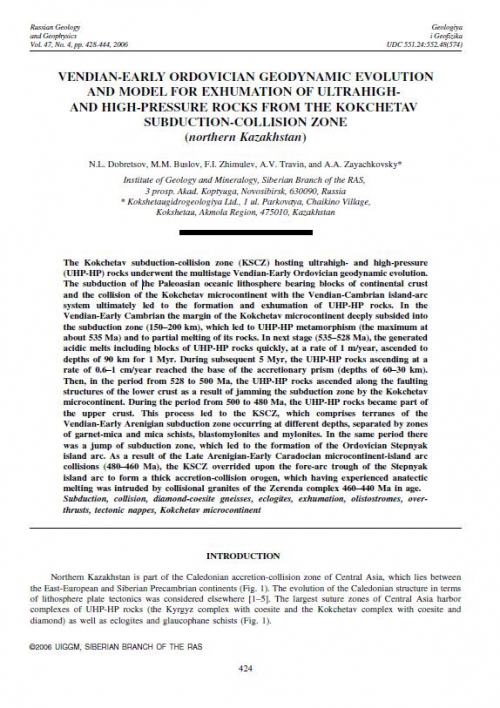
Vendian-early ordovican geodynamic evolution and model for exhumation of ultrahigh- and high-pressure rocks from the Kokchetav subduction-collision zone (northern Kazakhstan)

The Kokchetav subduction-collision zone (KSCZ) hosting ultrahigh- and high-pressure (UHP-HP) rocks underwent the multistage Vendian-Early Ordovician geodynamic evolution. The subduction of the Paleoasian oceanic lithosphere bearing blocks of continental crust and the collision of the Kokchetav microcontinent with the Vendian-Cambrian island-arc system ultimately led to the formation and exhumation of UHP-HP rocks. In the Vendian-Early Cambrian the margin of the Kokchetav microcontinent deeply subsided into the subduction zone (150–200 km), which led to UHP-HP metamorphism (the maximum at about 535 Ma) and to partial melting of its rocks. In next stage (535–528 Ma), the generated acidic melts including blocks of UHP-HP rocks quickly, at a rate of 1 m/year, ascended to depths of 90 km for 1 Myr. During subsequent 5 Myr, the UHP-HP rocks ascending at a rate of 0.6–1 cm/year reached the base of the accretionary prism (depths of 60–30 km). Then, in the period from 528 to 500 Ma, the UHP-HP rocks ascended along the faulting structures of the lower crust as a result of jamming the subduction zone by the Kokchetav microcontinent. During the period from 500 to 480 Ma, the UHP-HP rocks became part of the upper crust. This process led to the KSCZ, which comprises terranes of the Vendian-Early Arenigian subduction zone occurring at different depths, separated by zones of garnet-mica and mica schists, blastomylonites and mylonites. In the same period there was a jump of subduction zone, which led to the formation of the Ordovician Stepnyak island arc. As a result of the Late Arenigian-Early Caradocian microcontinent-island arc collisions (480–460 Ma), the KSCZ overrided upon the fore-arc trough of the Stepnyak island arc to form a thick accretion-collision orogen, which having experienced anatectic melting was intruded by collisional granites of the Zerenda complex 460–440 Ma in age.

Автор(ы):Fowler T.J.
Издание:Journal of Structural Geology, 1996 г., 17 стр.
Язык(и)Английский
Flexural-slip generated bedding-parallel veins from central Victoria, Australia

Thin continuous laminated bedding-parallel quartz veins (BPVs) with slip-striated and fibred vein walls occur within slates, or at their contact with sandstones, on the limbs of chevron folds in the Bendigc-Castlemaine goldfields, southeastern Australia. Two microstructural Types of BPV (I and II) have been previously recognized, and are confirmed in this study. Both types are concluded to have formed during and/or after crenulation cleavage (the first tectonic axial planar structure) in the wallrock slates, and during flexural-slip folding. Type I BPVs consist of syntaxial phyllosilicate inclusion trails, parallel to bedding, enclosing inclined inclusion bands, the latter formed by detachment of wallrock phyllosilicate particles from the walls of pressure solution-segmented discordant tension veins. Type I BPVs are formed by bedding-parallel shear, and grow in width by propagation of the discordant veins into the BPV walls. Type II veins are composed of quartz bands separated by wallrock slate seams which have split away from the vein wall during dilatant shear opening. They incorporate numerous torn-apart fragments of crenulated wallrock slate. Type I BPV inclusion band average spacing of 0.5 mm probably represents the magnitude of slip increments during stick-slip flexural-slip folding activity

Автор(ы):Arehart G.B.
Издание:Department of Geology Science, Reno, 4 стр.
Язык(и)Английский
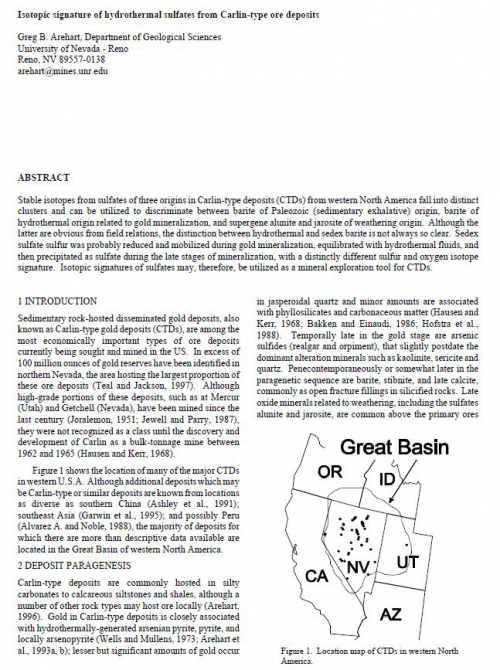
Isotopic signature of hydrothermal sulfares from Carlin-type ore deposit

Stable isotopes from sulfates of three origins in Carlin-type deposits (CTDs) from western North America fall into distinct clusters and can be utilized to discriminate between barite of Paleozoic (sedimentary exhalative) origin, barite of hydrothermal origin related to gold mineralization, and supergene alunite and jarosite of weathering origin. Although the latter are obvious from field relations, the distinction between hydrothermal and sedex barite is not always so clear. Sedex sulfate sulfur was probably reduced and mobilized during gold mineralization, equilibrated with hydrothermal fluids, and then precipitated as sulfate during the late stages of mineralization, with a distinctly different sulfur and oxygen isotope signature. Isotopic signatures of sulfates may, therefore, be utilized as a mineral exploration tool for CTDs.


Автор(ы):Dawson J.B., Hawthorne J.B.
Язык(и)Английский
Magmatic sedimentation and carbonatitic brentiation in kimberlite sills at Benfontein, South Afric

At Benfontein, near Kimberley, South Africa, three sills of kimberlite intrude Dwyka shales and overlying Karroo dolerite. Each sill results from numerous injections of kimberlite that have consolidated to give the sill a layered appearance. Many layers - show magmatic sedimentation features and cumulus textures, and, although some show in situ differentiation, other layers result from pre-injection differ­entiations The transporting, intercumulus liquid was carbonate-rich and some layers have differentiated to form a carbonate rock composed of the intercumulus calcite; this, on trace element and isotopic data, shows strong affinities with carbonatite. In one of the sills 'one calcite layer has migrated diapirically into overlying layers in.the sill. These sedimentation features, combined with thermal metamorphism of country-rock shales and the presence of quench calcite and apatite, are interpreted as evidence that the kimberlite was injected as a highly mobile fluid, comprising megacrysts of olivine, garnet, pyroxene, mica and picroilmenite in a hot carbonatitic liquid from which olivine, magnetic spinel, perov-skite, apatite, calcite, dolomite, ankerite and quartz crystallised. The evidence that the transportation medium was a warm carbon­atitic liquid is directly opposed to earlier hypotheses proposing that kimberlite is intruded as a cold or plastic paste, and also supports proposals of a genetic link between kimberlite and carbonatite.


Том 17, Выпуск 10
Автор(ы):Gray D.J., Stewart J., Tan B.K.
Издание:Journal of Structural Geology, 1995 г., 8 стр.
Язык(и)Английский
Volume change accompanying cleavage development in graptolitic shales from Gisborne, Victoria, Australia

Studies on shape changes in deformed Oncograptus upsilon combined with strain analysis of pressure shadows around framboidal pyrite revealed that a small volume change of the order of 5 percent accompanied the cleavage development in the shales from Gisborne, Victoria. Starting from the proximal end, Oncograptus upsilon exhibits progressive increase in the spacing between successive thecae along the stipes. A new technique utilizing the distance between a specific number of thecae is used for computing the change in length along stipes of Oncograptus upsilon. The low volume change, accompanying a more than 70 percent shortening deformation, indicates that there is a less significant mass loss during cleavage development than has been inferred from some studies on volume change from thecal spacing in deformed graptolites.


Издание:22 стр.
Язык(и)Английский
Diachronous subduction to diamond- and coesite-facies conditions in the Kokchetav massif

The absolute and relative time of subduction of rocks is crucial information for subduction-exhumation models. We investigated the timing of subduction in one of the oldest ultra-high pressure (UHP) localities worldwide: the Kokchetav massif in Kazakhstan. SHRIMP ion microprobe dating of monazite from coesite-bearing micaschists of the Kulet unit indicates that subduction occurred between ~500-520 Ma. This new data provides evidence that the Kulet unit underwent UHP metamorphism 10-15 Ma later than the diamond-facies rocks in the nearby Kumdy-Kol unit. This time constrain excludes models that argue for a simultaneous evolution of coesite- and diamond-facies rocks, it suggest that subduction continued well after continental crust was involved, and that exhumation was not initiated by a single event such as slab break-off. The dynamic of this UHP massif also indicates that Cambrian tectonic was similar to that of recent orogenic belts.

Автор(ы):Jackson M., Lewis Teal
Издание:2002 г., 11 стр.
Язык(и)Английский
Geologic overview of the Carlin trend gold deposits / Геологический обзор золоторудных месторождений Карлин-Тренд

The Carlin trend in northeastern Nevada forms the largest and most productive accumulation of gold deposits in North America. Teal and Jackson (1997b) reported a gold endowment that by the end of 1996 included past production, reserves, resources, and mineral inventory of over 107 million ounces (3,330 t [metric tons]). More than 40 separate deposits have been delineated since disseminated gold mineralization in carbonate host rocks was first discovered by Newmont geologists John Livermore and Alan Coope in 1961. From their original discovery, a classification for this style of gold mineralization has come to be referred to as “Carlin-type” deposits. By early 2002, more than 50 million ounces (1,560 t) of gold had been recovered on the Carlin trend from 26 separate operating or past producing mines. Open-pit mining began in 1965 at the Carlin Mine, and underground mining began in 1993 on the same deposit.

The scope of this paper is to present a regional geologic setting of the Carlin trend. As part of the concluding discussion, a spectrum of Carlin trend deposit types is categorized to illustrate the relative influence of structural and stratigraphic controls on each deposit.

Выпуск 44
Издание:Journal of Asian Earth Sciences, 2012 г., 20 стр.
Язык(и)Английский
Late palaeozoic and meso-cenozoic tectonic evolution of the southern Kyrgyz Tien Shan: constraints from multi-method thermochronology in the Trans-Alai, Turkestan-Alai segment and the southeastern Ferghana Basin

In this paper we present new geochronological and thermochronological data from the Turkestan-Alai segment of the southern Kyrgyz Tien Shan, the Ferghana Basin transition and the Trans-Alai Pamir foreland. In the southern and central parts of the Alai Range, towards the Alai Valley, mainly post-collisional granitoids were targeted for zircon U/Pb dating by Laser Ablation-Inductively Coupled Plasma-Mass Spectrometry (LA-ICP-MS), apatite fission-track (AFT) and apatite (U-Th-Sm)/He (AHe) thermochronology. These granitoids, and their thermally metamorphosed contact aureole, yielded Middle Permian zircon crystallization ages of 284 ± 4 to 264 ± 5 Ma. AFT ages (both using the traditional external detector approach as well as using LA-ICP-MS) for these samples are constrained to the Miocene and range between 22.3 ±1.1 and 8.4 ±0.3 Ma, while the AHe ages are somewhat younger, between 12.5 ±0.8 and 5.0 ± 0.3 Ma. This low-temperature thermochronological data suggests an Early Miocene onset of denudation in this area in the Tien Shan orogen, continuing through the Miocene and Pliocene. This denudation is interpreted as a response to reactivation of the mountain belt in the framework of India-Eurasia convergence, and specific to this region, of the Pamir-Tien Shan interaction. On the northern slopes of the Alai Range, at the edge of the Ferghana Basin, a Late Palaeozoic conglomerate yielded a reset Early Cretaceous AFT age of 118 ± 7 Ma, pointing to an older denudation event with respect to those identified in the southern and central parts of the Alai Range. A Mesozoic sediment sample from the same region only contains a Late Triassic age component of ~223 Ma. Mesozoic and Cenozoic age components on the other hand are all detected in the Cenozoic sediments of the Trans-Alai Range, at the transition between the southern Alai Valley and the Pamirs, revealing several Meso-Cenozoic denudation events in the adjoining basement source rocks. The age components in these detrital apatites are ~207 Ma, ~75 Ma, ~18 Ma and ~3 Ma.

Ленты новостей
555.8