Добрый день, Коллеги. Важное сообщение, просьба принять участие. Музей Ферсмана ищет помощь для реставрационных работ в помещении. Подробности по ссылке

Выпуск 342
Автор(ы):Godard G., Kunze K., Mauler A.
Издание:Journal Tectonophysics, 2001 г., 32 стр.
Язык(и)Английский
Crystallographic fabrics of omphacite, rutile and quartz in Vendee eclogites (Armorican Massif, France). Consequences for deformation mechanisms and regimes

This study aims at further understanding of the mechanisms how lattice-preferred orientations (LPO) develop during deformation in the main eclogite minerals. Microstructures and textures of deformed eclogites from the Les Essarts complex (Western France) were investigated using optical microscopy and electron backscatter diffraction (EBSD) in the scanning electron microscope. Microfabric analyses of eclogite-facies minerals are used to identify their deformation mechanisms, which define the rheology at high-pressure metamorphic conditions. Mechanisms of intracrystalline deformation by dislocation movement (dislocation creep) result usually in a non-linear flow law (typically power law), while diffusive processes (diffusion creep) correspond to linear flow laws. General microstructural observations may suggest intracrystalline deformation (dislocation creep) of omphacite. The omphacite LPO vary between S- and L-type and correlate with oblate or prolate grain shape fabrics, respectively. Until now, these LPO types have not been understood by plasticity models based on dislocation glide on the known slip systems in clinopyroxene. An alternative interpretation is given in terms of anisotropic growth and dissolution, with grain boundary diffusion as the rate controlling process. There are further indications suggesting diffusion creep with concomitant anisotropic growth and dissolution as a main deformation mechanism in omphacite. In omphacite around a hollow garnet, crystallographic and shape fabrics align with the c[001] axes parallel to the grain elongations defining the mineral lineation, which rotates locally with the inferred flow direction. In this part, the grain sizes of omphacite and rutile are larger than in the surrounding matrix. The geometry of both the shape and crystallographic fabrics is interpreted to represent the local stress regime (directions and ratios of the principal stresses). The LPO of rutile duplicate the LPO of omphacite and a similar distinction between S- and L-type was used. Rutile deformation mechanisms probably involve dislocation creep as well as diffusion creep. Quartz mainly occurs as an interstitial phase with weak LPO patterns interpreted as random. No representative obliquity of the LPO in omphacite nor rutile with respect to foliation and lineation was observed to be used as potential shear sense criteria. However, the rutile LPO was slightly rotated relative to the omphacite LPO consistently in most samples. The results suggest that diffusion processes are strongly involved in the deformation of eclogites. A linear flow law should be taken into account in tectonic models where eclogites are incorporated. 

Выпуск 52
Автор(ы):Buslov M.M.
Издание:Russian Geology and Geophysics, 2011 г., 20 стр.
Язык(и)Английский
Tectonics and geodynamics of the Central Asian Foldbelt: the role of Late Paleozoic large-amplitude strike-slip faults / Тектоника и геодинамика Центральноазиатского складчатого пояса: роль позднепалеозойских крупноамплитудных сдвиговых разломов

The following structural elements have been recognized to constitute the tectonic demarcation of Central Asian Foldbelt: (1) The Kazakhstan–Baikal composite continent, its basement formed in Vendian–Cambrian as a result of Paleoasian oceanic crust, along with Precambrian microcontinents and Gondwana-type terranes, subduction beneath the southeastern margin of the Siberian continent (western margin in present-day coordinates). The subduction and subsequent collision of microcontinents and terranes with the Kazakhstan–Tuva–Mongolia island arc led to crustal consolidation and formation of the composite-continent basement. In Late Cambrian and Early Ordovician, this continent was separated from Siberia by the Ob’–Zaisan ocean basin. (2) The Vendian and Paleozoic Siberian continental margin complexes comprising the Vendian–Cambrian Kuznetsk–Altai island arc and the rock complexes of Ordovician–Early Devonian passive margin and Devonian to Early Carboniferous active margin. Fragments of Vendian–Early Cambrian oceanic crust represented by ophiolite and paleo-oceanic mounds dominate in the accretionary wedges of island arc. The Gondwana-type continental blocks are absent in western Siberian continental margin complexes and supposedly formed at the convergent boundary of a different ocean, probably, Paleopacific. (3) The Middle–Late Paleozoic Charysh–Terekta–Ulagan–Sayan suture-shear zone separating the continental margin complexes of Siberia and Kazakhstan–Baikal. It is composed of fragments of Cambrian and Early Ordovician oceanic crust of the Ob’–Zaisan basin, Ordovician blueschists and Cambrian–Ordovician turbidites, and Middle Paleozoic metamorphic rocks of shear zones. In the suture zone, the Kazakhstan–Baikal continental masses moved westward along the southeastern margin of Siberia. In Late Devonian and Early Carboniferous, the continents amalgamated to form the North Asian continent. (4) The Late Paleozoic strike-slip faults forming an orogenic collage of terranes, which resulted from Late Devonian to Early Carboniferous collision between Kazakhstan–Baikal and Siberian continents and Late Carboniferous to Permian and Late Permian to Early Triassic collisions between East European Craton and North Asian continent. As a result, the Vendian to Middle Paleozoic accretion-collisional continental margins of Siberia and the entire Kazakhstan–Baikal composite continent became fragmented by large-amplitude (up to a few thousand kilometers) strike-slip faults and conjugate thrusts into several strike-slip terranes, which mixed with each other and thus disrupted the original geodynamic, tectonic, and paleogeographic demarcation.

Автор(ы):Шахов Ф.Н.
Издание:Akademie Verlag, Berlin, 1971 г., 11 стр.
Язык(и)Английский, Немецкий
Die geschichte der vorstellungen uber die genese der kontaktlagerstatten

The term of "contact-metamorphic deposit" appears in the literature at the beginning of the 19th century. In the course of nearly two centuries its content and views held on the formation of such deposits have changed considerably, as have the complexes of deposits included by various authors in this group. In the author's opinion the development of views on the genesis of these deposits is closely connected with a change experienced by ideas on the process of metamorphism, in particular of contaetmetamorphism, as well as by ideas on the mechanism of action of hot Solutions.

The deposits are not only observed by geologists working in the field of economic geology, but also by scientists concerned with the metamorphism and formation of magmas. This may be the reason for a great number of contradictory views held at the present state of knowledge on this group of deposits. In discussions of their genesis the following contradictory points are answered, with a neglection of the fact that the process of metasomatism itself is not likewise considered:

1) role of the contact in the genesis and systcmatization of contact deposits; 2) the chronological relation between skarn formation and contaetmetamorphism; 3) the sources of volatiles, the source of metals, and the position of sulphidic ore formation within the process of skarn formation; 4) role of passive rocks in the formation of skarns. These problems are discussed by the author in greatest detail.


Издание:Journal Tectonophysics, 2001 г., 17 стр.
Язык(и)Английский
Magma flow directions of shallow dykes from the East Greenland volcanic margin inferred from magnetic fabric studies / Направления движения магмы по неглубоким дамбам от вулканической окраины Восточной Гренландии

The role played by plume-generated crustal magmatic complexes in the segmentation of volcanic margins is highlighted by a preliminary study of magma flow directions in shallow intrusives from the East Greenland volcanic margin. We investigate the magmatic texture using anisotropy of magnetic susceptibility for eight dykes of tholeitic affinity belonging to a dyke swarm associated with the Tertiary opening of the North Atlantic Ocean. The thickness of the sampled dykes ranges from 3 to 37 m. The dykes are of doleritic texture and contain up to 12% of opaque minerals and 35% of plagioclase laths. Dykes showing a magnetic foliation plane within the dyke plane, i.e. a magnetic fabric usually attributed to magmatic processes, represent 40% of the samples from the studied swarm. These dykes have a low degree of anisotropy and their ellipsoid of magnetic susceptibility is strongly oblate. Inverse magnetic fabrics, where the maximum principal susceptibility axis lies near the pole to the dyke account for 60% of the data. We interpret these inverse fabrics either as alteration minerals with highly prolate ellipsoids of magnetic susceptibility or primary titanomagnetites with oblate ellipsoid of low anisotropy. The flow direction is inferred for normal fabric dykes using the mirror imbrication of magnetic lineation. Analysis of thin sections shows a good agreement between magnetic fabric directions and phenocryst preferred orientations. The inferred flow directions are predominantly horizontal, throwing a new light on volcanic margin development. 

Выпуск 26
Автор(ы):Brodie K.H., Rutter E.H.
Издание:Pergamon, 2004 г., 12 стр.
Язык(и)Английский
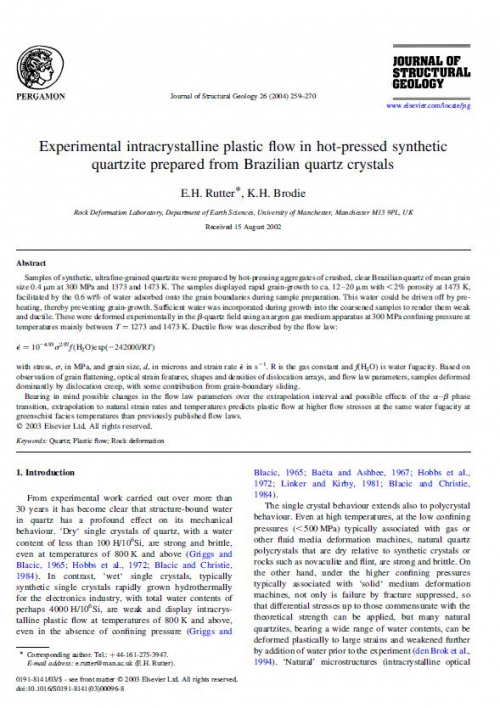
Experimental intracrystalline plastic flow in hot-pressed synthetic quartzite prepared from Brazilian quartz crystals

Samples of synthetic, ultrafine-grained quartzite were prepared by hot-pressing aggregates of crushed, clear Brazilian quartz of mean grain size 0.4 mm at 300 MPa and 1373 and 1473 K. The samples displayed rapid grain-growth to ca. 12–20 mm with ,2% porosity at 1473 K, facilitated by the 0.6 wt% of water adsorbed onto the grain boundaries during sample preparation. This water could be driven off by preheating, thereby preventing grain-growth. Sufficient water was incorporated during growth into the coarsened samples to render them weak and ductile. These were deformed experimentally in the b-quartz field using an argon gas medium apparatus at 300 MPa confining pressure at temperatures mainly between T ¼ 1273 and 1473 K. Ductile flow was described by the flow law


with stress, s, in MPa, and grain size, d, in microns and strain rate e_ in s21. R is the gas constant and f(H2O) is water fugacity. Based on observation of grain flattening, optical strain features, shapes and densities of dislocation arrays, and flow law parameters, samples deformed dominantly by dislocation creep, with some contribution from grain-boundary sliding. Bearing in mind possible changes in the flow law parameters over the extrapolation interval and possible effects of the a–b phase transition, extrapolation to natural strain rates and temperatures predicts plastic flow at higher flow stresses at the same water fugacity at greenschist facies temperatures than previously published flow laws.


Том 46, Выпуск 9
Автор(ы):Buslov M.M., Vovna G.M.
Издание:Journal Geochemistry International, 2008 г., 10 стр.
Язык(и)Английский
Composition and Geodynamic Nature of the Protoliths of Diamondiferous Rocks from the Kumdy-Kol Deposit of the Kokchetav Metamorphic Belt, Northern Kazakhstan

The distribution of rare earth elements was analyzed in the Early Cambrian diamondiferous calcsilicate rocks and gneisses, calciphyres, and marbles of the Kumdy-Kol deposit. These data were compared with the lithogeochemical characteristics of the sedimentary assemblages of weakly metamorphosed Late Precambrian graphite-bearing sedimentary rocks of the Kokchetav metamorphic belt. The obtained results allowed us to suppose that the protoliths of the Kumdy-Kol rocks were compositionally similar to the Late Precambrian graphite-bearing terrigenous–carbonate and sand–shale sequences of the continental shelf of the Kokchetav microcontinent, some of which were transformed in a subduction zone into diamondiferous rocks.

Автор(ы):Talusani R.V.R.
Издание:Journal Ore geology reviews, 2001 г., 7 стр.
Язык(и)Английский
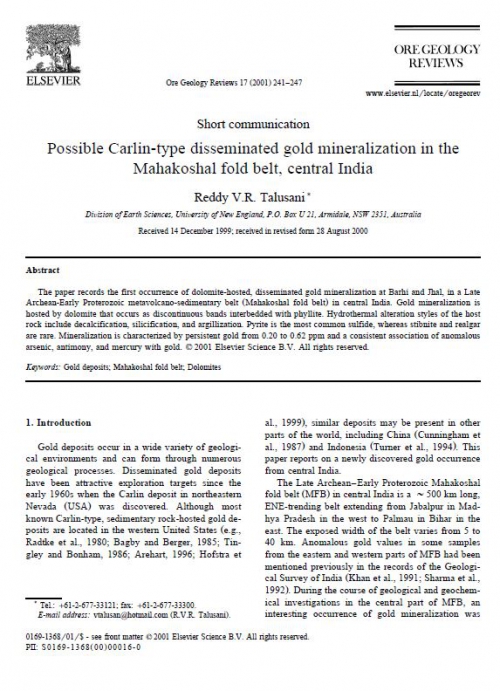
Possible Carlin-type disseminated gold mineralization in the Mahakoshal fold belt, central India

The paper records the first occurrence of dolomite-hosted, disseminated gold mineralization at Barhi and Jhal, in a Late Archean-Early Proterozoic metavolcano-sedimentary belt ŽMahakoshal fold belt. in central India. Gold mineralization is hosted by dolomite that occurs as discontinuous bands interbedded with phyllite. Hydrothermal alteration styles of the host rock include decalcification, silicification, and argillization. Pyrite is the most common sulfide, whereas stibnite and realgar are rare. Mineralization is characterized by persistent gold from 0.20 to 0.62 ppm and a consistent association of anomalous arsenic, antimony, and mercury with gold.

Издание:Journal Tectonophysics, 1997 г., 22 стр.
Язык(и)Английский
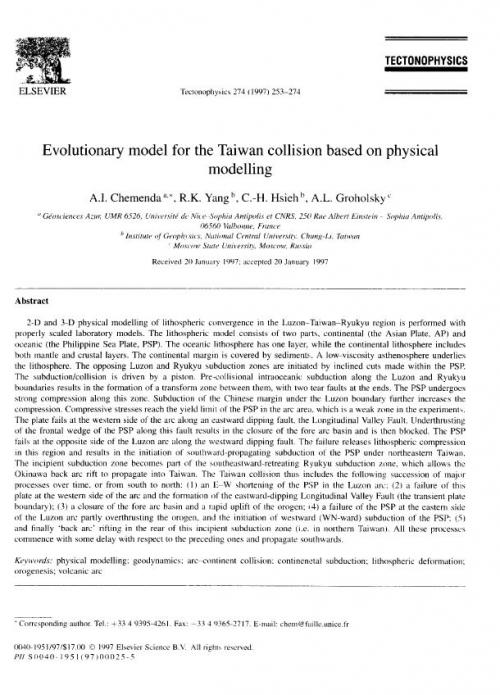
Evolutionary model for the Taiwan collision based on physical modelling

2-D and 3-D physical modelling of lithospheric convergence in the Luzon-Taiwan-Ryukyu region is performed with properly scaled laboratory models. The lithospheric model consists of two pails, continental (the Asian Plate, AP) and oceanic (the Philippine Sea Plate, PSP). The oceanic lithosphere has one layer, while the continental lithosphere includes both mantle and crustal layers. The continental margin is covered by sediments. A low-viscosity asthenosphere underlies the lithosphere. The opposing Luzon and Ryukyu subduction zones are initiated by inclined cuts made within the PSP. The subduction/collision is driven by a piston. Pre-collisional intraoceanic subduction along the Luzon and Ryukyu boundaries results in the formation of a transform zone between them, with two tear faults at the ends. The PSP undergoes strong compression along this zone. Subduction of the Chinese margin under the Luzon boundary further increases the compression. Compressive stresses reach the yield limit of the PSP in the arc area, which is a weak zone in the experiments. The plate fails at the western side of the arc along an eastward dipping fault, the Longitudinal Valley Fault. Underthrusting of the frontal wedge of the PSP along this fault results in the closure of the fore arc basin and is then blocked. The PSP fails at the opposite side of the Luzon arc along the westward dipping fault. The failure releases lithospheric compression in this region and results in the initiation of southward-propagating subduction of the PSP under northeastern Taiwan. The incipient subduction zone becomes part of the southeastward-retreating Ryukyu subduction zone, which allows the Okinawa back arc rift to propagate into Taiwan. The Taiwan collision thus includes the following succession of major processes over time, or from south to north: (1) an L-W shortening of the PSP in the Luzon arc; (2) a failure of this plate at the western side of the arc and the formation of the eastward-dipping Longitudinal Valley Fault (the transient plate boundary); O) a closure of the fore arc basin and a rapid uplift of the orogen; i4) a failure of the PSP at the eastern side of the Luzon arc partly overthrusting the orogen, and the initiation of westward (WN-ward) subduction of the PSP; (5) and finally 'back arc' rifting in the rear of this incipient subduction zone (i.e. in northern Taiwan). All these processes commence with some delay with respect to the preceding ones and propagate southwards.

Издание:Russian Geology and Geophysics, 2011 г., 9 стр.
Язык(и)Английский
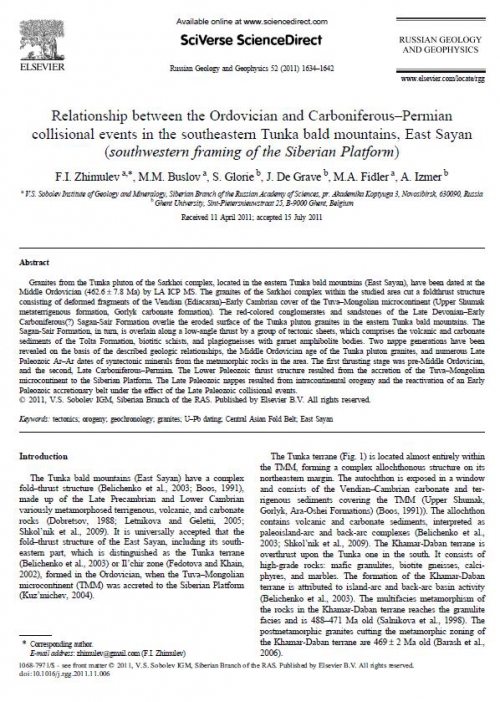
Relationship between the Ordovician and Carboniferous–Permian collisional events in the southeastern Tunka bald mountains, East Sayan (southwestern framing of the Siberian Platform)

Granites from the Tunka pluton of the Sarkhoi complex, located in the eastern Tunka bald mountains (East Sayan), have been dated at the Middle Ordovician (462.6 ± 7.8 Ma) by LA ICP MS. The granites of the Sarkhoi complex within the studied area cut a foldthrust structure consisting of deformed fragments of the Vendian (Ediacaran)–Early Cambrian cover of the Tuva–Mongolian microcontinent (Upper Shumak metaterrigenous formation, Gorlyk carbonate formation). The red-colored conglomerates and sandstones of the Late Devonian–Early Carboniferous(?) Sagan-Sair Formation overlie the eroded surface of the Tunka pluton granites in the eastern Tunka bald mountains. The Sagan-Sair Formation, in turn, is overlain along a low-angle thrust by a group of tectonic sheets, which comprises the volcanic and carbonate sediments of the Tolta Formation, biotitic schists, and plagiogneisses with garnet amphibolite bodies. Two nappe generations have been revealed on the basis of the described geologic relationships, the Middle Ordovician age of the Tunka pluton granites, and numerous Late Paleozoic Ar–Ar dates of syntectonic minerals from the metamorphic rocks in the area. The first thrusting stage was pre-Middle Ordovician, and the second, Late Carboniferous–Permian. The Lower Paleozoic thrust structure resulted from the accretion of the Tuva–Mongolian microcontinent to the Siberian Platform. The Late Paleozoic nappes resulted from intracontinental orogeny and the reactivation of an Early Paleozoic accretionary belt under the effect of the Late Paleozoic collisional events

Выпуск 283
Автор(ы):Canole P., Odonne F., Polve M.
Издание:Journal Tectonophysics, 1997 г., 15 стр.
Язык(и)Английский
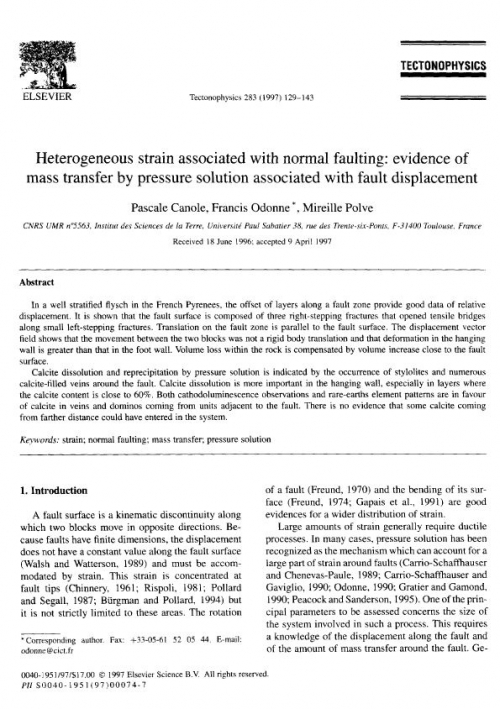
Heterogeneous strain associated with normal faulting evidence of mass transfer by pressure solution associated with fault displacement

In a well stratified flysch in the French Pyrenees, the offset of layers along a fault zone provide good data of relative displacement. It is shown that the fault surface is composed of three right-stepping fractures that opened tensile bridges along small left-stepping fractures. Translation on the fault zone is parallel to the fault surface. The displacement vector field shows that the movement between the two blocks was not a rigid body translation and that deformation in the hanging wall is greater than that in the foot wall. Volume loss within the rock is compensated by volume increase close to the fault surface.

Calcite dissolution and reprecipitation by pressure solution is indicated by the occurrence of stylolites and numerous calcite-filled veins around the fault. Calcite dissolution is more important in the hanging wall, especially in layers where the calcite content is close to 60%. Both cathodoluminescence observations and rare-earths element patterns are in favour of calcite in veins and dominos coming from units adjacent to the fault. There is no evidence that some calcite coming from farther distance could have entered in the system.

Ленты новостей
490.86