Добрый день, Коллеги. Важное сообщение, просьба принять участие. Музей Ферсмана ищет помощь для реставрационных работ в помещении. Подробности по ссылке

Издание:Doklady Earth Science, 2007 г., 4 стр.
Язык(и)Английский
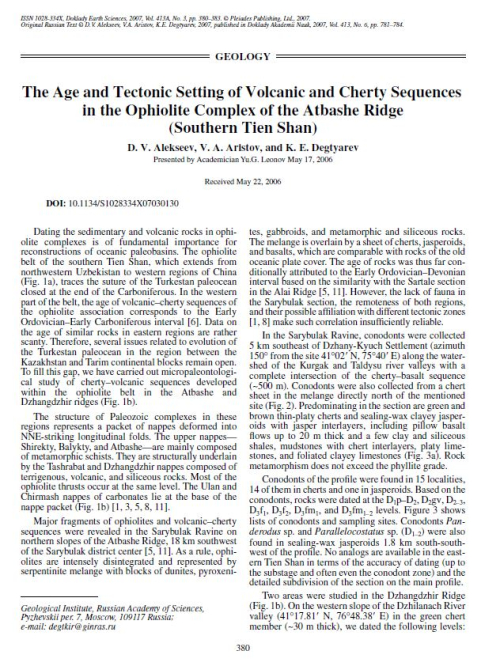
The age and tectonic setting of volcanic and cherty sequences in the ohiolite complex of the Atbashe Ridge (Southern Tien Shan) / Возраст и тектоническая обстановка вулканических и кремнистых отложений в офиолитовом комплексе хребта Атбаше Южный Тянь-Шань

Dating the sedimentary and volcanic rocks in ophiolite complexes is of fundamental importance for reconstructions of oceanic paleobasins. The ophiolite belt of the southern Tien Shan, which extends from northwestern Uzbekistan to western regions of China (Fig. 1a), traces the suture of the Turkestan paleocean closed at the end of the Carboniferous. In the western part of the belt, the age of volcanic–cherty sequences of the ophiolite association corresponds to the Early Ordovician–Early Carboniferous interval [6]. Data on the age of similar rocks in eastern regions are rather scanty. Therefore, several issues related to evolution of the Turkestan paleocean in the region between the Kazakhstan and Tarim continental blocks remain open. To fill this gap, we have carried out micropaleontological study of cherty–volcanic sequences developed within the ophiolite belt in the Atbashe and Dzhangdzhir ridges (Fig. 1b).

The structure of Paleozoic complexes in these regions represents a packet of nappes deformed into NNE-striking longitudinal folds. The upper nappes—Shirekty, Balykty, and Atbashe—are mainly composed of metamorphic schists. They are structurally underlain by the Tashrabat and Dzhangdzhir nappes composed of terrigenous, volcanic, and siliceous rocks. Most of the ophiolite thrusts occur at the same level. The Ulan and Chirmash nappes of carbonates lie at the base of the nappe packet (Fig. 1b) [1, 3, 5, 8, 11]. Major fragments of ophiolites and volcanic–cherty sequences were revealed in the Sarybulak Ravine on northern slopes of the Atbashe Ridge, 18 km southwest of the Sarybulak district center [5, 11]. As a rule, ophiolites are intensely disintegrated and represented by serpentinite melange with blocks of dunites, pyroxenites, gabbroids, and metamorphic and siliceous rocks. The melange is overlain by a sheet of cherts, jasperoids, and basalts, which are comparable with rocks of the old oceanic plate cover. The age of rocks was thus far conditionally attributed to the Early Ordovician–Devonian interval based on the similarity with the Sartale section in the Alai Ridge [5, 11]. However, the lack of fauna in

the Sarybulak section, the remoteness of both regions, and their possible affiliation with different tectonic zones [1, 8] make such correlation insufficiently reliable. <...>


Выпуск 101
Автор(ы):Henry C.D., Ressel M.W.
Издание:Economic geology, 2006 г., 37 стр.
Язык(и)Английский
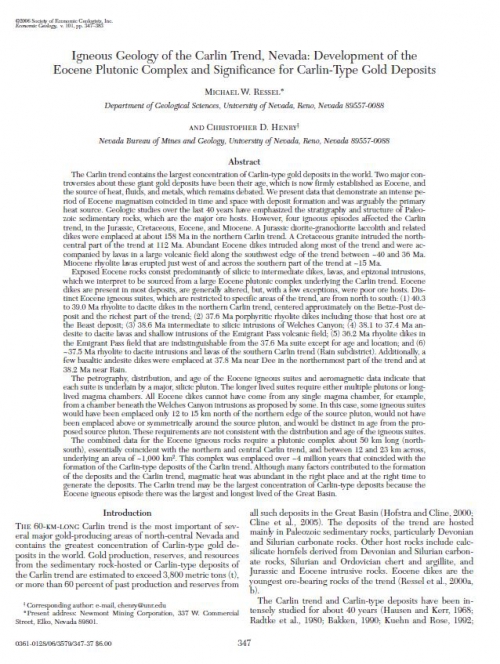
Igneous Geology of the Carlin Trend, Nevada: Development of the Eocene Plutonic Complex and Significance for Carlin-Type Gold Deposits

The Carlin trend contains the largest concentration of Carlin-type gold deposits in the world. Two major controversies about these giant gold deposits have been their age, which is now firmly established as Eocene, and the source of heat, fluids, and metals, which remains debated. We present data that demonstrate an intense period of Eocene magmatism coincided in time and space with deposit formation and was arguably the primary heat source. Geologic studies over the last 40 years have emphasized the stratigraphy and structure of Paleozoic sedimentary rocks, which are the major ore hosts. However, four igneous episodes affected the Carlin trend, in the Jurassic, Cretaceous, Eocene, and Miocene. A Jurassic diorite-granodiorite laccolith and related dikes were emplaced at about 158 Ma in the northern Carlin trend. A Cretaceous granite intruded the northcentral part of the trend at 112 Ma. Abundant Eocene dikes intruded along most of the trend and were accompanied by lavas in a large volcanic field along the southwest edge of the trend between ~40 and 36 Ma. Miocene rhyolite lavas erupted just west of and across the southern part of the trend at ~15 Ma.

Том 47, Выпуск 4
Издание:Russian Geology and Geophysics, 2006 г., 7 стр., УДК: 551.24:48 (574)
Язык(и)Английский
Timing of collision of the Kokchetav massif with Stepnyak Island arc on the basis of conodonts and radiolarians from siliceous rocks of juxtaposed terranes of different geodynamic seetings

The siliceous rocks from structures of the junction zone of the Kokchetav massif and Stepnyak trough that occur in turbidites of the accretionary wedge, silica-volcanogenic sequence of the Stepnyak trough and syntectonic olistostrome were dated on the basis of findings of conodonts and radiolarians within the Middle-Upper Arenigian (conodont zones O. evae, B. navis—lower Par. originalis). This range of time is marked by a powerful tectonic rearrangement, involved with the rearrangement of the accretionary wedge and overriding of the Kokchetav massif upon the Stepnyak fore-arc trough.

Издание:Elsevier, 2000 г., 16 стр.
Язык(и)Английский
Microstructural and textural development of calcite marbles during polyphase deformation of Penninic units within the Tauern Window (Eastern Alps)

The evolution of calcite microstructures and crystallographic preferred orientations (CPOs) is well understood due to well constrained experimental studies. However, the interpretation of naturally deformed calcite marbles is more difficult because of less constrained strain paths, a multiphase deformation history, and variable P–T conditions. The Penninic units within the Tauern Window (Eastern Alps) have been affected by several deformation events and metamorphic overprint. Generally, three major deformational events can be distinguished. D1 is related to underthrusting of Penninic units beneath the Austroalpine nappe complex, and top-to-the-N nappe stacking within the Penninic continental units. Deformation stage D2 is interpreted as reflecting the subsequent continent collision between the Penninic continental units and the European foreland. D3 is related to the formation of the dome structure of the Tauern Window. This polyphase deformation history can be partly reconstructed by the evolution of calcite microfabrics and CPOs.

Издание:Elsevier, 2010 г., 16 стр.
Язык(и)Английский
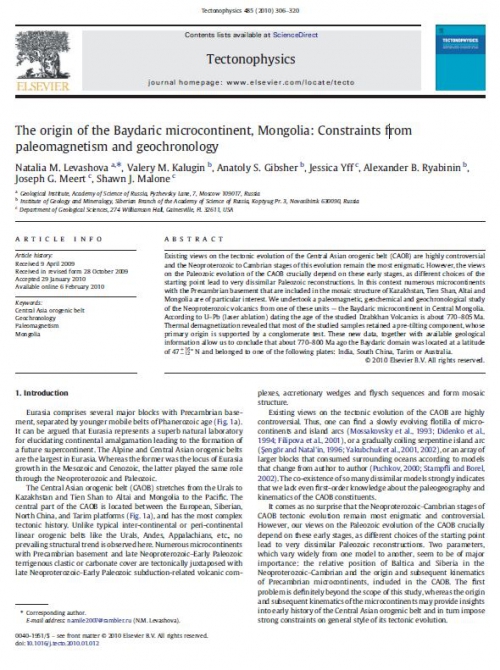
The origin of the Baydaric microcontinent, Mongolia: Constraints from paleomagnetism and geochronology

Existing views on the tectonic evolution of the Central Asian orogenic belt (CAOB) are highly controversial and the Neoproterozoic to Cambrian stages of this evolution remain the most enigmatic. However, the views on the Paleozoic evolution of the CAOB crucially depend on these early stages, as different choices of the starting point lead to very dissimilar Paleozoic reconstructions. In this context numerous microcontinents with the Precambrian basement that are included in the mosaic structure of Kazakhstan, Tien Shan, Altai and Mongolia are of particular interest. We undertook a paleomagnetic, geochemical and geochronological study of the Neoproterozoic volcanics from one of these units — the Baydaric microcontinent in Central Mongolia. According to U–Pb (laser ablation) dating the age of the studied Dzabkhan Volcanics is about 770–805 Ma. Thermal demagnetization revealed that most of the studied samples retained a pre-tilting component, whose primary origin is supported by a conglomerate test. These new data, together with available geological information allow us to conclude that about 770–800 Ma ago the Baydaric domain was located at a latitude of 47 (+16/-12)° N and belonged to one of the following plates: India, South China, Tarim or Australia.

Издание:Ore deposit and exploration technology, 2007 г., 21 стр.
Язык(и)Английский
Models and exploration methods for major gold deposit types / Модели и методы разведки основных типов месторождений золота

Gold occurs as primary commodity in a wide range of gold deposit types and settings. In the last decade, significant progress has been made in the classification, definition and understanding of the main gold deposit types. Three main clans of deposits are now broadly defined, each including a range of specific deposit types with common characteristics and tectonic settings. The orogenic clan has been introduced to include vein-type deposits formed during crustal shortening of their host greenstone, BIF or clastic sedimentary rock sequences. Deposits of the new reduced intrusion-related clan share an Au-Bi-Te-As metal signature and an association with moderately reduced equigranular post-orogenic granitic intrusions. Oxidized intrusion-related deposits, including porphyry, skarn, and high-sulfidation epithermal deposits, are associated with high-level, oxidized porphyry stocks in magmatic arcs. Other important deposit types include Carlin, low-sulfidation epithermal, Au-rich VMS and Witwatersrand deposits. The key geology features of the ore-forming environments and the key geologic manifestations of the different deposit types form the footprints of ore systems that are targeted in exploration programs. Important progress has been made in our ability to integrate, process, and visualize increasingly complex datasets in 2D GIS and 3D platforms. For gold exploration, important geophysical advances include airborne gravity, routine 3D inversions of potential field data, and 3D modeling of electrical data. Improved satellite-, airborne- and field-based infrared spectroscopy has significantly improved alteration mapping around gold systems, extending the dimensions of the footprints and enhancing vectoring capabilities. Conventional geochemistry remains very important to gold exploration, while promising new techniques are being tested. Selection of the appropriate exploration methods must be dictated by the characteristics of the targeted model, its geologic setting, and the surficial environment. Both greenfield and brownfield exploration contributed to the discovery of major gold deposits (>2.5 moz Au) in the last decade but the discovery rates have declined significantly. Geologists are now better equipped than ever to face this difficult challenge, but geological understanding and quality field work were important discovery factors and must remain the key underpinnings of exploration programs.

Издание 2
Издание:Springer, Newfoundland, 2005 г., 421 стр., ISBN: 3-211-23584-1, 978-3-211-23584-3
Язык(и)Английский
Physical Geodesy / Физическая геодезия

Almost the period of one generation has passed since 1967, the year of the first release of Physical Geodesy by Weikko A. Heiskanen and Helmut Moritz. Soon this book became a bestseller. Today, when studying publications dealing with physical geodesy, not surprisingly the book is still frequently quoted. Have the clocks been stopped since then? Not at all, time has flown as fast as usual or maybe even faster - at least in someone's imagination. However, excellent quality is correlated with a long life expectation. This is the reason why "the book" still plays an important role in geodetic science and beyond.

In the last decades, nevertheless, geodesy has certainly continually developed further - on the one hand by new computational methods and ideas and on the other hand by modern measurement techniques. This is where the story of this book starts.

ТематикаГеодезия
МеткиГеодезия (424)
Выпуск 45
Издание:Journal of Asian Earth Sciences, 2012 г., 13 стр.
Язык(и)Английский
Tectonic history of the Irtysh shear zone (NE Kazakhstan): New constraints from zircon U/Pb dating, apatite fission track dating and palaeostress analysis / Тектоническая история Иртышской зоны сдвига (Северо-Восточный Казахстан)

The Irtysh shear zone (ISZ) is an important structure in the framework of the Central Asian Orogenic Belt (CAOB). It represents the site of final collision of Kazakhstan with Siberia during Hercynian times and records up to 1000 km of lateral displacement during subsequent reorganization in the CAOB edifice. We present new zircon U/Pb, apatite fission track and fault kinematic data along the ISZ and consequently derived its tectonic history with emphasis on its formation and reactivation episodes. Carboniferous (340–320 Ma) zircon U/Pb ages were obtained for the syn- and post-collisional Kalba–Narym intrusives, dating their emplacement in the framework of the Siberia–Kazakhstan collision. During this period, the ISZ experienced an ‘early brittle’ left-lateral, mainly transtensional stress regime. Late Carboniferous–Early Permian post-collisional intrusives were emplaced and the stress regime changed to a ‘late brittle regime, characterized by more compressional conditions, indicating rheological strengthening as a response to cessation of ductile shearing and cooling of the ISZ crust. Apatite fission track data and thermal history modeling reveal Late Cretaceous (100–70 Ma) cooling of the ISZ basement rocks as a response to denudation of a bordering Late Mesozoic Altai orogen. After this denudation event, the tectonic activity ceased during the Late Mesozoic–Early Cenozoic. A final step of cooling (from 25 Ma), exhibited by some of the thermal history models, may reflect reactivation of the ISZ and initiation of Cenozoic Altai mountain building. The Late Plio-Pleistocene phase of mountain building coincides with a new change in the Palaeostress field, characterized by minor transpressional, right-lateral shear conditions.

Выпуск 22
Автор(ы):Garlick S.R., Gromet L.P.
Издание:Journal metamorphic Geol, 2004 г., 18 стр.
Язык(и)Английский
Diffusion creep and partial melting in high temperature mylonitic gneisses, Hope Valley shear zone, New England Appalachians, USA

Field, petrographic, microstructural and isotopic studies of mylonitic gneisses and associated pegmatites along the Hope Valley shear zone in southern Rhode Island indicate that late Palaeozoic deformation (c. 275 Ma)in this zone occurred at very high temperatures (>650 C). High-energy cuspate ⁄ lobate phase boundary microstructures, a predominance of equant to sub-equant grains with low internal lattice strain, and mixed phase distributions indicate that diffusion creep was an important and possibly predominant deformation mechanism. Field and petrographic evidence are consistent with the presence of an intergranular melt phase during deformation, some of which collected into syntectonic pegmatites. Rb ⁄ Sr isotopic analyses of tightly sampled pegmatites and wall rocks confirm that the pegmatites were derived as partial melts of the immediately adjacent, isotopically heterogeneous mylonitic gneisses. The presence of syntectonic interstitial melts is inferred to have permitted a switch from dislocation creep to melt-enhanced diffusion creep as the dominant mechanism in these relatively coarse-grained mylonitic gneisses (200–500 lm syn-deformational grain size). A switch to diffusion creep would lead to significant weakening, and may explain why the Hope Valley shear zone evolved into a major regional tectonic boundary. This work identifies conditions under which diffusion creep operates in naturally deformed granitic rocks and illuminates the deformation processes involved in the development of a tectonic boundary between two distinct Late Proterozoic (Avalonian)basement terranes.

Автор(ы):Marino F.
Издание:University of Nevada, Reno, 2003 г., 27 стр.
Язык(и)Английский
Structural and mineralogical features of the deep post gold deposit, Northern Carlin Trend, Nevada

PLAN:

1. INTRODUCTION

2. OBJECTIVES

3. HISTORY AND PREVIOUS WORK

4. METHODS

5. GEOLOGY AT DEEP POST MINE

6. Stratigraphy

7. Structures

8. HYDROTHERMAL ALTERATION

9. MINERALIZATION

10. MODEL AND CONCLUSIONS

Ленты новостей
975.02