Добрый день, Коллеги. Важное сообщение, просьба принять участие. Музей Ферсмана ищет помощь для реставрационных работ в помещении. Подробности по ссылке
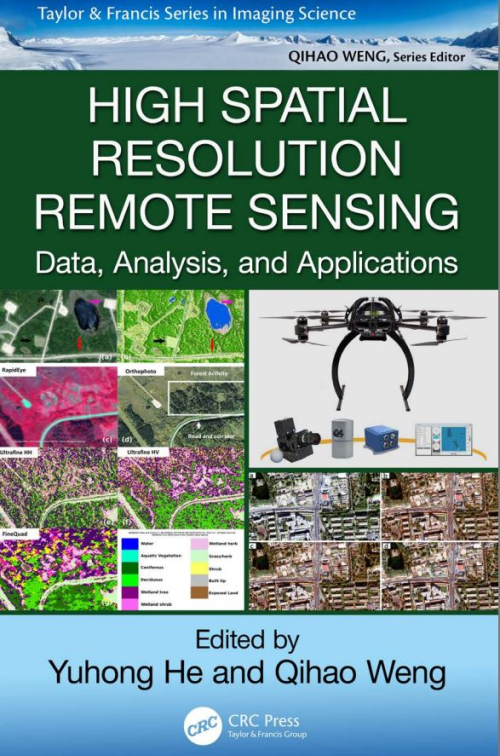
High spatial resolution data provide a novel data source for addressing environmental questions with an unprecedented level of detail. These remote sensing data are a result of significant advances in image acquisition platforms and sensors, including satellite, manned aircraft, and unmanned aerial vehicle (UAV) platforms. Furthermore, the recent development of commercially operated satellite platforms with high spatial resolution sensors allows for the collection of a large amount of images at regular time intervals, with relatively large footprints (i.e., image swathes).
This volume is a collection of lectures presented during the 2009 International School on High-pressure Crystallography, which took place at the Ettore Majorana Center for Scientific Culture, between June 4 and 14, 2009, in the very picturesque Sicilian town of Erice. The 2009 school was the 41st course of the “International School of Crystallography” organized at the Majorana Center and was directed by Elena Boldyreva (Novosibirsk University) and Przemyslaw Dera (University of Chicago). Unmatched support and excellent on-site organization was provided by the expert team consisting of Prof. Paola Spadon (Uniersity of Padova), Prof. Lodovico Riva di San Severino (University of Bologna), Elena Papinutto and Prof. John Irvin (University of California, San Franciso), aided by great team of young local organizers (“orange scarfs”). <...>
Most of the deformation on Earth is concentrated in relatively narrow high-strain zones (e.g. plate boundaries). The purpose of this volume was to address different aspects dealing with high-strain zones, from the map scale to the processes active in high-strain zones to the physical properties of highly strained rocks. Several of the contributions were originally presented in a special session entitled 'High-Strain Zones' at the EGSAGU-EUG meeting 2003 in Nice, France, which inspired the compilation of this book. <...>
This volume is the third in the new series entitled .Reviews in Mineralogy and Geochemistry [RiMG] (formerly Reviews in Mineralogy [RiM]), published jointly by the Mineralogical Society of America (MSA) and the Geochemical Society. “High-Pressure and High-Temperature Crystal Chemistry” is the brainchild of Bob Hazen, who in 1982 wrote—with his colleage at the Geophysical Lab, Larry Finger—a monograph by the title “Comparative Crystal Chemistry.”
The art and science of crystal chemistry lies in the interpretation of threedimensional electron and nuclear density data from diffraction experiments in terms of interatomic bonding and forces. With the exception of meticulous high-resolution studies (e.g. Downs 1983, Downs et al. 1985, Zuo et al. 1999), these density data reveal little more than the possible atomic species and their distributions within the unit cell. Other parameterizations of crystal structures, including atomic radii, bond distances, packing indices, polyhedral representations, and distortion indices, are model-dependent. These secondary parameters have proven essential to understanding structural systematics, but they are all based on interpretations of the primary diffraction data. <...>
In high-temperature geochemistry and cosmochemistry, highly siderophile and strongly chalophile elements can be defined as strongly preferring metal or sulfide, respectively, relative to silicate or oxide phases. The highly siderophile elements (HSE) comprise Re, Os, Ir, Ru, Pt, Rh, Pd, and Au and are defined by their extreme partitioning (>104) into the metallic
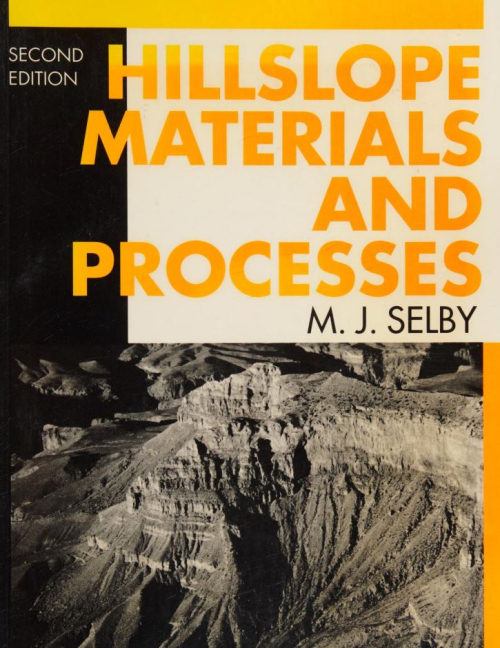
The study of hillslopes is of concern to many scientists - geologists, pedologists, hydrologists, engineers, and geomorphologists. As a result the literature on the subject is dispersed through many books and journals and the approaches to the subject are varied. In writing this text I have attempted to draw on all the relevant disciplines and particularly to use the contributions of the exponents of rock and soil mechanics.
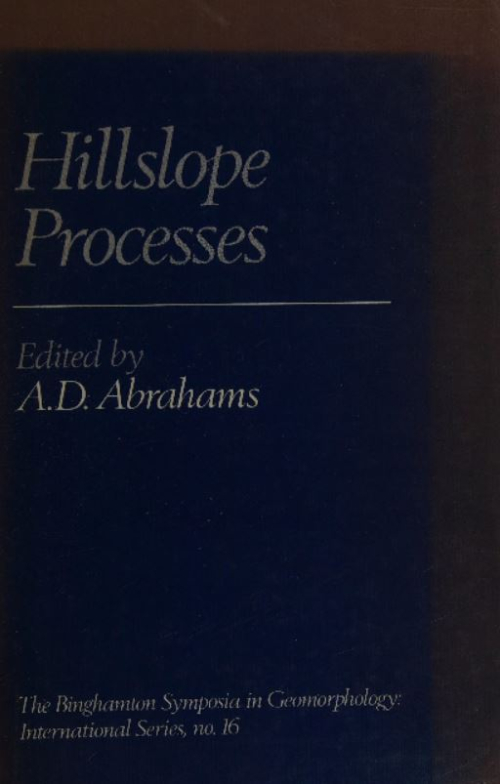
Hillslopes occupy most of the land surface of the Earth. In areas of erosional topography the entire landscape, except the valley floors, consists of hillslopes. Consequently, hillslopes are a major focus of research in geomorphology. The study of hillslopes is essential not only in order to understand better the natural landscape but also for numerous practical reasons, such as controlling soil erosion and sedimentation on agricultural lands and mitigating the hazard posed by landslides. Geomorphologists have studied hillslopes since the latter part of the 19th century, but until the late 1950s their research focused almost exclusively on morphology. During the past 30 years, however, there has been a growing interest in hillslope processes, and today research on processes dominates this branch of geomorphology <...>