Добрый день, Коллеги. Важное сообщение, просьба принять участие. Музей Ферсмана ищет помощь для реставрационных работ в помещении. Подробности по ссылке
Perhaps no sector in the Himalaya is endowed with so exciting a geological setup as Nepal. Forming a bridge between the Western and Eastern Himalaya, Nepal occupies a pivotal and significant place in the geology of the Himalaya. Stretching from the low lying foothill in south to the highest peak of Sagarmatha (Mt. Everest) in the north and covering a vast time span from the Proterozoic to Holocene, the Nepal Himalaya preserves unique geological events. Varied kinds of igneous rocks, metamorphosed sequences and sedimentary rocks of disparate environments make a captivating geological mosaic.
The -1590 Ma Olympic Dam Cu-U-Au-Ag-REE deposit is located in the Stuart Shelf geological province of South Australia, on the eastern margin of the Gawler Craton. The deposit is hosted by the Olympic Dam Breccia Complex, a large hydrothermal breccia system wholly contained within the Roxby Downs Granite, a Proterozoic age granitoid inteipreted to be part of the Hiltaba Suite. Initial hydrothermal activity within the Olympic Dam Breccia Complex was probably localised by structures in a dextral fault jog environment. Subsequent development of the complex involved repetitive and overprinting physical, chemical and volcanic brecciation mechanisms, resulting in a highly variable array of irregularly shaped and distributed breccia zones with widely differing and gradational lithologies. A complex pattern of hydrothermal alteration dominated by hematite and sericite, with lesser chlorite, siderite and quartz is associated with the breccia zones. Mineralisation within the deposit is intimately associated with iron-oxide alteration of the granitoid, which dominantly occurs as hematite, with lesser magnetite at depth and on the periphery of the breccia complex. The principal copper minerals within the deposit show a broad lateral and vertical, hypogene zonation pattern grading from chalcopyrite on the margins to bornite, then chalcocite adjacent to a central barren core. Gold and silver are mainly associated with the copper sulfides, while uranium dominantly occurs in pitchblende disseminated throughout the hematitic breccia zones. Overall, mineralisation grade generally correlates with the degree of hematite alteration and is largely dependent on copper sulfide tenor. Minor brittle faulting post-dates breccia development and appears to have exploited existing anisotropies within the complex. Late-stage fault movements are associated with barite-fluorite vein arrays which overprint the orebody. The deposit formed in a high level volcanic environment, venting to the surface and possibly forming a composite phreatomagmatic eruption crater, which has subsequently been completely eroded. Mafic and felsic dykes intruded the breccia complex, locally producing diatreme structures. Tectonism, hydrothermal activity, dyke intrusion, brecciation, alteration and mineralisation within the system were broadly concurrent and interdependent. Hydrothermal fluids and metals have a dominantly magmatic source, probably associated with the Middle Proterozoic volcano-plutonic event correlated with the Gawler Range Volcanics and Hiltaba Suite intrusives.
Arabia is one of the most enigmatic and unknown continents on Earth. The vast Rub al-Khali desert, known as the Empty Quarter, occupying most of the landmass of Arabia was one of the last of the great continental extreme environments to be explored. Richard Burton, William Palgrave, Charles Doughty, Gertrude Bell and Freya Stark were a few of the redoubtable explorers who ventured into the vast desert wasteland of the Rub al-Khali, in what is now Saudi Arabia and the frankincense coast of Dhofar, Hadramaut and the Magreb (Yemen) in south Arabia. Although local bedouin certainly made long-distance camel treks across parts of Arabia, the first recorded north–south crossing of the Empty Quarter was achieved by Bertram Thomas in 1930–1931, described in his book ‘Arabia Felix’.
This volume of the Geology of the Philippines, Second Edition comes at an opportune time when the Philippines has become once more a beehive of activities by geologists owing to the efforts of government to promote the revitalization of the mining industry. This edition is a timely reference material that gives the reader an overview of the geology of the Philippines, as well as the stratigraphic make-up of local areas.
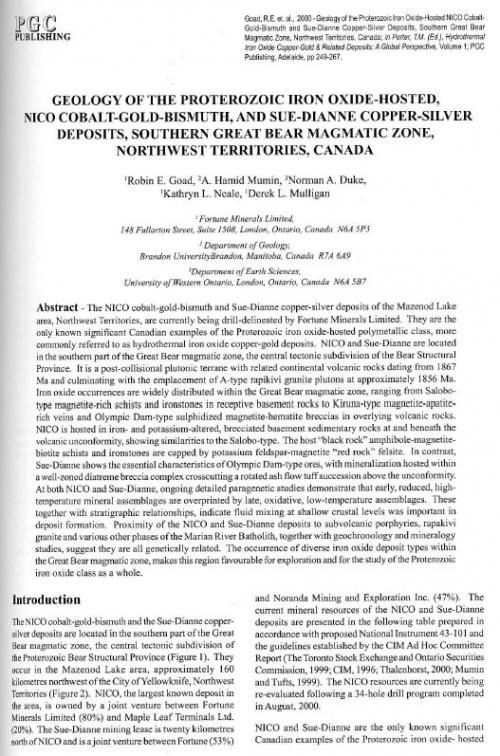
Геология протерозойских месторождений оксидов железа, Нико-кобальт-золото-висмутовых и Сью-Дайанн-медно-серебряных, южная магматическая зона Грейт-Беар, северо-западные территории, Канада.
The NICO cobalt-gold-bismuth and Sue-Dianne copper-silver deposits of the Mazenod Lake area, Northwest Territories, are currently being drill-delineated by Fortune Minerals Limited. They are the only known significant Canadian examples of the Proterozoic iron oxide-hosted polymetallic class, more commonly referred to as hydrothermal iron oxide copper-gold deposits. NICO and Sue-Dianne are located in the southern part of the Great Bear magmatic zone, the central tectonic subdivision of the Bear Structural Province. It is a post-collisional plutonic terrane with related continental volcanic rocks dating from 1867 Ma and culminating with the emplacement of A-type rapikivi granite plutons at approximately 1856 Ma. Iron oxide occurrences are widely distributed within the Great Bear magmatic zone, ranging from Salobo-type magnetite-rich schists and ironstones in receptive basement rocks to Kiruna-type magnetite-apatite-rich veins and Olympic Dam-type sulphidized magnetite-hematite breccias in overlying volcanic rocks. NICO is hosted in iron- and potassium-altered, brecciated basement sedimentary rocks at and beneath the volcanic unconformity, showing similarities to the Salobo-type. The host "black rock" amphibole-magnetite-biotite schists and ironstones are capped by potassium feldspar-magnetite "red rock" felsite. In contrast, Sue-Dianne shows the essential characteristics of Olympic Dam-type ores, with mineralization hosted within a well-zoned diatreme breccia complex crosscutting a rotated ash flow tuff succession above the unconformity. At both NICO and Sue-Dianne, ongoing detailed paragenetic studies demonstrate that early, reduced, high-temperature mineral assemblages are overprinted by late, oxidative, low-temperature assemblages. These together with stratigraphic relationships, indicate fluid mixing at shallow crustal levels was important in deposit formation. Proximity of the NICO and Sue-Dianne deposits to subvolcanic porphyries, rapakivi granite and various other phases of the Marian River Batholith, together with geochronology and mineralogy studies, suggest they are all genetically related. The occurrence of diverse iron oxide deposit types within the Great Bear magmatic zone, makes this region favourable for exploration and for the study of the Proterozoic iron oxide class as a whole.
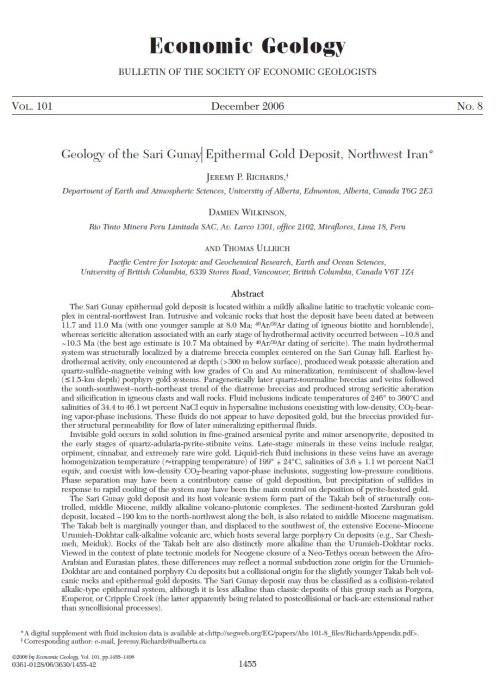
The Sari Gunay epithermal gold deposit is located within a mildly alkaline latitic to trachytic volcanic complex in central-northwest Iran. Intrusive and volcanic rocks that host the deposit have been dated at between 11.7 and 11.0 Ma (with one younger sample at 8.0 Ma; 40Ar/39Ar dating of igneous biotite and hornblende), whereas sericitic alteration associated with an early stage of hydrothermal activity occurred between ~10.8 and ~10.3 Ma (the best age estimate is 10.7 Ma obtained by 40Ar/39Ar dating of sericite).
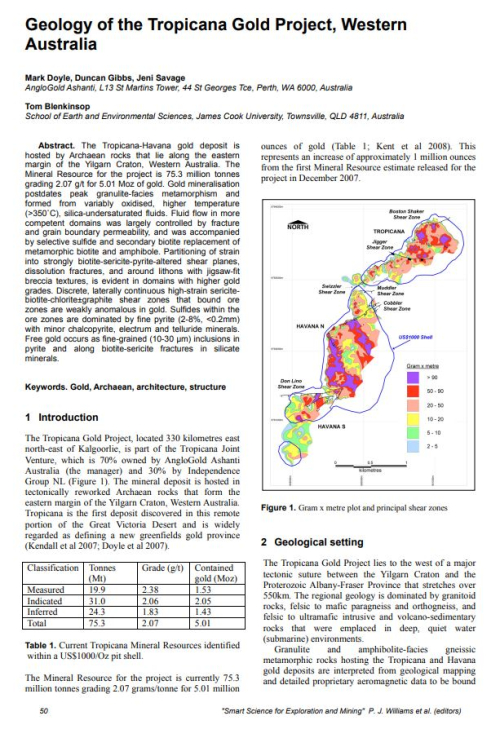
The Tropicana-Havana gold deposit is hosted by Archaean rocks that lie along the eastern margin of the Yilgarn Craton, Western Australia. The Mineral Resource for the project is 75.3 million tonnes grading 2.07 g/t for 5.01 Moz of gold. Gold mineralisation postdates peak granulite-facies metamorphism and formed from variably oxidised, higher temperature (>350˚C), silica-undersaturated fluids.
A review of exploration expenditure by exploration stage over 15 years at Laverton Western Australia has identified a poor conversion rate from the first stage (ground acquisition) to the second stage (drill testing). This poor conversion rate is primarily due to poor target selection. The use of a well described ore deposit model and regional geological and regional geophysical datasets is able to improve target selection. The Thermal Aureole Gold ore deposit model and the relevant geological features that can be detected in regional geological maps are described and some examples are shown for Morila, Sadiola and Muruntau gold deposits. <...>
Геология, флюидные включения, минеральный и (S-O) изотопный состав Бадранского орогенного месторождения золота, Яно-Колымский пояс, Восточная Сибирь: влияние на рудогенез