Добрый день, Коллеги. Важное сообщение, просьба принять участие. Музей Ферсмана ищет помощь для реставрационных работ в помещении. Подробности по ссылке
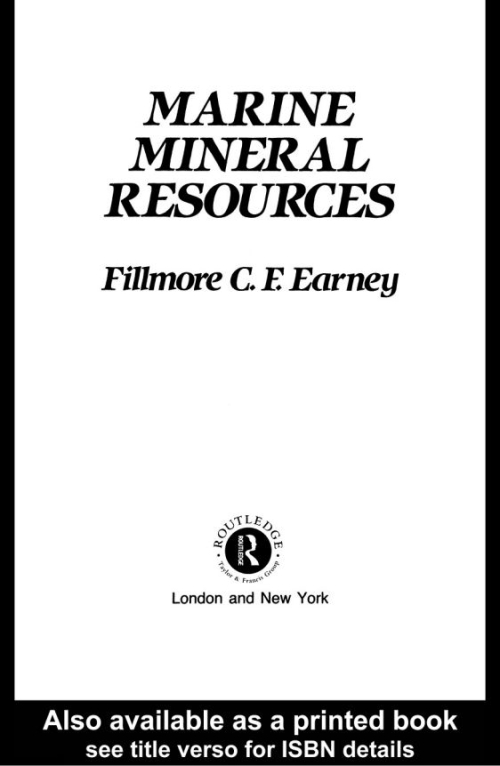
During the past century, scientists, world statesmen, and international entrepreneurs have become increasingly aware of the potential of the oceans as a source for minerals. This book provides an authoritative picture of the currentstate of marine mineral extraction. A major work of reference, it will be essential reading both for those engaged in maritime studies and for professional organizations involved in the extraction of underwater minerals.
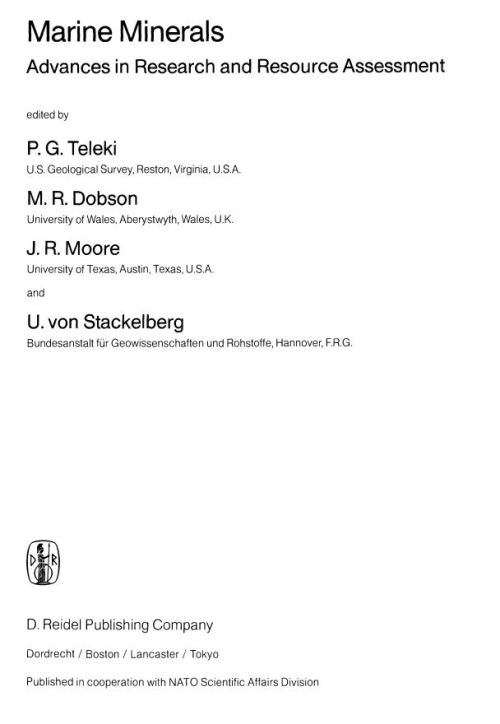
Discoveries of new types of marine mineral occurrences during the last decade, and specifically the massive sulfide deposits at spreading ridges on the ocean floor, have significantly advanced geologic concepts about the origin of ore deposits in a very short period of time. These discoveries also renewed interest in all marine mineral occurrences including the well-known manganese nodules, and led to more wide-ranging and thorough examination of cobalt-rich manganese crusts, expanded mapping of phosphorites of continental shelves, and the initiation of several new surveys for placer minerals in shallow waters. The result of these activities is already noticeable in an increasingly broader variety of minerals being found on and below the ocean floor. <...> Report of the working group on placer minerals
Report of the working group on marine phosphorites
Report of the working group on manganese nodules and crusts
Report of the working group on marine sulfides
Sedimentary models to estimate the heavy-mineral potential of shelf sediments
Exploring the offshore area of N.E. Greece for placer deposits
The development of techniques for marine geological surveys
Model of Tertiary phosphorites on the world's continental margins
Open-ocean phosphorites: In a class by themselves?
Some mineral resources of the West African continental shelves related to Holocene shorelines: Phosphorite (Gabon, Congo), glauconite (Congo) and ilmenite (Senegal, Mauritania)
Exploration and genesis of submarine phosphorite deposits from the Chatham Rise, New Zealand: A review
Controls on the nature and distribution of manganese nodules in the western Equatorial Pacific Ocean
Growth history and variability of manganese nodules of the Equatorial North Pacific
Chemistry and growth history of central Pacific Mn-crusts and their economic importance
Geochemical methods in manganese nodule exploration
Analysis and metallurgy of manganese nodules and crusts
Nodule exploration: Accomplishments, needs and problems
Deep-ocean near-bottom surveying techniques
Seafloor polymetallic sulfides: Scientific curiosities or mines of the future?
Sulfide deposits of the seafloor: Geological models and resource perspectives based on studies in ophiolite sequencesRecent hydrothermal metal accumulation, products, and condi tions of formation
The chemistry of submarine oTrace element and precious metal concentrations in East Pacific Rise, Cyprus and Red Sea submarine sulfide depositsre-forming solutions
Possibility of mineral enrichment in the Black Sea
Seafloor volcanism and polymetallic sulfide deposits in ancient active margins: The case of the Iberian pyrite belt
Scientific rationale for establishing long-term ocean bottom observatory/laboratory systems
Electrical methods in the exploration of seafloor mineral deposits
Sources of confusion: What ~re marine mineral resources?
Thoughts on appraising marine mineral resources
Estimation of the probability of occurrence of polymetallic massive sulfide deposits on the ocean floor
Resource assessments, geological deposit models and offshore minerals with an example of heavy-mineral sands
Aspects of marine placer minerals: Economic potential of coastal deposits in Italy, testing procedures and market condi tions
Geostatistical problems in marine placer exploration
Geostatistical reserve modeling and mining simulation of the Atlantis II Deep's metalliferous sediments
An investigation of the applicability of trend surface analysis to marine exploration geochemistry
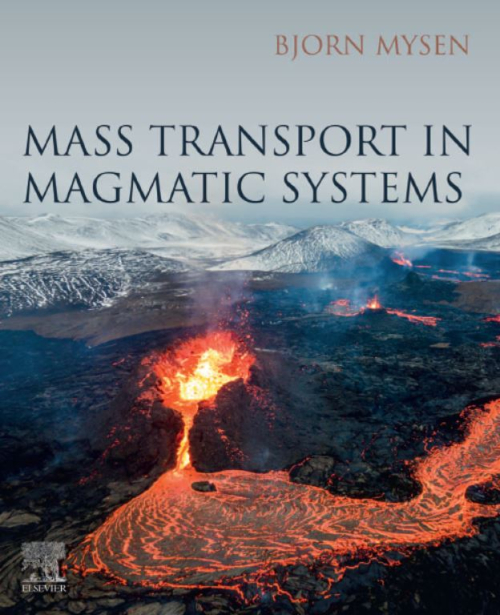
The formation and evolution of the Earth and planets depend on transfer of mass and energy. Magma and fluid are integral parts of the transport processes that govern the mass and energy transfer. Mass transport property data are central to describe those processes. Mass transport is accomplished by transfer of fluids and magma and typically takes place at high temperature and pressure. Mass transport typically occurs along temperature and pressure gradients, which means that energy transport also associates with mass transport, although in this book, energy transfer is not explicitly discussed.
Interest in the plastic deformation of rocks arises mainly from its application in the Earth sciences, especially in structural geology and tectonics. Its experimental study has consequently been pursued mainly in laboratories associated with geology or geophysics departments or institutes. However, the physical mechanisms involved are of considerable interest in materials science and some workers in the field of rock deformation have had a materials science affiliation.
Учебное пособие содержит примеры, позволяющие получить основные навыки работы в программе Mathcad, а также задачи, решаемые инженером-нефтяником. Приведенные примеры иллюстрируют применение математических методов для решения задач нефтедобычи. Набор задач подобран таким образом, чтобы охватить разные аспекты деятельности: анализ разработки, обработка результатов исследований скважин, расчет показателей и др.
Учебное пособие предназначено для студентов специальности «Разработка и эксплуатация нефтяных и газовых месторождений» (130503) при изучении дисциплины «Применение ЭВМ в нефтегазодобыче».
This book is divided into four parts. The introduction (Part I) provides the physical background of the geophysical models that are analyzed in this book from a mathematical viewpoint. Part II is devoted to a self-contained proof of the existence of weak (or strong) solutions to the incompressible Navier–Stokes equations.
Part III deals with the rapidly rotating Navier–Stokes equations, first in the whole space, where dispersion effects are considered. Then the case where the domain has periodic boundary conditions is considered, and finally rotating Navier–Stokes equations between two plates are studied, both in the case of horizontal coordinates in R2 and periodic. In Part IV the stability of Ekman boundary layers, and boundary layer effects in magnetohydrodynamics and quasigeostrophic equations are discussed.
The boundary layers which appear near vertical walls are presented and formally linked with the classical Prandlt equations. Finally spherical layers are introduced, whose study is completely open.
This book concerns the application of mathematics to problems in the physical sciences, and particularly to problems which arise in the study of the environment. Much of the environment consists of fluid—the atmosphere, the ocean—and even those parts which are solid may deform in a fluid-like way—ice sheets, glaciers, the Earth’s mantle; as a consequence, one way into the study of the environment is through the study of fluid dynamics, although we shall not follow that approach here. Rather, we shall approach the study of environmental problems as applied mathematicians, where the emphasis is on building a suitable mathematical model and solving it, and in this introductory chapter, we set out the stall of techniques and attitudes on which the subsequent chapters are based <...>
The spontaneous potential well-logging is one of the most common and useful welllogging techniques in petroleum exploitation. Since the earth layer can be regarded as a piecewise uniform medium, and due to electrochemical and other factors, there exists a jump of potential (spontaneous potential difference) on each interface of different layers.
Mathematical modelling and computer simulations are an essential part of the analytical skills for earth scientists. Nowadays, computer simulations based on mathematical models are routinely used to study various geophysical, environmental and geological processes, from geophysics to petroleum engineering, from hydrology to environmental fluid dynamics. The topics in earth sciences are very diverse and the syllabus itself is evolving. From a mathematical modelling point of view, therefore, this is a decision to select topics and limit the number of chapters so that the book remains concise and yet comprehensive enough to include important and interesting topics and popular algorithms. Furthermore, we use a ‘theorem-free’ approach in this book with a balance of formality and practicality. We will increase dozens of worked examples so as to tackle each problem in a step-by-step manner, thus the style will be especially suitable for non-mathematicians, though there are enough topics, such as the calculus of variation and pattern formation, that even mathematicians may find them interesting. <...>