Добрый день, Коллеги. Важное сообщение, просьба принять участие. Музей Ферсмана ищет помощь для реставрационных работ в помещении. Подробности по ссылке
Introduction: Precambrian –Palaeozoic history and framework
KUSKY, T. M., WINDLEY, B. F. & ZHAI, M.-G. Tectonic evolution of the North China Block: from orogen to craton to orogen Magmatism and geochemistry
ZHANG, H.-F. Temporal and spatial distribution of Mesozoic mafic magmatism in the North China Craton and implications for secular lithospheric evolution HUANG, F., LI, S.-G. & YANG, W. Contributions of the lower crust to Mesozoic mantle-derived mafic rocks from the North China Craton: implications for lithospheric thinning FAN, W.-M., GUO, F., WANG, Y.-J. & ZHANG, H.-F. Late Mesozoic mafic magmatism from the North China Block: constraints on chemical and isotopic heterogeneity of the subcontinental lithospheric mantle
The most dramatic new discoveries about the structure of the Earth in recent years have been those arising from the investigations of the ocean floors and the deep structure of the Earth (as it now is) by geophysical means. For a long time, however, a much larger bulk of information has been accumulating from the investigations of the continental masses; moreover, this information generally yields evidence of successively earlier stages in tectonic history. It is clearly essential in elaborating geotectonic hypotheses to take into account all the relevant evidence, and failure to do so may, in large measure, be attributed to the difficulty of searching through an enormous bulk of literature on continental tectonics and also to the subjective way in which much of it appears. It therefore seemed appropriate and timely to make available tectonic data aiming at a convenient and essentially objective presentation <...>
Plate tectonics, as it operates in the modern earth, represents in a fundamental sense a mechanism by which excess thermal energy from the mantle is dissipated (Sclater et ai., 1980). A substantial data base now exists concerning the operation of plate tectonics during Phanerozoic time, and evidence for similar tectonic activity during Proterozoic time appears to be steadily growing, both in quantity and quality.
It is an old wisdom that metals are indispensable for life. Indeed, several of them, like sodium, potassium, and calcium, are easily discovered in living matter. However, the role of metals and their impact on life remained largely hidden until inorganic chemistry and coordination chemistry experienced a pronounced revival in the 1950s. The experimental and theoretical tools created in this period and their application to biochemical problems led to the development of the field or discipline now known as Bioinorganic Chemistry, Inorganic Biochemistry, or more recently also often addressed as Biological Inorganic Chemistry. By 1970 Bioinorganic Chemistry was established and further promoted by the book series Metal Ions in Biological Systems founded in 1973 (edited by H.S., who was soon joined by A.S.) and published by Marcel Dekker, Inc., New York, for more than 30 years. After this company ceased to be a family endeavor and its acquisition by another company, we decided, after having edited 44 volumes of the MIBS series (the last two together with R.K.O.S.) to launch a new and broader minded series to cover today’s needs in the Life Sciences. Therefore, the Sigels’ new series is entitled <...>
The purpose of this publication is to make an extended price history for a wide range of metals available in a single document. Such information can be useful for the analysis of mineralcommodity issues, as well as for other purposes. The chapter for each mineral commodity includes a graph of annual current and constant dollar prices for 1959 through 1998, where available; a list of significant events that affected prices; a brief discussion of the metal and its history; and one or more tables that list current dollar prices.
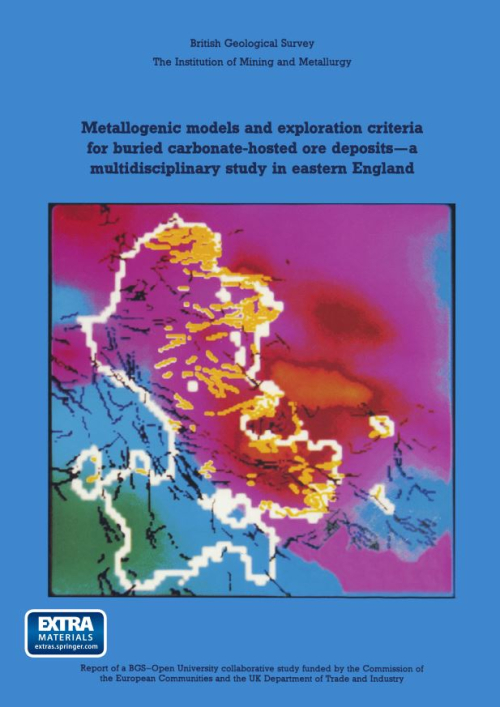
The report that follows presents a first statement of the results of a study sponsored by the European Economic Community and the Department of Trade and Industry as communicated to a meeting of the Institution of Mining and Metallurgy Midlands Section at which the President (Dr A. J. Robinson) and the Section Chairman (Professor N. A. Warner) were present. It was my privilege to attend and to make some concluding remarks; these form the basis of this preface. The Geological Survey, now in its 154th year, has as one of its principal objects the provision of geological maps based on surveying in maximum detail at a scale of 1:10 000. In areas where extractive or other engineering industry is important, the surveys have been revised more than once as new subsurface data became available.
Post-Collisional Magmatism and Its Relationship to Late-Variscan Ore Forming Processes in the Erzgebirge (Bohemian Massif)
Постколлизионный магматизм и его связь с поздневарисканскими рудообразующими процессами в Эрцгебирге (Богемский массив)
The main goal of this contribution is to document the possible importance of post-collisional lamprophyre intrusions for late-Variscan ore mineralization in the Erzgebirge (Germany and Czech Republic). Located at the northwestern border of the Bohemian massif in the Internal Variscides, the Erzgebirge is one of the most important silver, tin, tungsten, uranium, lead, zinc, copper, indium, bismuth, cobalt, and fluorite ore deposit provinces in Europe with a mining history of more than 800 years. Because of the close spatial association between late-Variscan ore mineralization and Permo-Carboniferous lamprophyric and rhyolitic intrusions the Erzgebirge is one of the key localities to study the genetic relationship of epigenetic Sn-W-Mo, Ag-base metal, and U deposits with post-collisional, mantle derived magmatic pulses.
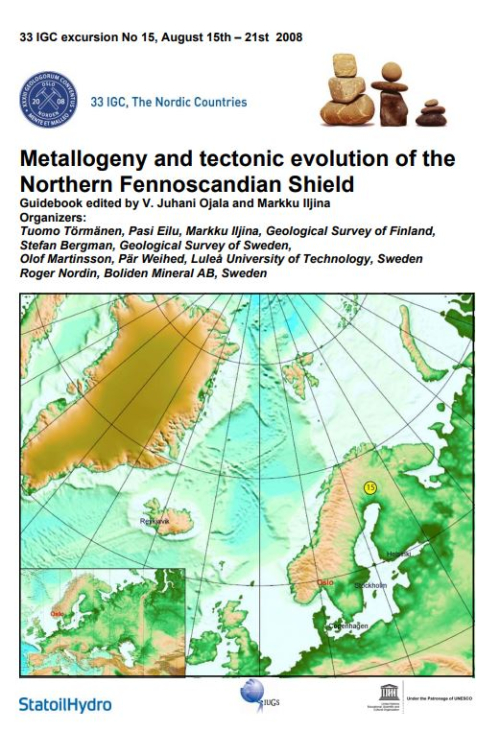
The Fennoscandian Shield forms the north-westernmost part of the East European craton and constitutes large parts of Finland, NW Russia, Norway, and Sweden (Fig. 1). The oldest rocks yet found in the shield have been dated at 3.5 Ga (Huhma et al. 2004) and major orogenies took place in the Archaean and Palaeoproterozoic.
The Kibara belt is an intracontinental mobile belt formed between 1400 and 900 Ma within a craton of Lower Proterozoic age. The belt's evolution started by early rifting at about 1400 Ma, and continued by transition into a marine basin filled by clastic sediments > 10 km thick, with minor basic and acidic volcanic rocks. At about 1300 Ma, the pile was deformed by thrusting and folding of the main Kibaran Orogeny and intruded by numerous large syn-orogenic granite bodies.
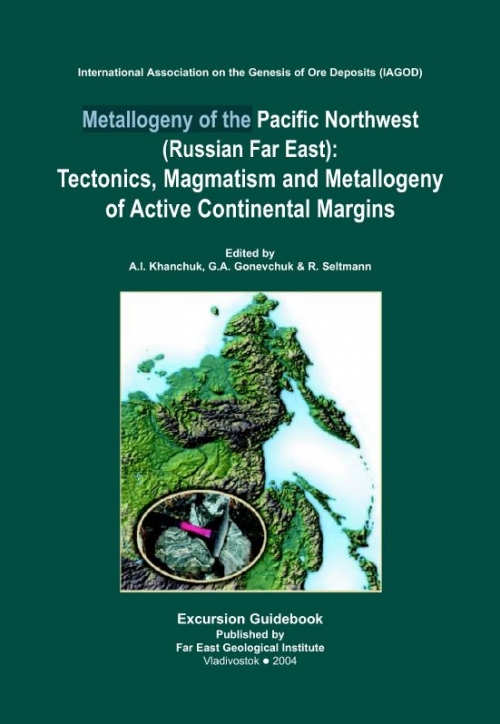
Металлогения Тихоокеанского Северо-Запада (Дальний Восток России): тектоника, магматизм и металлогения активных континентальных окраин. Путеводитель по полевым экскурсиям на Дальнем Востоке России: 1-20 сентября 2004 г.
This guidebook was prepared for the Interim IAGOD Conference on Metallogeny of the Pacific Northwest: Tectonics, Magmatism and Metallogeny of Active Continental Margins, which took place in September of 2004 in Vladivostok, the southernmost port of the Russian Far East. The book describes the geology of a number of important ore districts and deposits in the region. These are the major deposits of fluorine (Voznesenka), boron (Dalnegorsk), tungsten (Vostok-2), platinum (Konder), gold (Pokrovka), and some smaller deposits of tin, lead, zinc, and other metals.