Добрый день, Коллеги. Важное сообщение, просьба принять участие. Музей Ферсмана ищет помощь для реставрационных работ в помещении. Подробности по ссылке
The main aim of this book is to provide an introduction to the most relevant investigation methods and techniques that can be used to study karst hydrogeological systems, including modern approaches to interpreting and modelling the data obtained. Studying karst aquifers is not only scientifically challenging, but it is also important for humanity. Ford & Williams (1989) estimated that 25% of the world’s population drink water from such resources. Although this number is probably an over-estimate, karst groundwater constitutes a crucial freshwater resource for many countries, regions and cities around the world.
The experimenter is confronted nearly every day with the examination of results from his or her own experiments as well as those of others. There is a need to know the methods by which the data were obtained and what confidence can be placed in the numerical results. Significant aspects of these matters involve the principles and methods of statistics, and the jective of this chapter is to describe the basic ideas of statistics that are relevant to errors of observations and numbers derived from these observations.
The Soil Science Society of America is extremely pleased to publish this comprehensive compilation of modern mineralogical methods. Co-editors April L. Ulery and L. Richard Drees have done an outstanding job of assembling this volume. This valuable work began with the vision of Dr. L. Richard Drees, who unfortunately fell ill during the early stages of the monograph and was unable to complete the task. Co-editor Dr. April Ulery has done a great job of bringing it to completion.
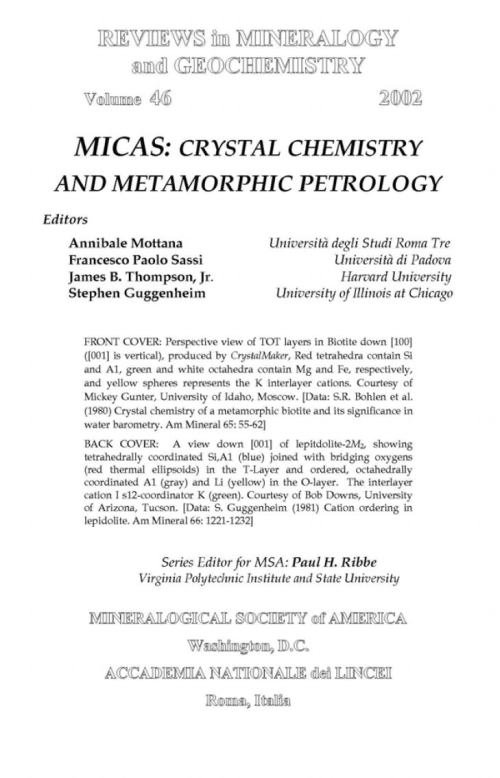
Micas are among the most common minerals in the Earth crust: 4.5% by volume. They are widespread in most if not all metamorphic rocks (abundance: 11%), and common also in sediment and sedimentary and igneous rocks. Characteristically, micas form in the uppermost greenschist facies and remain stable to the lower crust, including anatectic rocks (the only exception: granulite facies racks). Moreover, some micas are stable in sediments and diagenetic rocks and crystallize in many types of lavas. In contrast, they are also present in association with minerals originating from the very deepest parts of the mantle—they are the most common minerals accompanying diamond in kimberlites.
During recent years, systematic, scientific, and engineering effort by researchers in the United States and abroad, has established the scientific basis for Microbial Enhanced Oil Recovery (MEOR) technology. In the past, basic research was left to the laboratory, and field use was generally limited to an uninformed oil producer using microbes without knowing what to expect. The merger of these two groups--researchers and producers--is fostering acceptance of MEOR technology through the petroleum community. The applicability of MEOR technologies, its economic feasibility, and indications for future directions have become essential elements of current MEOR research programs. <...>
Behold the power of the microcomputer before your very eyes! This book took less than a year to complete from the initial conversations between Dan Merriam and myself to final typeset copy. This would have been impossible when the first volume of this book was published. All of the papers in this volume, with one exception, arrived on floppy disk but in four different disk formats and many wordprocessing formats. These were all handled elegantly by our typesetter and converted into the appropriate Macintosh file format. Even some of the figures were placed in the book electronically. I see this as a great boon to the world of science because of the much shorter time between inception and dispersal of scientific knowledge. As a result of using microcomputers to typeset this book, the information contained in it is current and fresh. <...>
Reviewers of the German edition of this book found that the text deals with facts and descriptions of limestones rather than with global speculations on facies models or large-scale sedimentation patterns. The book is neither a picture-book nor a recipe-book for facies interpretation of carbonates, but an attempt to summarize the present "state of the art" of a rather small but increasingly more important part of geology.
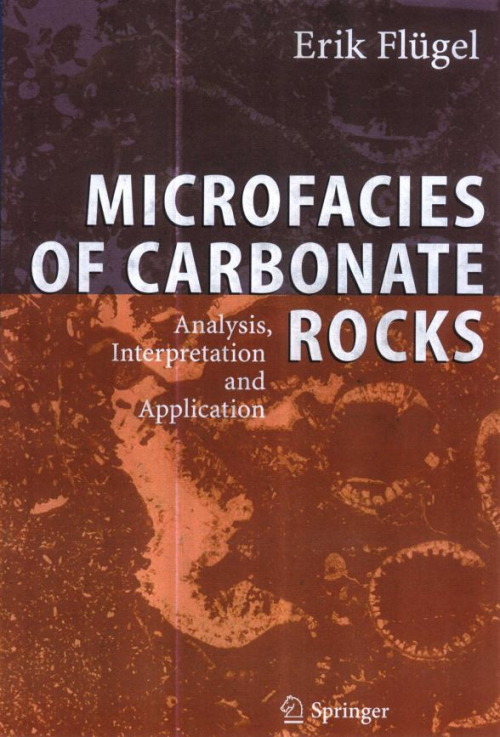
The objective of this book is to provide a synthesis of the methods used in microfacies studies of carbonate rocks and to show how the application of microfacies studies has contributed to new developments in carbonate geology. In contrast with other textbooks on carbonate sedimentology this book focuses on those compositional and textural constituents of carbonates that reflect the depositional and diagenetic history and determine the practical usefulness of carbonate rocks.
The objective of this book is to provide a synthesis of the methods used in microfacies studies of carbonate rocks and to show how the application of microfacies studies has contributed to new developments in carbonate geology. In contrast with other textbooks on carbonate sedimentology this book focuses on those compositional and textural constituents of carbonates that reflect the depositional and diagenetic history and determine the practical usefulness of carbonate rocks.