Добрый день, Коллеги. Важное сообщение, просьба принять участие. Музей Ферсмана ищет помощь для реставрационных работ в помещении. Подробности по ссылке
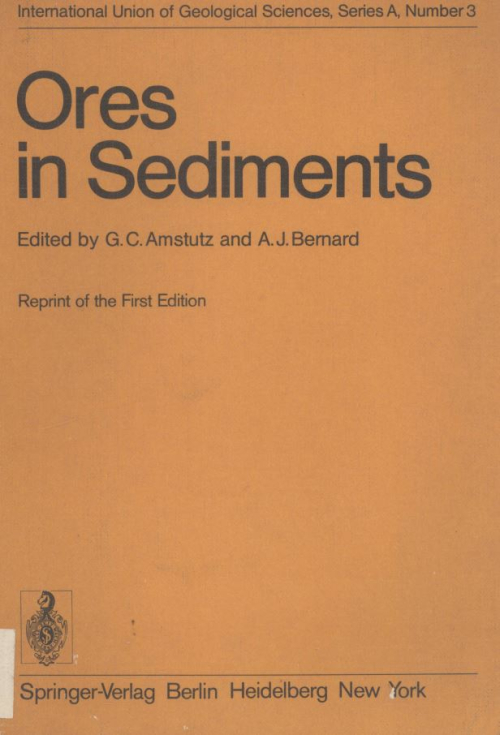
BERNARD, A. J. : A Review of Processes Leading to the Formation of Mineral Deposits in Sediments ARNOLD, M., MAUCHER, A., SAUPE, F. : Diagenetic Pyrite and Associated Sulphides at the Almad^n Mercury Mine, Spain BARTHOLOME, P. , EVRARD, P., KATEKESHA, F. , LOPEZ-RUIZ, J. , NGONGO, M. : Diagenetic Ore-forming Processes at Kamoto, Katanga, Republic of the Congo BERNARD, A. J. : Metallogenic Processes of Intra-karstic Sedimentation BOGDANOV, Y. V., KUTYREV, ЕЛ. : Classification of Stratified Copper and Lead-Zinc Deposits and the Regularities of Their Distribution. BRONDI, A., CARRARA, C., POLIZZANO, C. : Uranium and Heavy Metals in Permian Sandstones Near Bolzano (Northern Italy)
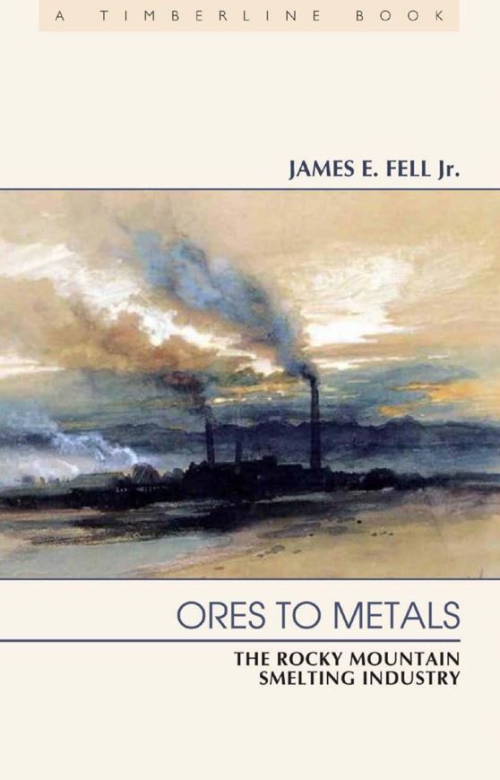
The mountains and deserts of the West still hold the picturesque ruins of abandoned mines. The boarded tunnels, rough-hewn buildings, immense piles of yellow tailings, and narrow headframes that reach upward to the sky stand as silent witnesses to the vitality of men who once wrested minerals from the earth. But there are few ruins to remind a passerby of the smelters that bought the ores, reduced them to bullion and matte, and then drew out the gold, silver, copper, lead, and other metals. Here you might see bushes growing through a stone foundation; there you might note a mound of black slag. Here you might glimpse a small chimney rising amid the aspen; there you might notice a towering smokestack still piercing the western sky. But little else remains. The wreckers left few reminders of this industry that rose, flourished, and died in symbiosis with the mines. <...>
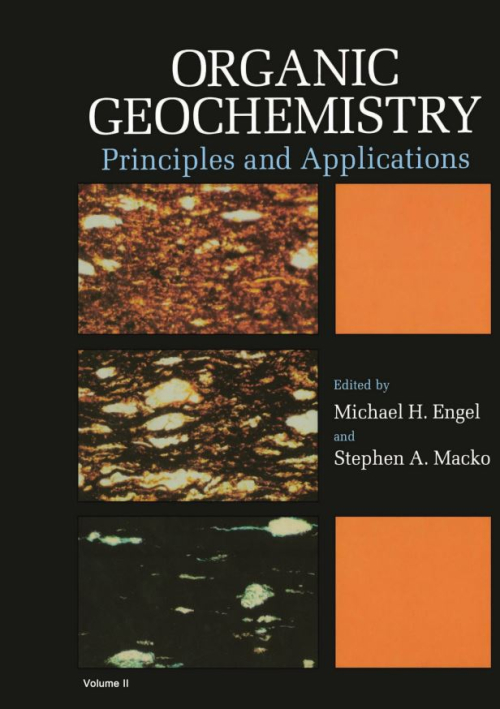
The publication of Organic Geochemistry by Professors Engel and Macko is welcomed by geochemists and geologists working in the disciplinary field of geochemistry. The forty chapters and fifty-eight authors represent the many specialties in geochemistry as well as the interdisciplinary and international nature of the field. Geophysicists, mathematicians, exobiologists, paleontologists, microbiologists, and stable isotope chemists also contribute to the diverse investigations of organic matter as it appears in the biomass of the earth and solar system.
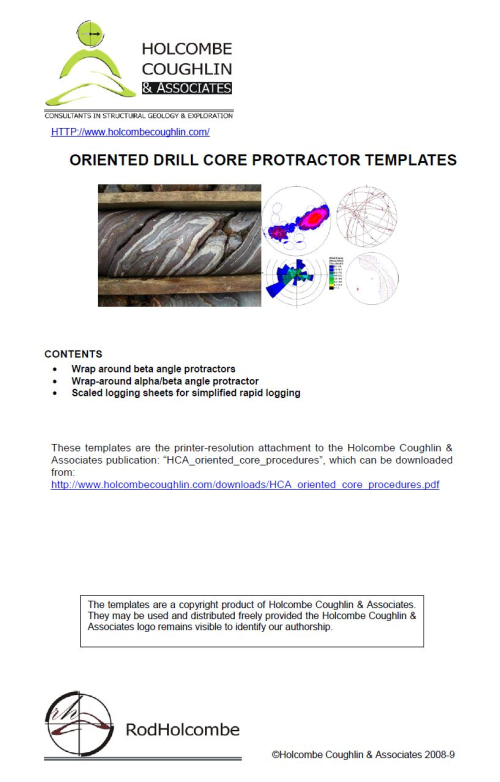
Each of the following pages contains a protractor for a specific size of drill core.
Choose the appropriate chart for the drill core size. Check the core diameter to choose the appropriate template within each core size grouping.
The protractors are in two groups: beta angle protractors and alpha/beta angle protractors. In practice I find that the beta angle protractor alone is best as it is least cluttered with lines (and alpha angles are easily measured using a protractor). <...>
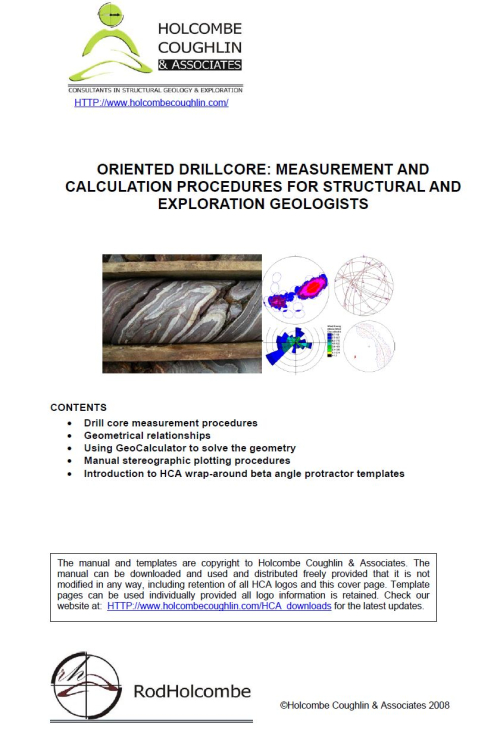
During core drilling, runs of core up to about three metres long are extracted from the core barrel. The extraction process rotates the core randomly, so that once the core is laid out in core boxes its original orientation is lost, although the orientation of the core axis is generally known. Various down-hole surveying techniques are available for this, and the common usage of 3-D modelling software has lead to holes being generally very well surveyed. <...>
Over the past four decades, Earth scientists have made great strides in understanding our planet’s workings and history. We understand as never before how plate tectonics shapes our planet’s surface, how life can be sustained over billions of years, and how geological, biological, atmospheric, and oceanic processes interact to produce climate—and climatic change. Yet at the most basic level, this progress has served principally to lay bare more fundamental questions about Earth.
The solar system is chemically and isotopically heterogeneous. The earth contains only 0.0003% of the mass of the solar system, but the abundance pattern of non-radiogenic isotopes for each terrestrial element has been defined as “normal”. The outer planets consist mostly of light elements like H, He and C. The inner planets are rich in heavy elements like Fe and S. Isotopic irregularities are closely linked with these chemical differences in planets, as well as in the primary minerals of chondritic meteorites.
Three of the world's largest Cu-Mo deposits, Los Pelambres, Rio Blanco-Los Bronces and El Teniente, formed in close temporal association with southward migration of the locus of subduction of the Juan Fernandez Ridge and the resultant decrease in subduction angle below central Chile during the Miocene and Pliocene. All three contain large Cu-mineralised magmatic-hydrothermal biotite itourmaline ±anhydrite breccia pipes generated by exsolution of saline, high-temperature fluids from crystallising magmas. Sr, Nd, Pb, S, Os, 0 and H isotopic data indicate that the metals these breccias contain, and aqueous fluids responsible for their emplacement, were derived from the same magmas that produced igneous rocks associated with each deposit. Isotopic data are consistent with derivation of these magmas from subduction-modified subarc mantle, and suggest that formation of these deposits did not involve either dehydration or melting of continental crust. Each deposit formed by multiple mineralising events occurring over a >2 m.y. period during which there is no evidence for coeval volcanic activity. Assuming an average Andean magma with 100 ppm Cu, the original lOOxlO6 tonnes of Cu in each deposit prior to erosion requires a parent body of magma with a batholith-size dimension of approximately >600 km3. We suggest that the multiple Cu-mineralised breccia pipes in each deposit were generated by exsolution of magmatic fluids from the roofs of large, long-lived, open-system magma chambers, crystallising at depths of >4 km below the palaeosurface as indicated by
This book is for undergraduates, postgraduates and research workers who wish to gain an insight into present ideas and speculations on the origin of granite batholiths. It is a summary of the proceedings of a one-day meeting of the Geochemistry Group of the Mineralogical Society held at the University of liverpool on the 2nd May 1979, entitled The Origin of Granite Batholiths: Geochemical Evidence. <...>