Добрый день, Коллеги. Важное сообщение, просьба принять участие. Музей Ферсмана ищет помощь для реставрационных работ в помещении. Подробности по ссылке
Происхождение высокосортной золотой руды, источник флюидных компонентов руды и генезис месторождений Мейкл и соседних месторождений Карлинского типа, Северный Карлин-Тренд, Невада
The Meikle mine exploits one of the world’s highest grade Carlin-type gold deposits with reserves of ca. 220 t gold at an average grade of 24.7 g/t. Locally, gold grades exceed 400 g/t. Several geologic events converged at Meikle to create these spectacular gold grades. Prior to mineralization, a Devonian hydrothermal system altered the Bootstrap limestone to Fe-rich dolomite. Subsequently the rocks were brecciated by faulting and Late Jurassic intrusive activity. The resulting permeability focused flow of late Eocene Carlin-type ore fluids and allowed them to react with the Fe-rich dolomite. Fluid inclusion data and mineral assemblages indicate that these fluids were hot (ca. 220°C),of moderate salinity (<6 wt % NaCl equiv), acidic, and H2S rich. Gold-rich pyrite formed by dissolution of dolomite and sulfidation of its contained Fe. Where dissolution and replacement were complete, ore-stage pyrite and other insoluble minerals were all that remained. Locally, these minerals accumulated as internal sediments in dissolution cavities to form ore with gold grades >400 g/t.
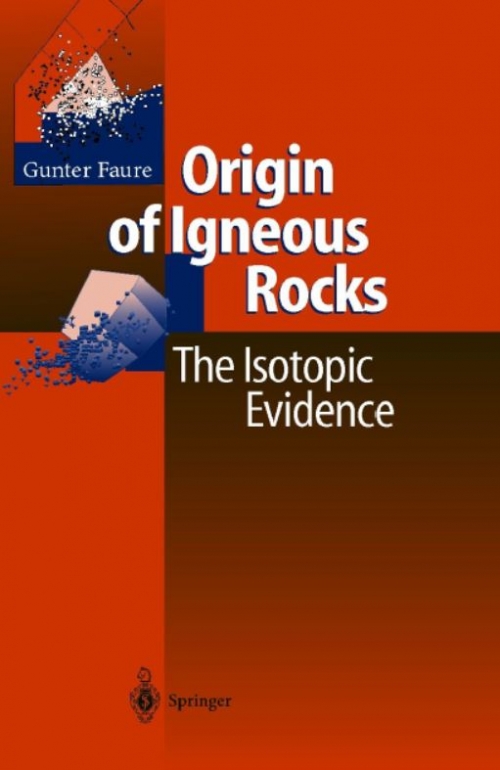
This book is intended for graduate students of the Earth Sciences who require a comprehensive examination of the origins of igneous rocks as recorded by the isotope compositions of the strontium, neodymium, lead, and oxygen they contain. Students who have not had a formal course in the systematics of radiogenic isotopes can acquire a basic understanding of this subject by a careful study of Chap. 1. Additional information is readily available in a textbook by Faure (1986). The primary purpose of this book is to demonstrate how the isotope composition of Sr, Nd, Pb, and 0 in igneous rocks has been used to shed light on the origin of igneous rocks and hence on the activity of the mantle and on its interactions with the continental and oceanic crust.
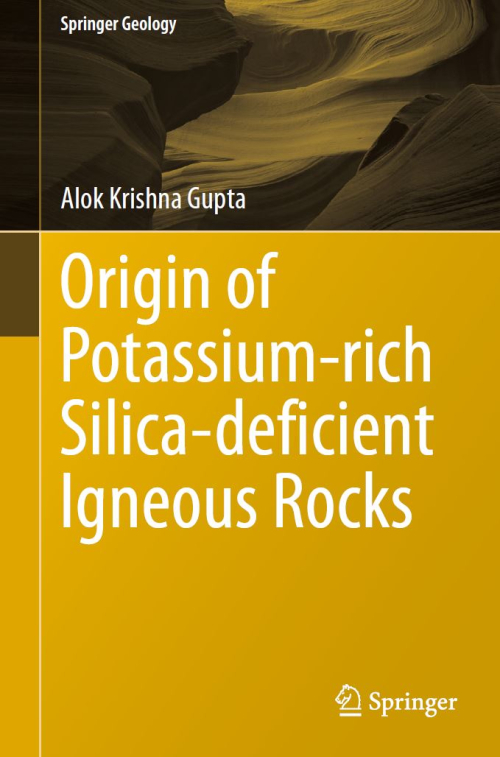
In this book the author attempts to provide up-to-date information about the geochemistry, exotic mineralogy, petrology, and experimental studies on ultrapotassic feldspathoid-bearing mafic and ultramafic rocks, which are quite distinct from the rocks of basalt family. The parental liquids for this intriguing group of rocks bear definite signature of their deep mantle source.
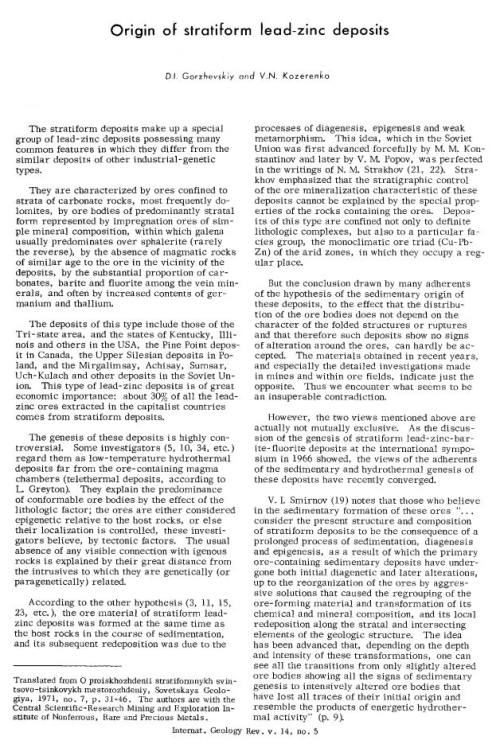
The stratiform deposits make up a special group of lead-zinc deposits possessing many common features in which they differ from the similar deposits of other industrial-genetic types. They are characterized by ores confined to strata of carbonate rocks, most frequently dolomites, by ore bodies of predominantly stratal form represented by impregnation ores of simple mineral composition, within which galena usually predominates over sphalerite (rarely the reverse), by the absence of magmatic rocks of similar age to the ore in the vicinity of the deposits,
Sometimes interest in the problem of the Moon’s genesis seems exaggerated. Why does this small celestial body, one of many in the solar system, attract so much attention?
First of all, the Moon genesis is part of the Earth genesis problem. Knowledge of our own planet, understanding of how and when its oceans and atmosphere came into existence, how and when the crust and the core of the Earth were formed, and how life originated on the Earth are not just academic issues; these are profound issues of human self-consciousness. Understanding the Earth’s genesis is impossible without solving simultaneously the Moon genesis problem.
J. Alistair Crame, Origins and evolution of the Antarctic biota: an introduction L. R. M. Cocks, Antarctica’s place within Cambrian to Devonian Gondwana Francoise Debrenne & Peter D. Kruse, Cambrian Antarctic archaeocyaths Gerald F. Webers & Ellis L. Yochelson, Late Cambrian molluscan faunas and the origin of the Cephalopoda G. C. Young, The Aztec fish fauna (Devonian) of southern Victoria Land: evolutionary and biogeographic significance Sherri L. DeFauw, Patterns of evolution in the Dicynodontia with special reference to austral taxa W. G. Chaloner & G. T. Creber, The phenomenon of forest growth in Antarctica: a review Mary E. Dettmann, Antarctica: Cretaceous cradle of austral temperate rainforests? Rosemary A. Askin, Endemism and heterochroneity in the Late Cretaceous (Campanian) to Paleocene palynofloras of Seymour Island, Antarctica: implications for origins, dispersal and palaeoclimates of southern floras T. H. Rich, P. V. Rich, B. Wagstaff, J. McEwen-Mason, С. B. Douthitt & R. T. Gregory, Early Cretaceous biota from the northern side of the Australo—Antarctic rift valley
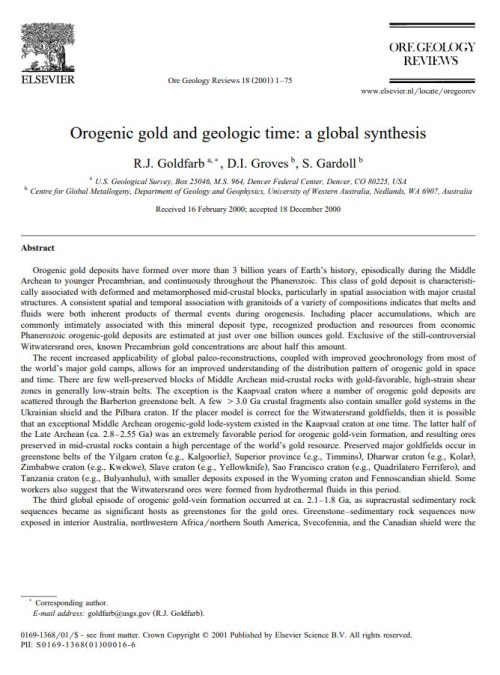
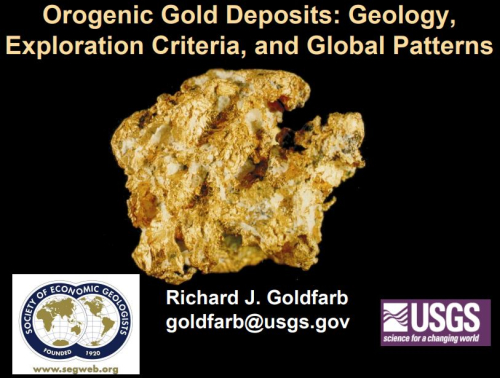
Orogenic gold deposits have formed over more than 3 billion years of Earth’s history, episodically during the Middle Archean to younger Precambrian, and continuously throughout the Phanerozoic. This class of gold deposit is characteristically associated with deformed and metamorphosed mid-crustal blocks, particularly in spatial association with major rustal structures. A consistent spatial and temporal association with granitoids of a variety of compositions indicates that melts and fluids were both inherent products of thermal events during orogenesis.
The so-called ‘mesothermal’ gold deposits are associated with regionally metamorphosed terranes of all ages. Ores were formed during compressional to transpressional deformation processes at convergent plate margins in accretionary and collisional orogens. In both types of orogen, hydrated marine sedimentary and volcanic rocks have been added to continental margins during tens to some 100 million years of collision.
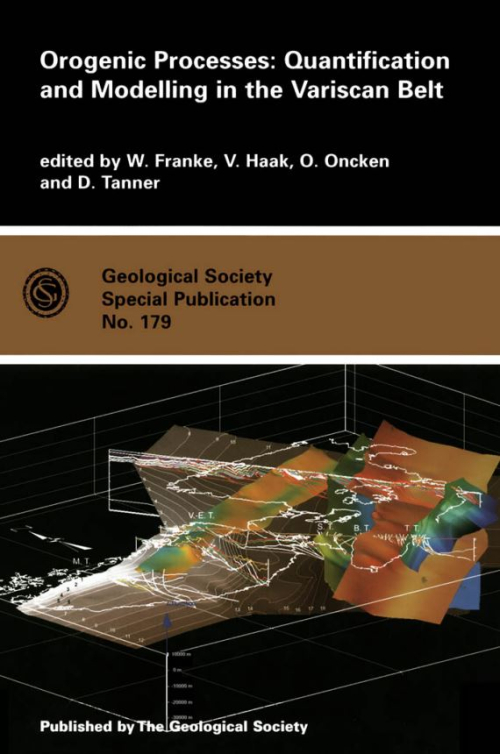
Franke, W., Haak, V., Oncken, O. & Tanner, D. Orogenic processes: quantification and modelling in the Variscan Belt McKerrow, W. S. & van Staal, C, R. The Palaeozoic time scale reviewed McKerrow, W. S., MacNiocaill, C., Ahlberg, P. E., Clayton, G., Cleal, C. J. & Eagar, R. M. C. The Late Palaeozoic relations between Gondwana and Laurussia Tait, J., Schatz, M., Bachtadse, V. & Soffel, H. Palaeomagnetism and Palaeozoic palaeogeography of Gondwana and European terranes Franke, W. The mid-European segment of the Variscides: tectonostratigraphic units, terrane boundaries and plate tectonic evolution Franke, W. & Zelazniewicz, A. The eastern termination of the Variscides: terrane correlation and kinematic evolution Belka, Z., Ahrendt, FI., Franke, W. & Wemmer, K. The Baltica-Gondwana suture in central Europe: evidence from K-Ar ages of detrital muscovites and biogeographical data Finger. F., Hanzl, P., Pin, C., von Quadt, A. & Steyrer. FI. P. The Brunovistulian: Avalonian Precambrian sequence at the eastern end of the Central European Variscides? Hegner, E. & Kroner. A. Review of Nd isotopic data and xenocrystic and detrital zircon ages from the pre-Variscan basement in the eastern Bohemian Massif: speculations on palinspastic reconstructions