Добрый день, Коллеги. Важное сообщение, просьба принять участие. Музей Ферсмана ищет помощь для реставрационных работ в помещении. Подробности по ссылке
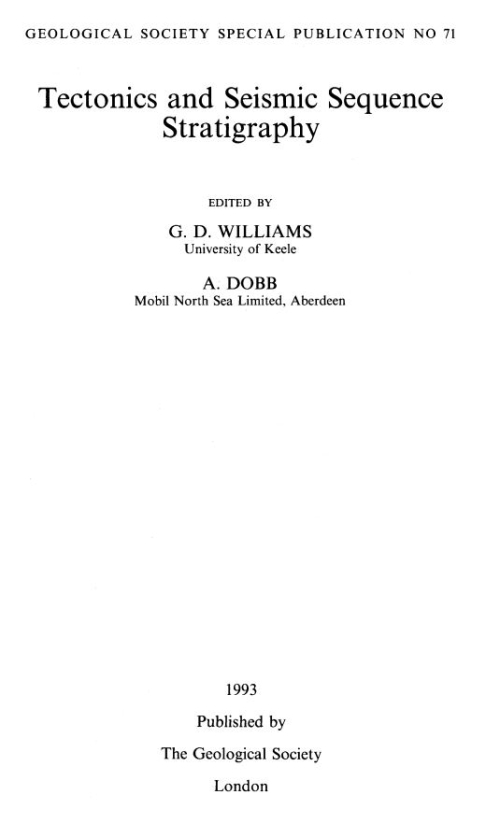
Williams, G. D. Tectonics and seismic sequence stratigraphy: an introduction Cartwright, J. A., Haddock, R. C. & Pinheiro, L. M. The lateral extent of sequence boundaries Prosser, S. Rift-related linked depositional systems and their seismic expression Waltham, D., Hardy, S. & Abousetta, A. Sediment geometries and domino faulting Roberts, A. M., Yielding, G. & Badley, M. E. Tectonics and bathymetric controls on stratigraphic sequences within evolving half-graben Joy, A. M. Comments on the pattern of post-rift subsidence in the Central and Northern North Sea Basin Higgs, W. G. & McClay, K. R. Analogue sandbox modelling of Miocene extensional faulting in the Outer Moray Firth Light, M. P. R., Maslanyj, M. P., Greenwood, R. J. & Banks, N. L. Seismic sequence stratigraphy and tectonics offshore Namibia Deramond, J., Souquet, P., Fondecave-Wallez, M-J. & Specht, M. Relationships between thrust tectonics and sequence stratigraphy surfaces in foredeeps: model and examples from the Pyrenees (Cretaceous-Eocene, France, Spain)
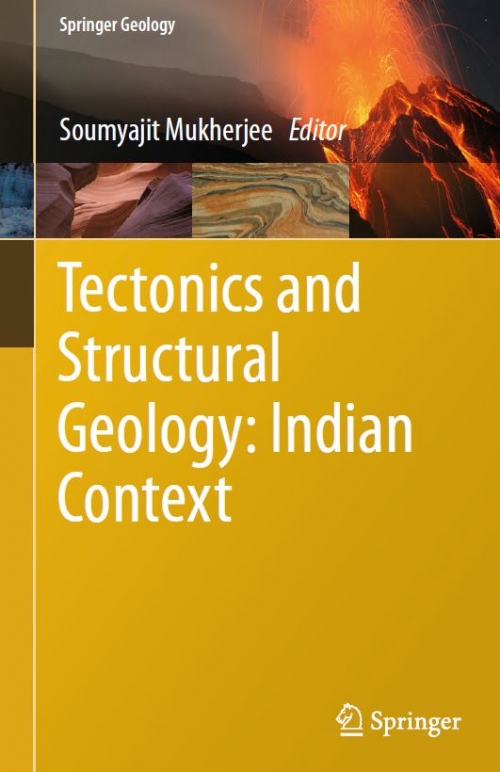
Tectonics and structural geology of Indian terrain is of great interest to the Government and a number of private exploration agencies that are working presently. This edited volume aims to meet this requirement. In addition, B.Sc. and M. Sc. geoscience students undergoing geohistory and/or tectonic courses would benefit using this book. This edited volume brings 16 research papers (Chaps. 2–17) from both academia and industry. Mukherjee et al. (2019) in Chap. 2 present an exhaustive review on the geology and the geochronology and of the Chotanagpur Granite Gneissic Complex (CGGC). They classify the CGGC into three domains, and also comment on the India-Antarctica reconstruction. <...>
The plate tectonic revolution of the 1960’s provided the first unified framework for models on the origin of mountain belts and basins; this resulted in an outpouring of landmark papers in the 1970’s and 1980’s. When Ray Ingersoll and Cathy Busby taught Tectonics of Sedimentary Basins in the late 1980s (at UCLA and UCSB respectively), they were frustrated by a lack of textbooks or summary papers on this topic. Instead, professors were forced to compile impossibly long reading lists for their students, and try to synthesize he material for them. For this reason, Professors Busby and Ingersoll decided to edit a textbook on the topic for Blackwell, to be aimed at the senior undergraduate to professional geologist level.
The Arctic is a geologically unique region where the North American, Eurasian and Pacific lithospheric plates come together, and a new Arctic Ocean is born on the continuation of the North Atlantic. The northern geographical and magnetic poles are located in the Arctic. Large ore deposits have been discovered in the Arctic regions, and the shelves contain large hydrocarbon resources.
TRELOAR, P. J., SEARLE, M. P., KHAN, M. A. & JAN, M. Q. Tectonics of the Nanga Parbat syntaxis and the western Himalaya: an introduction CAPORALI, A. The gravity field of the Karakoram Mountain Range and surrounding areas
TRELOAR, P. J., GEORGE M. T. & WHITTINGTON, A. G. Mafic sheets from Indian plate gneisses in the Nanga Parbat syntaxis: their significance in dating crustal growth and metamorphic and deformation events BUTLER, R. W. H. Structural evolution of the western margin of the Nanga Parbat massif, Pakistan Himalaya: insights from the Raikhot-Liachar area EDWARDS, M. A., KIDD, W. S. R, KHAN, M. A. & SCHNEIDER, D. A. Tectonics of the SW margin of the Nanga Parbat-Haramosh massif
When the major mineral deposits of Africa are studied in relation to the structure of the continent, two tectono-metallogenic units emerge, as follows: (a) younger orogens consisting of zones which have suffered orogenesis from time to time during the past ca. 1200 m.y. - characterised by major deposits of Cu, Pb, Zn, Co. Sn, W, Be and Nb-Ta; and (b) older cratons, with a record of older orogenesis but which have remained stable throughout the younger periods of tectonism - characterised by important deposits of Au, Fe, Cr, asbestos and diamond. The more localised metallogenic provinces of ore concentration within these major units are briefly discussed.
Evolution of the Appalachian orogen spanned the Paleozoic and Mesozoic Eras. Within the confines of the northern Appalachians of the United States (the New England States - Maine, New Hampshire, Vermont, Massachusetts, Connecticut and Rhode Island - and New York), the sequence of known major Appalachian tectonic events is late Proterozoic rifting of the protoNorth American craton; Ordovician subduction accompanied by destruction of the Iapetus Ocean and by obduction of tectonostratigraphic sequences; Devonian deformation, accretion, plutonism, and metamorphism, of uncertain plate tectonic context but likely related to a continent continentcollision; formation of late Carboniferous transtensive (oblique strikeslip) basins in which coal formed; and late Carboniferous to Permian thermal, plutonic, and metamorphic events. During the Mesozoic, the New England Appalachians underwent crustal extension associated with both alkalic and tholeiitic magmatism. These extensional processes (11-7, V-l)~/ reflect the opening of the North Atlantic Ocean and the creation of a passive margin, which remains today.<...>
The Canary Islands Archipelago, offshore of the northwestern coast of Africa, originated from ocean-island volcanism over a span of 20 million ears. This 600-km-long chain of islands (total population *2 million), with their beautiful volcanic landscapes, beaches, and year-round mild climate, receives more than 12 million visitors each year. The prime tourist destination is Teide Volcano on the Island of Tenerife, the centerpiece of Teide National Park and the focus of this scientific volume. In 2010, Teide National Park was the most heavily visited national park of any European country and the second most visited worldwide.