Добрый день, Коллеги. Важное сообщение, просьба принять участие. Музей Ферсмана ищет помощь для реставрационных работ в помещении. Подробности по ссылке

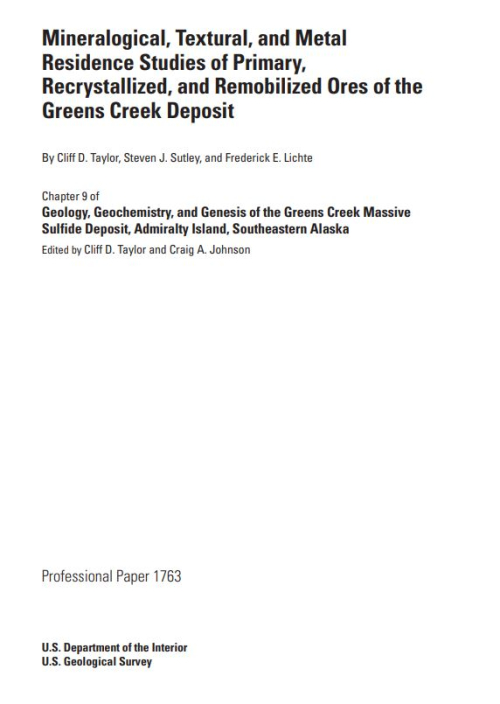
Редактор(ы):Lichte F.E., Sutley S.J., Taylor C.D.
Издание:USGS, 53 стр.
Язык(и)Английский
Mineralogical, textural and metal residence studies of primary, recrystallized and remobilized ores of the Greens Creek Deposit / Минералогические, текстурные и геохимические исследования образования, рекристаллизации и ремобилизации руд месторождения ГК

The Greens Creek deposit is a 24.2-million-ton polymetallic massive sulfide with a diverse base- and preciousmetal-rich mineralogy, which has been subjected to regional lower greenschist facies metamorphism. Roughly 30 percent of the ores retain primary mineralogy and mineral textures as well as gross original ore stratigraphy. Ore lithologies fall into two groups: massive sulfide ores (greater than 50 percent sulfides) and semimassive or disseminated sulfide gangue-rich “white” ores (less than 50 percent sulfides). There are two types of massive ore: massive pyritic and massive base-metalrich ore.

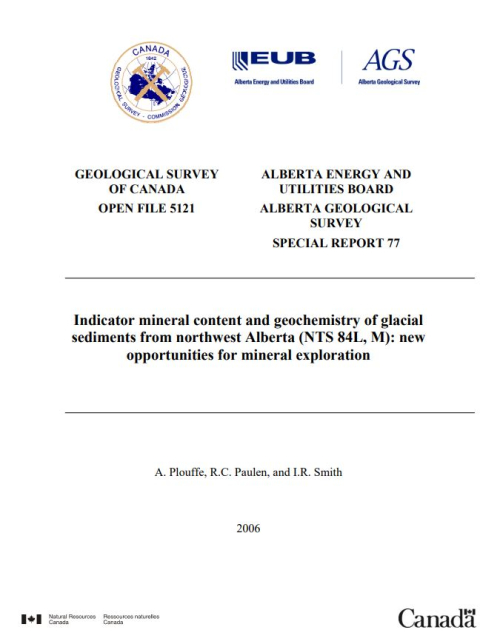
Автор(ы):Paulen R.C., Plouffe A., Smith I.R.
Издание:Alberta Geological Survey, 2006 г., 29 стр.
Язык(и)Английский
Indicator mineral content and geochemistry of glacial sediments from NW Alberta: new opportunities for mineral exploration / Содержание минералов-индикаторов и геохимия гляциальных осадков северо-запада Альберты: новые возможности для поисковой геохимии

This report presents the results of heavy mineral and geochemical analyses conducted on glacial sediment samples collected in northwest Alberta. This study was undertaken as part of a collaborative project between the Alberta Geological Survey (Alberta Energy and Utilities Board) and the Geological Survey of Canada (Natural Resources Canada) originally designed to assess the regional occurrence of kimberlite indicator minerals (KIMs) in glacial deposits.

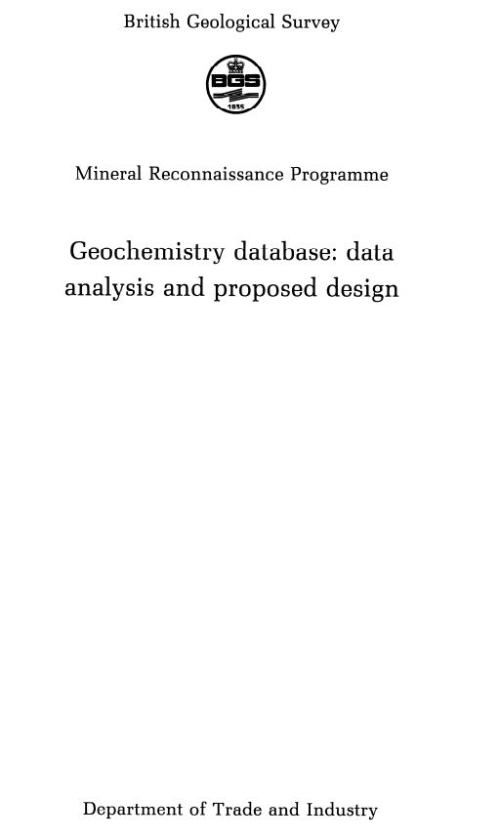
Автор(ы):Coats J.S., Harris J.R.
Издание:NERC, 1992 г., 169 стр.
Язык(и)Английский
Geochemistry database: data analysis and proposed design / Геохимическая база данных: анализ данных и проектирование работ

The results of the data analysis for a geochemistry relational database to hold the UK, land-based datasets currently managed by the Minerals and Geochemical Surveys Division plus some other geochemical datasets held by BGS are presented in full in the form of a geochemistry data model.

Автор(ы):Grünfeld K.
Издание:2005 г., 53 стр., ISBN: 91-7178-014-9
Язык(и)Английский
Visualization, integration and analysis of multi-element geochemical data / Визуализация, комплексное изучение и анализ мульти-элементных геохимических данных

Geochemical mapping programs carried out by the Geological Survey of Sweden (SGU) have generated large databases containing information on the concentrations of chemical elements in rocks, surface sediments and biogeochemical materials. Regional geochemical data being imprecise, multivariate, spatially auto-correlated and non-normally distributed pose specific problems to the choice of data analysis methods. Commonly several methods are combined, and the choice of techniques depends on the characteristics of data as well as the purpose of study.

Автор(ы):Filzmoser P., Reimann C., Templ M.
Издание:2006 г., 39 стр.
Язык(и)Английский
Cluster analysis applied to regional geochemical data: Problems and possibilities / Кластерный анализ применительно к региональным геохимическим данным: проблемы и возможности

A large regional geochemical data set of O-horizon samples from a 188,000 km2 area in the European Arctic, analysed for 38 chemical elements, pH, electrical conductivity (both in a water extraction) and loss on ignition (LOI, 480 oC), was used to test the influence of different variants of cluster analysis on the results obtained. Due to the nature of regional geochemical data (neither normal nor log-normal, strongly skewed, often multi-modal data distributions),

Редактор(ы):Davis B., Ho S.E., Jefferss G.
Издание:Australian Institute of Geoscientists, 1999 г., 146 стр., ISBN: 1-876118-10-5
Язык(и)Английский
Exploration geochemistry for the new illennium / Поисковая геохимия для нового тысячелетия

Geochemistry has led to numerous success stories in mineral exploration. From the relatively simple colorimetric stream sediment analysis through to sophisticated, high technology, isotope geochemical tools, exploration geochemistry has enjoyed a rapid growth and evolution during the second half of the twentieth century. But where is geochemistry heading in the new millennium? This is the issue that this conference seeks to address. <...>

Издание:ИГЕМ РАН, Москва, 1967 г., 43 стр.
Язык(и)Русский
Справочник по аналитическим определениям, выполняемым в лабораториях ИГЕМа

Справочник подготовлен по решению дирекции ИГЕМ АН временной аналитической комиссией - зав. центральной химической лабораторией докт. геол.-мин. наук И.Д,Борнеман-Старынкевич, зав,рентгено-химической лабораторией канд, физ.-мат.наук К.И.Нарбуттом, зав. лабораторией спектрального анализа канд. технич. наук В.Г.Дитровьш председатель комиссии).

Издание:Agilent technologies, 2005 г., 84 стр.
Язык(и)Английский
ICP-MS Inductively Coupled Plasma Mass Spectrometry. A Primer / Масс-спектрометрия с индуктивно-связанной плазмой. Введение

Inductively Coupled Plasma Mass Spectrometry (ICP-MS) was developed as a commercial analytical technique in the early 1980’s and has since been applied to the determination of trace, minor and major elements in almost every analytical field. Strengths of the technique include:

• Wide elemental coverage - virtually all elements can be measured by ICP-MS, including alkali and alkaline earth elements, transition and other metals, metalloids, rare earth elements, most of the halogens and some of the non-metals

Издание:SRK, 2011 г., 28 стр.
Язык(и)Английский
Laser ablation inductively coupled plasma mass spectrometry (LA-ICP-MS) / Лазерная абляция с масс-спректрометрией с индуктивно-связанной плазмой

Inductively coupled plasma mass spectrometry (ICP‐MS) is undoubtedly the fastest‐growing trace element technique available today. Since its commercialization in 1983, approximately 5000 systems have been installed worldwide, carrying out many varied and diverse applications. The most common ones, which represent approximately 80% of the ICP‐MS analyses being carried out today, include environmental, geological, semiconductor, biomedical, and nuclear application fields.

Ленты новостей
446.47