Добрый день, Коллеги. Важное сообщение, просьба принять участие. Музей Ферсмана ищет помощь для реставрационных работ в помещении. Подробности по ссылке

Автор(ы):Coulson M.
Издание:Harriman House Ltd, 2008 г., 384 стр., ISBN: 9781905641550
Язык(и)Английский
An insider's guide to the mining sector. An in-depth study of gold and mining shares / Руководство для инсайдеров по горнодобывающему сектору. Подробное исследование акций золотодобывающих компаний

The first edition of this book covered those subjects that I believed were fundamental to acquiring sufficient knowledge about the mining sector to invest in it with confidence. In doing this I dipped into a wide number of subjects and tried to extract the points and issues most relevant to successful investing. Since then the mining and metals sector has experienced a massive bull market and this has led to a number of new or enhanced influences for the sector arising.

Автор(ы):Yaseen I.A.A.B.
Издание:2015 г., 14 стр.
Язык(и)Английский
Geochemical exploration for gold and the association of As-Cu-Pb-Sn-Zn-Li in the upper proterozoic granitoids of the wadi Rumman Area, Southwest Jordan / Геохимическая разведка золота и ассоциации As-Cu-Pb-Sn-Zn-Li в гранитоидах верхнего протерозоя

Геохимическая разведка золота и ассоциации As-Cu-Pb-Sn-Zn-Li в гранитоидах верхнего протерозоя в районе Вади-Румман на юго-западе Иордании

The geochemical studies were conducted in an area covering about 15 km2 of the south side of the Wadi Rumman area, SW Jordan. The study area included a part of a basement of complex exposed rocks in southwestern Jordan. The complexes comprised igneous and metamorphic suites, mostly from the late Proterozoic age. A systematic geochemical sampling was conducted using rock and heavy mineral-panned concentrate of geochemical samples. Fifty rock samples were collected from the granitic rocks, simple pegmatite dyke, quartz veins and alteration zone, which covered the area.

Издание:2002 г., 13 стр.
Язык(и)Английский
An investigation of gold/ceramic and gold/glass interfaces / Исследование взаимодействия золота с керамикой и золота со стеклом

This paper describes how various characterisation methods can be used to investigate the physicochemical and spectral properties of gold films in contact with glass or ceramic. The interface between the metal and substrate has been given special attention. The examples chosen to illustrate this include: liquid gold films (decorated and fired) or inlayed gold layers on ceramic wares and “sandwich” gold foils between two glass sheets for mosaic application. Characterisation methods include: microanalytical scanning electron microscopy, X-ray diffraction, ion beam analyses (PIXE: particle induced X-ray emission; RBS: Rutherford back-scattering spectrometry), photo-spectrometry and colorimetry. The adhesion mechanism and colour behaviour of the coated objects is discussed. <...>

Автор(ы):Hedenquist J.W., White N.C.
Издание:1995 г., 9 стр.
Язык(и)Английский
Epithermal gold deposits: styles, characteristics and exploration / Эпитермальные месторождения золота: типы, характеристики и разведка

Epithermal ore deposits form at shallow depth. This conclusion was initially based on geologic reconstructions, ore mineralogy and related textures (Lindgren, 1933). It has subsequently been refined withfluid inclusion data to indicate that epithermal ores form over the temperature range of <150o C to ~300o C, from the surface to as deep as 1 to 2 km. Here we highlight the general characteristics of the two principal styles of epithermal mineralization in which gold is the dominant economic metal. We base our generalizations on observations of many deposits and prospects in the circum-Pacific region. Distinguishing between the two styles is crucial for effective exploration. Although they show similar alteration mineralogies, the distribution of the alteration zones is different, and the economic mineralization is associated with different parts of the system. The alteration zoning can be used as a pointer towards the most prospective part of the system, but only when the style has been correctly recognized. In addition, the two styles of mineralization have differences in their geochemical associations. <...>

Том 3
Редактор(ы):Wolf K.H.
Издание:Elsevier, 1981 г., 748 стр., ISBN: 0-444-41824-5
Язык(и)Английский
Handbook of strata-bound and stratiform ore deposits. Part 3. V9. Regional studies ans specific deposits / Практическое руководство по стратиформным месторождениям твердых полезных ископаемых. Часть 3. Региональные исследования и специфичные месторождения

Numerous detailed studies of stratiform  copper deposits reported in recent years have rejected the classic igneous-hydrothermal epithermal/telethermal origin for such mineralization, and have instead suggested that an origin intimately related to the processes of sedimentation would be much more suited to the observed character of these deposits. Overwhelming features, such as the widespread continuity of mineralization within a sedimentary basin and the distribution of mineralization within narrow stratigraphic limits, are commonly cited as evidence of sedimentary origins. However, such features do not exclude the possibility of diagenetic additions of ore metals to particularly favorable stratigraphic horizons, and in fact recent studies indicate repeatedly that one or more diagenetic events preceded the deposition of ore metals. For example, the deposition of iron sulfides, and in some cases sulfate-bearing minerals, is commonly observed to have occurred before the introduction of ore-stage metals. <...>

Автор(ы):Pirajno F.
Издание:Springer, 2000 г., 572 стр., ISBN: 978-90-481-4026-8
Язык(и)Английский
Ore deposits and mantle plumes / Рудные месторождения и мантийные плюмы

Increasingly explorationists are seeking to find new ore deposits in poorly prospected areas, be they geographically remote, such as in the Arctic, or geologically remote, such as those under sedimentary cover. Modern prospecting techniques, including low-detection-level geochemistry and the use of advanced geophysical instrumentation have greatly assisted explorers but fundamental to any soundly based exploration program remains an understanding of the geological framework of ore deposits. This allows the development of deposit models on macroscopic and mesoscopic scales.

Редактор(ы):Eliopoulos D.G.
Издание:Millpress, Rotterdam, 2003 г., 1225 стр., ISBN: 90 77017 77 1
Язык(и)Английский
Mineral exploration and sustainable development / Разведка полезных ископаемых и устойчивое развитие

At its 6th Biennial SGA Meeting in Krakow, Poland, August 2001, the Council of the Society for Geology Applied to Mineral Deposits (SGA) decided to offer the organization of the 7th Biennial Meeting to Athens, Greece. “Mineral Exploration and Sustainable Development” was chosen as the general theme of the meeting, in the expectation that would attract economic geologists from academia, government, and industry to discuss current issues regarding exploration for mineral deposits and their sustainable development by the minerals industry.

Редактор(ы):Пантелеева А.В., Сначев А.В.
Издание:Springer, 2024 г., 130 стр., ISBN: 978-3-031-60965-7
Язык(и)Английский
Geology, petrochemistry and ore content of carbonaceous deposits of the Kumak ore field / Геология, нефтехимия и рудоносность углеродистых отложений Кумакского рудного поля

Geological Structure and History of Exploration of the Anikhov Graben (Southern Urals, Russia) 

Alexandra V. Panteleeva, Aleksandr V. Snachev, P. V. Pankratev,
R. S. Kisil, and V. P. Petrishchev
Geological Structure of the Kumak Ore Field (Southern Urals, Russia)     
Alexandra V. Panteleeva, Aleksandr V. Snachev, P. V. Pankratev,
V. S. Panteleev, and R. S. Kisil
Petrographic Features and Carbonaceous Matter of the Black Shales of the Kumak Deposit (Southern Urals, Russia)  
Alexandra V. Panteleeva, Aleksandr V. Snachev, А. М. Tyurin,
Mikhail A. Rassomakhin, and Irina V. Smoleva

Автор(ы):Kyser K.
Издание:Elsevier, 2014 г., 25 стр.
Язык(и)Английский
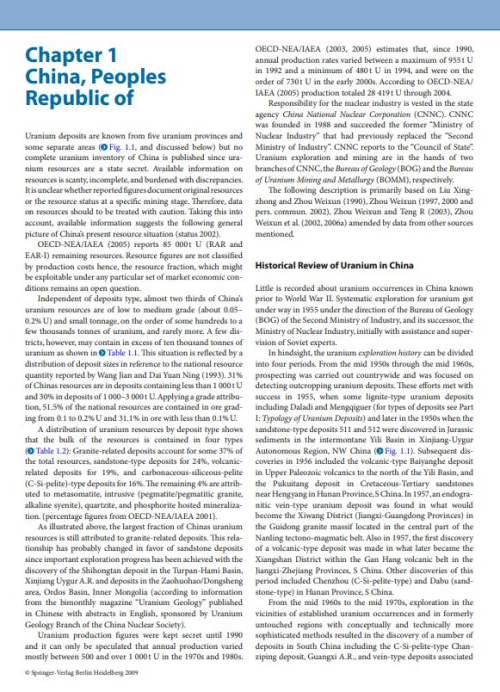
Uranium ore deposits / Месторождения урановых руд

The discovery of uranium is attributed to Klaproth, a German chemist who, in 1789, precipitated a yellow compound by dissolving pitchblende in nitric acid, neutralizing it with sodium hydroxide, and heating it with charcoal to obtain a black powder that was uranium oxide. He named the newly discovered element after the planet Uranus. In 1841, Pe´ligot, a French chemist working at the Baccarat crystal factory in Lorraine, isolated the first sample of uranium metal by heating uranium tetrachloride with potassium. Uranium was used during the nineteenth century to color pottery and glass until the discovery of radioactivity by Becquerel in 1896 (Becquerel, 1896), when he accidentally exposed a photographic plate to uranium. A team led by Enrico Fermi in 1934 observed that bombarding uranium with neutrons produces the emission of beta rays, and this led to the discovery of fission of uranium by the Fermi group on 2 December 1942 – the era of the power of the atom began <...>

Ленты новостей
490.09