Добрый день, Коллеги. Важное сообщение, просьба принять участие. Музей Ферсмана ищет помощь для реставрационных работ в помещении. Подробности по ссылке

Издание:PGS Publishing, Linden Park, 2005 г., 10 стр.
Язык(и)Английский
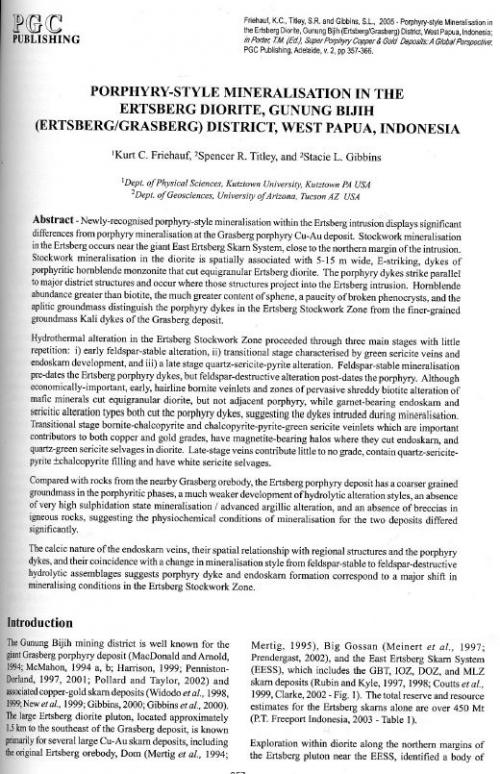
Porphyry-style mineralisation in the Ertsberg diorite, Gunung Bijih (Ertsberg/Grasberg) district, West Papua, Indonesia

Newly-recognised porphyry-style mineralisation within the Ertsberg intrusion displays significant differences from porphyry mineralisation at the Grasberg porphyry Cu-Au deposit. Stockwork mineralisation in the Ertsberg occurs near the giant East Ertsberg Skarn System, close to the northern margin of the intrusion. Stockwork mineralisation in the diorite is spatially associated with 5-15 m wide, E-striking, dykes of porphyritic hornblende monzonite that cut equigranular Ertsberg diorite. The porphyry dykes strike parallel to major district structures and occur where those structures project into the Ertsberg intrusion. Hornblende abundance greater than biotite, the much greater content of sphene, a paucity of broken phenocrysts, and the aplitic groundmass distinguish the porphyry dykes in the Ertsberg Stockwork Zone from the finer-grained groundmass Kali dykes of the Grasberg deposit.

Автор(ы):Cloos M., Paterson J.T.
Издание:PGS Publishing, Linden Park, 2005 г., 35 стр.
Язык(и)Английский
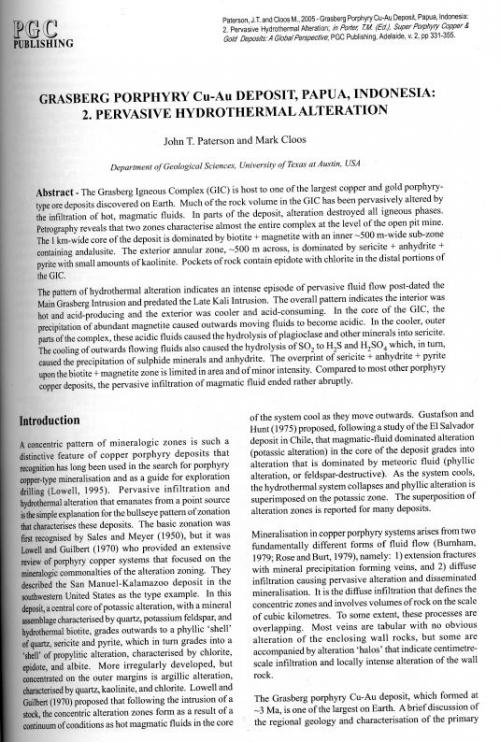
Grasberg Porphyry Cu-Au Deposit, Papua, Indonesia: Pervasive Hydrothermal Alteration

 The Grasberg Igneous Complex (GIC) is host to one of the largest copper and gold porphyry-type ore deposits discovered on Earth. Much of the rock volume in the GIC has been pervasively altered by the infiltration of hot, magmatic fluids. In parts of the deposit, alteration destroyed all igneous phases. Petrography reveals that two zones characterise almost the entire complex at the level of the open pit mine. The 1 km-wide core of the deposit is dominated by biotite + magnetite with an inner ~500 m-wide sub-zone containing andalusite. The exterior annular zone, -500 m across, is dominated by sericite + anhydrite + pyrite with small amounts of kaolinite. Pockets of rock contain epidote with chlorite in the distal portions of the GIC.

Автор(ы):Cloos M., Paterson J.T.
Издание:PGS Publishing, Linden Park, 2005 г., 17 стр.
Язык(и)Английский
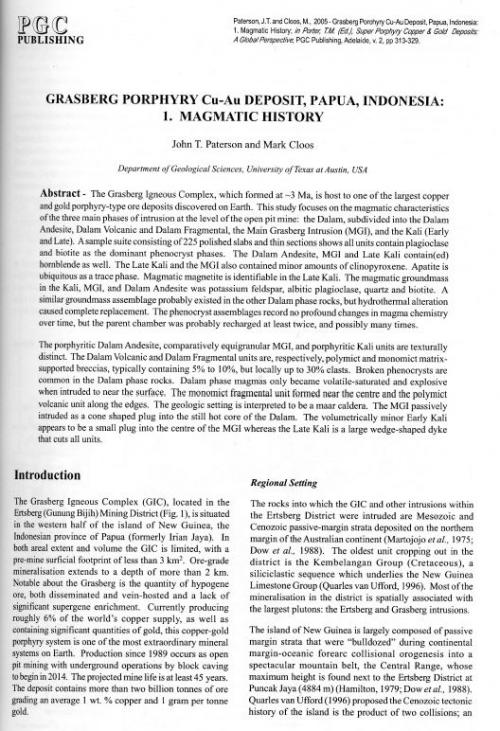
Grasberg Porphyry Cu-Au Deposit, Papua, Indonesia: Magmatic History

The Grasberg Igneous Complex, which formed at ~3 Ma, is host to one of the largest copper and gold porphyry-type ore deposits discovered on Earth. This study focuses on the magmatic characteristics of the three main phases of intrusion at the level of the open pit mine: the Dalam, subdivided into the Dalam Andesite, Dalam Volcanic and Dalam Fragmental, the Main Grasberg Intrusion (MGI), and the Kali (Early and Late). A sample suite consisting of 225 polished slabs and thin sections shows all units contain plagioclase and biotite as the dominant phenocryst phases. The Dalam Andesite, MGI and Late Kali contain(ed) hornblende as well. The Late Kali and the MGI also contained minor amounts of clinopyroxene. Apatite is ubiquitous as a trace phase. Magmatic magnetite is identifiable in the Late Kali. The magmatic groundmass in the Kali, MGI, and Dalam Andesite was potassium feldspar, albitic plagioclase, quartz and biotite. A similar groundmass assemblage probably existed in the other Dalam phase rocks, but hydrothermal alteration caused complete replacement. The phenocryst assemblages record no profound changes in magma chemistry over time, but the parent chamber was probably recharged at least twice, and possibly many times.

Автор(ы):Glen R.A., Porter T.M.
Издание:PGS Publishing, Linden Park, 2005 г., 26 стр.
Язык(и)Английский
The Porphyry Au-Cu Deposits and Related Shoshonitic Magmatism of the Palaeozoic Macquarie Volcanic Arc, Eastern Lachlan Orogen in New South Wales, Australia: A Review / Порфировые месторождения золота и меди


Ordovician volcanic, volcaniclastic and intrusive rocks of calc-alkaline affinity in the Eastern Subprovince of the Lachlan Orogen were formed in the intraoceanic Macquarie Volcanic Arc. The Macquarie Arc was developed in response to west-dipping subduction along part of the boundary between eastern Gondwana and the proto-Pacific Plate and was situated on the Gondwana Plate, some 1000 km east of Precambrian continental crust. The intervening area was occupied by a back arc basin that developed on oceanic crust as the proto-PacificPlate rolled back eastwards after the Middle Cambrian Delamerian Orogeny. Subsequent extension, strike-slip translation and thin-skinned tectonics have structurally dissected the single arc into four north to NNE trending structural belts of Ordovician calc-alkaline rocks that are separated largely by younger rift basins and in part by coeval craton-derived turbidites.

Автор(ы):McMillan W.J.
Издание:PGS Publishing, Linden Park, 2005 г., 16 стр.
Язык(и)Английский
Porphyry Cu-Mo Deposits of the Highland Valley District, Guichon Creek Batholith, British Columbia, Canada

Copper-molybdenum and copper-gold porphyry deposits in the Quesnel terrane occur in association with either calc-alkalic or alkalic intrusive suites respectively, emplaced within a succession of island arc volcanic rocks that are of Late Triassic to Middle Jurassic or Late Cretaceous to Eocene age. The Highland Valley porphyry district, in southern British Columbia, consists of five major copper-molybdenum deposits, Valley, Lornex, Bethlehem, Highmont and J A, located within a fifteen square kilometre area in the centre of the Guichon Creek batholith. The batholith is a Late Triassic calc-alkalic intrusion that REE data suggest was derived from either subducted oceanic crust or depleted mantle. The crystallisation age of the batholith, based on U-Pb zircon analyses, is 210 Ma. Mineralisation occurred in late magmatic and early post magmatic time. Oxide analyses suggest a single source magma but younger phases were locally injected into older due to tectonic forces. The earliest deposits occurred after separation of a fluid phase that is marked by a sharp discontinuity in the evolution path of the alkali oxides.

Издание:PGS Publishing, Linden Park, 2005 г., 15 стр.
Язык(и)Английский
Geology of the Bingham Mining District, Salt Lake County, Utah

The Bingham deposit is centred on a small 40 Ma stock of older, generally equigranular, monzonite that is cut by quartz monzonite porphyry, latite, and quartz latite porphyry dykes. The surrounding country rocks are quartzite and minor but important limestone. A body of fractured rock formed over the top of the monzonite as it cooled leaving a weakly fractured core below a dome of strong fracturing. Early fluids entered this fractured mass at about the time of the intrusion of the first porphyry resulting in an undetermined amount of alteration and mineralisation. This fracturing is a major control on the location of the ore shell and the concentric zoning pattern of alteration and mineralisation. Five porphyry intrusives have been described and each is followed by a cycle of veining, alteration and mineralisation. The porphyries all trend north-easterly across the northern half of the deposit, forming the porphyry trend. At least three overlapping centres of fracturing, alteration and mineralisation seem to be present within the stock, one centred in the fracture dome and two or more in the porphyry trend.

Автор(ы):Cook S.S., Porter T.M.
Издание:PGS Publishing, Linden Park, 2005 г., 34 стр.
Язык(и)Английский
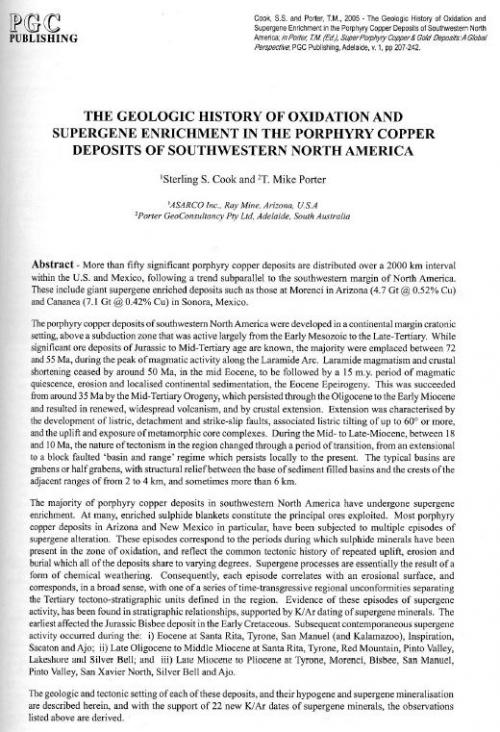
The Geologic History of Oxidation and Supergene Enrichment in the Porphyry Copper Deposits of Southwestern North America

More than fifty significant porphyry copper deposits are distributed over a 2000 km interval within the U.S. and Mexico, following a trend subparallel to the southwestern margin of North America. These include giant supergene enriched deposits such as those at Morenci in Arizona (4.7 Gt @ 0.52% Cu) and Cananea (7.1 Gt @ 0.42% Cu) in Sonora, Mexico.

The porphyry copper deposits of southwestern North America were developed in a continental margin cratonic setting, above a subduction zone that was active largely from the Early Mesozoic to the Late-Tertiary. While significant ore deposits of Jurassic to Mid-Tertiary age are known, the majority were emplaced between 72 and 55 Ma, during the peak of magmatic activity along the Laramide Arc. Laramide magmatism and crustal shortening ceased by around 50 Ma, in the mid Eocene, to be followed by a 15 m.y. period of magmatic quiescence, erosion and localised continental sedimentation, the Eocene Epeirogeny. This was succeeded from around 35 Ma by the Mid-Tertiary Orogeny, which persisted through the Oligocene to the Early Miocene and resulted in renewed, widespread volcanism, and by crustal extension. Extension was characterised by the development of listric, detachment and strike-slip faults, associated listric tilting of up to 60° or more, and the uplift and exposure of metamorphic core complexes. During the Mid- to Late-Miocene, between 18 and 10 Ma, the nature of tectonism in the region changed through a period of transition, from an extensional to a block faulted 'basin and range' regime which persists locally to the present. The typical basins are grabens or half grabens, with structural relief between the base of sediment filled basins and the crests of the adjacent ranges of from 2 to 4 km, and sometimes more than 6 km.


Автор(ы):Lipten E.J., Smith S.W.
Издание:PGS Publishing, Linden Park, 2005 г., 15 стр.
Язык(и)Английский
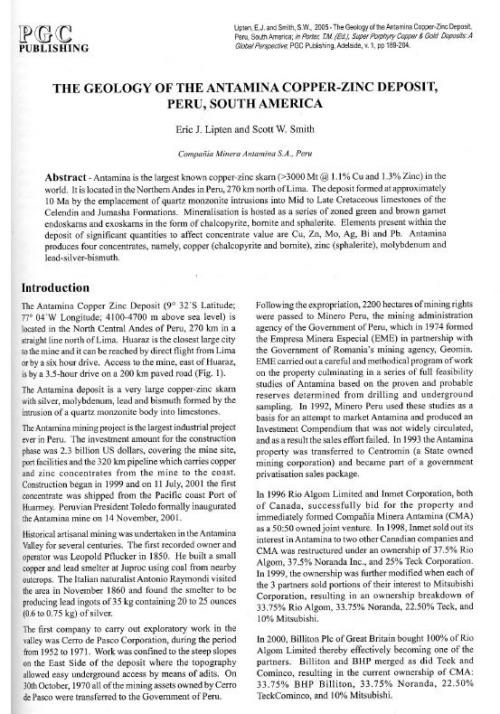
The Geology of the Antamina Copper-Zinc Deposit, Peru, South America

Antamina is the largest known copper-zinc skarn (>3000 Mt @ 1.1% Cu and 1.3% Zinc) in the world. It is located in the Northern Andes in Peru, 270 km north of Lima. The deposit formed at approximately 10 Ma by the emplacement of quartz monzonite intrusions into Mid to Late Cretaceous limestones of the Celendin and Jumasha Formations. Mineralisation is hosted as a series of zoned green and brown garnet endoskarns and exoskarns in the form of chalcopyrite, bornite and sphalerite. Elements present within the deposit of significant quantities to affect concentrate value are Cu, Zn, Mo, Ag, Bi and Pb. Antamina produces four concentrates, namely, copper (chalcopyrite and bornite), zinc (sphalerite), molybdenum and lead-silver-bismuth.

Издание:PGS Publishing, Linden Park, 2005 г., 14 стр.
Язык(и)Английский
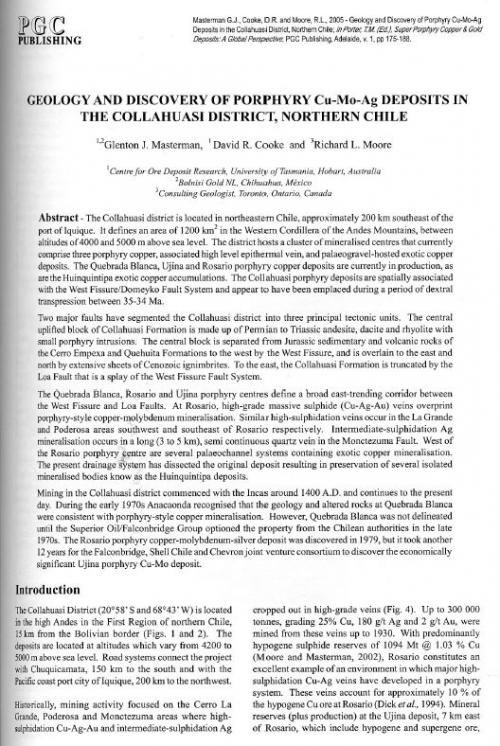
Geology and Discovery of Porphyry Cu-Mo-Ag Deposits in the Collahuasi District, Northern Chile

The Collahuasi district is located in northeastern Chile, approximately 200 km southeast of the port of Iquique. It defines an area of 1200 km2 in the Western Cordillera of the Andes Mountains, between altitudes of 4000 and 5000 m above sea level. The district hosts a cluster of mineralised centres that currently comprise three porphyry copper, associated high level epithermal vein, and palaeogravel-hosted exotic copper deposits. The Quebrada Blanca, Ujina and Rosario porphyry copper deposits are currently in production, as are the Huinquintipa exotic copper accumulations. The Collahuasi porphyry deposits are spatially associated with the West Fissure/Domeyko Fault System and appear to have been emplaced during a period of dextral transpression between 35-34 Ma.

Издание:PGS Publishing, Linden Park, 2005 г., 24 стр.
Язык(и)Английский
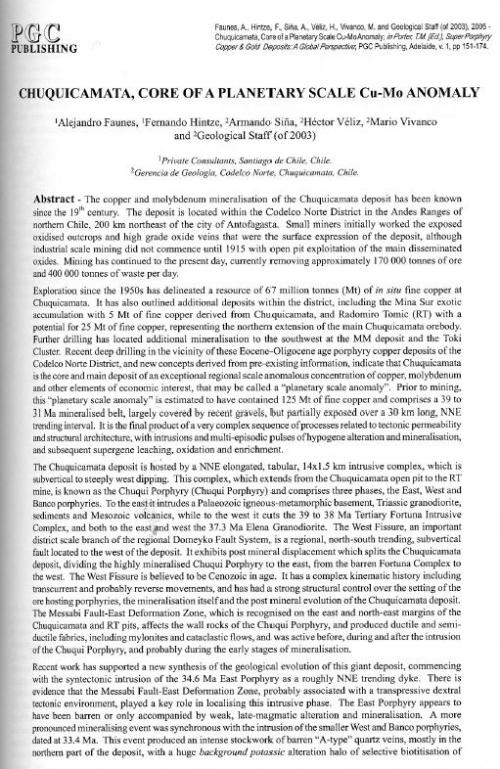
Chuquicamata, Core of a Planetary Scale Cu-Mo Anomaly

The copper and molybdenum mineralisation of the Chuquicamata deposit has been known since the 19' century. The deposit is located within the Codelco Norte District in the Andes Ranges of northern Chile, 200 km northeast of the city of Antofagasta. Small miners initially worked the exposed oxidised outcrops and high grade oxide veins that were the surface expression of the deposit, although industrial scale mining did not commence until 1915 with open pit exploitation of the main disseminated oxides. Mining has continued to the present day, currently removing approximately 170 000 tonnes of ore and 400 000 tonnes of waste per day.

Ленты новостей
614.77