Добрый день, Коллеги. Важное сообщение, просьба принять участие. Музей Ферсмана ищет помощь для реставрационных работ в помещении. Подробности по ссылке

Издание:PGS Publishing, Linden Park, 2002 г., 9 стр.
Язык(и)Английский
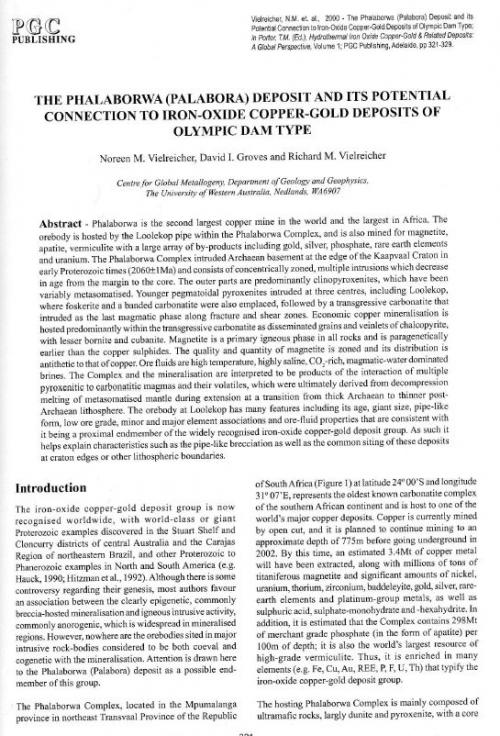
The Phalaborwa (Palabora) deposit and its potential connections to iron-oxide copper-gold depositsof Olympic Dam type / Месторождение Пхалабора (Palabora) и его потенциальная связь с железооксидными медно-золотыми месторождениями типа Олимпик Дам

Phalaborwa is the second largest copper mine in the world and the largest in Africa. The orebody is hosted by the Loolekop pipe within the Phalaborwa Complex, and is also mined for magnetite, apatite, vermiculite with a large array of by-products including gold, silver, phosphate, rare earth elements and uranium. The Phalaborwa Complex intruded Archaean basement at the edge of the Kaapvaal Craton in early Proterozoic times (2060±lMa) and consists of concentrically zoned, multiple intrusions which decrease in age from the margin to the core. The outer parts are predominantly clinopyroxenites, which have been variably metasomatised.

Автор(ы):Fourie P.J.
Издание:PGS Publishing, Linden Park, 2002 г., 12 стр.
Язык(и)Английский
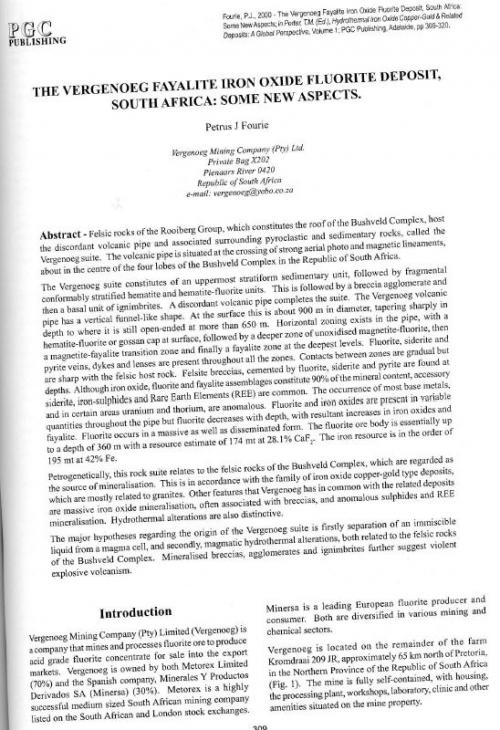
The Vergenoeg fayalite iron oxide fluorite deposit, South Africa: some new aspects

Felsic rocks of the Rooiberg Group, which constitutes the roof of the Bushveld Complex., host the discordant volcanic pipe and associated surrounding pyroclastic and sedimentary rocks, called the Vergenoeg suite. The volcanic pipe is situated at the crossing of strong aerial photo and magnetic lineaments, about in the centre of the four lobes of the Bushveld Complex in the Republic of South Africa.

The Vergenoeg suite constitutes of an uppermost stratiform sedimentary unit, followed by fragmental conformably stratified hematite and hematite-fluorite units. This is followed by a breccia agglomerate and then a basal unit of ignimbrites. A discordant volcanic pipe completes the suite. The Vergenoeg volcanic pipe has a vertical funnel-like shape. At the surface this is about 900 m in diameter, tapering sharply in depth to where it is still open-ended at more than 650 m. Horizontal zoning exists in the pipe, with a hematite-fluorite or gossan cap at surface, followed by a deeper zone of unoxidised magnetite-fluorite, then a magnetite-fayalite transition zone and finally a fayalite zone at the deepest levels. Fluorite, siderite and pyrite veins, dykes and lenses are present throughout all the zones. Contacts between zones are gradual but are sharp with the felsic host rock. Felsite breccias, cemented by fluorite, siderite and pyrite are found at depths.

Издание:PGS Publishing, Linden Park, 2002 г., 12 стр.
Язык(и)Английский
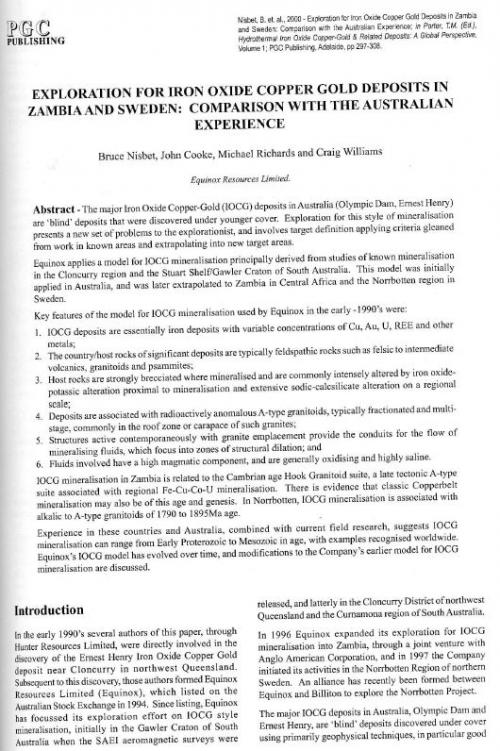
Exploration for iron oxide copper gold deposits in Zambia and Sweden: comparison with the Australian experience

The major Iron Oxide Copper-Gold (IOCG) deposits in Australia (Olympic Dam, Ernest Henry) are 'blind' deposits that were discovered under younger cover. Exploration for this style of mineralisation presents a new set of problems to the explorationist, and involves target definition applying criteria gleaned from work in known areas and extrapolating into new target areas.

Equinox applies a model for IOCG mineralisation principally derived from studies of known mineralisation in the Cloncurry region and the Stuart Shelf/Gawler Craton of South Australia. This model was initially applied in Australia, and was later extrapolated to Zambia in Central Africa and the Norrbotten region in Sweden.


Автор(ы):Carlon C.J.
Издание:PGS Publishing, Linden Park, 2002 г., 14 стр.
Язык(и)Английский
Iron-oxide system and base metal mineralisation in northern Sweden

The Lower Proterozoic succession in Northern Sweden, hosts a major iron oxide province with a widespread and diverse base metal sulphide mineralisation. A large amount of geological and exploration data exists, but fundamental questions remain regarding the distribution and relationship of the iron and predominantly copper rich sulphide mineralisation. Detailed field, isotopic, mineralogical, petrological, fluid inclusion and structural observations are now providing new data on this historically important and significant province. Genetic concepts can now be reassessed and specific deposits re-evaluated to investigate the interrelationship of base metal mineralisation, iron oxide deposits, rock alteration, metamorphism, orogenic cycles, structural development and igneous activity.

Автор(ы):Chengyu W., Smith M.
Издание:PGS Publishing, Linden Park, 2002 г., 11 стр.
Язык(и)Английский
The geology and genesis of the Bayan Obo Fe-REE-Nb deposit: a review

The Bayan Obo Fe-REE-Nb deposit is currently the world's largest REE resource. It has estimated reserves of up to 1500Mt of iron oxides (35 wt. % Fe), 48-1 OOMt REE (6 wt. % REE,03) and IMt Nb (0.13 wt. % Nb). The deposits are hosted in the Proterozoic Bayan Obo group sediments, mostly in dolomite marble, although the deposits themselves are principally Caledonian in age (555-420Ma). Fe occurs as magnetite and hematite, whilst the REE occur principally as monazite and bastnasite, although over 16 individual REE-minerals and 17 REE-bearing niobium minerals are also present. The deposits are accompanied by an alteration assemblage of apatite, aegirine, aegirine-augite, fluorite, alkali amphibole, phlogopite and barite. Albite and K-feldspar occur in the overlying slates and schists.

The deposits were formed by multistage hydrothermal replacement of marble during Caledonian subduction. The source of metals and fluids is uncertain, although carbonatites, alkaline igneous rocks, A-type granites and subduction-derived fluids have all been suggested as possibilities. Late stage, low salinity fluids were responsible for extensive modification of the deposit, and an overprint of sulphide and barite alteration. The deposits show many similarities in processes to others of the Fe-oxide class, but there are important differences including the absence of significant base metal sulphide mineralisation, no enrichment in U, and the absence of evidence for the involvement of hypersaiine brines in ore genesis.

Издание:PGS Publishing, Linden Park, 2002 г., 17 стр.
Язык(и)Английский
Geology of the proterozoic iron oxide-hosted, Nico cobalt-gold-bismuth, and Sue-Dianne copper-silver deposits, southern great bear magmatic zone, northwest territories, Canada

The NICO cobalt-gold-bismuth and Sue-Dianne copper-silver deposits of the Mazenod Lake area, Northwest Territories, are currently being drill-delineated by Fortune Minerals Limited. They are the only known significant Canadian examples of the Proterozoic iron oxide-hosted polymetallic class, more commonly referred to as hydrothermal iron oxide copper-gold deposits. NICO and Sue-Dianne are located in the southern part of the Great Bear magmatic zone, the central tectonic subdivision of the Bear Structural Province. It is a post-collisional plutonic terrane with related continental volcanic rocks dating from 1867 Ma and culminating with the emplacement of A-type rapikivi granite plutons at approximately 1856 Ma. Iron oxide occurrences are widely distributed within the Great Bear magmatic zone, ranging from Salobo-type magnetite-rich schists and ironstones in receptive basement rocks to Kiruna-type magnetite-apatite-rich veins and Olympic Dam-type sulphidized magnetite-hematite breccias in overlying volcanic rocks. NICO is hosted in iron- and potassium-altered, brecciated basement sedimentary rocks at and beneath the volcanic unconformity, showing similarities to the Salobo-type. The host "black rock" amphibole-magnetite-biotite schists and ironstones are capped by potassium feldspar-magnetite "red rock" felsite. In contrast, Sue-Dianne shows the essential characteristics of Olympic Dam-type ores, with mineralization hosted within a well-zoned diatreme breccia complex crosscutting a rotated ash flow tuff succession above the unconformity. At both NICO and Sue-Dianne, ongoing detailed paragenetic studies demonstrate that early, reduced, high-temperature mineral assemblages are overprinted by late, oxidative, low-temperature assemblages. These together with stratigraphic relationships, indicate fluid mixing at shallow crustal levels was important in deposit formation. Proximity of the NICO and Sue-Dianne deposits to subvolcanic porphyries, rapakivi granite and various other phases of the Marian River Batholith, together with geochronology and mineralogy studies, suggest they are all genetically related. The occurrence of diverse iron oxide deposit types within the Great Bear magmatic zone, makes this region favourable for exploration and for the study of the Proterozoic iron oxide class as a whole.

Автор(ы):Seeger M.C.
Издание:PGS Publishing, Linden Park, 2002 г., 12 стр.
Язык(и)Английский
Southeast Missouri iron metallogenic province: characteristics and general chemistry

The Southeast Missouri Iron Metallogenic Province is comprised of eight known major and numerous minor magnetite and hematite deposits. It is hosted by the Middle Proterozoic St. Francois granite-rhyolite terrane. Host rocks are rhyolites, trachytes, and andesites. Ore is associated with, although not necessarily hosted by, magnetite trachytes. Deposits are associated with caldera subsidence structures and, sometimes, trachyte ring intrusions. Deposits are within or near margins of these structures. Areal association of the deposits with a major Proterozoic tectonic zone, possibly a transform fault, suggests additional tectonic/ structural control on ore emplacement. Magnetite and hematite have been produced in the province; currently, only magnetite is produced. Potential exists for production of rare earth elements, copper, and gold.

A characteristic alteration suite is associated with the iron oxide mineralization. The suite includes silicification, potassium metasomatism, and alteration of host rock to actinolite, chlorite, garnet and epidote. While several alteration types are associated with each deposit, every type is not seen at each deposit.

Chemistry suggests that magnetite and hematite deposits in the province have a unique chemical signature when compared to magnetite not directly associated with the major deposits. In addition, hematite that is an oxidation product of magnetite has a different chemical signature than presumed primary hematite.


Автор(ы):Karin Requia, Lluis Fontbote
Издание:PGS Publishing, Linden Park, 2002 г., 12 стр.
Язык(и)Английский
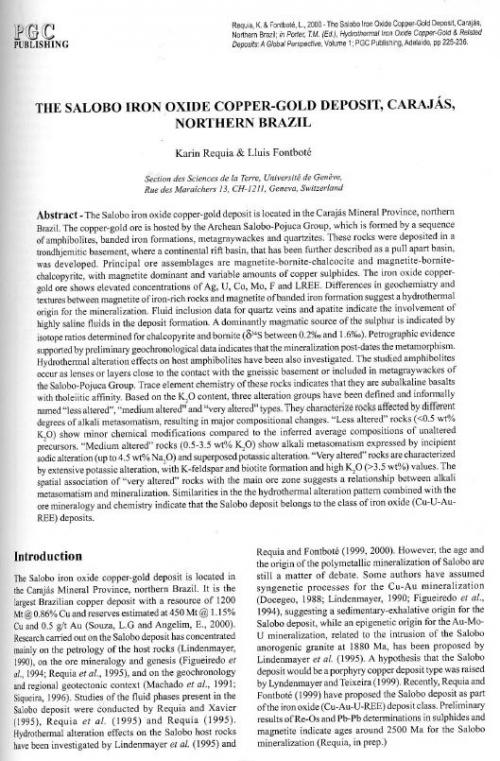
The Salobo iron oxide copper-gold deposit, Carajas, northern Brazil

The Salobo iron oxide copper-gold deposit is located in the Carajas Mineral Province, northern Brazil. The copper-gold ore is hosted by the Archean Salobo-Pojuca Group, which is formed by a sequence of amphibolites, banded iron formations, metagraywackes and quartzites. These rocks were deposited in a trondhjemitic basement, where a continental rift basin, that has been further described as a pull apart basin, was developed. Principal ore assemblages are magnetite-bornite-chalcocite and magnetite-bornite-chalcopyrite, with magnetite dominant and variable amounts of copper sulphides. The iron oxide copper-gold ore shows elevated concentrations of Ag, U, Co, Mo, F and LREE. Differences in geochemistry and textures between magnetite of iron-rich rocks and magnetite of banded iron formation suggest a hydrothermal origin for the mineralization. Fluid inclusion data for quartz veins and apatite indicate the involvement of highly saline fluids in the deposit formation. Adominantly magmatic source of the sulphur is indicated by isotope ratios determined for chalcopyrite and bornite (834S between 0.2%o and 1.6%o). Petrographic evidence supported by preliminary geochronological data indicates that the mineralization post-dates the metamorphism. Hydrothermal alteration effects on host amphibolites have been also investigated. The studied amphibolites occur as lenses or layers close to the contact with the gneissic basement or included in metagraywackes of the Salobo-Pojuca Group. Trace element chemistry of these rocks indicates that they are subalkaline basalts with tholeiitic affinity. Based on the K.,0 content, three alteration groups have been defined and informally named "less altered", "medium altered" and "very altered" types. They characterize rocks affected by different degrees of alkali metasomatism, resulting in major compositional changes. "Less altered" rocks (<0.5 wt% K.,0) show minor chemical modifications compared to the inferred average compositions of unaltered precursors. "Medium altered" rocks (0.5-3.5 wt% K20) show alkali metasomatism expressed by incipient sodic alteration (up to 4.5 wt% Na20) and superposed potassic alteration. "Very altered" rocks are characterized by extensive potassic alteration, with K-feldspar and biotite formation and high K20 (>3.5 wt%) values. The spatial association of "very altered" rocks with the main ore zone suggests a relationship between alkali metasomatism and mineralization. Similarities in the the hydrothermal alteration pattern combined with the ore mineralogy and chemistry indicate that the Salobo deposit belongs to the class of iron oxide (Cu-U-Au-REE) deposits.

Автор(ы):Souza L.H., Vieira E.A.P.
Издание:PGS Publishing, Linden Park, 2002 г., 12 стр.
Язык(и)Английский
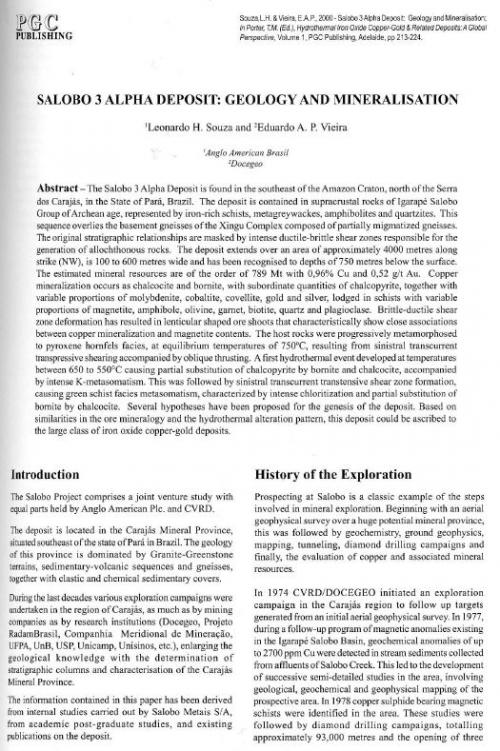
Salobo 3 Alpha deposit: geology and mineralisation

The Salobo 3 Alpha Deposit is found in the southeast of the Amazon Craton, north of the Serra dos Carajas, in the State of Para, Brazil. The deposit is contained in supracrustal rocks of Igarape Salobo Group of Archean age, represented by iron-rich schists, metagreywackes, amphibolites and quartzites. This sequence overlies the basement gneisses of the Xingu Complex composed of partially migmatized gneisses. The original stratigraphic relationships are masked by intense ductile-brittle shear zones responsible for the generation of allochthonous rocks. The deposit extends over an area of approximately 4000 metres along strike (NW), is 100 to 600 metres wide and has been recognised to depths of 750 metres below the surface. The estimated mineral resources are of the order of 789 Mt with 0,96% Cu and 0,52 g/t Au. Copper mineralization occurs as chalcocite and bomite, with subordinate quantities of chalcopyrite, together with variable proportions of molybdenite, cobaltite, covellite, gold and silver, lodged in schists with variable proportions of magnetite, amphibole, olivine, garnet, biotite, quartz and piagioclase. Brittle-ductile shear zone deformation has resulted in lenticular shaped ore shoots that characteristically show close associations between copper mineralization and magnetite contents. The host rocks were progressively metamorphosed to pyroxene hornfels facies, at equilibrium temperatures of 750°C, resulting from sinistral transcurrent transpressive shearing accompanied by oblique thrusting. A first hydrothermal event developed at temperatures between 650 to 550°C causing partial substitution of chalcopyrite by bornite and chalcocite, accompanied by intense K-metasomatism. This was followed by sinistral transcurrent transtensive shear zone formation, causing green schist facies metasomatism, characterized by intense chloritization and partial substitution of bornite by chalcocite. Several hypotheses have been proposed for the genesis of the deposit. Based on similarities in the ore mineralogy and the hydrothermal alteration pattern, this deposit could be ascribed to the large class of iron oxide copper-gold deposits.

Автор(ы):de Oliveira C.G., Tazava E.
Издание:PGS Publishing, Linden Park, 2002 г., 10 стр.
Язык(и)Английский
The Igarape Bahia Au-Cu(-REE-U) deposit, Carajas mineral province, northern Brazil

The Igarape Bahia Au-Cu-(REE-U) deposit is located in the Carajas Mineral Province - Northern Brazil - and is hosted by an Archaean low-grade metamorphosed volcanosedimentary sequence characterized by metavolcanic rocks of the footwall and metavolcanoclastic/metasedimentary rocks of the hangwall. An intense hydrothermal alteration occurred in this sequence, promoting intense chloritization, Fe-metasomatism, Cu-sulphidation (chalcopyrite and bornite), carbonatization, silicification, tourmalinization and biotitization.

Ленты новостей
559.41