Добрый день, Коллеги. Важное сообщение, просьба принять участие. Музей Ферсмана ищет помощь для реставрационных работ в помещении. Подробности по ссылке

Издание:PGS Publishing, Linden Park, 2002 г., 12 стр.
Язык(и)Английский
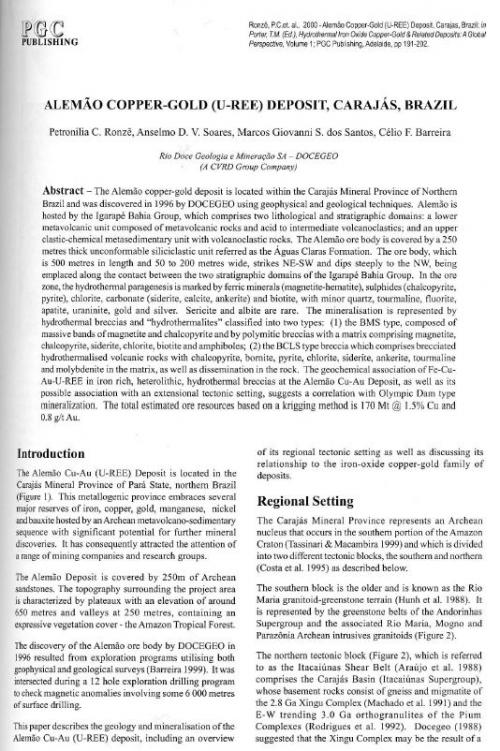
Alemao copper-gold (U-REE) deposits, Carajas, Brazil

The Alemao copper-gold deposit is located within the Carajas Mineral Province of Northern Brazil and was discovered in 1996 by DOCEGEO using geophysical and geological techniques. Alemao is hosted by the Igarape Bahia Group, which comprises two lithological and stratigraphic domains: a lower metavolcanic unit composed of metavolcanic rocks and acid to intermediate volcanoclastics; and an upper clastic-chemical metasedimentary unit with volcanoclastic rocks. The Alemao ore body is covered by a 250 metres thick unconfonnable siliciclastic unit referred as the Aguas Claras Formation. The ore body, which is 500 metres in length and 50 to 200 metres wide, strikes NE-SW and dips steeply to the NW, being emplaced along the contact between the two stratigraphic domains of the Igarape Bahia Group. In the ore zone, the hydrothermal paragenesis is marked by ferric minerals (magnetite-hematite), sulphides (chalcopyrite, pyrite), chlorite, carbonate (siderite, calcite, ankerite) and biotite, with minor quartz, tourmaline, fluorite, apatite, uraninite, gold and silver. Sericite and albite are rare. The mineralisation is represented by hydrothermal breccias and "hydrothermalites" classified into two types: (1) the BMS type, composed of massive bands of magnetite and chalcopyrite and by polymitic breccias with a matrix comprising magnetite, chalcopyrite, siderite, chlorite, biotite and amphiboles; (2) the BCLS type breccia which comprises brecciated hydrothermalised volcanic rocks with chalcopyrite, bornite, pyrite, chlorite, siderite, ankerite, tourmaline and molybdenite in the matrix, as well as dissemination in the rock. The geochemical association of Fe-Cu-Au-U-REE in iron rich, heterolithic, hydrothermal breccias at the Alemao Cu-Au Deposit, as well as its possible association with an extensional tectonic setting, suggests a correlation with Olympic Dam type mineralization. The total estimated ore resources based on a krigging method is 170 Mt @ 1.5% Cu and 0.8g/tAu.


Автор(ы):Correa A., Hopper D.
Издание:PGS Publishing, Linden Park, 2002 г., 13 стр.
Язык(и)Английский
The Panulcillo and Teresa de Colmo copper deposits: two contrasting examples of fe-ox Cu-Au mineralization from the Coastal Cordillera of Chile

The Coastal Cordillera of Chile hosts several world-class FeOx CuAu deposits, including Candelaria, Mantos Blancos, Manto Verde, and El Soldado. Despite this comparatively little has been published on Chilean FeOx CuAu systems. This paper presents observations from two small Chilean FeOx CuAu deposits of Lower Cretaceous age; Panulcilio and Teresa de Colmo.

Panulcilio is a pseudo-stratiform FeOx CuAu / Skarn deposit located within the metamorphic aureole of a monzodioritic intrusive. Chalcopyrite, bornite, pyrite and pyrrhotite occur with calcic amphibole as disseminations and microveinlets in K-feldspar-albite-silica altered meta-andesites, magnetite-albite-scapolite rich mcta-andcsites and in overlying garnet skam.

Издание:PGS Publishing, Linden Park, 2002 г., 12 стр.
Язык(и)Английский
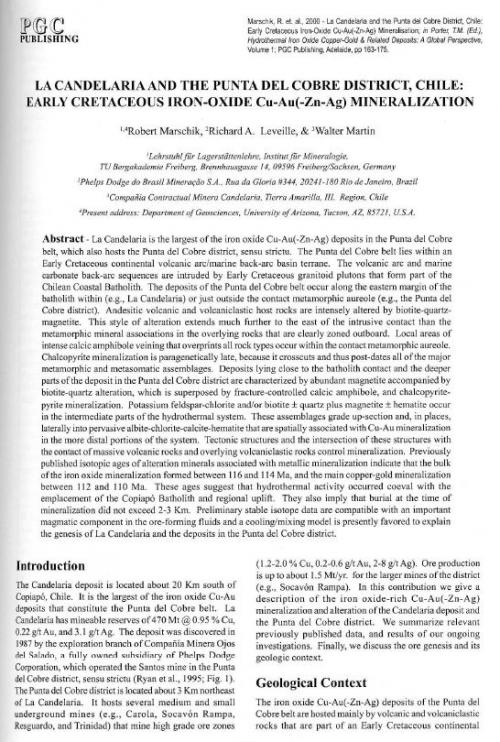
La Candelaria and the Punta del Cobre district, Chile: early cretaceous iron-oxide Cu-Au(-Zn-Ag) mineralization

La Candelaria is the largest of the iron oxide Cu-Au(-Zn-Ag) deposits in the Punta del Cobre belt, which also hosts the Punta del Cobre district, sensu strictu. The Punta del Cobre belt lies within an Early Cretaceous continental volcanic arc/marine back-arc basin terrane. The volcanic arc and marine carbonate back-arc sequences are intruded by Early Cretaceous granitoid plutons that form part of the Chilean Coastal Batholith. The deposits of the Punta del Cobre belt occur along the eastern margin of the batholith within (e.g., La Candelaria) or just outside the contact metamorphic aureole (e.g., the Punta del Cobre district). Andesitic volcanic and volcaniclastic host rocks are intensely altered by biotite-quartz-magnetite. This style of alteration extends much further to the east of the intrusive contact than the metamorphic mineral associations in the overlying rocks that are clearly zoned outboard. Local areas of intense calcic amphibole veining that overprints all rock types occur within the contact metamorphic aureole.

Автор(ы):Skirrow R.G.
Издание:PGS Publishing, Linden Park, 2002 г., 12 стр.
Язык(и)Английский
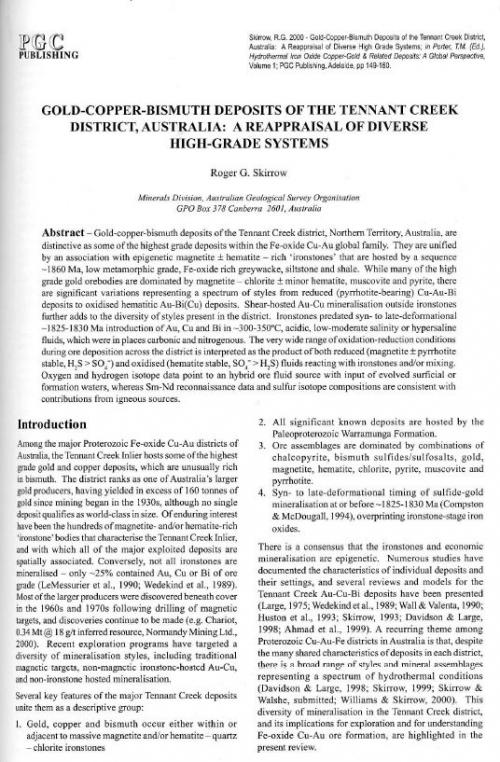
Gold-copper-bismuth deposits of the Tennant creek district, Australia: a reappraisal of diverse high-grade systems

Gold-copper-bismuth deposits of the Tennant Creek district, Northern Territory, Australia, are distinctive as some of the highest grade deposits within the Fe-oxide Cu-Au global family. They are unified by an association with epigenetic magnetite ± hematite - rich 'ironstones' that are hosted by a sequence -I860 Ma, low metamorphic grade, Fe-oxide rich greywacke, siltstone and shale. While many of the high grade gold orebodies are dominated by magnetite - chlorite ± minor hematite, muscovite and pyrite, there are significant variations representing a spectrum of styles from reduced (pyrrhotite-bearing) Cu-Au-Bi deposits to oxidised hematitic Au-Bi(Cu) deposits. Shear-hosted Au-Cu mineralisation outside ironstones further adds to the diversity of styles present in the district. Ironstones predated syn- to late-deformational ~1825-1830 Ma introduction of Au, Cu and Bi in ~-300-350°C, acidic, low-moderate salinity or hypersaline fluids, which were in places carbonic and nitrogenous. The very wide range of oxidation-reduction conditions during ore deposition across the district is interpreted as the product of both reduced (magnetite ± pyrrhotite stable, H2S > S04=) and oxidised (hematite stable, S04= > H2S) fluids reacting with ironstones and/or mixing. Oxygen and hydrogen isotope data point to an hybrid ore fluid source with input of evolved surficial or formation waters, whereas Sm-Nd reconnaissance data and sulfur isotope compositions are consistent with contributions from igneous sources.

Автор(ы):Fanning C.M., Teale G.S.
Издание:PGS Publishing, Linden Park, 2002 г., 11 стр.
Язык(и)Английский
The Portia - North Portia Cu-Au(-Mo) prospect, South Australia: timing of mineralization, albitisation and origin of ore fluid

Cu-Au(-Mo) mineralisation at the Portia-North Portia prospect is located under cover on the eastern flank of the Benagerie Ridge Magnetic Complex, within the Curnamona Province and approximately 125 km WNW of Broken Hill. The mineralisation is located within rocks which have a SHRIMP U-Pb zircon age of 1703 + 6 Ma, which is similar to Willyama Supergroup ages obtained from the Broken Hill and Olary Domains. The meta-sedimentary unit that hosts the mineralisation is approximately 200m thick and is overlain by carbonaceous phyllite, and underlain by a unit which is dominated by albite-magnetite-hematite. The host units contain numerous carbonate-rich domains intercalated with meta-evaporitic sediments. The sequence had undergone low-grade metamorphism and fabric development and was subsequently intensely albitised. Hydrothermal monazites formed during this albitisation event give SHRIMP II in situ U-Pb ages of ~1630 Ma. The albitised meta-sediments proved to be an excellent host to the later Cu-Au(-Mo) mineralisation. Abundant monazite associated with the mineralisation yield SHRIMP II ages of ~1605 Ma. It is possible that the numerous, highly fractionated and altered diorite bodies known to be present on the Benagerie Ridge, may have produced some of the metals. The "Hiltaba age" (-1585-1590 Ma) granites of the area cannot be considered as a source of the metals.

Издание:PGS Publishing, Linden Park, 2002 г., 13 стр.
Язык(и)Английский
The evolution of the Ernest Henry Fe-oxide-(-Cu-Au) hydrothermal system

The >1510-1500 Ma Ernest Henry Fe-oxide-Cu-Au orebody is a hydrothermal deposit hosted in K-feldspar altered ca 1740 Ma plagioclase phyric volcanic rocks in the Cloncurry district, Mount Isa Inlier. Mineralization occurred late in a post-peak metamorphic hydrothermal system, and the ore is mainly hosted in an infill-supported hydrothermal breccia that grades to crackle veining at the margins. The orebody has a > 1km down dip extension, and is structurally-controlled between two shear zones that trend NE-SW and dip -35° to the SE. The ore is mainly composed of subrounded clasts separated by a fine- to medium-grained infill composed of magnetite, calcite, pyrite, biotite, K-feldspar, chalcopyrite, hematite, garnet, barite, fluorite, quartz and molybdenite.

Автор(ы):Skirrow R.G., Williams P.J.
Издание:PGS Publishing, Linden Park, 2002 г., 18 стр.
Язык(и)Английский
Overview of iron oxide-copper-gold deposits in the Curnamona province and Cloncurry district (Eastern mount Isa block), Australia

The Cumamona Province (South Australia/New South Wales) and Cloncurry district (NW Queensland) are both extensively metasomatised terrains containing hydrothermal iron oxide copper-gold and related deposits. Structural timing criteria and geochronological data suggest that the deposits formed at 1630-1600 Ma (Cumamona) and 1540-1500 Ma (Cloncurry). The Cloncurry deposits have a close temporal association with I-type granitoids and limited data suggest a similar relationship exists in the Cumamona Province. The majority of deposits are hosted by metamorphosed Palaeoproterozoic supracrustal rocks of varying age, composition and metamorphic grade. Mineralisation was localised by a range of brittle-ductile and brittle structures and produced vein, stockwork, breccia and replacement orebodies. Variations of fluid chemistry, host rocks and physical conditions produced mineralogically-diverse alteration zones, varying Cu:Au ratios, many different minor element associations, and inconsistent spatial relationships between magnetite and ore metals. Regional-scale alteration systems are dominated by Na-(Fe-Ca)-rich assemblages in which the most characteristic mineral is albite. Most of the ore deposits are specifically associated with pre- to synmineralisation alteration assemblages composed of medium to high temperature K-Fe-(Ca-Mg)-rich minerals together with late-stage parageneses containing carbonates. The deposits formed in deep-seated (> 5km) environments by a variety of different geochemical mechanisms from complex H,0-C02±CH4±N2-saIt fluids of magmatic and/or metamorphic derivation .

Автор(ы):Reynolds L.J.
Издание:PGS Publishing, Linden Park, 2002 г., 12 стр.
Язык(и)Английский
Geology of the Olympic Dam Cu-U-Au-Ag-REE deposit

The -1590 Ma Olympic Dam Cu-U-Au-Ag-REE deposit is located in the Stuart Shelf geological province of South Australia, on the eastern margin of the Gawler Craton. The deposit is hosted by the Olympic Dam Breccia Complex, a large hydrothermal breccia system wholly contained within the Roxby Downs Granite, a Proterozoic age granitoid inteipreted to be part of the Hiltaba Suite. Initial hydrothermal activity within the Olympic Dam Breccia Complex was probably localised by structures in a dextral fault jog environment. Subsequent development of the complex involved repetitive and overprinting physical, chemical and volcanic brecciation mechanisms, resulting in a highly variable array of irregularly shaped and distributed breccia zones with widely differing and gradational lithologies. A complex pattern of hydrothermal alteration dominated by hematite and sericite, with lesser chlorite, siderite and quartz is associated with the breccia zones. Mineralisation within the deposit is intimately associated with iron-oxide alteration of the granitoid, which dominantly occurs as hematite, with lesser magnetite at depth and on the periphery of the breccia complex. The principal copper minerals within the deposit show a broad lateral and vertical, hypogene zonation pattern grading from chalcopyrite on the margins to bornite, then chalcocite adjacent to a central barren core. Gold and silver are mainly associated with the copper sulfides, while uranium dominantly occurs in pitchblende disseminated throughout the hematitic breccia zones. Overall, mineralisation grade generally correlates with the degree of hematite alteration and is largely dependent on copper sulfide tenor. Minor brittle faulting post-dates breccia development and appears to have exploited existing anisotropies within the complex. Late-stage fault movements are associated with barite-fluorite vein arrays which overprint the orebody. The deposit formed in a high level volcanic environment, venting to the surface and possibly forming a composite phreatomagmatic eruption crater, which has subsequently been completely eroded. Mafic and felsic dykes intruded the breccia complex, locally producing diatreme structures. Tectonism, hydrothermal activity, dyke intrusion, brecciation, alteration and mineralisation within the system were broadly concurrent and interdependent. Hydrothermal fluids and metals have a dominantly magmatic source, probably associated with the Middle Proterozoic volcano-plutonic event correlated with the Gawler Range Volcanics and Hiltaba Suite intrusives.

Автор(ы):W'Haynes D.
Издание:PGS Publishing, Linden Park, 2002 г., 20 стр.
Язык(и)Английский
Iron oxide copper (-gold) deposits: their position in the ore deposit spectrum and models of origin / Месторождения железоокисной меди (-золота): их положение в спектре рудных месторождений и модели происхождения


Iron oxide copper (-gold) deposits consist of dominant magnetite or haematite, with one or more copper sulphides and pyrite, with associated K-feldspar or sericite or albite or biotite and chlorite predominant in the ore host rocks. The deposits display a unique association with host successions characterised by an absence of, or by very minor occurrence of, elemental carbon or reduced-carbon compounds and reduced-sulphur minerals. The relatively oxidised nature of the ore host succession is reflected in the "magnetically active" signature that usually defines iron oxide copper (-gold) mineralised districts. This signature shows that magnetite is ubiquitous and variably abundant within ore host successions. Host successions with discrete domains respectively characterised by (a) by rocks with an absence or rarity of carbon or reduced carbon minerals, and (b) by a predominance of rocks containing carbon or reduced carbon minerals, however, contain iron sulphide-copper (-gold) deposits on or near the boundaries of the domains. Examples of the iron sulphide-copper (-gold) deposits are the Mt Isa and Gunpowder deposits, many small occurrences in the Eastern Fold Belt (Mt Isa Inlier), the El Soldado deposit, and others.

Издание:PGS Publishing, Linden Park, 2002 г., 10 стр.
Язык(и)Английский
The chemistry of crustal brines: tracking their origins / Химия коровых рассолов: отслеживание их происхождения

Brines may be generated in sedimentary, magmatic or metamorphic settings, and they change chemistry extensively as they move through rocks and interact with them. The primary constraint on their metal carrying capacity is their salinity, but they may carry very variable amounts of S in solution, depending on their source and the rocks that they have encountered. Sulphur availability and oxidation state are also major controls on which metals will be transported and which precipitated. Availability of fluid inclusion brine analyses is making possible the characterisation of a much wider range of brine types than was hitherto possible, and providing information about metal contents in a wide range of settings, as well as tracer analyses. Iron contents of brines are broadly temperature dependent, and are much higher in magmatic brines than in sedimentary ones, but basinal fluids may still carry sufficient Fe in solution to precipitate iron oxides at an oxidation front, and may be much more voluminous. Brines of different origins can often be distinguished on the basis of conservative halogen tracers unaffected by wall rock interactions: Br/CI ratios used in conjunction with I/Cl ratios or d"Cl values separate residual bittern fluids from re-dissolved evaporites, with igneous brines forming an intermediate, but somewhat distinct, grouping.

Ленты новостей
475.48