Добрый день, Коллеги. Важное сообщение, просьба принять участие. Музей Ферсмана ищет помощь для реставрационных работ в помещении. Подробности по ссылке

Автор(ы):Daliran А.
Издание:PGS Publishing, Linden Park, 2002 г., 18 стр.
Язык(и)Английский
Kiruna-Type Iron Oxide-Apatite Ores and "Apatitites" of the Bafq District, Iran, with an Emphasis on the REE Geochemistry of their Apatites

The Bafq metallogenic province in Iran contains world class Kiruna-type apatite-iron oxide ores, apatite-rich magmatic rocks called "apatitites", REE, Th-U, Pb-Zn and recently reported Cu(-Au?) mineralisation. The metallogenesis is related to magmatic events that accompanied a major late Precambrian rifting event within Gondwanaland. The magmatic activity is subvolcanic to volcanic, is characterised by thebimodal association of rhyolites and spilitic basalts and is accompanied by a regional alkali metasomatism.

The iron deposits are commonly hosted by hydrothermally altered and metasomatised rhyolitic rocks, which are either interstratified with volcano-sedimentary sequences, or form large subvolcanic and volcanic masses. The iron ore is dominantly a Ti-V-poor massive magnetite with subordinate hematite, and is commonly accompanied by apatite. Apatite also occurs within the magmatic "apatitites', which are spatially and temporally closely associated with the iron ores.

Автор(ы):McLean R.N.
Издание:PGS Publishing, Linden Park, 2002 г., 9 стр.
Язык(и)Английский
The Sin Quyen Iron Oxide-Copper-Gold-Rare Earth Oxide Mineralisation of North Vietnam


The Sin Quyen deposit in northern Vietnam is an unusual example of the Fe oxide-Cu-Au-REE group of deposits. Magnetite-orthite-chalcopyrite-gold mineralisation is hosted by extremely altered amphibolite and biotite-gneiss lenses within highly defonned and metamorphosed sediments of the Proterozoic Sin Quyen Formation. The deposit fonned in a wide fault zone which acted as a channel for pre-mineralisation amphibolite and granitic dykes, mineralising fluids as well as post mineralisation granite, pegmatite and amphibolite. Metasomatic alteration produced a variety of assemblages predominantly composed of variable amounts of quartz, hastingsite and biotite but also including small zones of hedenbergite-garnet skarn. Alteration is closely associated with magnetite and orthite (allanite) development. Sulphide mineralisation, mainly chalcopyrite and pyrrhotite with lesser pyrite is a later and lower temperature hydrothermal phase, although the majority of the sulphides were deposited within the alteration zones.

Автор(ы):Martyn J.E., Strickland C.D.
Издание:PGS Publishing, Linden Park, 2002 г., 17 стр.
Язык(и)Английский
The Guelb Moghrein Fe-Oxide Copper-Gold-Cobalt Deposit and Associated Mineral Occurrences, Mauritania: A Geological Introduction

The Guelb Moghrein deposit is located within the Mauritanide Mobile Zone, north east of Nouakchott in the Islamic Republic of Mauritania, West Africa. The copper, gold and iron deposits of the Maurilanides fold/thrust belt of the Akjoujt area have many of the characteristics of the hydrothermal iron oxide copper-gold class of deposits as well as showing distinctive features of their own. Exploration by General Gold International SA since 1994 has concluded that they represent, perhaps, a carbonate-rich sub class and show considerable diversity of form and setting.

The Mauritanides in Mauritania incorporate a great diversity of rocks in multiple, thrust-bounded domains including metamorphosed siliciclastic sediments, meta-felsic volcanics, meta-basic volcanics, serpentinite, and bodies of granitoid rocks.

Автор(ы):Laznicka P.
Издание:PGS Publishing, Linden Park, 2002 г., 18 стр.
Язык(и)Английский
Wernecke Mountains (Yukon) Breccias and Scattered Ore Occurrences: What Contribution to FeOx-Cu-Au-U Metallogeny? / Горы Вернеке (Юкон) Брекчии и разрозненные рудопроявления: каков вклад в металлогению FeOx-Cu-Au-U?

The Wernecke and Southern Ogilvie Mountains in Yukon are part of an almost east-west trending range in the northern Canadian Cordillera in which several areas of the Palaeo-Mesoproterozoic basement are exposed, enveloped by a Phanerozoic miogeoclinal sequence. The oldest division, the -1.8-1.4 Ga Wernecke Supergroup, is interpreted as a "clastic rift'". It is an up to 15 km thick pile, the bulk of which is a monotonous, well-bedded siltite-quartz rich litharenite-argillite, topped by carbonate-pelite units. Less than 1% of the area consists of small gabbro to diorite intrusions of several, mostly Palaeoproterozoic and Mesoproterozoic, generations. The predominantly brittle deformation regime produced extensive tracts of disrupted and dismembered units grading to tectonic (not subduction !) melange. These have been overprinted by large scale Na, Ca, Mg, Fe, C02 and lesser Si, K metasomatism to produce widespread albitisation, chloritisation, carbonatisation, hematitisation and less extensive sericitisation (with local biotite) of the fractured sedimentary » magmatic rocks as well as tectonic fragmentites. The "Wernecke Breccia" is a metasomatised disaggregated breccia series and it is associated with hundreds of small scattered showings of specular hematite, magnetite and chalcopyrite, several occurrences of U and Co minerals, and anomalous gold. Not even a marginally economic orebody has so far been discovered despite intermittent exploration going back to the 1960s. It appears that we are dealing with a moderately deep (closely above the ductile-brittle interface) level of regional release and displacement of metals from source rocks (Fe, Cu and Co from gabbros; U perhaps from carbonaceous argillites) by metasomatic destruction of the carrier minerals. However, the system lacked sufficient plumbing and the channelling required to produce better metal accumulations at higher levels.

Издание:PGS Publishing, Linden Park, 2002 г., 6 стр.
Язык(и)Английский
Comparison of the Geology of Proterozoic Iron Oxide Deposits in the Adirondack and Mid-Atlantic Belt of Pennsylvania, New Jersey and New York / Сравнение геологии протерозойских железооксидных отложений в Адирондаке и Срединно-Атлантическом поясе Пенсильв

Сравнение геологии протерозойских железооксидных отложений в Адирондаке и Срединно-Атлантическом поясе Пенсильвании, Нью-Джерси и Нью-Йорка

Proterozoic hydrothermal iron oxide deposits occur within two metallogenic belts in the northeastern U.S.: the Adirondack region, and the Mid-Atlantic (Reading Prong) belt. A 175 km wide belt of Palaeozoic cover separates these two regions, although some iron deposits occur in Proterozoic rocks near the unconformity, suggesting a possible continuation beneath the cover. Although potentially part of the same continuous metallogenic province sharing similar mineralogy, host rock composition and hydrothermal alteration, deposits in the two regions differ in degree of deformation. Differences in the degree of metamorphic deformation fuel the debate of the relative timing of mineralisation, igneous activity, and metamorphism. Generally less deformed textures in the Adirondack deposits led workers in the New York deposits to conclude iron ores in the Adirondacks are associated with anorogenic granites that postdate peak metamorphism. Folded iron ores in granitic gneiss of the Mid-Atlantic belt suggest some deposits in eastern Pennsylvania, northern New Jersey, and southern New York predate peak metamorphism. REE-enriched deposits in both belts are characterised by abundant apatite, tourmaline, and manganese concentrations, as well as the presence of hematite-chlorite alteration in addition to magnetite. Unlike deposits hosted exclusively within granite gneisses, deposits within supracrustal rocks commonly contain significant sulphides and so are potential hosts for copper mineralisation.

Издание:PGS Publishing, Linden Park, 2002 г., 19 стр.
Язык(и)Английский
The Epigenetic Sediment-hosted Serra Pelada Au-PGE Deposit and its Potential Genetic Association with Fe-Oxide Cu-Au Mineralisation within the Carajas Mineral Province, Amazon Craton, Brazil / Эпигенетическое месторождение Серра Пелада Au-PGE

Эпигенетическое месторождение Серра Пелада Au-PGE, залегающее в отложениях, и его потенциальная генетическая связь с железооксидно-медно-золотой минерализацией в минеральной провинции Карахас, Амазонский кратон, Бразилия

The Serra Pelada Au-PGE deposit is located within the Carajas Mineral Province of the southeastern Amazon Craton, Brazil. Gold-PGE ores are epigenetic and display a strong structural control, being hosted in sub-greenschist facies carbonaceous and calcareous meta-siltstone, within the hinge zone of a reclined, tight, regional-scale F2 synform. Although the entire orebody has undergone deep tropical weathering, some evidence of the original hydrothermal alteration is preserved. Gold-PGE mineralisation is associated with the formation of magnetite- and hematite-rich hydrothermal breccias, massive zones of hematite metasomatism, intense sericite (white mica)-kaolin metasomatism, siderite veining and a jasperoid envelope of amorphous silica alteration hosting rare disseminated pyrite. All other Au-PGE ore-related mineral assemblages have undergone intense weathering to hydrated Fe-oxides and secondary clay minerals, preventing further description of primary ore and alteration features. The geochemistry of the primary Au-PGE ores at Serra Pelada displays many similarities to that of Fe-oxide Cu-Au deposits within the Carajas Mineral Province, and indeed world-wide, in terms of metal association (eg. Co, Ni, Cu, U), LREE enrichment and accompanying Fe-metasomatism. The Au-Pd-Pt association also suggests ore metal transport in acid, oxidising, chloride-rich fluids, similar to those for Fe-oxide Cu-Au deposits. In combination with these similarities, and the location of the Serra Pelada Au-Pd-Pt deposit, it is suggested that the latter represents a distal equivalent to the Fe-oxide Cu-Au deposits and, as such, a target that may have been overlooked during exploration programs around such terrains globally.


Издание:PGS Publishing, Linden Park, 2002 г., 20 стр.
Язык(и)Английский
Magmatic Iron Ores and Associated Mineralisation: Examples from the Chilean High Andes and Coastal Cordillera

The El Laco magnetite-apatite ore deposits in the Andean Cordillera of northern Chile occur as massive, tabular bodies, as stratified, pyroclastic ores, and as crosscutting dykes and vein complexes. The ore deposits and surrounding volcanic rocks, mainly andesites, are Plio-Pleistocene in age and preserve many of their original volcanic textures and structures. All the field and laboratory data are consistent with an origin by eruption and shallow intrusion of a high-temperature, volatile-rich, iron-oxide magma. A number of other iron-oxide-apatite deposits of Cenozoic age in the Andean Cordillera, and a belt of Cretaceous iron deposits in the Coastal Cordillera of Chile also have features that suggest a magmatic origin. Associated with these magmatic ore deposits are economic and sub-economic concentrations of Cu, Au, U, and REE.

Автор(ы):Maksaev V., Zentilli M.
Издание:PGS Publishing, Linden Park, 2002 г., 20 стр.
Язык(и)Английский
Chilean Strata-bound Cu- (Ag) Deposits: An Overview

Strata-bound Cu- (Ag) deposits, long known as 'Chilean manto-type', occur along the Coastal Cordillera of northern Chile (22°-30°S) hosted by Jurassic and Lower Cretaceous volcanic and volcano-sedimentary rocks. These deposits are typical of the first stage of Andean evolution characterised by an extensional setting of the arc magmatism along the active margin of South America. Strata-bound Cu- (Ag) deposits were formed during two metallogenic epochs in the Late Jurassic and uppermost Early Cretaceous. The mineralisation took place at the time of structurally controlled emplacement of batholiths within the Mesozoic volcanic and sedimentary strata. The volcanic-hosted strata-bound Cu- (Ag) deposits invariably occur distal, but peripheral to coeval batholiths emplaced within tilted Mesozoic strata. The prevalent view that these deposits have an inherent genetic relationship with hydrothermal fluid derivation from subvolcanic stocks and dykes is contended here, because these minor intrusions are largely barren and this hypothesis does not fit well with Sr, Os and Pb isotopic data that call for crustal contribution of these elements. The strata-bound Cu- (Ag) mineralisation appears to be produced by fluids of mixed origin that were mobilised within penneable levels and structural weakness zones of the Mesozoic arc-related volcano-sedimentary sequence during the emplacement of shallow granodioritic batholiths under transtensional regimes. These hydrothermal fluids deposited copper and subordinate silver when reacted with organic matter, pyrite and/or cooled away from their heat sources. Although strata-bound Cu- (Ag) mineralisation took place during the same Cretaceous metallogenic event that formed the magnetite-apatite bodies, and Fe-oxide-Cu-Au deposits along the present Coastal Cordillera, the conceivable relationships with these other types of deposits are hampered by the inconclusive debate about the origin of the Chilean Fe-oxide deposits. However, the available data strongly suggest that the Fe oxide-rich deposits are metasomatic in origin and genetically related to contact zones of Lower Cretaceous dioritic batholiths, whereas the iron-poor volcanic-hosted Cu-(Ag) stratabound deposits constitute distal mineralisation peripheral to Upper Jurassic of Lower Cretaceous granodioritic batholiths.

Издание:PGS Publishing, Linden Park, 2002 г., 22 стр.
Язык(и)Английский
The Geology of the El Soldado Manto Type Cu (Ag) Deposit, Central Chile

El Soldado is the largest (>200 Mt @ 1.4% Cu) of the known Cu manto-type deposits in central Chile. It is strata-bound within a submarine, bimodal calc-alkaline basalt - rhyodacite unit of the Lower Cretaceous Lo Prado Formation., which also contains marine carbonaceous shales and volcaniclastic sandstones. Although stratigraphically restricted, the clustered orebodies are mostly vein-like and discordant, controlled by a system of N-S to NNW faults fonned within a transtensional zone (cymoid loop) of a sinistral, strike-slip brittle shear system. Individual orebodies are zoned, with an external and deeper zone of barren pyrite, followed inward by concentric zones with chalcopyrite-pyrite, chalcopyrite bornite, bornite-chalcocite, and a central zone of chalcocite (± digenite ± covellite) and abundant hematite. The deposit was formed in two main phases: l)a low-temperature, diagenetic phase during which framboidal pyrite developed in association with migrated petroleum, at ca. 130 to 120 Ma; 2) a high-temperature (>300°C from fluid inclusions) hydrothennal phase at ca. 103 Ma, (coinciding with batholith emplacement), that deposited early hematite (± magnetite), followed by chalcopyrite, bornite and chalcocite, mostly replacing pre-existing pyrite, with the excess Fe forming hematite. Gangue minerals are calcite, albite, k-feldspar and chlorite. The hydrothermal Cu mineralization is associated with an increase in Na and depletion in K in host rocks, although there are localised zones of K increase in bornite-chalcocite assemblages near structures. Isotopic studies indicate that: a) the sulphur in diagenetic pyrite provided the bulk of the sulphur for Cu sulphides; b) petroleum was the source of carbon in bitumen and part of the carbonate; c) osmium in diagenetic pyrite was derived from the black shales; d) strontium in calcites was inherited from the Cretaceous arc lavas; e) oxygen isotopes in carbonates, and K-feldspar and atmospheric argon in K-feldspar plus the high salinity of fluid inclusions (21-26% NaCl equivalent) suggest a basinal connate-metamorphic brine was responsible for Cu transport, yet a (distal) magmatic component to the fluids cannot be ruled out.

Автор(ы):Dow R.J., Hitzman M.W.
Издание:PGS Publishing, Linden Park, 2002 г., 9 стр.
Язык(и)Английский
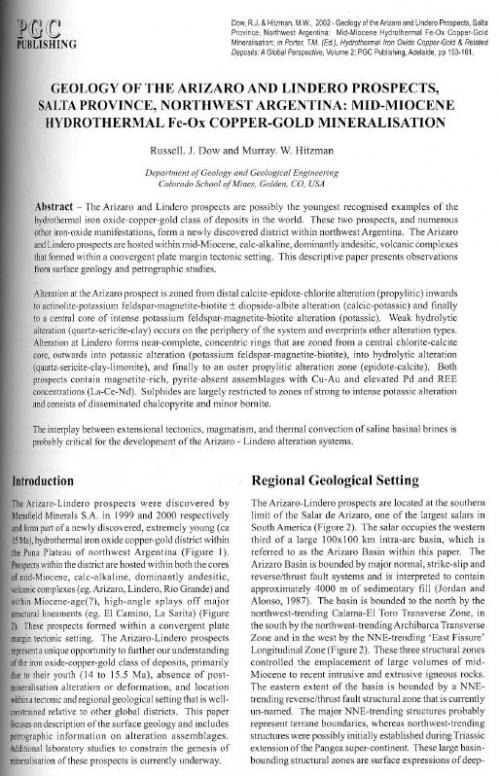
Geology of the Arizaro and Lindero Prospects, Salta Province, Northwest Argentina: Mid-Miocene Hydrothermal Fe-Ox Copper-Gold Mineralisation

The Arizaro and Lindero prospects are possibly the youngest recognised examples of the hydrothermal iron oxide-copper-gold class of deposits in the world. These two prospects, and numerous other iron-oxide manifestations, form a newly discovered district within northwest Argentina. The Arizaro and Lindero prospects are hosted within mid-Miocene, calc-alkaline, dominantly andesitic, volcanic complexes that formed within a convergent plate margin tectonic setting. This descriptive paper presents observations from surface geology and petrographic studies.

Ленты новостей
676.16