Добрый день, Коллеги. Важное сообщение, просьба принять участие. Музей Ферсмана ищет помощь для реставрационных работ в помещении. Подробности по ссылке

Автор(ы):Porter T.M.
Издание:PGS Publishing, Linden Park, 2002 г., 3 стр.
Язык(и)Английский
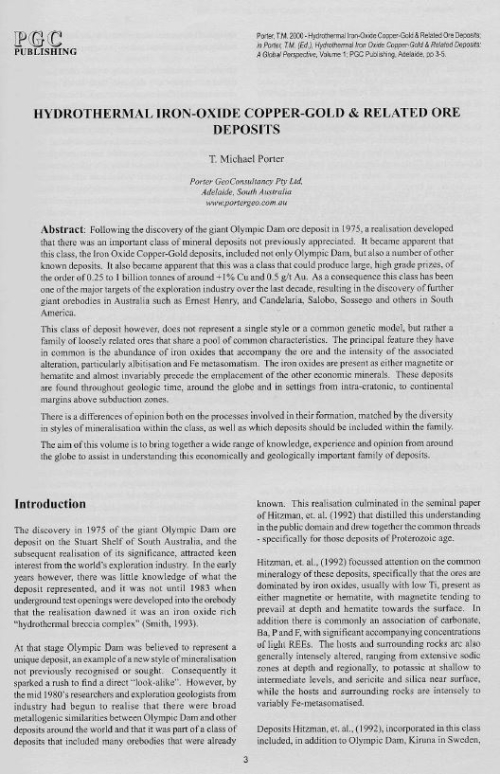
Hydrothermal iron-oxidecopper-gold and related ore deposits / Гидротермальные железо-окисленномедно-золоторудные и связанные с ними месторождения


Abstract: Following the discovery of the giant Olympic Dam ore deposit in 1975, a realisation developed that there was an important class of mineral deposits not previously appreciated. It became apparent that this class, the Iron Oxide Copper-Gold deposits, included not only Olympic Dam, but also a number of other known deposits. It also became apparent that this was a class that could produce large, high grade prizes, of the order of 0.25 to 1 billion tonnes of around +1% Cu and 0.5 g/t Au. As a consequence this class has been one of the major targets of the exploration industry over the last decade, resulting in the discovery of further giant orebodies in Australia such as Ernest Henry, and Candelaria, Salobo, Sossego and others in South America.

This class of deposit however, does not represent a single style or a common genetic model, but rather a family of loosely related ores that share a pool of common characteristics. The principal feature they have in common is the abundance of iron oxides that accompany the ore and the intensity of the associated alteration, particularly albitisation and Fe metasomatism. The iron oxides are present as either magnetite or hematite and almost invariably precede the emplacement of the other economic minerals. These deposits are found throughout geologic time, around the globe and in settings from intra-cratonic, to continental margins above subduction zones.

There is a differences of opinion both on the processes involved in their formation, matched by the diversity in styles of mineralisation within the class, as well as which deposits should be included within the family.

The aim of this volume is to bring together a wide range of knowledge, experience and opinion from around the globe to assist in understanding this economically and geologically important family of deposits.

Том 2
Издание:PGS Publishing, Linden Park, 2005 г., 257 стр., ISBN: 0-9580574-3-5
Язык(и)Английский
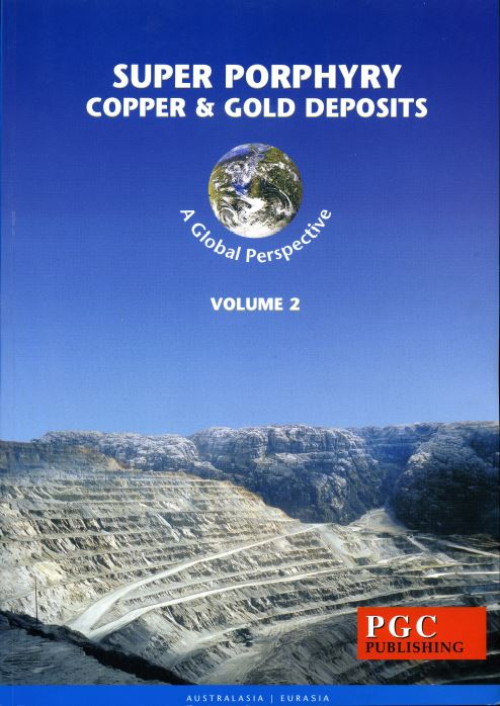
Super porphyry copper and gold deposits. Volume 2 / Суперпорфировые месторождения меди и золота. Том 2

Porphyry-style Cu-Au/Mo deposits are among the most sought after targets for both base and precious metal exploration in the world today. Of particular interest are the "super porphyry" copper and or gold deposits, because of their size, grade and ability to support large scale, long life, profitable operations.

The term "super porphyry" is interpreted loosely in this publication, relating in general to the largest deposits in any established porphyry province. For a discussion of the accepted terminology and size classification of large porphyry-style deposits, see the introduction section of Richards, (2005) in this publication.

Том 1
Издание:PGS Publishing, Linden Park, 2005 г., 257 стр., ISBN: 0-9580574-2-7
Язык(и)Английский
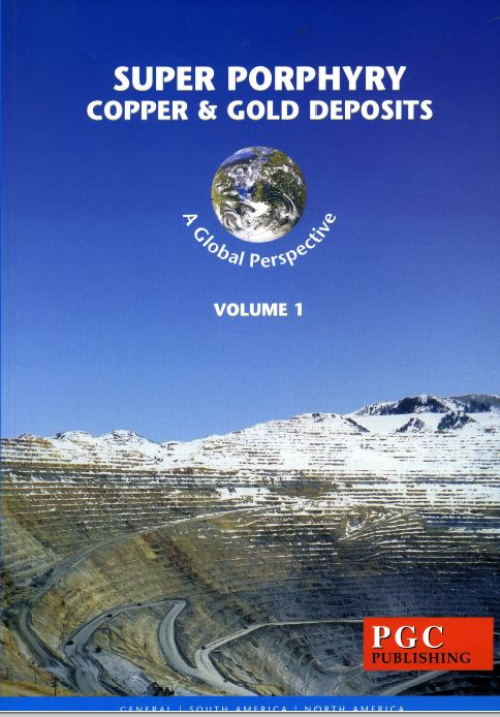
Super porphyry copper and gold deposits. Volume 1 / Суперпорфировые месторождения меди и золота. Том 1

Porphyry-style Cu-Au/Mo deposits are among the most sought after targets for both base and precious metal exploration in the world today. Of particular interest are the "super porphyry" copper and/or gold deposits, because of their size, grade and ability to support large scale, long life, profitable operations.

The term "super porphyry" is interpreted loosely in this publication, relating in general to the largest deposits in any established porphyry province. For a discussion of the accepted terminology and size classification of large porphyry-style deposits, see the introduction section of Richards, (2005) in this publication.

Издание 2, Выпуск 2
Издание:PGS Publishing, Linden Park, 2002 г., 339 стр.
Язык(и)Английский
Hydrothermal, iron oxide, copper-gold and related deposits. Volume 2 / Гидротермальные, железооксидные, медно-золотые и родственные месторождения. Том 2

This preface presents the background to this book, the second volume of the "Hydrothermal Iron Oxide Copper-Gold & Related Deposits - A Global Perspective" series, and briefly discusses the rationale for inviting the papers it contains, their format and what it is hoped the volume will achieve. It also offers some observations on the unifying characteristics of the iron oxide copper-gold family of deposits and what they may represent in a broader context.

The "hydrothermal iron-oxide copper-gold" (IOCG) family and related deposits continue to attract keen interest, both as the subject of academic research and as arguably the most sought after mineral exploration target in the world today.

Том 1, Издание 2
Издание:PGS Publishing, Linden Park, 2002 г., 321 стр., ISBN: 0-9580574-0-0
Язык(и)Английский
Hydrothermal, iron oxide, copper-gold and related deposits. Volume 1 / Гидротермальные, железооксидные, медно-золотые и родственные месторождения. Том 1

Following the discovery of the giant Olympic Dam ore deposit in 1975, a realisation developed that there was an important class of mineral deposits not previously appreciated. It became apparent that this class, the Iron Oxide Copper-Gold deposits, included not only Olympic Dam, but also a number of other known deposits. It also became apparent that this was a class that could produce large, high grade prizes, of the order of 0.25 to 1 billion tonnes of around +1% Cu and 0.5 g/t Au. As a consequence this class has been one of the major targets of the exploration industry over the last decade, resulting in the discovery of further giant orebodies in Australia such as Ernest Henry, and Candelaria, Salobo, Sossego and others in South America.

Редактор(ы):Porter T.M.
Издание:PGS Publishing, Linden Park, 2002 г., 214 стр., ISBN: 0-908039-71-9
Язык(и)Английский
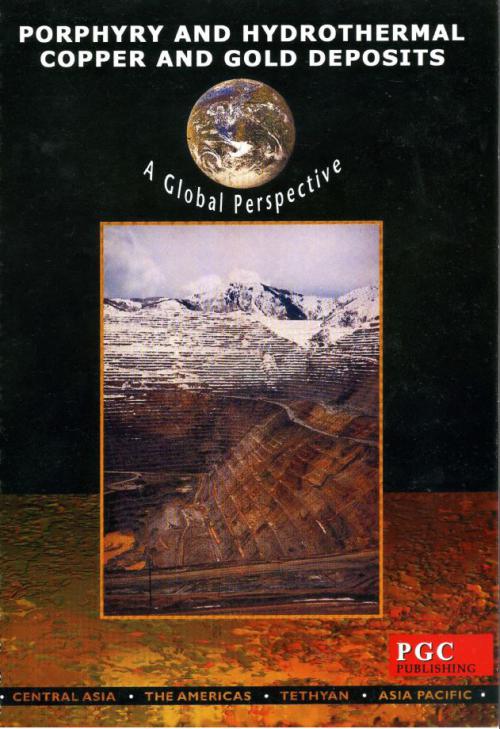
Porphyry and hydrothermal copper and gold deposits. A global perspective / Порфировые и гидротермальные месторождения меди и золота. Глобальные перспективы

Abstract - Hydrothermal copper & gold deposits associated with felsic intrusives, particularly porphyry related and epithermal ores, are found in a series of extensive, narrow, linear metallogenic provinces throughout the world. These are predominantly associated with the great Mesozoic to Cainozoic orogenic belts. Major deposits however, are also found within Palaeozoic orogens, while a few are known from the Precambrian. The style and setting of these deposits is variable and diverse, although many common features emerge from a global comparison.

Издание:The University of Chicago, 2009 г., 21 стр.
Язык(и)Английский
Dating magmatism in Central Mongolia / Магматизм в Центральной Монголии

Central Mongolia represents a heterogeneous crustal domain of the Central Asian Orogenic Belt and is composed of contrasting lithotectonic units with distinct preorogenic histories. We report single-zircon evaporation and SHRIMP ages for high-grade rocks of the Neoarchean-Paleoproterozoic Baydrag block and for metaigneous rocks of the junction between the late Neoproterozoic Bayankhongor ophiolite zone (BOZ) and the Baydrag block. Zircon ages for metamorphic rocks of the Baydrag block indicate a major tectonothermal event between 1840 and 1826 Ma, coeval with the emplacement of granitic rocks at middle-crustal level dated at 1839 Ma. A granite-gneiss yielded a much younger crystallization age of 1051 Ma, the first Grenvillian age reported for this region. Together with predominantly Mesoproterozoic detrital zircon ages for a quartzite lens from the Burd Gol accretionary complex, these data attest to the heterogeneity and long Precambrian history of the Baydrag block. Crystallization ages for granite-gneisses from the northeastern margin of the Baydrag block indicate prolonged plutonic activity between 579 and 537 Ma, probably related to southward subduction of the Bayankhongor oceanic crust.Asyntectonic granite vein yielded a crystallization age of 519 Ma, probably linked to accretion of the BOZ onto the northeastern active margin of the Baydrag block. Lastly, a felsic metavolcanic rock from the southeastern termination of the BOZ yielded a crystallization age of 472 Ma and suggests that punctuated volcanic centers developed during the early Ordovician in response to protracted convergence.

Издание:1999 г., 8 стр.
Язык(и)Английский
Geology in the Bayankhongor Region, Mongolia / Геология региона Баянхонгор, Монголия

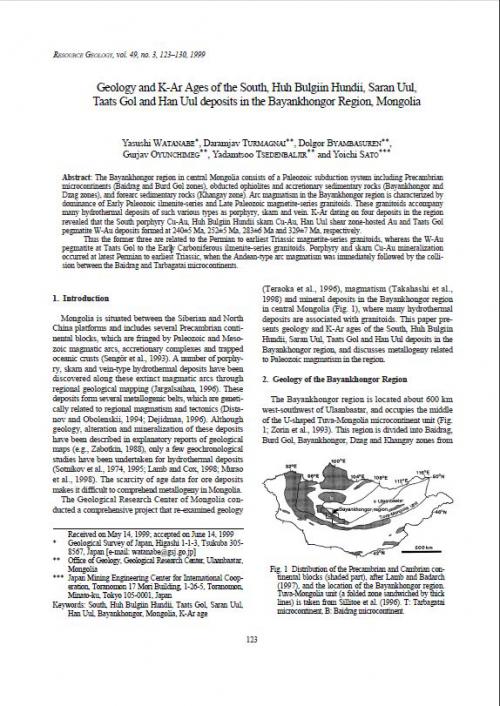
Mongolia is situated between the Siberian and North China platforms and includes several Precambrian continentalblocks, which are fringed by Paleozoic and Mesozoic magmatic arcs, accretionary complexes and trapped oceanic crusts (Sengör et al., 1993). A number of porphyry, skarn and vein-type hydrothermal deposits have been discovered along these extinct magmatic arcs through regional geological mapping (Jargalsaihan, 1996). Thesedeposits form several metallogenic belts, which are genetically related to regional magmatism and tectonics (Distanov and Obolenskii, 1994; Dejidmaa, 1996). Although geology, alteration and mineralization of these deposits

have been described in explanatory reports of geological maps (e.g., Zabotkin, 1988), only a few geochronological studies have been undertaken for hydrothermal deposits (Sotnikov et al., 1974, 1995; Lamb and Cox, 1998; Muraoet al., 1998). The scarcity of age data for ore deposits makes it difficult to comprehend metallogeny in Mongolia. The Geological Research Center of Mongolia conducted a comprehensive project that re-examined geology (Teraoka et al., 1996), magmatism (Takahashi et al., 1998) and mineral deposits in the Bayankhongor region in central Mongolia (Fig. 1), where many hydrothermal deposits are associated with granitoids. This paper presents geology and K-Ar ages of the South, Huh Bulgiin Hundii, Saran Uul, Taats Gol and Han Uul deposits in the Bayankhongor region, and discusses metallogeny related to Paleozoic magmatism in the region.

Издание:Elsevier, 2008 г., 16 стр.
Язык(и)Английский
Structural evolution of the Bayanhongor region, west-central Mongolia / Структурная эволюция региона Bayanhongor, западно-центральной части Монголии

Most of previous models suggest that the Central Asia Orogenic Belt grew southward in the Phanerozoic. However, in the Bayanhongor region in west-central Mongolia, volcanic arc, accretionary prism, ophiolite, and passive margin complexes accreted northeastward away from the Baydrag micro-continent, and hence the region constitutes the southwestern part of a crustal-scale syntaxis close to the west. The syntaxis should be original, because presumably reorientation due to strike-slip faulting can be ignored. It is reconfirmed that the Baydrag eventually collided with another micro-continent (the Hangai) to the northeast. A thick sedimentary basin developed along the southern passive margin of the Hangai micro-continent. This region is also characterized by an exhumed metamorphosed accretionary complex and a passive margin complex, which are both bounded by detachment faults as well as basal reverse faults which formed simultaneously as extrusion wedges. This part of the Central Asia Orogenic Belt lacks exhumed crystalline rocks as observed in the Himalayas and other major collisional orogenic belts. In addition, we identified two phases of deformation, which occurred at each phase of zonal accretion as D1 through Cambrian and Devonian, and a synchronous phase of final micro-continental collision of Devonian as D2. The pre-collisional ocean was wide enough to be characterized by a mid-ocean ridge and ocean islands. Two different structural trends of D1 and D2 are observed in accretionary complexes formed to the southwest of the late Cambrian mid-ocean ridge. That

is, the relative plate motions on both sides of the mid-ocean ridge were different. Accretionary complexes and passive margin sediments to the northeast of the mid-ocean ridge also experienced two periods of deformation but show the same structural trend. Unmetamorphosed cover sediments on the accretionary prism and on the Hangai micro-continent experienced only the D2 event due to microcontinental collision. These unmetamorphosed sediments form the hanging walls of the detachment faults. Moreover, they were at least partly derived from an active volcanic arc formed at the margin of the Baydrag micro-continent.

Редактор(ы):Cox D.P., Singer D.A.
Издание:U.S. Department of the interior, 1992 г., 393 стр.
Язык(и)Английский
Mineral Deposit Models / Модели месторождений полезных ископаемых

Conceptual models that describe the essential characteristics of groups of similar deposits have a  long and useful role in geology. The first models were undoubtedly empirical attempts to extend previous experiences into future success. An example might be the seeking of additional gold nuggets in a stream in which one nugget had already been found, and the extension of that model to include other streams as well. Emphasis within the U.S. Geological Survey on the synthesis of mineral deposit models (as contrasted with a long line of descriptive and genetic studies of specific ore deposits) began with the collation by R. L. Erickson (1982) of 48 models. The 85 descriptive deposit models and 60 grade-tonnage models presented here are the culmination of a process that began in 1983 as part of the USGS-INGEOMINAS Cooperative Mineral Resource Assessment of Colombia (Hodges and others, 1984). Effective cooperation on this project required that U.S. and Colombian geologists agree on a classification of mineral deposits, and effective resource assessment of such a broad region required that grade-tonnage models be created for a large

number of mineral deposit types. A concise one-page format for descriptive models was drawn up by Dennis CO X, Donald Singer, and Byron Berger, and Singer devised a graphical way of presenting grade and tonnage data. Sixty-five descriptive models (Cox, 1983a and b) and 37 grade-tonnage models (Singer and Mosier, 1983a and b) were applied to the Colombian project. Because interest in these models ranged far beyond the Colombian activity, it was decided to enlarge the number of models and to include other aspects of mineral deposit modeling. Our colleagues in

the Geological Survey of Canada have preceded this effort by publishing a superb compilation of models of deposits important in Canada (Eckstrand, 1984). Not urprisingly, our models converge quite well, and in several cases we have drawn freely from the Canadian publication.

Ленты новостей
537.45