Добрый день, Коллеги. Важное сообщение, просьба принять участие. Музей Ферсмана ищет помощь для реставрационных работ в помещении. Подробности по ссылке
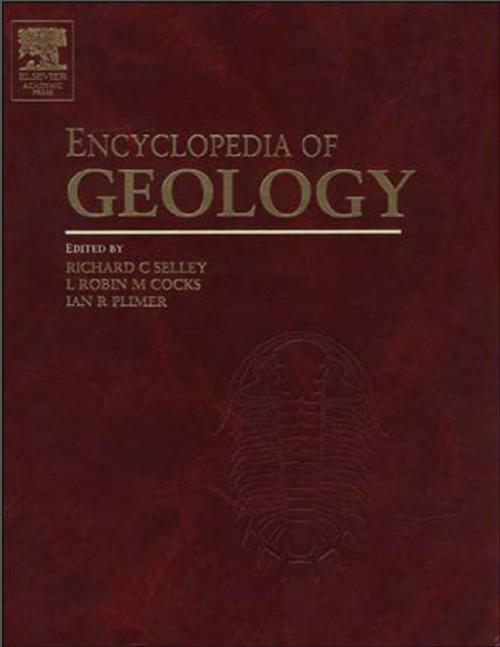
Few areas of science can have changed as fast as geology has in the past forty years. In the first half of the last century geologists were divided, often bitterly, between the drifters and those who believed that the Earth and its continents were static. Neither side of this debate foresaw that the application of methods from physics, chemistry and mathematics to these speculations would revolutionize the study of all aspects of the Earth Sciences, and would lead to accurate and detailed reconstructions of world geography at former times, as well as to an understanding of the origin of the forces that maintain the continental movements. This change in world-view is no longer controversial, and is now embedded in every aspect of the Earth Sciences. It is a real pleasure to see this change, which has revitalized so many classic areas of research, reflected in the articles of this encyclopedia. Particularly affected are the articles on large-scale Earth processes, which discuss many of the new geological ideas that have come from geophysics and geochemistry. Forty years ago we had no understanding of these topics, which are fundamental to so many aspects of the Earth Sciences. The editors have decided, and in my view quite rightly, not to include detailed discussion of the present technology that is used to make geophysical and geochemical measurements. Such instrumental aspects are changing rapidly and become dated very quickly. They can easily be found in more technical publications. Instead the editors have concentrated on the influence such studies have had on our understanding of the Earth and its evolution, and in so doing have produced an excellent and accessible account of what is now known.
Any encyclopedia has to satisfy a wide variety of users, and in particular those who know that some subject like sedimentation or mineral exploration is part of geology, and go to an encyclopedia of geology to find out more. The editors have made a very thorough attempt to satisfy such users, and have included sections on such unexpected geological topics as the evolution of the Earth’s atmosphere, the geology of Jupiter, Saturn, and their moons, aggregates, and creationism. I congratulate the editors and authors for producing such a fine summary of our present knowledge, and am particularly pleased that they intend to produce an online version of the encyclopedia. Though I have become addicted to using the Internet as my general encyclopedia, I will be delighted to be able to access something concerned with my own field that is as organized and scholarly as are these volumes.
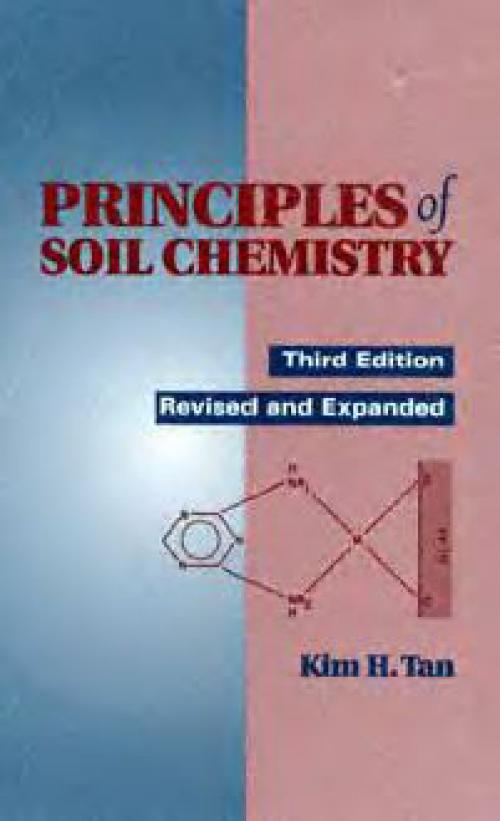
As soon as the second edition of Principles of Soil Chemistry appeared, it was sought after by many scholars, students, professionals, and scientists interested in the chemistry of soils. It was chosen as the textbook at the University of Georgia for teaching the senior-level undergraduate and graduate course in soil chemistry. It has been used as a textbook in soil chemistry at the University of California, Davis, and other universities in the United States. Because of its simple language and style, which avoid making problems more complex than needed without sacrificing scientific standards, the book is particularly appealing as a textbook in many universities overseas. The first edition of Principles of Soil Chemistry was translated in Indonesian and published by the University of Gadjah Mada Press, Yogyakarta, under the title Dasar-Dasar Kimia Tanah, which soon sold out and is out of press. I was invited to teach Soil Chemistry and Soil Genesis courses for a semester in 1996 at the University of Andalas, Padang, Sumatra, Indonesia, and in 1995 at the Universidad Nacional del Sur, Bahia Blanca, Argentina, where my first and then the second edition were adopted as the main textbook for these courses.
This book contains information obtained from authentic and highly regarded sources. Reprinted material is quoted with permission, and sources are indicated. A wide variety of references are listed. Reasonable efforts have been made to publish reliable data and information, but the author and the publisher cannot assume responsibility for the validity of all materials or for the consequences of their use.
Neither this book nor any part may be reproduced or transmitted in any form or by any means, electronic or mechanical, including photocopying, microfilming, and recording, or by any information storage or retrieval system, without prior permission in writing from the publisher.
The consent of CRC Press LLC does not extend to copying for general distribution, for promotion, for creating new works, or for resale. Specific permission must be obtained in writing from CRC Press LLC for such copying.
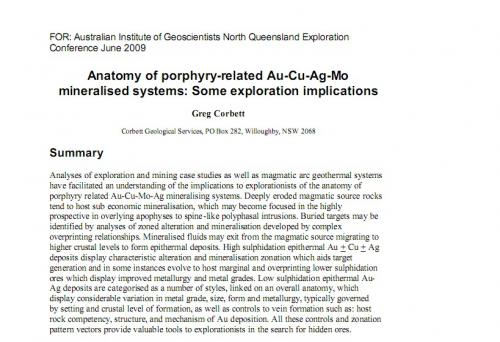
Analyses of exploration and mining case studies as well as magmatic arc geothermal systems have facilitated an understanding of the implications to explorationists of the anatomy of porphyry related Au-Cu-Mo-Ag mineralising systems. Deeply eroded magmatic source rocks tend to host sub economic mineralisation, which may become focused in the highly prospective in overlying apophyses to spine-like polyphasal intrusions. Buried targets may be identified by analyses of zoned alteration and mineralisation developed by complex overprinting relationships. Mineralised fluids may exit from the magmatic source migrating to higher crustal levels to form epithermal deposits. High sulphidation epithermal Au + Cu + Ag deposits display characteristic alteration and mineralisation zonation which aids target generation and in some instances evolve to host marginal and overprinting lower sulphidation ores which display improved metallurgy and metal grades. Low sulphidation epithermal Au-Ag deposits are categorised as a number of styles, linked on an overall anatomy, which display considerable variation in metal grade, size, form and metallurgy, typically governed by setting and crustal level of formation, as well as controls to vein formation such as: host rock competency, structure, and mechanism of Au deposition. All these controls and zonation pattern vectors provide valuable tools to explorationists in the search for hidden ores.
Problem Solving in Soil Mechanics is primarily designed as a supplement to Soil Mechanics: Basic Concepts and Engineering Applications, but can be used as an independent problem solving text, since there is no specific reference to any equation or figure in the main book. This book is written for university students taking first-degree courses in civil engineering, environmental and agricultural engineering. Its main aim is to stimulate problem solving learning as well as facilitating self-teaching. The book is written with the following objectives:
1. To present the solution of unsolved problems of Soil Mechanics: Basic Concepts and Engineering Applications.
2, To provide all necessaiy methods, equations and figures in a clear step by step explanation of the solution to each problem.
This new book by Marc Pansu and Jacques Gautheyrou provides a synopsis of the analytical procedures for the physicochemical analysis of soils. It is written to conform to analytical standards and quality control. It focuses on mineralogical, organic and inorganic analyses, but also describes physical methods when these are a precondition for analysis. It will help a range of different users to choose the most appropriate method for the type of material and the particular problems they have to face. The compiled work is the product of the experience gained by the authors in the laboratories of the Institute of Research for Development (IRD) in France and in tropical countries, and includes an extensive review of the literature. The reference section at the end of each chapter lists source data from pioneer studies right up to current works, such as, proposals for structural models of humic molecules, and itself represents a valuable source of information.
IRD soil scientists collected data on Mediterranean and tropical soils in the field from West and North Africa, Madagascar, Latin America, and South East Asia. Soil materials from these regions are often different from those found in temperate zones. As their analysis brought new problems to light, it was essential to develop powerful and specific physicochemical methods. Physicists, chemists and biologists joined forces with IRD soil scientists to contribute knowledge from their own disciplines thereby widening its scope considerably. This work is the fruit of these experiments as applied to complex systems, involving soils and the environment.
Источники фанерозойских гранитоидов на разрезе Баянхонгор – Улан-Батор, Монголия: геохимические и изотопные данные Nd, а также последствия для роста фанерозойской коры
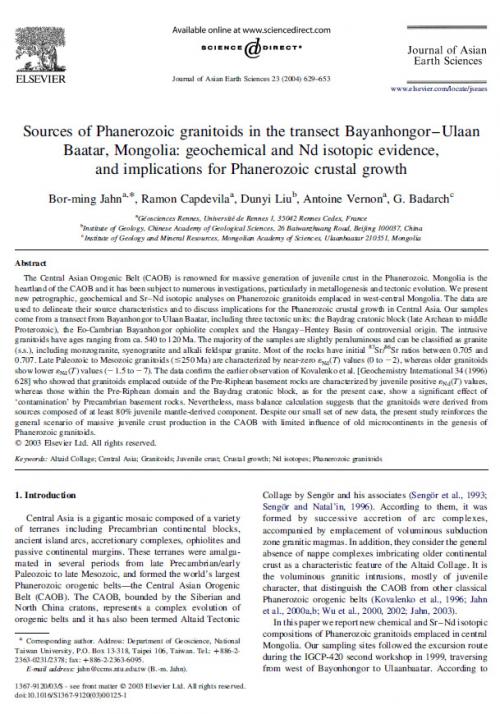
The Central Asian Orogenic Belt (CAOB) is renowned for massive generation of juvenile crust in the Phanerozoic. Mongolia is the heartland of the CAOB and it has been subject to numerous investigations, particularly in metallogenesis and tectonic evolution. We present new petrographic, geochemical and Sr–Nd isotopic analyses on Phanerozoic granitoids emplaced in west-central Mongolia. The data are used to delineate their source characteristics and to discuss implications for the Phanerozoic crustal growth in Central Asia. Our samples come from a transect from Bayanhongor to Ulaan Baatar, including three tectonic units: the Baydrag cratonic block (late Archean to middle Proterozoic), the Eo-Cambrian Bayanhongor ophiolite complex and the Hangay–Hentey Basin of controversial origin. The intrusive granitoids have ages ranging from ca. 540 to 120 Ma. The majority of the samples are slightly peraluminous and can be classified as granite (s.s.), including monzogranite, syenogranite and alkali feldspar granite. Most of the rocks have initial 87Sr/86Sr ratios between 0.705 and 0.707. Late Paleozoic to Mesozoic granitoids (#250 Ma) are characterized by near-zero Nd(T) values (0 to 22), whereas older granitoids show lower Nd(T) values (21.5 to 27). The data confirm the earlier observation of Kovalenko et al. [Geochemistry International 34 (1996) 628] who showed that granitoids emplaced outside of the Pre-Riphean basement rocks are characterized by juvenile positive Nd(T) values, whereas those within the Pre-Riphean domain and the Baydrag cratonic block, as for the present case, show a significant effect of ‘contamination’ by Precambrian basement rocks. Nevertheless, mass balance calculation suggests that the granitoids were derived from sources composed of at least 80% juvenile mantle-derived component. Despite our small set of new data, the present study reinforces the general scenario of massive juvenile crust production in the CAOB with limited influence of old microcontinents in the genesis of Phanerozoic granitoids.
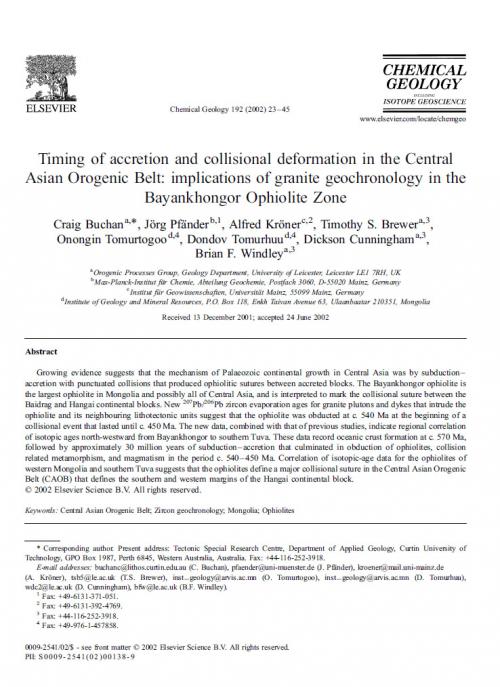
Growing evidence suggests that the mechanism of Palaeozoic continental growth in Central Asia was by subduction– accretion with punctuated collisions that produced ophiolitic sutures between accreted blocks. The Bayankhongor ophiolite is the largest ophiolite in Mongolia and possibly all of Central Asia, and is interpreted to mark the collisional suture between the Baidrag and Hangai continental blocks. New 207Pb/206Pb zircon evaporation ages for granite plutons and dykes that intrude the ophiolite and its neighbouring lithotectonic units suggest that the ophiolite was obducted at c. 540 Ma at the beginning of a collisional event that lasted until c. 450 Ma. The new data, combined with that of previous studies, indicate regional correlation of isotopic ages north-westward from Bayankhongor to southern Tuva. These data record oceanic crust formation at c. 570 Ma, followed by approximately 30 million years of subduction–accretion that culminated in obduction of ophiolites, collision related metamorphism, and magmatism in the period c. 540–450 Ma. Correlation of isotopic-age data for the ophiolites of western Mongolia and southern Tuva suggests that the ophiolites define a major collisional suture in the Central Asian Orogenic Belt (CAOB) that defines the southern and western margins of the Hangai continental block.
Эта публикация классифицирует и описывает типы Au-Cu систем ЮЗ части Тихоокеанского кольца (рис.S.1) и анализирует гидротермальные рудообразующие процессы. Исследование этих систем с точки зрения геологического строения, гидротермальных изменений и типов рудной минерализации дает информацию, которая может помочь в определении направления миграции потоков гидротерм в действующих гидротермальных системах.
Главные структуры локализуют магматические гидротермальные системы в условиях магматических дуг и создают предпосылки для рудообразования в условиях растяжения оперяющих структур (разломов). Различные типы конвергенсии влияют на тип главных структур и условия рудообразования в них. Брекчии встречаются в большинстве Au-Cu месторождений и могут рассматриваться в качестве ведущего признака в понимании условий рудообразования, так как наблюдается тесная зависимость между образованием брекчий и типами рудной минерализации.
Предполагается, что температура и рН гидротерм являются наиболее важными из большинства факторов, которые контролируют типы гидротермальных изменений. Гидротермальные минералы классифицируются с позиций этих двух факторов, что придает осмысленность интерпретации данных о гидротермальных метаморфитах. Возможные механизмы переноса металлов и их отложения дают основу понимания распространения металлов в системах, связанных с интрузиями
В сборнике представлены материалы Международной конференции "Международное сотрудничество и обмен опытом в геологическом изучении и разведке платннонометалльных месторождений северной части Фенноскандннавнн". организованного в рамках проекта международного сотрудничества KOLARCTIC ИНТРРЕГ Ш A North - ТАСИС № КА-0197 «Стратегические минеральные ресурсы - основа устойчивого развития Севера» (Россия — Финляндия — Швеция). Обсуждаются проблемы геологических поисков, разведки и освоения месторождений металлов платиновой группы (МПГ) в трансграничных районах северной части Фенноскандинавского шита. Впервые опубликованы геологические и экономические материалы по новым сырьевым объектам Колького региона. Особое внимание уделено аспектам интеграции ресурсов, опыта, знания и технологических (лабораторных) возможностей ведущих научных. образовательных и производственных геологических организаций Лапландии (Финляндии, Швеции и России), а также подготовке высококвалифицированных кадров за счет привлечения молодых специалистов и студентов к выполнению работ в рамках международного проекта.
Материалы сборника будут полезны для широкого круга геологов, горняков, экономистов и студентов геологических специальностей.
Сборник подготовлен н издан при поддержке гранта KOLARCTIC ИНТРРЕГ III A North - ТАСИС № КА-0197 «Стратегические минеральные ресурсы — основа устойчивого развития Севера» (ЕЭС), гранта № 04-11/78-2 софннанснровання международного сотрудничества, предоставленного Правительством Мурманской области, и научной школы академика РАН Ф.П.Мнтрофанова № НШ-1413.2006.5.
The volume presents records of the International conference "International cooperation and experience exchange in the field of geological research and PGE deposit exploration in the north Fennoscandia" organized within the framework of the International Collaboration Project of KOLARCTIC INTERREG Ш A Noith - TACIS NKA-0197 entitled as "Strategic mineral resoiuces as a basis of sustainable development of the North" (Russia — Finland — Sweden). The issues of geological exploration. prospecting and development of PGE deposits in trans-border regions of the northern Fennoscandian Shield are discussed. First geological and economical records of new resource areas discovered on the Kola Peninsula are published in the volume. A special emphasis has been put on the aspects of merging resoiuces. experience, knowledge and tedmological (laboratory) capabilities of leading research, academic and industrial mstitutions of Lapland (Finland, Sweden, and Russia), as well as on the hauling of highly qualified staff through attracting yoimg researchers and students to the investigation within the framework of the international project.The proceedings of the volume are of interest for geologists of different expertise, mining engineers, economists and students of earth sciences.The volume is prepared and published under the support of KOLARCTIC INTERREG Ш A North - TACIS N KA-0197 grant «Strategic mineral resoiuces as a basis of sustainable development of the North» (EU). grant N04-11/78-2 of by-financing of international cooperation provided by the Government of Murmansk region, and scientific school headed by the academician RAS Felix Mitrofanov. SC N 1413.2006.5.