Добрый день, Коллеги. Важное сообщение, просьба принять участие. Музей Ферсмана ищет помощь для реставрационных работ в помещении. Подробности по ссылке

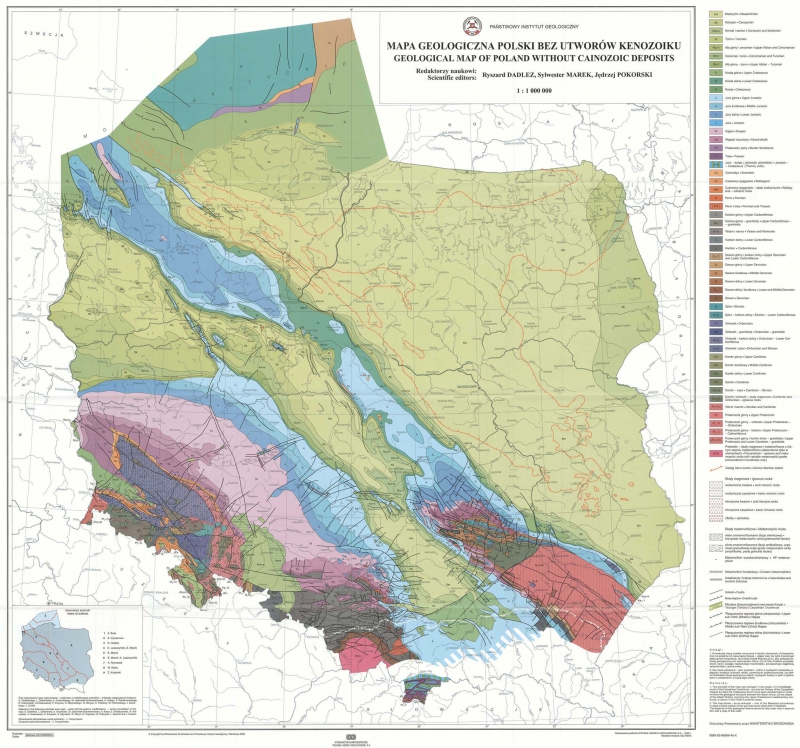
Mapa geologiczna Polski bez utworow kenozoiku
Карта составлена:Panstwowy instytut geologiczny, 2000 г.
Редактор(ы):Dadlez R., Marek S., Pokorski J.
Язык(и)Английский, Польский
Масштаб:1:1000000
Назначение карты:Геологическая карта
Скачать
Карта (615.51k)
На странице представлен материал:Геологическая карта: Mapa geologiczna Polski bez utworow kenozoiku, масштаб: 1:1000000 , составлена: Panstwowy instytut geologiczny, 2000 г., редактор(ы): Dadlez R., Marek S., Pokorski J.
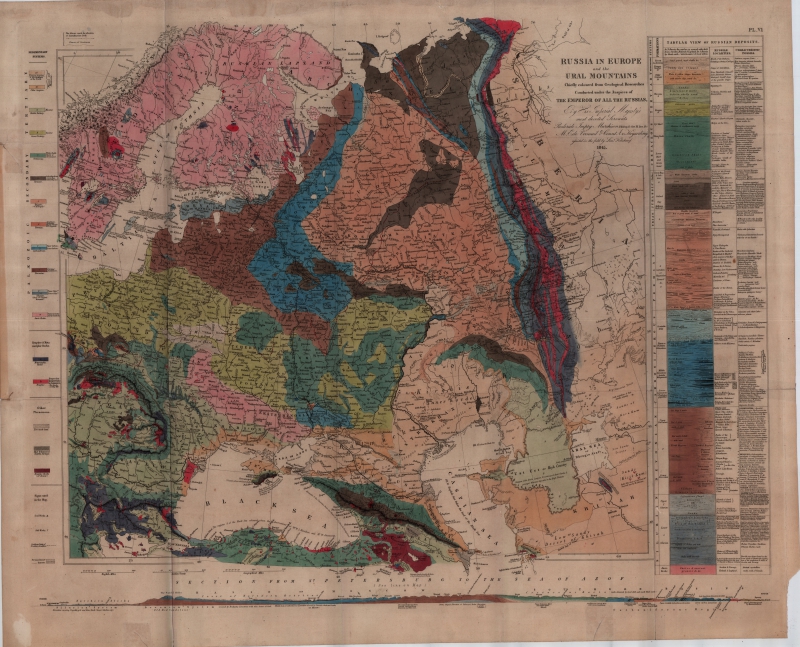
Russia in Europe and the Ural Mountains.
Карта составлена:1845 г.
Редактор(ы):Roderick Impey Murchison
Язык(и)Английский
Назначение карты:Геологическая карта
Скачать
Карта (18.16M)
На странице представлен материал:Геологическая карта: Russia in Europe and the Ural Mountains., составлена: 1845 г., редактор(ы): Roderick Impey Murchison
Издание:Debeersgroup, 31 стр.
Язык(и)Английский
Diamond Geology

Diamond deposits can be classified as primary (kimberlites and lamproites) and secondary (alluvial and marine). In 1995, their relative production contributions in South Africa were, primary (kimberlite) 8.63 million carats (89% of total), alluvial 960,000 carats (10%). and marine 90.000 carats (1%). The percentage of gems in kimberlites is highly variable. Published figures suggest approximately 40% for the Kimberley mines and 55% for Premier mine. The proportion of gems in the West Coast marine deposits is over 98%. The MIBA mine in the Congo and the Argyle mine in Australia have an average gem content of only 5%. The dispersal of diamonds from their primary sources into streams and rivers and ultimately to the sea is generally accompanied by an increase in average value per carat.| as flawed stones are progressively destroyed with greater and greater transport.

Источник:www.debeersgroup.com
Издание:5 стр.
Язык(и)Английский
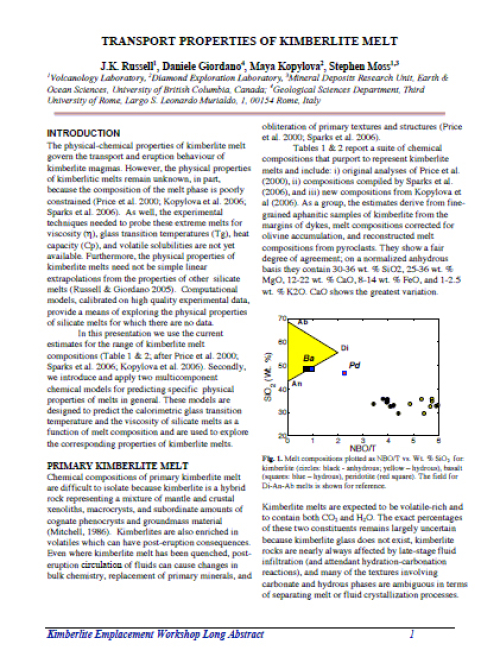
Transport properites of kimberlite melt / Транспортные свойства кимберлитового расплава


The physical-chemical properties of kimberlite melt govern the transport and eruption behaviour of kimberlite magmas. However, the physical properties of kimberlitic melts remain unknown, in part, because the composition of the melt phase is poorly constrained (Price et al. 2000; Kopylova et al. 2006; Sparks et al. 2006). As well, the experimental techniques needed to probe these extreme melts for viscosity (!), glass transition temperatures (Tg), heat capacity (Cp), and volatile solubilities are not yet available. Furthermore, the physical properties of kimberlite melts need not be simple linear extrapolations from the properties of other silicate melts (Russell & Giordano 2005). Computational models, calibrated on high quality experimental data, provide a means of exploring the physical properties of silicate melts for which there are no data.

In this presentation we use the current estimates for the range of kimberlite melt compositions (Table 1 & 2; after Price et al. 2000; Sparks et al. 2006; Kopylova et al. 2006). Secondly, we introduce and apply two multicomponent chemical models for predicting specific physical properties of melts in general. These models are designed to predict the calorimetric glass transition temperature and the viscosity of silicate melts as a function of melt composition and are used to explore the corresponding properties of kimberlite melts.

Издание 3
Издание:ФГБУ «ВСЕГЕИ», Санкт-Петербург, 2006 г., 96 стр., УДК: 551.7(083.133), ISBN: 5-93761-075-X
Язык(и)Английский, Русский
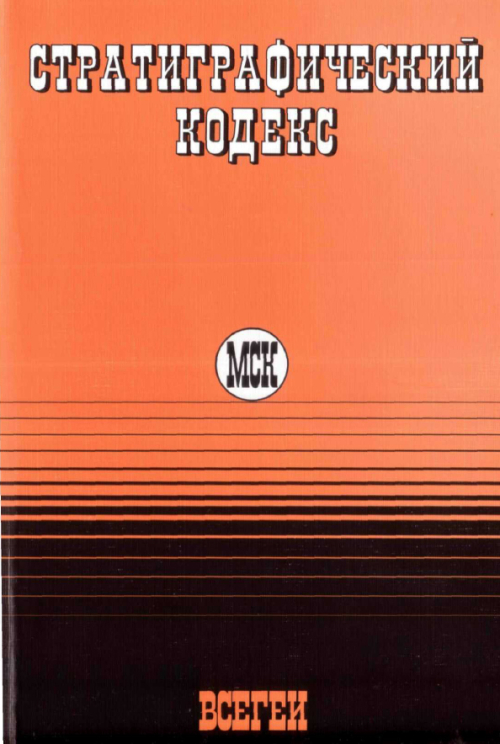
Стратиграфический кодекс России

Третье издание Стратиграфического кодекса России основано на тех же принципах, на которых были построены отечественные Стратиграфические кодексы 1977 и 1992 гг. с учетом тех изменений в требованиях, которые были обусловлены геологической практикой последнего десятилетия. В Кодексе сокращено число приложений и статей, исключены необязательные советы, примечания, примеры и др. Кодекс дополнен современной Шкалой геологического времени для докембрии, фанерозоя и отдельно для четвертичной системы; морфолито- и биостратиграфическими подразделениями; уточнены некоторые формулировки и определения.

Стратиграфический кодекс утвержден Межведомственным стратиграфическим комитетом и выполнение его требований обязательно при проведении геологических работ всеми ведомствами на территории Российской Федерации.

Издание:Кольский научный центр РАН, Ковдор-Апатиты, 1997 г., 117 стр.
Язык(и)Английский, Русский
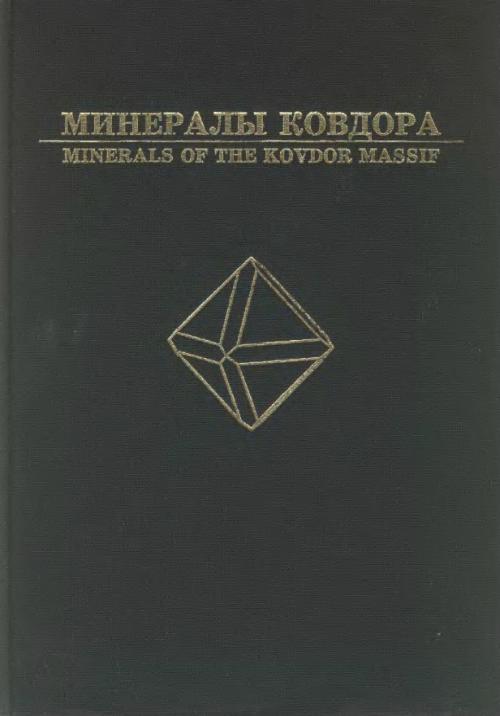
Минералы Ковдора

Ковдорский массив щелочных, ультраосновных и карбонатных пород открыт в 1933 году поисковой партией Ленинградского геологического управления под руководством К.М.Кошица. Он находится в юго-западной части Кольского полуострова (67°35/ N, 30°20' Е), в бассейне реки Ковдоры - левого притока реки Ёны. Ковдорский массив представляет собой крупную интрузию центрального типа, которая 380 миллионов лет тому назад прорвала древние биотит-плагиоклазовые гнейсы и гранито-гнейсы. Массив площадью около 41 квадратного километра имеет в плане грушевидную форму, а его зональное строение хорошо угадывается в современном рельефе. Так, центральная часть массива, сложенная устойчивыми к выветриванию ультраосновными породами, заметно приподнята над окружающими болотистыми лощинами, возникшими в зоне развития рыхлых ослюденелых пород. Последние опять окружены кольцом холмов, сложенных стойкими щелочными породами периферийных частей интрузии. Река Ковдора пересекает массив в субширотном направлении, а почти в самом его центре широко разливается в живописное озеро. Массив густо покрыт лесами из сосны, ели и берёзы. Вдоль рек и ручьёв протянулись заросли ивняка. На некоторых возвышенностях можно обнаружить небольшие участки каменистой тундры с ягелем, брусничником и карликовой берёзой.

The Kovdor Massif of alkaline, ultrabasic and carbonate rocks was discovered in 1993 by a prospecting expedition of the Leningrad Geological Survey, headed by K.M.Koshits. The Massif is situated in the southwestern part of the Kola Peninsula (67°35' N, 30°20' E), in the basin of the river Kovdora (Fig.l), which is a left tributary of the river Yona. Geologically, the Kovdor Ma+3sif is a large central-type intrusion, which was emplaced in pre-existing biotite-plagioclase gneiss and granite-gneiss approximately 380 million years ago. The Massif occupies an area of about 41 square kilometers and is pear-shaped in plan. Its zoned structure is easily discernible in topographical features. The central part of the Ma+ssif, being composed of ultrabasic rocks which are fairly resistant to weathering, is noticeably higher than the surrounding marshy dells spread over loose, micaceous rocks (Fig. 2). In their turn, the dells are encircled by hills: Mogovid in the north-east, Utsivid and Votsuvaara in the west, and Pilkomselga in the south-west; the hills are made up of alkaline rocks forming peripheral parts of the intrusion. The Kovdora river intersects the area in a sub-latitudinal direction, and there is a picturesque lake almost in the center of the Massif. The vegetation is represented by mixed forests of pine, spruce and birch. Osier-beds are common along rivers and creeks. On some heights, one can find rocky tundra patches with reindeer moss, mountain cranberries and dwarf birch-trees.

Язык(и)Английский
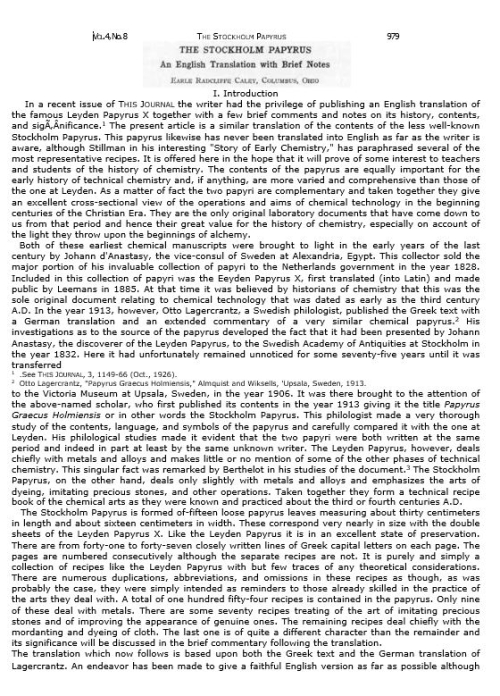
Стокгольмский папирус

In a recent issue of This Journal the writer had the privilege of publish­ing an English translation of the famous Leyden Papyrus X together with a few brief comments and notes on its history, contents, and sig­nificance.1 The present article is a similar translation of the contents of the less well-known Stockholm Papyrus. This papyrus likewise has never been translated into English as far as the writer is aware, although Stillman in his interesting "Story of Early Chemistry," has paraphrased several of the most representative recipes. It is offered here in the hope that it will prove of some interest to teachers and students of the history of chemistry. The contents of the papyrus are equally important for the early history of technical chemistry and, if anything, are more varied and comprehensive than those of the one at Leyden. As a matter of fact the two papyri are complementary and taken together they give an excellent cross-sectional view of the operations and aims of chemical technology in the beginning centuries of the Christian Era. They are the only original laboratory documents that have come down to us from that period and hence their great value for the history of chemistry, es­pecially on account of the light they throw upon the beginnings of alchemy.

Язык(и)Английский
Лейденский папирус

The chemical arts and knowledge of the ancient world are known to us chiefly through the writings of Pliny, Dioscorides, Theophrastus, Vitruvius, and a few other writers, aided in a considerable degree by the examination and chemical analysis of the various relics and remains of the older civilizations. While these writings do furnish us with a very considerable degree of information concerning the beginnings of chemical knowledge they are, at the best, only indirect sources and are lacking in details. By a fortunate chance, however, there have come to light in recent years-two original sources in the form of two remarkable Greek papyri known to students of the early history of chemistry as the Leyden Papyrus X and the Stockholm Papyrus. These invaluable documents are by far the most ancient that we possess dealing with chemical arts and operations as such. The earliest authentic alchemical manuscript is that of St. Marks at Venice which is believed to have been transcribed from earlier writings during the tenth or eleventh centuries. These two papyri have, however, upon the basis of unquestioned philological and paleographic evidence, been ascertained to have been written at about the end of the third century A.D. so that they are by far the earliest original historical evidence that we have in our possession concerning the nature and the extent of ancient chemical knowledge. They are; therefore, of the highest value for the history of chemistry and throw a whole flood of light upon the origins of the pseudo-science, alchemy, as the researches of Berthelot have so clearly demonstrated.

Издание:ELBS, 1988 г., 148 стр., ISBN: 0-582-02641-5
Язык(и)Английский
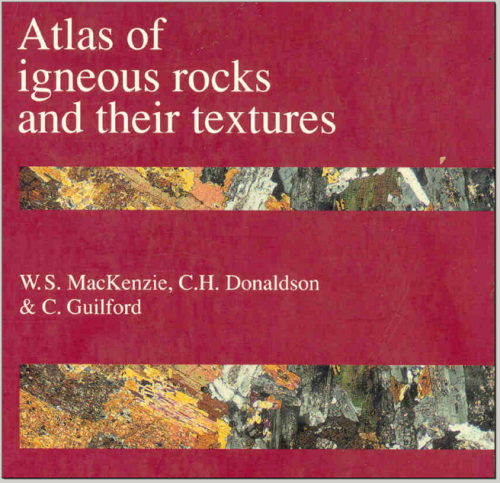
Atlas of igneous rocks and their textures / Атлас магматических пород и их текстур

Atlas of igneous rocks and their textures A companion volume to the Atlas of Rock-forming Minerals in Thin Section, this full-colour handbook is designed to be used as a laboratory manual both by elementary students of earth sciences undertaking a study of igneous rocks in thin section under the microscope, and by more advanced students and teachers as a reference work. The book is divided into two parts — Part One is devoted to photographs of many of the common textures found in igneous rocks with brief descriptions accompanying each photograph. Part Two illustrates the appearance of examples of some sixty of the commonest (and a few not so common) igneous rock types; each photograph is accompanied by a brief description of the field of view shown. Nearly 300 full-colour photographs are included, and in many cases the same view is shown both in plane-polarized light and under crossed polars. A brief account of how thin sections can be prepared is included as an appendix. It is believed that the amateur geologist using these instructions will be able to make his own thin sections and, with the aid of a relatively simple microscope, enjoy the study of rocks in thin section.

Автор(ы):Hanchar J.M., Hoskin P.W.O.
Издание:Mineralogical Society of America, Washington, 2003 г., 500 стр., ISBN: 0939950650
Язык(и)Английский
Zircon (Reviews in Mineralogy and Geochemistry, vol. 53)

"Chapters ... prepared for presentation at a Short Course, sponsored by the Mineralogical Society of America (MSA) in Freiburg, Germany, April 3-4, 2003"--P. v
Includes bibliographical references

Ленты новостей
658.39