Добрый день, Коллеги. Важное сообщение, просьба принять участие. Музей Ферсмана ищет помощь для реставрационных работ в помещении. Подробности по ссылке

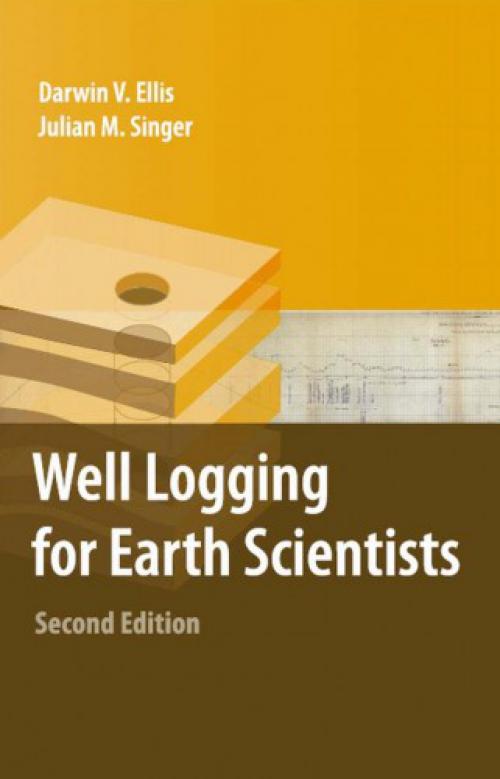
Издание 2
Издание:Springer Science+Business Media B.V., 2008 г., 699 стр., ISBN: 978-1-4020-4602-5
Язык(и)Английский
Well Logging for Earth Scientists (Second Edition) / ГИС для геологов и геофизиков (второе издание)

Well logging lies at the intersection of applied geophysics, petroleum and geotechnical engineering. It has its roots in the tentative electrical measurements in well bores which were made by the Schlumberger brothers some 80 years ago in the earliest days of systematic petroleum exploration. Today, a variety of specialized instruments is used to obtain measurements from the borehole during, as well as after, the drilling process. This readable and authoritative treatment of the physics of these measurements dispels the "black magic" of well log interpretation by relating them, including those obtained by the latest generation of tools, to rock physics. It offers a thorough exposé of the physical basis of borehole geophysical measurements, as well as an introduction to practical petrophysics -- extracting desired properties from well log measurements.

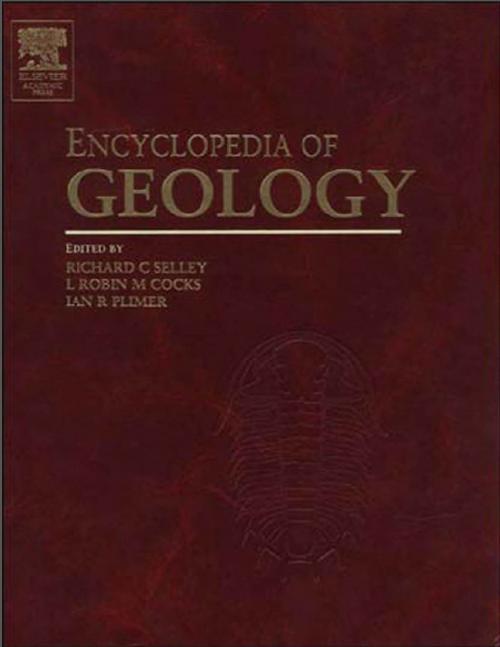
Том 5
Редактор(ы):M.Cocks, Richard C.Selly, Robin L., Ian R.Plimer
Издание:Elsevier, Oxford, 2005 г., 810 стр., ISBN: 0-12-636380-3 (set)
Язык(и)Английский
Encyclopedia of Geology. S-W


Few areas of science can have changed as fast as geology has in the past forty years. In the first half of the last century geologists were divided, often bitterly, between the drifters and those who believed that the Earth and its continents were static. Neither side of this debate foresaw that the application of methods from physics, chemistry and mathematics to these speculations would revolutionize the study of all aspects of the Earth Sciences, and would lead to accurate and detailed reconstructions of world geography at former times, as well as to an understanding of the origin of the forces that maintain the continental movements. This change in world-view is no longer controversial, and is now embedded in every aspect of the Earth Sciences. It is a real pleasure to see this change, which has revitalized so many classic areas of research, reflected in the articles of this encyclopedia. Particularly affected are the articles on large-scale Earth processes, which discuss many of the new geological ideas that have come from geophysics and geochemistry. Forty years ago we had no understanding of these topics, which are fundamental to so many aspects of the Earth Sciences. The editors have decided, and in my view quite rightly, not to include detailed discussion of the present technology that is used to make geophysical and geochemical measurements. Such instrumental aspects are changing rapidly and become dated very quickly. They can easily be found in more technical publications. Instead the editors have concentrated on the influence such studies have had on our understanding of the Earth and its evolution, and in so doing have produced an excellent and accessible account of what is now known.

Any encyclopedia has to satisfy a wide variety of users, and in particular those who know that some subject like sedimentation or mineral exploration is part of geology, and go to an encyclopedia of geology to find out more. The editors have made a very thorough attempt to satisfy such users, and have included sections on such unexpected geological topics as the evolution of the Earth’s atmosphere, the geology of Jupiter, Saturn, and their moons, aggregates, and creationism. I congratulate the editors and authors for producing such a fine summary of our present knowledge, and am particularly pleased that they intend to produce an online version of the encyclopedia. Though I have become addicted to using the Internet as my general encyclopedia, I will be delighted to be able to access something concerned with my own field that is as organized and scholarly as are these volumes.

Dan McKenzie

Royal Society Professor of Earth Sciences

Cambridge University, UK

Том 4
Редактор(ы):M.Cocks, Richard C.Selly, Robin L., Ian R.Plimer
Издание:Elsevier, Oxford, 2005 г., 694 стр., ISBN: 0-12-636380-3 (set)
Язык(и)Английский
Encyclopedia of Geology. N-S

Few areas of science can have changed as fast as geology has in the past forty years. In the first half of the last century geologists were divided, often bitterly, between the drifters and those who believed that the Earth and its continents were static. Neither side of this debate foresaw that the application of methods from physics, chemistry and mathematics to these speculations would revolutionize the study of all aspects of the Earth Sciences, and would lead to accurate and detailed reconstructions of world geography at former times, as well as to an understanding of the origin of the forces that maintain the continental movements. This change in world-view is no longer controversial, and is now embedded in every aspect of the Earth Sciences. It is a real pleasure to see this change, which has revitalized so many classic areas of research, reflected in the articles of this encyclopedia. Particularly affected are the articles on large-scale Earth processes, which discuss many of the new geological ideas that have come from geophysics and geochemistry. Forty years ago we had no understanding of these topics, which are fundamental to so many aspects of the Earth Sciences. The editors have decided, and in my view quite rightly, not to include detailed discussion of the present technology that is used to make geophysical and geochemical measurements. Such instrumental aspects are changing rapidly and become dated very quickly. They can easily be found in more technical publications. Instead the editors have concentrated on the influence such studies have had on our understanding of the Earth and its evolution, and in so doing have produced an excellent and accessible account of what is now known.

Any encyclopedia has to satisfy a wide variety of users, and in particular those who know that some subject like sedimentation or mineral exploration is part of geology, and go to an encyclopedia of geology to find out more. The editors have made a very thorough attempt to satisfy such users, and have included sections on such unexpected geological topics as the evolution of the Earth’s atmosphere, the geology of Jupiter, Saturn, and their moons, aggregates, and creationism. I congratulate the editors and authors for producing such a fine summary of our present knowledge, and am particularly pleased that they intend to produce an online version of the encyclopedia. Though I have become addicted to using the Internet as my general encyclopedia, I will be delighted to be able to access something concerned with my own field that is as organized and scholarly as are these volumes.

Dan McKenzie

Royal Society Professor of Earth Sciences

Cambridge University, UK

Том 3
Редактор(ы):M.Cocks, Richard C.Selly, Robin L., Ian R.Plimer
Издание:Elsevier, Oxford, 2005 г., 661 стр., ISBN: 0-12-636380-3 (set)
Язык(и)Английский
Encyclopedia of Geology. G-M

Few areas of science can have changed as fast as geology has in the past forty years. In the first half of the last century geologists were divided, often bitterly, between the drifters and those who believed that the Earth and its continents were static. Neither side of this debate foresaw that the application of methods from physics, chemistry and mathematics to these speculations would revolutionize the study of all aspects of the Earth Sciences, and would lead to accurate and detailed reconstructions of world geography at former times, as well as to an understanding of the origin of the forces that maintain the continental movements. This change in world-view is no longer controversial, and is now embedded in every aspect of the Earth Sciences. It is a real pleasure to see this change, which has revitalized so many classic areas of research, reflected in the articles of this encyclopedia. Particularly affected are the articles on large-scale Earth processes, which discuss many of the new geological ideas that have come from geophysics and geochemistry. Forty years ago we had no understanding of these topics, which are fundamental to so many aspects of the Earth Sciences. The editors have decided, and in my view quite rightly, not to include detailed discussion of the present technology that is used to make geophysical and geochemical measurements. Such instrumental aspects are changing rapidly and become dated very quickly. They can easily be found in more technical publications. Instead the editors have concentrated on the influence such studies have had on our understanding of the Earth and its evolution, and in so doing have produced an excellent and accessible account of what is now known.

Any encyclopedia has to satisfy a wide variety of users, and in particular those who know that some subject like sedimentation or mineral exploration is part of geology, and go to an encyclopedia of geology to find out more. The editors have made a very thorough attempt to satisfy such users, and have included sections on such unexpected geological topics as the evolution of the Earth’s atmosphere, the geology of Jupiter, Saturn, and their moons, aggregates, and creationism. I congratulate the editors and authors for producing such a fine summary of our present knowledge, and am particularly pleased that they intend to produce an online version of the encyclopedia. Though I have become addicted to using the Internet as my general encyclopedia, I will be delighted to be able to access something concerned with my own field that is as organized and scholarly as are these volumes.

Dan McKenzie

Royal Society Professor of Earth Sciences

Cambridge University, UK

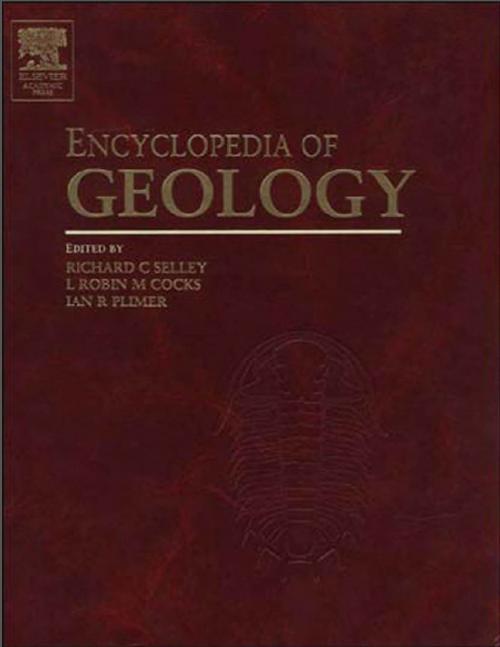
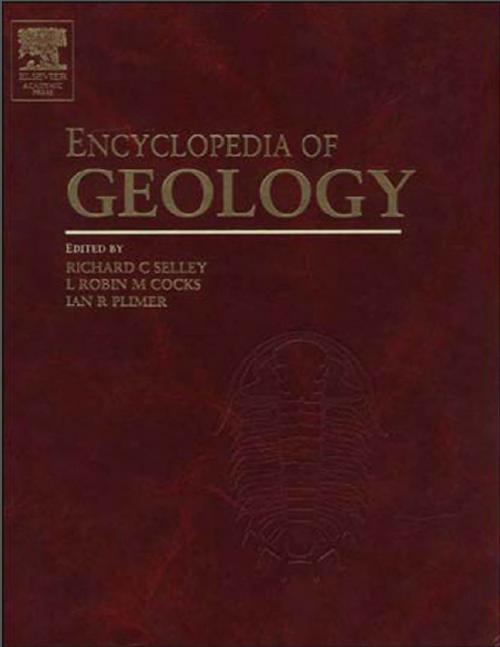
Том 2
Редактор(ы):M.Cocks, Richard C.Selly, Robin L., Ian R.Plimer
Издание:Elsevier, Oxford, 2005 г., 545 стр., ISBN: 0-12-636380-3
Язык(и)Английский
Encyclopedia of Geology. E-F

Few areas of science can have changed as fast as geology has in the past forty years. In the first half of the last century geologists were divided, often bitterly, between the drifters and those who believed that the Earth and its continents were static. Neither side of this debate foresaw that the application of methods from physics, chemistry and mathematics to these speculations would revolutionize the study of all aspects of the Earth Sciences, and would lead to accurate and detailed reconstructions of world geography at former times, as well as to an understanding of the origin of the forces that maintain the continental movements. This change in world-view is no longer controversial, and is now embedded in every aspect of the Earth Sciences. It is a real pleasure to see this change, which has revitalized so many classic areas of research, reflected in the articles of this encyclopedia. Particularly affected are the articles on large-scale Earth processes, which discuss many of the new geological ideas that have come from geophysics and geochemistry. Forty years ago we had no understanding of these topics, which are fundamental to so many aspects of the Earth Sciences. The editors have decided, and in my view quite rightly, not to include detailed discussion of the present technology that is used to make geophysical and geochemical measurements. Such instrumental aspects are changing rapidly and become dated very quickly. They can easily be found in more technical publications. Instead the editors have concentrated on the influence such studies have had on our understanding of the Earth and its evolution, and in so doing have produced an excellent and accessible account of what is now known.

Any encyclopedia has to satisfy a wide variety of users, and in particular those who know that some subject like sedimentation or mineral exploration is part of geology, and go to an encyclopedia of geology to find out more. The editors have made a very thorough attempt to satisfy such users, and have included sections on such unexpected geological topics as the evolution of the Earth’s atmosphere, the geology of Jupiter, Saturn, and their moons, aggregates, and creationism. I congratulate the editors and authors for producing such a fine summary of our present knowledge, and am particularly pleased that they intend to produce an online version of the encyclopedia. Though I have become addicted to using the Internet as my general encyclopedia, I will be delighted to be able to access something concerned with my own field that is as organized and scholarly as are these volumes.

Dan McKenzie

Royal Society Professor of Earth Sciences

Cambridge University, UK

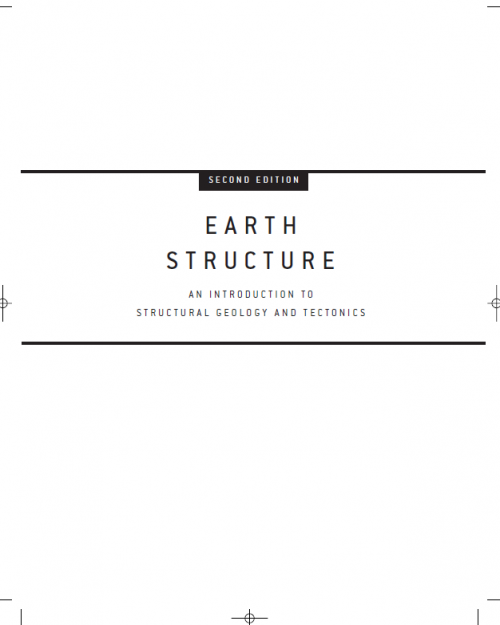
Автор(ы):Ben A., Marshak S.
Издание:W.W.Norton & Company, 2004 г., 672 стр., ISBN: 039392467X
Язык(и)Английский
Earth Structure: An Introduction to Structural Geology and Tectonics (Second Edition) / Строение Земли - Введение в структурную геологию и тектонику (второе издание)

This book is concerned with the deformation of rock in the Earth’s lithosphere, as viewed from the atomic scale, through the grain scale, the hand specimen scale, the outcrop scale, the mountain range scale, and the tectonic plate scale. A deformational feature observed on one scale typically reflects processes occurring on other scales. For example, we can’t understand continental deformation without understanding mountains, we can’t understand mountains without understanding folding and faulting, and we can’t understand folding and faulting without understanding ductile and brittle deformation mechanisms at the atomic scale. This book attempts to integrate topics pertaining to all scales of rock deformation, emphasizing the linkages between structural geology and tectonics.

Данная книга рассматривает деформацию пород в литосфере Земли , которая наблюдается на атомном уровне, переходя на масштаб зерна, образца, обнажения, горного хребта и тектонической плиты. Деформационные особенности, наблюдаемые в одном масштабе, закономерно отражают процессы, возникающие в другом масштабе. К примеру, мы не можем понять деформацию континента без понимания процессов горообразования, мы не можем понять горообразование без понимания процессов образования складок и разломов, и мы не можем понять процессы складкообразования и разрывных нарушений без понимания механизмов пластичной и хрупкой деформации на атомарном уровне. Эта книга пытается объединить темы, касающиеся деформации пород на всех уровнях, подчеркивая связь между структурной геологией и тектоникой.

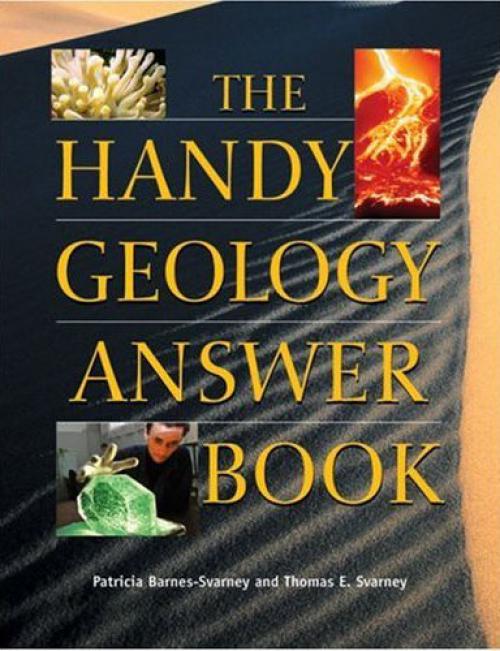
Издание:Visible Ink Press, 2004 г., 458 стр., ISBN: 1-57859-156-2
Язык(и)Английский
The Handy Geology Answer Book / Карманная книга ответов по геологии

Справочник по геологии, составленный в формате "вопрос - ответ" с делением по разделам. В конце имеется алфавитный указатель.


Courtesy of The Lord of/he Rings trilogy, movie audiences have been drawn to a fantasy place called "Middle Earth," an ever-changing landscape that seems almost alien. The Lord ofthe Rings may have come from the imagination of two great storytellers, author J. R. R. Tolkien and director Peter Jackson, but the landscape chosen for the movies was real. This enthralling fantasy world was actually New Zealand, a land formed and shaped by two of the most awe-inspiring, yet destructive, forces known to humans: volcanoes and plate tectonics. This was one instance where geology made a movie even more fascinating. But geology is more than just amazing landscapes. It is rocks, minerals, fossils, processes, cycles, the physical characteristics and features of our amazing planet. We are surrounded by geology-it is in everyone's backyard; it is at everyone's feet. Geology describes how our environment became what it is, in effect providing a history of the planet and its universe. Ranging from the backyard to outer space, The Handy Geology Answer Book answers nearly 1,100 fundamental questions about this most fascinating science. With more than 100 photographs and illustrations, The Handy Geology Answer Book takes you on a tour of our world. It answers questions on topics ranging from the microscopic formation of crystals to the titanic, eons-long processes that form islands, mountains, continents, and even planets. You'll be taken back in time to uncover the mysteries of dinosaur fossils and then catapulted toward the forefront of science, where you will learn how artificial gems are synthesized and why glaciologists fret over the effects of global warming on Earth's massive ice shelves. Along the way, you will get to know some of the famous geologists who cleared a path for future generations of scientists as they explore the mysteries of caves, mine the planet's rich mineral resources, and try to save lives by accurately predicting earthquakes, volcanic eruptions, and tsunamis. Once your appetite has been whetted, the final chapter of Handy Geology provides a solid foundation for further research, as well as helpful advice on how to begin XI XII enjoying geology as a hobby or even a career. Ahelpful glossary will tell you what, for example, an alluvial fan or a talus slope is. As scientists and writers, we have used our experience to write this book. Our backgrounds and love of nature have taken us to many of the geologic rarities of the world.  We have traveled extensively across the Earth, doing fieldwork, conducting interviews with scientists, and managing many "rock hunts" of our own. We have crossed Antarctica's Transantarctic Mountains, hiked the European Alps, traveled the oceans, and wit· nessed the upheaval caused by the shift of tectonic plates in New Zealand and other places. We have visited almost every geologic "hot site" in America, hiking into the Grand Canyon, walking the rim of Meteor Crater, and watching an active Cascade Range volcano. We have also explored plenty of dormant sites and experienced several California earthquakes, just to name a few of our adventures. Not that we have shunned our own backyard-we live just about where the edge of the last glacial ice sheet existed over 10,000 years ago, right near the famous New York Finger Lakes, where deep troughs were carved by glacial advances and retreats over millions of years. In part, this book represents a distillation of what we discovered during our travels. And it answers hundreds of basic questions on that most interesting of topicsplanet Earth. So sit back, grab your rock hammer and hand lens, and enjoy the scenery.


Автор(ы):Walder O.
Издание:Springer, 2008 г., 180 стр., ISBN: 978-3-540-75298-1
Язык(и)Английский
Математические методы для инженеров и геологов (Mathematical methods for engineers and geoscientists)

This work is subject to copyright. All rights are reserved, whether the whole or part of the material is concerned, specifically the rights of translation, reprinting, reuse of illustrations, recitation, broadcasting, reproduction on microfilm or in any other way, and storage in data banks. Duplication of this publication or parts thereof is permitted only under the provisions of the German Copyright Law of September 9, 1965, in its current version, and permission for use must always be obtained from Springer. Violations are liable to prosecution under the German Copyright Law. The use of general descriptive names, registered names, trademarks, etc. in this publication does not imply, even in the absence of a specific statement, that such names are exempt from the relevant protective laws and regulations and therefore free for general use. We start with a fun puzzle in mathematics and mathematical methods. How many corners does a four-dimensional cube have? Does such a thing exist, you ask? You may be a geoscientist or a philosopher.

Автор(ы):Джон Эриксон
Издание:Facts On File. Inc, 2003 г., 333 стр., ISBN: 0-8160-4874-6
Язык(и)Английский
Морская геология

Это полностью пересмотренное и расширенное издание "Морской геологии" В нём внимательно изучается взаимосвязь между водой ее формами жизни и геологических структур. Здесь рассматривается несколько идей о происхождении Земли, континентов, океанов, и каким образом эти процессы укладываются в происхождении Вселенной. Эта книга охватывает все области подводных ландшафтов и форм жизни, от гигантских подводных каньонов до океанских вулканов.

Oceans cover approximately two-thirds of the Earth’s surface, yet we have explored less of the ocean’s depths and mysteries than the surfaces of several nearby planets. The oceans have inspired myths and legends and have been the sources of intrigue, fear, and hope for thousands of years. They have hindered migration of peoples and biota between distant continents yet paradoxically now serve as a principal means of transportation. Oceans provide us with incredible mineral wealth and renewable food and energy sources yet also breed devastating hurricanes. Life on Earth may have begun in environments around hot volcanic events on the seafloor, and we are only beginning today to explore the diverse and unique fauna that thrive in deep, dark waters around similar vents. In the revised edition of Marine Geology, Jon Erickson explores several ideas hypothesizing the origin of the Earth, continents, and oceans and how these processes fit into the origin of the universe.The role of oceans and water in the development of plate tectonics is discussed in detail, while the reader isgiven essential information on how plate tectonics works. Ocean basins have continually expanded and contracted on Earth, and the continents have alternately converged into large single supercontinents and then broken apart by the formation of new ocean basins.The appearance, evolution, and extinction of different life-forms are inextricably linked to the expansion and contraction of ocean basins, partly through the changing environmental conditions associated with tectonic processes.The history of several different ocean basins over the past billion years is discussed in Marine Geology, as well as the changing life-forms in each successive ocean basin.

Редактор(ы):Lorenz R., Murray C., Nimmo F., Russell S., Bagenal F., Jewitt D.
Издание:Cambridge, 2007 г., 484 стр., ISBN: 978-0-511-28492-2
Язык(и)Английский
Геология Марса

Исследование геологических процессов, происходящих на Марсе, опирается на интерпретацию снимков и других данных, передаваемых зондами, беспилотными орбитальными и посадочными аппаратами. Эта интерпретация основывается на наших знаниях о процессах, происходящих на Земле, поэтому земные аналоговые исследования играют важную роль в понимании геологических особенностей, наблюдаемых на Марсе. Это первая книга, в которой проводится прямое сравнение между местами действия на Земле и Марсе и приводятся работы ведущих планетарных геологов, в которых показываются сходства и различия между этими соседними планетами.

Ленты новостей
521.16