Добрый день, Коллеги. Важное сообщение, просьба принять участие. Музей Ферсмана ищет помощь для реставрационных работ в помещении. Подробности по ссылке
This book is a follow-up to a Geological Society of London conference with the same title, held in urlington House, London, in February 2000. Following the conference it was decided to compile a Special Publication based in part on papers presented at the conference and in part on papers that were added later to form a balanced content. The content of New Insights into Structural Interpretation and Modelling presents a balanced overview of what the title promises. It is intended as a book that will serve the experienced professional as well as more advanced students in Earth sciences with a wide range of topics described in high quality publications. Some chapters are by leaders in the field, other chapters are written by young authors with fresh ideas.
Faults and their deeper-level equivalents, shear zones are localized regions of higher strain which effectively accommodate differential movement in the Earth's crust and mantle during deformation of the lithosphere. Shear zones may be more precisely defined as approximately tabular regions of concentrated deformation and flow across which adjacent relatively undeformed rock units are offset.
Scientific research can take unexpected, even counter-intuitive, directions because of technical innovation, the occasional brilliant idea that overturns conventional wisdom and new observations that provide previously unexpected insights into the way in which nature works. For these reasons no one is certain what the future holds in terms of breakthroughs.
Prior to Hubbert and Rubey's classic paper (Hubbert & Rubey 1959), which specifically recognized the role of high fluid pressures in lowering the shear stress required to move and emplace large thrust sheets, geologists had tended to ignore the importance of fluids in crustal deformation (Fyfe et al. 1978). Much has changed in the intervening 40 years. It is now accepted that not only do fluids enable deformation but that the converse is also true, i.e. that faulting can cause fluid migration.
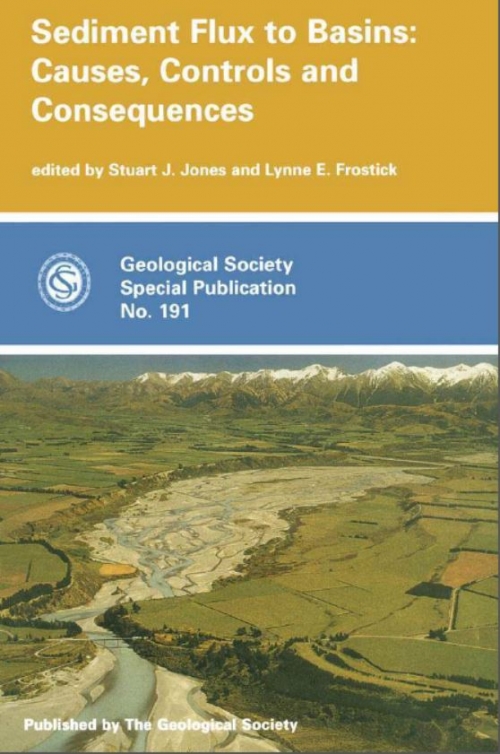
The stratigraphic record stored in sedimentary basins had traditionally been interpreted in terms of tectonic subsidence, climate change and sea-level rise or fall. During the last decade, however, the fundamental control of sediment flux in creating sedimentary sequences, and thus the need to understand variations in sediment flux in order to interpret the sedimentary record, has been recognized. Sediment flux is a first-order control on the pattern and distribution of sedimentary facies in depositional basins.
This special publication is a compilation of papers presented at the Drift Exploration in Glaciated Terrain Short Course held in conjunction with the 19th International Geochemical Exploration Symposium in Vancouver, British Columbia, Canada in April, 1999. The short course was sponsored by the Association of Exploration Geochemists.
The discovery of dinosaurs and other large extinct ‘saurians’, a term under which the Victorians commonly lumped ichthyosaurs, plesiosaurs, pterosaurs and their kin, makes exciting reading. The story of how early ‘fossilists’ first found the remains of these ‘primeval monsters’ has been told again and again in popular and semi-popular books about the history of palaeontology. Mary Anning making a living by collecting extinct reptiles along the Dorset coast, William Buckland and Gideon Mantell finding the ‘terrible lizards’ for which Richard Owen was to coin the word ‘Dinosauria’, O. C. Marsh and E. D. Cope fighting over new fossil vertebrates in the American West – all of these well-known stories have almost achieved the status of legends, and have often been retold with little regard for historical or scientific accuracy. <...>
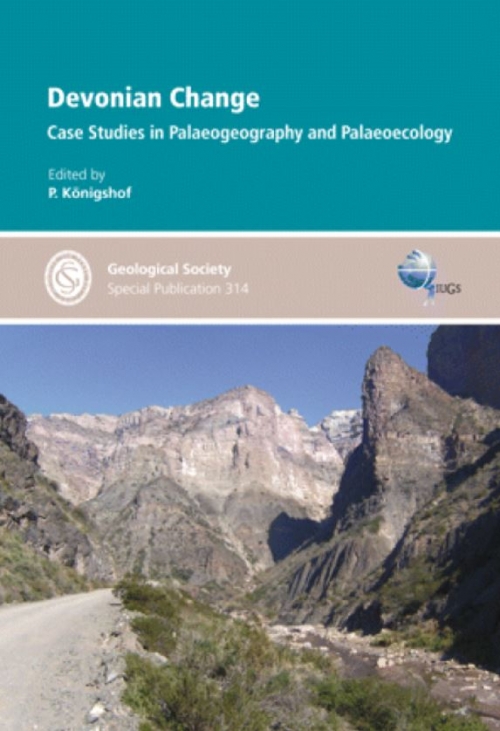
The Devonian was a peculiar time in the Phanerozoic evolution of the Earth. Most continents, including the large Gondwana and Laurussia cratons, formed a Pangea-type assembly around the tropical Prototethys and an increasingly hot, global, greenhouse climate prevailed, with a complete lack of major ice sheets, even in polar areas. There was gradual and increasing flooding of the continents, creating huge epicontinental seas that have no modern analogues. Under these conditions the plants finally conquered the land, with the innovation of deep roots in the Emsian, the appearance of seed precursors and trees in the Givetian, and the spread of vegetation into dry uplands in the late Famennian. In the marine realm, the largestknown Phanerozoic tropical reef belts surrounded craton margins and tropical islands. It was the time of the sudden radiation of early ammonoids, of the earliest episodic blooms of calcareousshelled, pelagic zooplankton (tentaculitoids), the rise to dominance of fishes, mostly of armoured forms and with giants reaching 10 m in length, but also including the first sharks, and the appearance of earliest tetrapods in marginal settings. However, the tropical and subtropical areas reaching up to 458 latitude were hardly a paradise. <...>
The Devonian was a critical period with respect to the diversification of early terrestrial ecosystems. The geotectonic setting was characterized by the switch from the post-Caledonian to the pre-Variscan situation. Plant life on land evolved from tiny tracheophytes to trees of considerable size in combination with a global increase in terrestrial biomass, and vertebrates started to conquer the land. Extensive shallow-marine areas and continental lowlands with a wide range of different habitats existed. These are preserved in a large number of basins all around the world. Climate change finally led from greenhouse to icehouse conditions towards the end of the Devonian. Rapid evolution of terrestrial ecosystems and climate change had a pronounced influence on sedimentation and biodiversity, not only in the terrestrial, but also in the marine realm. This volume contains case studies from Australia, China, Europe, South America and North America, and individual palaeoecosystems and their components have been investigated in different palaeogeographic settings that contribute to a much better understanding of the Devonian Period. This is a contribution to the IGCP 499 project on "Devonian land-sea interaction: evolution of ecosystems and climate”. <...>
Deserts provide an excellent subject for interchange between Earth scientists of differing subdisciplines. The aridity of climate and the sparseness of plants and animals, especially Man, encourage surface processes that produce sedimentary deposits sufficiently distinctive to be recognized unequivocally both throughout the passage of time and from one planet to another. Because of this, and because Lyell's dictum of uniformitarianism is probably most appropriate in desert settings where the impingement of evolving life forms has been least, an exchange between scientists concerned with the living deserts of Earth and beyond, on the one hand, and with ancient Earth counterparts, on the other, is extremely fruitful. Lessons are learned on all sides. This was the spirit that encouraged 185 participants to gather at a Special Scientific Meeting of the Geological Society of London in May 1986. It is also the underlying rationale for this Special Publication which incorporates a substantial proportion of the contributions made at that Meeting. <...>