Добрый день, Коллеги. Важное сообщение, просьба принять участие. Музей Ферсмана ищет помощь для реставрационных работ в помещении. Подробности по ссылке

Поиск по книгам
Редактор(ы):Sabloff P.L.W.
Издание:University of Pennsylvania Museum of Archaeology and Anthropology, 2007 г., 294 стр., ISBN: 978-1-934536-18-6
Язык(и)Английский
Mapping Mongolia. Situating Mongolia in the world from geologic time to the present / Составление карты Монголии. Положение Монголии в мире с геологических времен по настоящее время

When I first started conducting research in Mongolia, I found that I could make a room full of anthropologists jealous by telling them where I worked. To a discipline whose members pride themselves on working in exotic locations, Mongolia is a glamorous research site, for few Western and even fewer American anthropologists had worked there during the Cold War.1 Young anthropologists started to trickle in during the early 1990s: Norwegian, Danish, and French graduate students; Christopher Kaplonski, Peter Marsh, and Katherine Petrie from the United States; and, of course, the University of Cambridge research group (Mongolian and Inner Asian Studies Unit) headed by Caroline Humphrey and now David Sneath. So anthropology, my discipline, was becoming interested in Mongolia.

Автор(ы):Crampton J.W.
Издание:Wiley Blackwell, 2010 г., 230 стр., ISBN: 978-1-4051-2172-9
Язык(и)Английский
Mapping. A critical introduction to cartography and GIS / Картирование. Краткое введение в картографию и ГИС

This book is an introduction to critical cartography and GIS. As such, it is neither a textbook nor a software manual. My purpose is to discuss various aspects of mapping theory and practice, from critical social theory to some of the most interesting new mapping practices such as map hacking and the geospatial web. It is an appreciation of a more critical cartography and GIS.

Автор(ы):Clark A., Hawkes N., Moody T.C.
Издание:PGS Publishing, Linden Park, 2002 г., 16 стр.
Язык(и)Английский
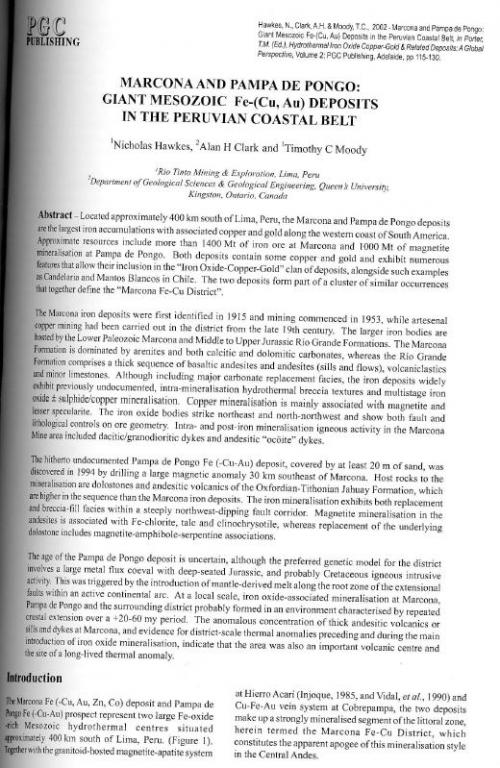
Marcona and Pampa de Pongo: Giant Mesozoic Fe-(Cu, Au) Deposits in the Peruvian Coastal Belt

Located approximately 400 km south of Lima, Peru, the Marcona and Pampa de Pongo deposits are the largest iron accumulations with associated copper and gold along the western coast of South America. Approximate resources include more than 1400 Mt of iron ore at Marcona and 1000 Mt of magnetite mineralisation at Pampa de Pongo. Both deposits contain some copper and gold and exhibit numerous features that allow their inclusion in the "Iron Oxide-Copper-Gold" clan of deposits, alongside such examples asCandelaria and Mantos Blancos in Chile. The two deposits form part of a cluster of similar occurrences that together define the "Marcona Fe-Cu District".

Редактор(ы):Turekian K.K.
Издание:Elsevier, 2010 г., 641 стр., ISBN: 978-0-08-096483-6
Язык(и)Английский
Marine Chemistry & Geochemistry / Морская химия и геохимия

The field of marine chemistry and geochemistry has developed dramatically since the end of World War II. Mainly this spurt of refinement was the consequence of the development of novel techniques of measurement of both radioactive and radiogenic isotopes as well as the light stable isotopes.

Редактор(ы):Chester R.
Издание:Blackwell science Ltd, 2000 г., 521 стр.
Язык(и)Английский
Marine geochemistry / Морская геохимия

All symbols used in the present work are defined at the appropriate place in the text, which can be found by reference to the index at the end of the volume. The units defined below, and the symbols by which they are identified, are confined to a general list of those most commonly used in the present work; other units will be defined where necessary in the text itself. It must be noted that a number of traditional units have been retained as a matter of policy throughout the work because they are still widely used in the current as well as in the past literature; e.g. the litre has been used as a unit volume although IAPSO have recommended that for high-precision measurements of volume it be replaced by the cubic decimetre (dm3). For a detailed treatment of the use of SI units in oceanography see the IAPSO recommendations published by Unesco (1985). <...>

Издание 2
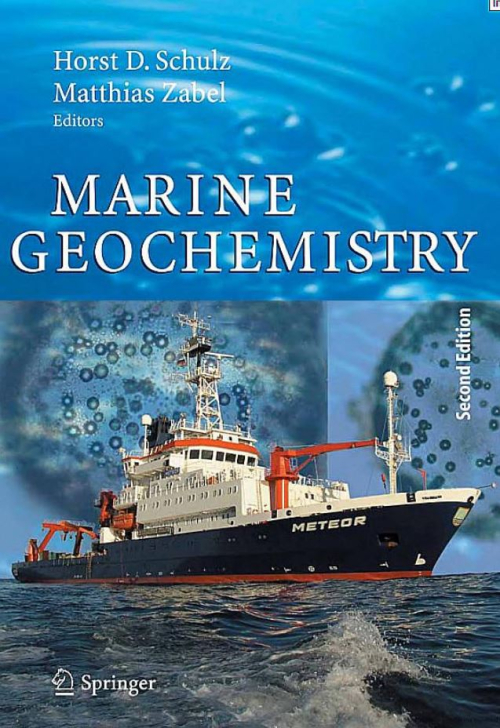
Редактор(ы):Schulz H.D., Zabel M.
Издание:Springer, 2006 г., 581 стр., ISBN: 978-3-540-32143-9
Язык(и)Английский
Marine geochemistry / Морская геохимия

The oceans of the world represent a natural depository for the dissolved and particulate products of continental weathering. After its input, the dissolved material consolidates by means of biological and geochemical processes and is deposited on the ocean floor along with the particulate matter from weathered rock. The ocean floor deposits therefore embody the history of the continents, the oceans and their pertaining water masses.

Автор(ы):Chester R., Jickella T.
Издание:Wiley Blackwell, 2012 г., 437 стр., ISBN: 978-1-118-34907-6
Язык(и)Английский
Marine geochemistry / Морская геохимия

The fundamental question underlying marine geochemistry is, ‘How do the oceans work as a chemical system?’ At present, that question cannot be answered fully. The past four decades or so, however, have seen a number of ‘quantum leaps’ in our understanding of some aspects of marine geochemistry. Three principal factors have made these leaps possible:
1    advances in sampling and analytical techniques;
2    the development of theoretical concepts;
3    the setting up of large-scale international oceanographic programmes (e.g. DSDP, MANOP, HEBBTE, GEOSECS, TTO, VERTEX, JGOFS, SEAREX, WOCE), which have extended the marine geochemistry database to a global ocean scale. <...>


Автор(ы):Chester R.
Издание:Unwin Hyman, London, 1990 г., 706 стр., ISBN: 978-94-010-9490-0
Язык(и)Английский
Marine geochemistry / Морская геохимия

The fundamental question underlying marine geochemistry is 'How do the oceans work as a chemical system?' At present, that question cannot be fully answered. However, the past two decades or so have seen a number of 'quantum leaps' in our understanding of some aspects of marine geochemistry. Three principal factors have made these leaps possible: (a) advances in sampling and analytical techniques; (b) the development of theoretical concepts; and (c) the setting up of large-scale international oceanographic programmes (e.g. DSDP, MANOP, HEBBLE, GEOSECS, TTO, VERTEX, GOFS, SEAREX), which have extended the marine geochemistry database to a global ocean scale. <...>
ТематикаГеохимия
МеткиГеохимия (611)
Редактор(ы):Berggren W.A., Pinxian W.
Издание:Taylor & Francis Group, 1997 г., 149 стр., ISBN: 978-0-367-448 17-2
Язык(и)Английский
Marine geology and palaeoceanography / Морская геология и палеоокеанография

Basic data on the opening of backarc basin, South China Sea (abbreviated as SCS hereafter) basin, were obtained through a two-year Japan and China cooperative joint marine geophysical survey in 1993 and 1994. Some new gravity, magnetic and seismic structural data by reflection as well as refraction study of SCS were obtained and added to existing data. A systematic three component magnetic measurement was made for the first time in this basin. These data in addition to those of earlier studies are constraints for depicting a thinning of a continental crust and later followed by a backarc basin opening by ocean floor spreading. Gravimetric and magnetic anomalies, heat flow, and ages of drilled rocks from this area are referred to speculating on the opening scheme of SCS. Origin of disoriented and scattered magnetic anomaly lineations is suggested to be due to intermittent activities along opening ridge systems of SCS. <...>

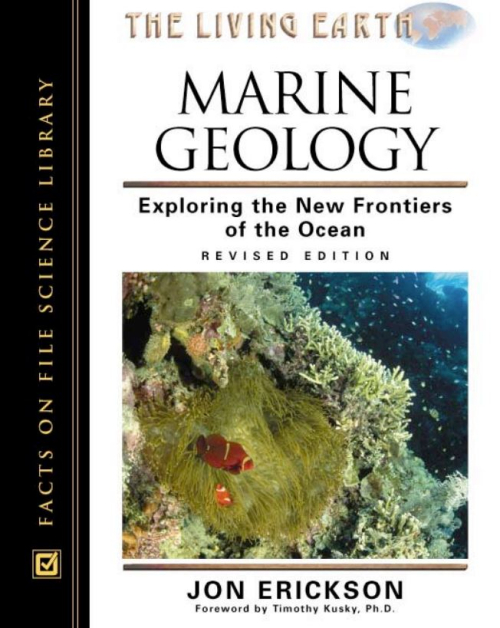
Автор(ы):Erickson J.
Издание:New York, 2003 г., ISBN: 0-8160-4874-6
Язык(и)Английский
Marine geology. Exploring the new frontiers of the ocean / Морская геология. Исследуем новые горизонты океана

This planet contains so much water that perhaps it should have been better named Oceania. It is the only known body in the solar system that is surrounded by water filled with unique geologic structures and teeming with a staggering assortment of marine life. Some of the strangest creatures on Earth, whose ancestors go back several hundred million years, live on the deep ocean floor.

1187.33